2008 JEEP GRAND CHEROKEE coolant
[x] Cancel search: coolantPage 292 of 490
![JEEP GRAND CHEROKEE 2008 WK / 3.G Owners Manual NOTE:The torque converter clutch will not engage
until the transmission fluid and engine coolant are warm
[usually after 1-3 miles (1.6 - 4.8 km) of driving]. Because
the engine speed is higher when t](/manual-img/16/7091/w960_7091-291.png "JEEP GRAND CHEROKEE 2008 WK / 3.G Owners Manual NOTE:The torque converter clutch will not engage
until the transmission fluid and engine coolant are warm
[usually after 1-3 miles (1.6 - 4.8 km) of driving]. Because
the engine speed is higher when t")
NOTE:The torque converter clutch will not engage
until the transmission fluid and engine coolant are warm
[usually after 1-3 miles (1.6 - 4.8 km) of driving]. Because
the engine speed is higher when the torque converter
clutch is not engaged, it may seem as if the transmission
is not shifting into Overdrive when cold. This is normal.
Manually shifting (using the ERS shift control) between 4
(direct gear) and 5/D (Overdrive gear) positions will
demonstrate that the transmission is able to shift into and
out of Overdrive.
NOTE:If the vehicle has not been driven in several
days, the first few seconds of operation after shifting the
transmission into gear may seem sluggish. This is due to
the fluid partially draining from the torque converter into
the transmission. This condition is normal and will not
cause damage to the transmission. The torque converter
will refill within five seconds of shifting from Park into
any other gear position.Rocking the Vehicle
If the vehicle becomes stuck in snow, sand, or mud, it can
often be moved by a rocking motion. Move the gear
selector rhythmically between D (Drive) and R (Reverse),
while applying slight pressure to the accelerator.
NOTE:The Electronic Stability Program (ESP) and
Traction Control (if equipped) should be turned OFF
before attempting to rock the vehicle. Refer to ªElectronic
Brake Control Systemº in Section 3 of this manual.
The least amount of accelerator pedal pressure to main-
tain the rocking motion without spinning the wheels or
racing the engine is most effective. Racing the engine or
spinning the wheels, due to the frustration of not freeing
the vehicle, may lead to transmission overheating and
failure. Allow the engine to idle with the transmission
selector in N (Neutral) for at least one minute after every
292 STARTING AND OPERATING
Page 407 of 490
WARNING!
Exhaust gases can injure or kill. They contain carbon
monoxide (CO) which is colorless and odorless.
Breathing it can make you unconscious and can even-
tually poison you. To avoid breathing CO, refer to
Exhaust Gas in the Safety Tips section of this manual.
Cooling System
WARNING!
You or others can be badly burned by hot antifreeze/
coolant or steam from your radiator. If you see or hear
steam coming from under the hood, don't open the
hood until the radiator has had time to cool. Never
try to open a cooling system pressure cap when the
radiator or coolant bottle is hot.
Engine Coolant Checks
Check antifreeze/coolant protection every 12 months
(before the onset of freezing weather, where applicable).
If antifreeze/coolant is dirty or rusty in appearance, the
system should be drained, flushed and refilled with fresh
antifreeze/coolant. Check the front of the A/C condenser
for any accumulation of bugs, leaves, etc. If dirty, clean by
gently spraying water from a garden hose vertically
down the face of the condenser.
Check the engine cooling system hoses for brittle rubber,
cracking, tears, cuts, and tightness of the connection at
the coolant recovery bottle and radiator. Inspect the
entire system for leaks.
With the engine at normal operating temperature (but
not running), check the cooling system pressure cap for
proper vacuum sealing by draining a small amount of
coolant from the radiator drain cock. If the cap is sealing
properly, the antifreeze/coolant will begin to drain from
MAINTAINING YOUR VEHICLE 407
7
Page 408 of 490
the coolant recovery bottle. DO NOT REMOVE THE
COOLANT PRESSURE CAP WHEN THE COOLING
SYSTEM IS HOT.
Cooling System Ð Drain, Flush, And Refill
At the intervals shown on the Maintenance Schedule, the
system should be drained, flushed and refilled.
If the solution is dirty and contains a considerable
amount of sediment, clean and flush with reliable cooling
system cleaner. Follow with a thorough rinsing to remove
all deposits and chemicals. Properly dispose of old
antifreeze/coolant solution.
Selection Of Coolant
Use only the manufacturer's recommended antifreeze/
coolant. Refer to Fluids, Lubricants, and Genuine Parts
for correct antifreeze/coolant type.
CAUTION!
Mixing of antifreeze/coolant other than the specified
HOAT antifreeze/coolant may result in engine dam-
age and may decrease corrosion protection. If a
non-HOAT antifreeze/coolant is introduced into the
cooling system in an emergency, it should be re-
placed with the specified antifreeze/coolant as soon
as possible.
Do not use plain water alone or alcohol base
antifreeze/coolant products. Do not use additional
rust inhibitors or antirust products, as they may not
be compatible with the antifreeze/coolant and may
plug the radiator.
This vehicle has not been designed for use with
Propylene Glycol based antifreeze/coolant. Use of
Propylene Glycol base antifreeze/coolant is not
recommended.
408 MAINTAINING YOUR VEHICLE
Page 409 of 490

Adding Coolant
Your vehicle has been built with an improved antifreeze/
coolant that allows extended maintenance intervals. This
antifreeze/coolant can be used up to 5 Years or 100,000
miles (160 000 km) before replacement. To prevent reduc-
ing this extended maintenance period, it is important that
you use the same antifreeze/coolant throughout the life
of your vehicle. Please review these recommendations for
using Hybrid Organic Additive Technology (HOAT)
antifreeze/coolant.
When adding antifreeze/coolant:
²The manufacturer recommends using Mopart
Antifreeze/ Coolant 5 Year/100,000 Mile Formula
HOAT (Hybrid Organic Additive Technology)
²Mix a minimum solution of 50% HOAT engine coolant
and distilled water. Use higher concentrations (not to
exceed 70%) if temperatures below -34ÉF (-37ÉC) are
anticipated.
²Use only high purity water such as distilled or deion-
ized water when mixing the water/antifreeze (cool-
ant) solution. The use of lower quality water will
reduce the amount of corrosion protection in the
engine cooling system.
Please note that it is the owner's responsibility to main-
tain the proper level of protection against freezing ac-
cording to the temperatures occurring in the area where
the vehicle is operated.
NOTE:Mixing antifreeze/coolant types will decrease
the life of the antifreeze/coolant and will require more
frequent antifreeze/coolant changes.
Cooling System Pressure Cap
The cap must be fully tightened to prevent loss of
antifreeze/coolant, and to insure that antifreeze/coolant
will return to the radiator from the coolant recovery tank.
MAINTAINING YOUR VEHICLE 409
7
Page 410 of 490
The cap should be inspected and cleaned if there is any
accumulation of foreign material on the sealing surfaces.
WARNING!
²The warning words DO NOT OPEN HOT on the
cooling system pressure cap are a safety precau-
tion. Never add antifreeze/coolant when the en-
gine is overheated. Do not loosen or remove the
cap to cool an overheated engine. Heat causes
pressure to build up in the cooling system. To
prevent scalding or injury, do not remove the
pressure cap while the system is hot or under
pressure.
²Do not use a pressure cap other than the one
specified for your vehicle. Personal injury or en-
gine damage may result.
Disposal of Used Engine Coolant
Used ethylene glycol-based antifreeze/coolant is a regu-
lated substance requiring proper disposal. Check with
your local authorities to determine the disposal rules for
your community. To prevent ingestion by animals and
children, do not store ethylene glycol-based antifreeze/
coolant in open containers or allow it to remain in
puddles on the ground. If ingested by a child, contact a
physician immediately. Clean up any ground spills im-
mediately.
Coolant Level
The coolant bottle provides a quick visual method for
determining that the antifreeze/coolant level is adequate.
With the engine idling, and warm to normal operating
temperature, the level of the antifreeze/coolant in the
bottle should be between the ranges indicated on the
bottle.
410 MAINTAINING YOUR VEHICLE
Page 411 of 490

The radiator normally remains completely full, so there is
not need to remove the radiator cap unless checking for
antifreeze/coolant freeze point or replacing antifreeze/
coolant. Advise your service attendant of this. As long as
the engine operating temperature is satisfactory, the
coolant bottle need only be checked once a month.
When additional antifreeze/coolant is needed to main-
tain the proper level, it should be added to the coolant
bottle. Do not overfill.
Points To Remember
NOTE:When the vehicle is stopped after a few miles
(kilometers) of operation, you may observe vapor coming
from the front of the engine compartment. This is nor-
mally a result of moisture from rain, snow, or high
humidity accumulating on the radiator and being vapor-
ized when the thermostat opens, allowing hot antifreeze/
coolant to enter the radiator.If an examination of your engine compartment shows no
evidence of radiator or hose leaks, the vehicle may be
safely driven. The vapor will soon dissipate.
²Do not overfill the coolant recovery bottle.
²Check antifreeze/coolant freeze point in the radiator
and in the coolant recovery bottle. If antifreeze/
coolant needs to be added, contents of coolant recov-
ery bottle must also be protected against freezing.
²If frequent antifreeze/coolant additions are required,
or if the level in the coolant recovery bottle does not
drop when the engine cools, the cooling system should
be pressure tested for leaks.
²Maintain antifreeze/coolant concentration at 50%
HOAT antifreeze/coolant (minimum) and distilled
water for proper corrosion protection of your engine
which contains aluminum components.
MAINTAINING YOUR VEHICLE 411
7
Page 412 of 490

²Make sure that the radiator and coolant recovery
bottle hoses are not kinked or obstructed.
²Keep the front of the radiator clean. If your vehicle is
equipped with air conditioning, keep the front of the
condenser clean, also.
²Do not change the thermostat for summer or winter
operation. If replacement is ever necessary, install
ONLY the correct type thermostat. Other designs may
result in unsatisfactory cooling performance, poor gas
mileage, and increased emissions.
Hoses and Vacuum/Vapor Harnesses
Inspect surfaces of hoses and nylon tubing for evidence
of heat and mechanical damage. Hard or soft spots,
brittle rubber, cracking, tears, cuts, abrasions, and exces-
sive swelling indicate deterioration of the rubber.Pay particular attention to the hoses nearest to high heat
sources such as the exhaust manifold. Inspect hose rout-
ing to be sure hoses do not touch any heat source or
moving component that may cause heat damage or
mechanical wear.
Insure nylon tubing in these areas has not melted or
collapsed. Inspect all hose connections such as clamps
and couplings to make sure they are secure and no leaks
are present. Components should be replaced immedi-
ately if there is any evidence of degradation that could
cause failure.Fuel System Connections
Electronic Fuel Injection high pressure fuel systems are
designed with tubes and special connects, connections
and clamps which have unique material characteristics to
provide adequate sealing and resist attack by deterio-
rated gasoline.
412 MAINTAINING YOUR VEHICLE
Page 440 of 490
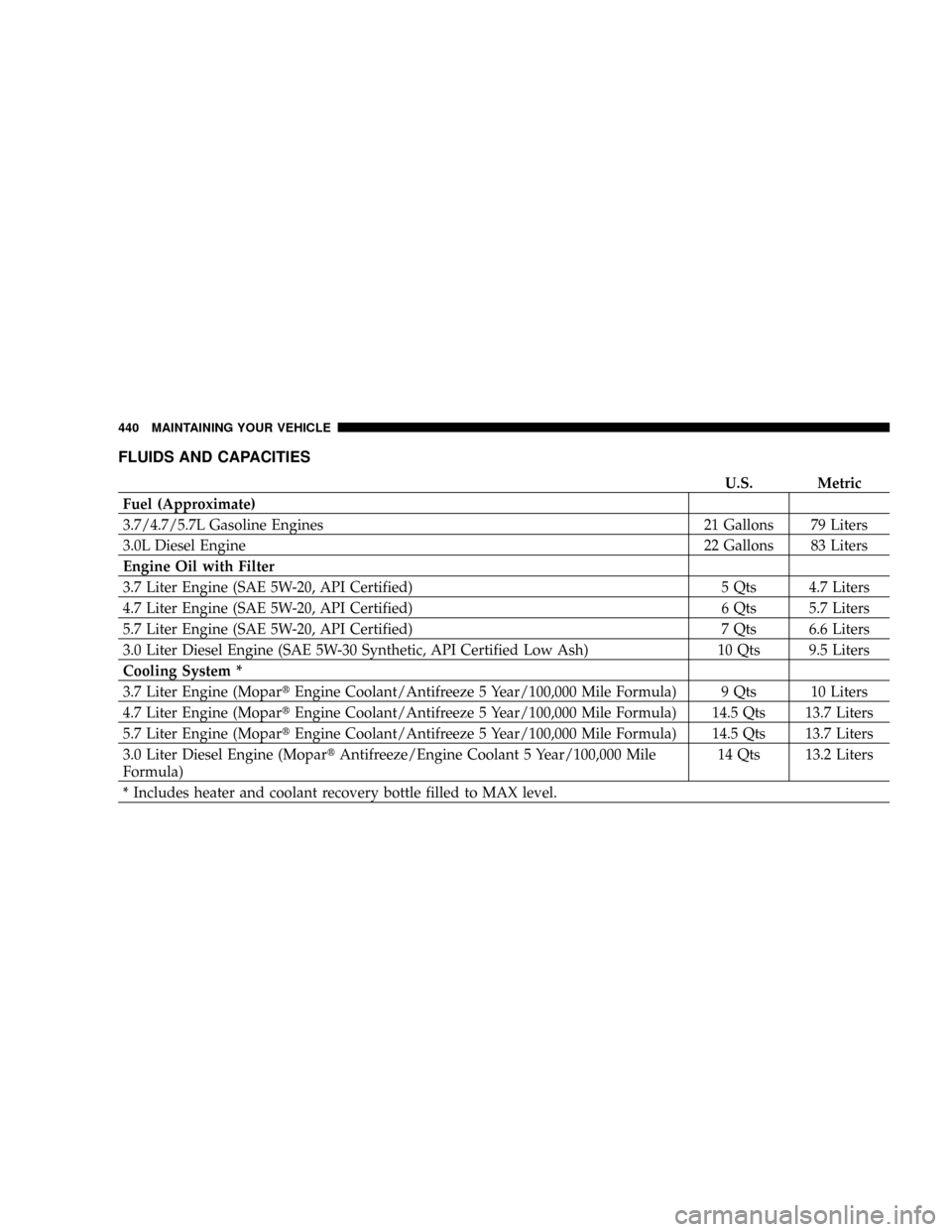
FLUIDS AND CAPACITIES
U.S. Metric
Fuel (Approximate)
3.7/4.7/5.7L Gasoline Engines 21 Gallons 79 Liters
3.0L Diesel Engine 22 Gallons 83 Liters
Engine Oil with Filter
3.7 Liter Engine (SAE 5W-20, API Certified) 5 Qts 4.7 Liters
4.7 Liter Engine (SAE 5W-20, API Certified) 6 Qts 5.7 Liters
5.7 Liter Engine (SAE 5W-20, API Certified) 7 Qts 6.6 Liters
3.0 Liter Diesel Engine (SAE 5W-30 Synthetic, API Certified Low Ash) 10 Qts 9.5 Liters
Cooling System *
3.7 Liter Engine (MopartEngine Coolant/Antifreeze 5 Year/100,000 Mile Formula) 9 Qts 10 Liters
4.7 Liter Engine (MopartEngine Coolant/Antifreeze 5 Year/100,000 Mile Formula) 14.5 Qts 13.7 Liters
5.7 Liter Engine (MopartEngine Coolant/Antifreeze 5 Year/100,000 Mile Formula) 14.5 Qts 13.7 Liters
3.0 Liter Diesel Engine (MopartAntifreeze/Engine Coolant 5 Year/100,000 Mile
Formula)14 Qts 13.2 Liters
* Includes heater and coolant recovery bottle filled to MAX level.
440 MAINTAINING YOUR VEHICLE