�µ
�µ
�µ
�µ
Fuel economy is not a f ixed number.
It varies based on driving conditions,
driving habits and vehicle condition.
Theref ore, it is not possible f or one
set of estimates to predict f uel
economy precisely f or all drivers in
all environments.
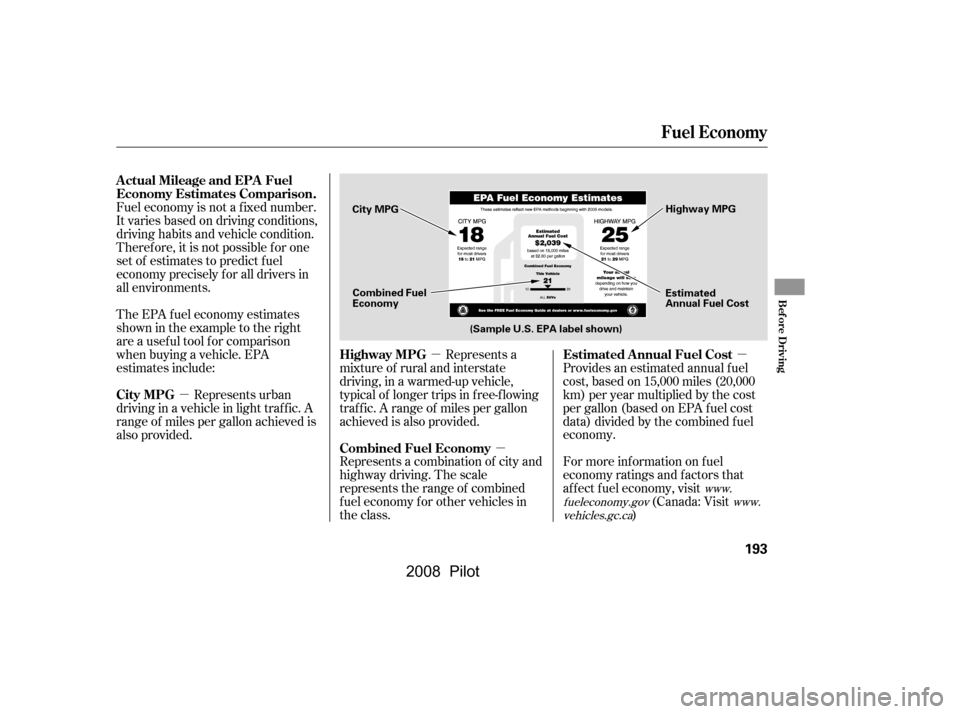
Provides an estimated annual f uel
cost, based on 15,000 miles (20,000
km) per year multiplied by the cost
pergallon(basedonEPAfuelcost
data) divided by the combined f uel
economy.
For more inf ormation on f uel
economy ratings and factors that
af f ect f uel economy, visit(Canada: Visit
)
Represents urban
driving in a vehicle in light traf f ic. A
range of miles per gallon achieved is
also provided.
The EPA f uel economy estimates
shownintheexampletotheright
are a usef ul tool f or comparison
when buying a vehicle. EPA
estimates include:
Represents a combination of city and
highway driving. The scale
represents the range of combined
f uel economy f or other vehicles in
the class.Represents a
mixture of rural and interstate
driving, in a warmed-up vehicle,
typical of longer trips in f ree-f lowing
traf f ic. A range of miles per gallon
achieved is also provided.
www.
fueleconomy.gov www. vehicles.gc.ca
Actual Mileage and EPA Fuel
Economy Estimates Comparison.
Estimated Annual Fuel Cost
City MPG
Combined Fuel Economy
Highway MPG
Fuel Economy
Bef ore Driving
193
Combined Fuel
Economy(Sample U.S. EPA label shown)
City MPG
Estimated
Annual Fuel Cost
Highway MPG
�\f���—�\f���—�\f���y�
�
�����������y���
�(���+�����\f�y�\f�
�����y
2008 Pilot
To avoid loss of control or rollover,
be sure to f ollow all precautions and
recommendations.
Be aware that a heavy load can
reduce ground clearance and your
ability to clear obstacles.
Keep your speed low, and never
go faster than the conditions
allow.
It’s up to you to continually assess
the situation and drive within the
limits.
Be sure to store cargo properly,
and do not exceed your vehicle
cargo load limits (see pages
and ).
Whenever you drive, make sure
you and your passengers always
wear seat belts.
Your vehicle has been designed
primarily f or use on pavement. But
its higher ground clearance allows
you to occasionally travel on unpaved
roads, such as campgrounds, picnic
sites, and similar locations. It is not
designed f or trail-blazing, mountain
climbing, or other challenging of f -
road activities.
If you decide to drive on unpaved
roads, you will f ind that it requires
somewhat dif f erent driving skills.
Your vehicle will also handle
somewhat dif f erently than it does on
pavement. Be sure to pay extra
attention to the precautions and tips
in this section, and get acquainted
with your vehicle bef ore leaving the
pavement.
199220
Important Saf ety PrecautionsGeneral Inf ormation
Of f -Highway Driving Guidelines
230
Improperly operating this
vehicle on or off-pavement can
cause an accident or rollover in
which you and your passengers
could be seriously injured or
killed.
Follow all instructions and
guidelines in this owner’s
manual.
Keep your speed low, and
don’t drive faster than
conditions permit.
�����—�����—�����y�
�
�����������y���
�(���+�������y���������y
2008 Pilot