Page 470 of 524
CONT INUED
Although this seems like a simple
procedure, you should take several
precautions.
You cannot start your vehicle by
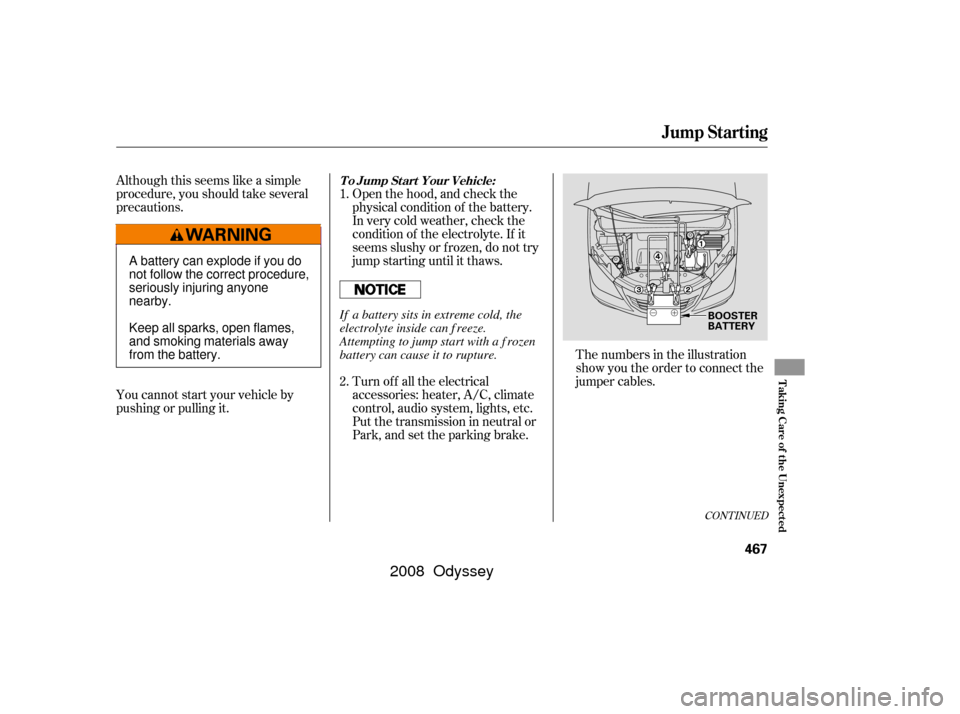
pushing or pulling it.The numbers in the illustration
show you the order to connect the
jumper cables.
Open the hood, and check the
physical condition of the battery.
In very cold weather, check the
condition of the electrolyte. If it
seems slushy or f rozen, do not try
jump starting until it thaws.
Turn of f all the electrical
accessories: heater, A/C, climate
control, audio system, lights, etc.
Put the transmission in neutral or
Park, and set the parking brake.
1.
2.To Jump Start Your Vehicle:
Jump Starting
T aking Care of t he Unexpect ed
467
BOOSTER
BATTERY
A battery can explode if you do
not follow the correct procedure,
seriously injuring anyone
nearby.
Keep all sparks, open flames,
and smoking materials away
from the battery.
If a battery sits in extreme cold, the
electrolyte inside can f reeze.
Attempting to jump start with a f rozen
battery can cause it to rupture.
�����—�����—�����y���
�������
���y���
�(�����������y���������y
2008 Odyssey
Page 476 of 524
The brake system
indicator normally
comesonwhenyou
turn the ignition switch to the ON
(II) position, and as a reminder to
check the parking brake. It will stay
on if you do not f ully release the
parking brake.
If the brake system indicator comes
on while driving, the brake f luid level
is probably low. Press lightly on the
brake pedal to see if it f eels normal.
If it does, check the brake f luid level
thenexttimeyoustopataservice
station (see page ). Slow down by shif ting to a lower
gear, and pull to the side of the road
when it is saf e. Because of the long
distance needed to stop, it is
hazardous to drive the vehicle. You
should have it towed and repaired as
soon as possible (see
on page ).
If the f luid level is low, take your
vehicle to a dealer, and have the
brake system inspected f or leaks or
worn brake pads.
However, if the brake pedal does not
f eel normal, you should take
immediate action. A problem in one
part of the system’s dual circuit
design will still give you braking at
two wheels. You will f eel the brake
pedal go down much f arther bef ore
the vehicle begins to slow down, and
you will have to press harder on the
pedal.
If the ABS indicator and the VSA
indicator come on with the brake
system indicator, have the vehicle
inspected by your dealer
immediately. If you must drive the vehicle a short
distance in this condition, drive
slowly and caref ully.
You will also see a ‘‘CHECK BRAKE
SYSTEM’’ message on the multi-
inf ormation display (see page ).
You will also see a ‘‘BRAKE FLUID
LOW’’ message on the multi-
inf ormation display (see page ).
88 88
427 480
On Touring models
On Touring models
Brake System Indicator
Emergency
Towing
T aking Care of t he Unexpect ed
473
U.S. Canada
�����—�����—�����y���
���������
�y���
�(�����������y���������y
2008 Odyssey
Page 478 of 524

Check the smaller f uses in the
under-hood f use box and all the
fuses in the interior fuse boxes by
pulling out each f use with the f use
puller provided in the primary
under-hood f use box.
Turn the ignition switch to the
LOCK (0) position. Make sure the
headlights and all other
accessories are of f . Check each of the large f uses in
the primary under-hood f use box
by looking through the top at the
wire inside. Removing these f uses
requires a Phillips-head
screwdriver.
If something electrical in your
vehicle stops working, the first thing
youshouldcheckforisablownfuse.
Determine f rom the chart on pages
through , or the diagram on
thefuseboxlid,whichfuseorfuses
control that device. The diagram f or
theinteriordriver’ssidefuseboxis
on the kick panel below the f use box.
Check those f uses f irst, but check all
the f uses bef ore deciding that a
blown f use is the cause. Replace any
blown f uses, and check if the device
works.
Remove the cover f rom the f use
box.
1.
2. 3.
4.
477 479
CONT INUED
Checking and Replacing Fuses
Fuses
T aking Care of t he Unexpect ed
475
FUSE
BLOWN FUSE PULLER
�����—�����—�����y���
�������
���y���
�(�����������y���������y
2008 Odyssey
Page 480 of 524

�µ �µ�Î�Î�Î
�Î �Î
�Î�Î �Î
�Î
No.
Circuits Protected
No. Amps. Circuits Protected No.
No.
CONT INUED
Circuits Protected
Circuits Protected
Amps. Amps.
Amps.
1
2
3
4
5
6
7
8
9
10
11
12 Left Headlight Low
Rear Defroster Coil
Left Headlight High
Small Lights
Right Headlight High
Right Headlight Low
Back Up
FI ECU (PCM)
Condenser Fan
Not used
Cooling Fan
MG Clutch
1
2
3
4
5
6 40 A
40 A
40 A
20 A
20 A Not Used
Left Power Sliding Door
Right Power Sliding Door
Power Tailgate
Premium
AC Inverter 13
14
15
16
17
18
19
20
21
22
23
7
8
9
10
11 Horn, Stop
Rear Defroster
Back Up, ACC
Hazard
VSA Motor
VSA
Option 1
Option 2
Heater Motor
Passenger’s Fuse Box
Battery
IG1 Main
Power Window Main
Fog Light
ACM
AS power Seat Slide
AS power Seat Recline
Rear Entertainment System
10 A
30 A
10 A
15 A
10 A
10 A
7.5 A 15 A
30 A
30 A
7.5 A 20 A
30 A
40 A
15 A
30 A
30 A
30 A
40 A
40 A
70 A
120 A 50 A
50 A
40 A
20 A
10 A
20 A
20 A
7.5 A
For some types
:
Fuse Locations
T aking Care of t he Unexpect ed
477
PRIMARY UNDER-HOOD FUSE BOX
SECONDARY UNDER-HOOD FUSE BOX
�����—�����—�����y���
�����������y���
�(�����������y���������y
2008 Odyssey
Page 481 of 524
�µ�µ
�Î
�Î �Î�Î
�Î
�Î �Î
No.
No. Amps. Amps.
Circuits Protected Circuits Protected
18
19
20
21
22
23
24
25
26
27
28
29
30
31
32
33
1
2
3
4
5
6
7
8
9
10
11
12
13
14
15
16
17 7.5 A
15 A
10 A
15 A
10 A
7.5 A
7.5 A
15 A
7.5 A 30 A
15 A
20 A
20 A
20 A
20 A
20 A 15 A
15 A
10 A
7.5 A 10 A
7.5 A 20 A
20 A
20 A
20 A
20 A
10 A
15 A
10 A
7.5 A
TPMS
IG Coil
Daytime Running Light
LAF
Radio
Interior Lights
Back Up
Not Used
Front Accessory Socket
OPDS
IG Wiper
Rear Accessory Socket
Left Power Sliding Door
Closer
Driver Power Seat Slide
Pedal Position Adjustment
Dr Power Seat Recline
Power Tailgate Closer IG ACG
IG Fuel Pump
IG Washer
IG Meter
IG SRS
IGP
Left Rear Power Window
Right Rear Power Window
Passenger’s Power Window
Driver’s Power Window
Moonroof
Not Used
IG HAC
IG SOL
ACC
HAC OP
For some types
:
Fuse Locations
478
Front
INTERIOR FUSE BOX
Driver’s Side
�����—�����—�����y���
�����������y���
�(�����������y���������y
2008 Odyssey
Page 490 of 524

�µ
�µ
�µ �µ
�µ
�µ
�µ
�µ
�µ
�µ
�µ
�µ
�µ
�µ
�µ
�µ
�µ
�µ
�µ �Î �Î
�Î
�Î
�Î
�Î
�Î�Î
�Î
�Î �Î
�Î
�Î
Specif ications
Technical Inf ormation
487
Battery Lights Alignment
Tires
Fuses Seating Capacities
60 W (HB3)
12 V
12 V 12 V
12 V
12 V
12 V
12 V
12 V
12 V 21 W
21/5 W
21 W
5W
16 W
2W
8W
3.8 W (2 CP)
Capacity 12 V 12 V60 AH/5 HR
72 AH/20 HR
Headlights
Fog lights
Front turn signal lights
Front parking/side marker
lights
Rear turn signal lights
Stop/Taillights
Taillights
Back-up lights
License plate lights
High-mount brake light
Individual map lights
Vanity mirror lights
Cargo area light
Door courtesy light
Toe-in
Camber
Caster
0.00 in (0.0 mm)
0.08 in (2.0 mm)
0°
0°30’
2°32’
235/65R16 103T
235-710R460A 104T T135/80D17 103M
33 psi (230 kPa , 2.3 kgf/cm
)
35 psi (240 kPa , 2.4 kgf/cm)
35 psi (240 kPa , 2.4 kgf/cm)
60 psi (420 kPa , 4.2 kgf/cm)
Size
Pressure
Interior
Under-hood Total
Front
Rear
12 V 51 W
12 V 55 W
12 V 21 W
12 V 3 CP
12 V 2 CP
12 V 8 W
12 V 5 W
235/60R17 102T
8/72
3/2 3
See page
478and 479or the fuse
label attached to the dashboard.
See page 479or the fuse label
attached to the inside of the fuse
box door under the dashboard.
See page 477or the fuse box
cover. Front
Rear
Front
Rear
Front
(Amber)
Driver’s side
Passenger’s side Front
Rear High
Low
:
1:
2:
3:
4:
Second row
Third row Front/Rear
Spare
Front
Rear
Spare
(H11) (HB4)
(Amber)
EX-L models Except U.S.Touring models (With PAX)
Touring models (Without PAX)
U.S. Touring models (With PAX)
U.S. LX and Canadian DX models
1
2 3
1
4
1
�����—�
�
�—�����y�
�������������y���
�(�����������y���������y
2008 Odyssey
Page 498 of 524

�Î
�ÎThe burning of gasoline in your
vehicle’s engine produces several by-
products. Some of these are carbon
monoxide (CO), oxides of nitrogen
(NOx), and hydrocarbons (HC).
Gasoline evaporating f rom the tank
also produces hydrocarbons. Con-
trolling the production of NOx, CO,
and HC is important to the environ-
ment. Under certain conditions of
sunlight and climate, NOx and HC
react to f orm photochemical ‘‘smog.’’
Carbon monoxide does not contri-
bute to smog creation, but it is a
poisonous gas. The United States Clean Air Act
sets standards f or automobile
emissions. It also requires that
automobile manufacturers explain to
owners how their emissions controls
workandwhattodotomaintain
them. This section summarizes how
the emissions controls work.
Scheduled maintenance is on page
.
Your vehicle has a positive
crankcase ventilation system. This
keeps gasses that build up in the
engine’s crankcase f rom going into
the atmosphere. The positive crankcase ventilation valve routes
them from the crankcase back to the
intake manif old. They are then
drawn into the engine and burned.
In Canada, Honda vehicles comply
with the Canadian emission
requirements, as specif ied in an
agreement with Environment
Canada, at the time they are
manuf actured. The onboard ref ueling vapor
recovery (ORVR) system captures
the f uel vapors during ref ueling. The
vapors are adsorbed in a canister
f illed with activated carbon. While
driving, the f uel vapors are drawn
into the engine and burned of f . As gasoline evaporates in the f uel
tank, an evaporative emissions
control canister f illed with charcoal
adsorbs the vapor. It is stored in this
canister while the engine is of f . Af ter
the engine is started and warmed up,
the vapor is drawn into the engine
and burned during driving.
416
The Clean Air Act
Crankcase Emissions Control
System
Onboard Ref ueling Vapor
Recovery Evaporative Emissions Control
System
Emissions Cont rols
Technical Inf ormation
495
�����—�����—�����y���
��
�
������y���
�(�����������y���������y
2008 Odyssey
Page 502 of 524
Then drive in city/suburban
traffic for at least 10 minutes.
When traf f ic conditions allow, let
the vehicle coast f or several
seconds without using the
accelerator pedal or the brake
pedal.
Select a nearby lightly traveled
major highway where you can
maintain a speed of 50 to 60 mph
f or at least 20 minutes. Drive on
the highway in D (A/T). Do not
use the cruise control. When
traffic allows, drive for 90 seconds
without moving the accelerator
pedal. (Vehicle speed may vary
slightly; this is okay.) If you cannot
do this f or a continuous 90
seconds because of traf f ic
conditions, drive f or at least 30
seconds, then repeat it two more
times (for a total of 90 seconds).
If the testing f acility determines the
readiness codes are still not set, see
your dealer.Make sure the vehicle has been
parked with the engine of f f or 30
minutes.
7.
8.
9.
Emissions T esting
Technical Inf ormation
499
�����—�����—�����y���
��
�
������y���
�(�����������y���������y
2008 Odyssey