Page 212 of 281
Open the hatch. Remove the light
assembly cover by pushing in on
the tabs on both sides and pulling
the cover down.
Remove the socket f rom the light
assembly by turning it one-quarter
turn counterclockwise.
Turn on the parking lights and
check that the new bulb is
working.
Put the lens back into the light
assembly, right side f irst. Push on
the lef t edge until it snaps into
place.
Using a cloth to prevent scratches,
insert a small f lat-tip screwdriver
between the lef t edge of the lens
and the housing. The lens will
come down.
Pull the bulb straight out of its
socket. Push the new bulb in until
it bottoms in the socket. 1.
2.
3.
4.
1.
2.
Lights
Replacing a High-mount Brake
Light Bulb
Replacing a Rear License Plate
Bulb
208
COVER
TAB TAB
BULB
LENS
SCREWDRIVER
HOUSING
LENS
CLOTH
�\f���—�\f���—�����y�
����\f��������y���
�(���+�����\f�y�\f���
���y
2008 Element
Page 213 of 281

If your seat belts get dirty, use a sof t
brush with a mixture of mild soap
and warm water to clean them. Do
not use bleach, dye, or cleaning
solvents. Let the belts air-dry bef ore
you use the vehicle.
Dirt build-up in the loops of the seat
belt anchors can cause the belts to
retract slowly. Wipe the insides of
the loops with a clean cloth
dampened in mild soap and warm
water or isopropyl alcohol.
Pull the bulb straight out of its
socket. Push the new bulb straight
into the socket until it bottoms.
Press the brake pedal to make
sure the new bulb is working.
Put the socket back into the light
assembly, and turn it clockwise to
lock it in place.
Put the cover back onto the light
assembly. Push it on until it locks
in place. The floor mats that came with your
vehicle hook over the f loor mat
anchors. This keeps the f loor mats
f rom sliding f orward, possibly
interf ering with the pedals, or
backwards, making the f ront
passenger’s weight sensors
inef f ective.
3.
4.
5.
6.
CONT INUED
If equipped
Cleaning the Seat Belts Floor Mats
Lights, Cleaning the Seat Belts, Floor Mats
Maint enance
209
LOOP
BULB
SOCKET
�\f���—�\f���—�����y�
����\f����\f���y���
�(���+�����\f�y�\f���
���y
2008 Element
Page 221 of 281

Mount tire chains on your tires when
required by driving conditions or
local laws. Install them only on the
f ront tires.
Because your vehicle has limited tire
clearance, use only SAE Class ‘‘S’’
cable-type traction devices, with
rubber chain tensioners, on the f ront
tires. Use traction devices only when
required by driving conditions or
local laws. Make sure they are the
correct size f or your tires. Metal link-
type ‘‘chains’’ should not be used.Because your vehicle has limited tire
clearance, Honda strongly
recommends using the chains listed
below, made by Security Chain
Company (SCC).When installing cables, f ollow the
manuf acturer’s instructions, and
mount them as tight as you can.
Make sure they are not contacting
the brake lines or suspension. Drive
slowly with them installed. If you
hear them coming into contact with
the body or chassis, stop and
investigate. Remove them as soon as
you begin driving on cleared roads.
Cable-type:SCC Super Z6 SZ 139
SC model
On all models except SC
Tires
Tire Chains
Maint enance
217
Using the wrong chains, or not
properly installing chains, can
damage the brake lines and
cause a crash in which you can
be seriously injured or killed.
Follow all instructions in this
owner’s manual regarding the
selection and use of tire chains.
Traction devices that are the wrong
size or improperly installed can
damage your vehicle’s brake lines,
suspension, body, and wheels. Stop
driving if they are hitting any part of
the vehicle.
�\f���—�\f���—�����y�
����\f��������y���
�(���+�����\f�y�\f�������y
2008 Element
Page 223 of 281

Fill the f uel tank.Block the rear wheels.
If the vehicle is to be stored f or a
longer period, it should be
supported on jackstands so the
tires are of f the ground.
Cover the vehicle with a
‘‘breathable’’ cover, one made
f rom a porous material such as
cotton. Non-porous materials, such
as plastic sheeting, trap moisture,
which can damage the paint.
If you need to park your vehicle f or
an extended period (more than 1
month), there are several things you
should do to prepare it f or storage.
Proper preparation helps prevent
deterioration and makes it easier to
get your vehicle back on the road. If
possible, store your vehicle indoors. Leave one window open slightly (if
the vehicle is being stored
indoors).
Disconnect the battery.
Support the f ront and rear wiper
blade arms with a f olded towel or
ragsotheydonottouchthe
windshield.
To minimize sticking, apply a
silicone spray lubricant to all door
and tailgate seals. Also, apply a
vehiclebodywaxtothepainted
surfaces that mate with the door
and tailgate seals.If possible, periodically run the
engine until it reaches f ull
operating temperature (the
cooling f ans cycle on and of f
twice). Pref erably, do this once a
month.
Wash and dry the exterior
completely.
Cleantheinterior.Makesurethe
carpeting, floor mats, etc., are
completely dry.
Leave the parking brake off. Put
the transmission in reverse
(manual) or Park (automatic).
Vehicle Storage
Maint enance
219
�\f���—�\f���—�����y�
����\f��������y���
�(���+�����\f�y�\f�������y
2008 Element
Page 225 of 281

This section covers the more
common problems that motorists
experience with their vehicles. It
gives you inf ormation about how to
safely evaluate the problem and what
to do to correct it. If the problem has
stranded you on the side of the road,
you may be able to get going again.
If not, you will also f ind instructions
on getting your vehicle towed.......................
Compact Spare Tire .222
....................
Changing a Flat Tire .223
.............
If the Engine Won’t Start .229
................................
Jump Starting .231
..............
If the Engine Overheats .233
.........
Low Oil Pressure Indicator .235
..........
Charging System Indicator .235
.......
Malf unction Indicator Lamp .236
...............
Brake System Indicator .237
..............................................
Fuses .238
..............................
Fuse Locations .241
......................
Emergency Towing .243
Taking Care of the Unexpected
T aking Care of t he Unexpect ed
221
�\f���—�\f���—�����y�
����\f��������y���
�(���+�����\f�y�\f�������y
2008 Element
Page 227 of 281

If you have a f lat tire while driving,
stop in a saf e place to change it.
Drive slowly along the shoulder until
you get to an exit or an area to stop
that is far away from the traffic lanes.Open the hatch and the tailgate.
The spare tire, jack, and tools are
under the cargo area f loor.
Park the vehicle on f irm, level, and
non-slippery ground. Put the
transmission in Park (automatic)
or reverse (manual). Apply the
parking brake.
If you are towing a trailer, unhitch
the trailer.
Turn on the hazard warning lights,
and turn the ignition switch to the
LOCK (0) position. Have all
passengers get out of the vehicle
while you change the tire.
1.
2.
3.
4.
CONT INUED
Changing a Flat Tire
T aking Care of t he Unexpect ed
223
TOOLS
SPARE TIRE
JACK
The vehicle can easily roll off
the jack, seriously injuring
anyone underneath.
Follow the directions for
changing a tire exactly, and
never get under the vehicle
when it is supported only by the
jack.
�\f���—�\f���—�����y�
����\f����\f���y���
�(���+�����\f�y�\f�������y
2008 Element
Page 230 of 281
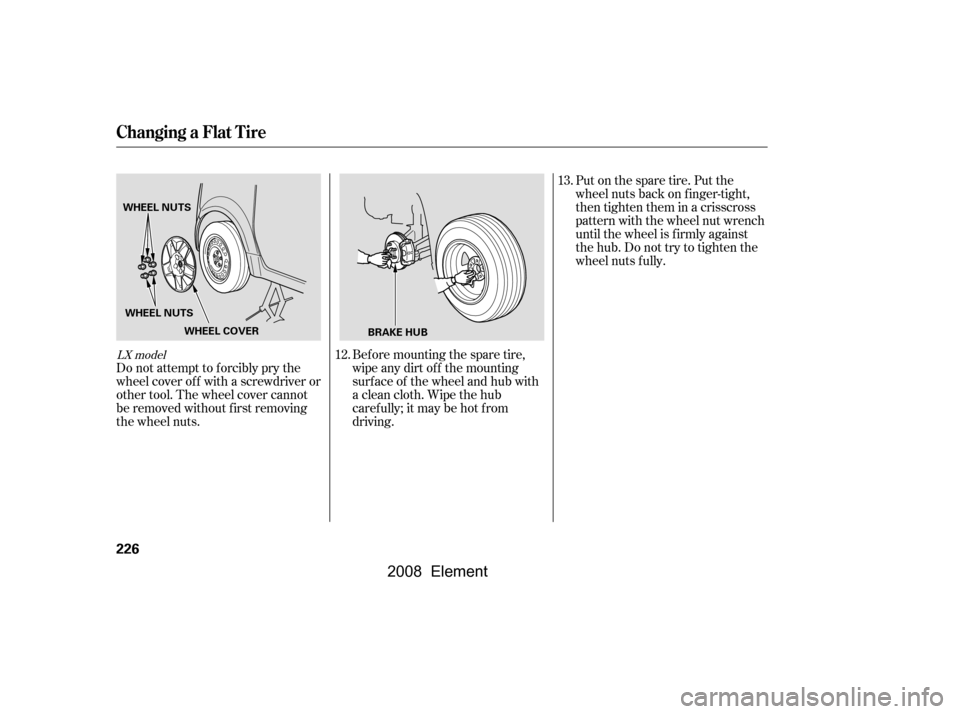
Bef ore mounting the spare tire,
wipeanydirtoff themounting
surface of the wheel and hub with
a clean cloth. Wipe the hub
carefully;itmaybehotfrom
driving.Put on the spare tire. Put the
wheel nuts back on f inger-tight,
then tighten them in a crisscross
pattern with the wheel nut wrench
until the wheel is f irmly against
the hub. Do not try to tighten the
wheel nuts f ully.
Do not attempt to forcibly pry the
wheel cover of f with a screwdriver or
other tool. The wheel cover cannot
be removed without f irst removing
the wheel nuts. 13.
12.LX model
Changing a Flat Tire
226
WHEEL COVER
WHEEL NUTS
WHEEL NUTS
BRAKE HUB
�\f���—�\f���—�����y�
����\f��������y���
�(���+�����\f�y�\f�����
�y
2008 Element
Page 235 of 281

Although this seems like a simple
procedure, you should take several
precautions.
You cannot start your vehicle with an
automatic transmission by pushing
or pulling it.The numbers in the illustration show
you the order to connect the jumper
cables.
Turn of f all the electrical
accessories: heater, A/C, audio
system, lights, etc. Put the
transmission in neutral (Manual)
or Park (Automatic), and set the
parking brake.
Open the hood, and check the
physical condition of the battery.
In very cold weather, check the
condition of the electrolyte. If it
seems slushy or f rozen, do not try
jump starting until it thaws.
1.
2.
CONT INUED
To Jump Start Your Vehicle:
Jump Starting
T aking Care of t he Unexpect ed
231
BOOSTER BATTERY
A battery can explode if you do
not follow the correct procedure,
seriously injuring anyone
nearby.
Keep all sparks, open flames,
and smoking materials away
from the battery.
If a battery sits in extreme cold, the
electrolyte inside can f reeze.
Attempting to jump start with a f rozen
battery can cause it to rupture.
�\f���—�\f���—�����y�
����\f����\f���y���
�(���+�����\f�y�\f�������y
2008 Element