Page 269 of 413
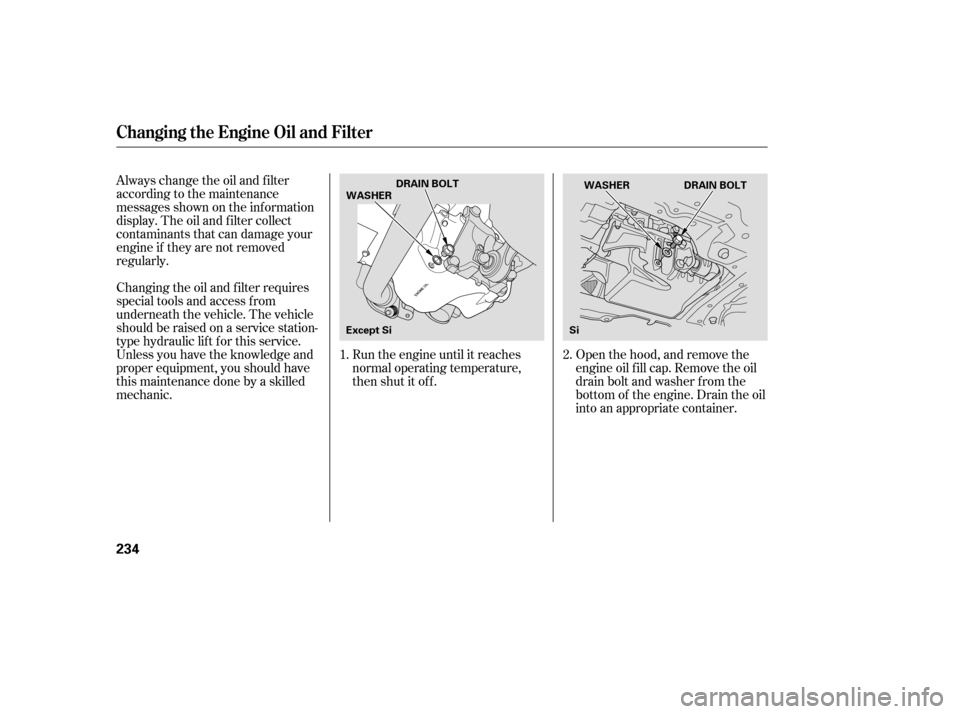
Park the vehicle, and set the
parking brake. Pull the hood
release handle under the lower lef t
corner of the dashboard. The
hood will pop up slightly.
Screw the f uel f ill cap back on
until it clicks at least once. If you
do not properly tighten the cap,
the malf unction indicator lamp
maycomeon(seepage ).You
will also see a ‘‘CHECK FUEL
CAP’’ message on the inf ormation
display.
Push the f uel f ill door closed until
it latches.
Remove the f uel f ill cap slowly.
You may hear a hissing sound as
pressure inside the tank escapes.
The fuel fill cap is attached to the
f uel f iller with a tether. Place the
cap in the holder on the f uel f ill
door.
Stop f illing the tank af ter the f uel
nozzle automatically clicks of f . Do
not try to ‘‘top off’’ the tank. Leave
some room f or the f uel to expand
with temperature changes.
even though the tank is not f ull,
there may be a problem with your
vehicle’s fuel vapor recovery
system. The system helps keep
f uel vapor f rom going into the
atmosphere. Try f illing at another
pump. If this does not f ix the
problem, consult your dealer.
1.
5. 6.
4.
3.
278If the f uel nozzle keeps clicking of f
Service Station Procedures
Opening and Closing the Hood
182
HOOD RELEASE HANDLE
�����—�����—�����y���
�����������y���
�(�#���������y���
�����y
Page 287 of 413

Shif t up
1st to 2nd
2nd to 3rd 3rd to 4th4th to 5th
5th to 6th
When slowing down, you can get
extra braking f rom the engine by
shifting to a lower gear. This extra
braking can help you maintain a safe
speed and prevent your brakes f rom
overheating while going down a
steep hill. Bef ore downshif ting,
make sure the engine speed will not
go into the tachometer’s red zone in
the lower gear.
Your vehicle is equipped with an
aluminum shif t lever. If you leave the
vehicle parked outside f or a long time on a hot day, be caref ul bef ore
moving the shift lever. Because of
the heat, the shift lever may be
extremely hot. If the outside
temperature is low, the shif t lever
f eels cold.
Drive in the highest gear that lets
the engine run and accelerate
smoothly. This will give you good
f uel economy and ef f ective
emissions control. The f ollowing
shif t points are recommended:
Shif t up
1st to 2nd
2nd to 3rd 3rd to 4th4th to 5th Normal acceleration
15 mph (24 km/h)
27 mph (43 km/h)
39 mph (63 km/h)
53 mph (85 km/h) Normal acceleration
17 mph (27 km/h)
29 mph (47 km/h)
37 mph (60 km/h)
43 mph (69 km/h)
49 mph (79 km/h)
With 5-speed manual transmission With 6-speed manual transmission
On Si model
Recommended Shif t Points
Manual T ransmission
200
Rapid slowing or speeding up
can cause loss of control on
slippery surfaces. If you crash,
you can be injured.
Use extra care when driving on
slippery surfaces.
�����—�����—�����y���
�����������y���
�(�#���������y���������y
Page 299 of 413

When the low tire pressure indicator
is on, one or more of your tires is
signif icantly underinf lated. You
should stop and check your tires as
soon as possible, and inf late them to
the proper pressure as indicated on
the vehicle’s tire inf ormation placard.
If you think you can saf ely drive a
short distance to a service station,
proceed slowly, and inf late the tire to
the recommended pressure shown
on the driver’s doorjamb.
If the tire is f lat, or if the tire
pressure is too low to continue
driving, replace the tire with the
compact spare tire (see page ).
If you cannot make the low tire
pressure indicator go out af ter
inf lating the tires to the specif ied
values, have your dealer check the
system as soon as possible.Driving on a signif icantly under-
inf lated tire causes the tire to
overheat and can lead to tire failure.
Under-inf lation also reduces f uel
efficiency and tire tread life, and may
af f ect the vehicle’s handling and
stopping ability.
Becausetirepressurevariesby
temperature and other conditions,
the low tire pressure indicator may
come on unexpectedly.
Each tire has its own pressure
sensor (not including the spare tire).
If the air pressure of a tire becomes
signif icantly low while driving, the
sensor in that tire immediately sends
a signal that causes the low tire
pressure indicator to come on.
Your vehicle is equipped with a tire
pressure monitoring system (TPMS)
that turns on every time you start the
engine and monitors the pressure in
your tires while driving.
266
U.S. models onlyLow Tire Pressure
Indicator
Tire Pressure Monitoring System (TPMS)
212
�����—�����—�����y���
��
������
�y���
�(�#���������y�����
���y
Page 307 of 413

The added weight, length, and
height of a trailer will af f ect your
vehicle’s handling and perf ormance,
so driving with a trailer requires
some special driving skills and
techniques.
Foryoursafetyandthesafetyof
others,taketimetopracticedriving
maneuvers bef ore heading f or the
open road, and f ollow the guidelines
below.
Drive slower than normal in all
driving situations, and obey posted
speed limits f or vehicles with trailers.
If you have an automatic
transmission, use D position when
towing a trailer on level roads. D is
the proper shif t lever position to use
when towing a trailer in hilly terrain.
(See ‘‘ ’’ in the next
column f or additional gear
inf ormation.)Maketurnsmoreslowlyandwider
than normal. The trailer tracks a
smaller arc than your vehicle, and it
canhitorrunoversomethingthe
vehicle misses. Allow more time and
distance f or braking. Do not brake or
turn suddenly as this could cause the
trailer to jackknif e or turn over.
When climbing hills, closely watch
your temperature gauge. If it nears
the red (Hot) mark, turn the air
conditioning of f , reduce speed and, if
necessary, pull to the side of the
road to let the engine cool.
If the automatic transmission shifts
f requently while going up a hill, shif t
to D .
If youmuststopwhenfacinguphill,
use the f oot brake or parking brake.
Do not try to hold the vehicle in
place by pressing on the accelerator,
as this can cause the automatic
transmission to overheat.
When driving down hills, reduce
your speed, and shif t down to second
gear. Do not ‘‘ride’’ the brakes, and
remember, it will take longer to slow
downandstopwhentowingatrailer.
33
Driving Saf ely With a T railer
T owing Speeds and Gears
Driving on Hills Making T urns and Braking
Driving on Hills
Towing a Trailer
220
�����—�����—�����y���
��
�
������y���
�(�#���������y���������y
Page 311 of 413
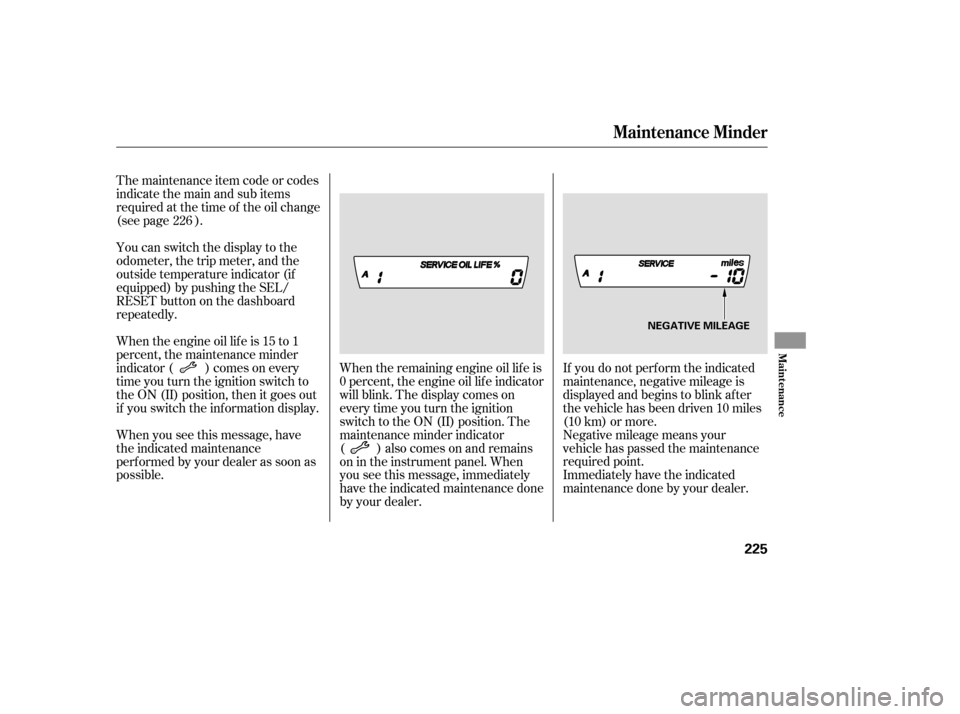
If you do not perf orm the indicated
maintenance, negative mileage is
displayed and begins to blink af ter
the vehicle has been driven 10 miles
(10 km) or more.
Negative mileage means your
vehicle has passed the maintenance
required point.
Immediately have the indicated
maintenance done by your dealer.
When the remaining engine oil lif e is
0 percent, the engine oil lif e indicator
will blink. The display comes on
everytimeyouturntheignition
switch to the ON (II) position. The
maintenance minder indicator
( ) also comes on and remains
on in the instrument panel. When
you see this message, immediately
have the indicated maintenance done
by your dealer.
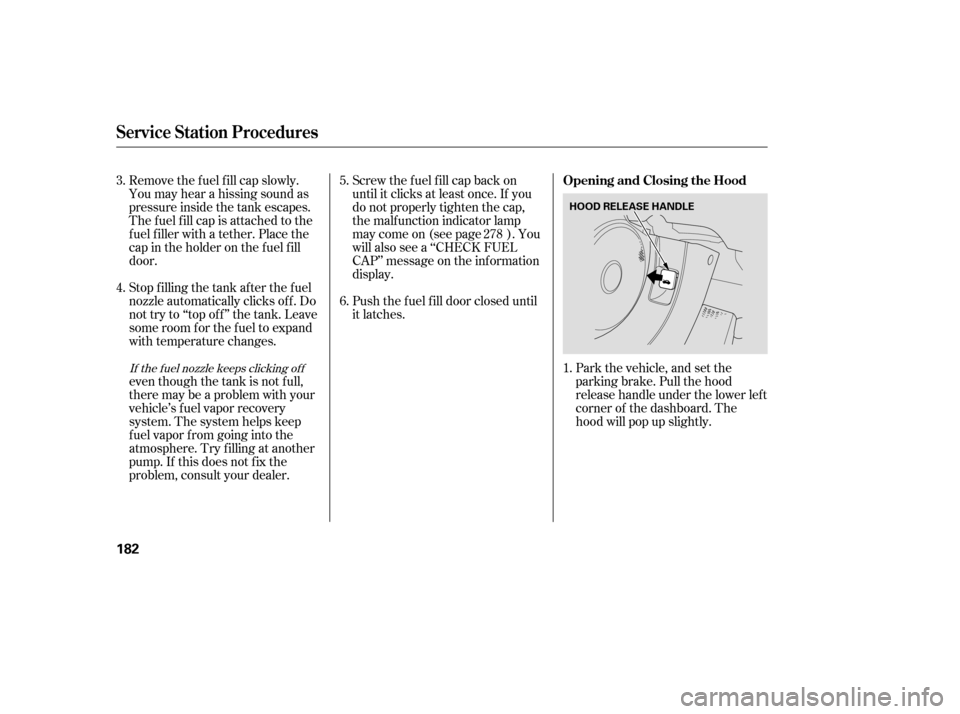
The maintenance item code or codes
indicate the main and sub items
required at the time of the oil change
(see page ).
You can switch the display to the
odometer, the trip meter, and the
outside temperature indicator (if
equipped) by pushing the SEL/
RESET button on the dashboard
repeatedly.
Whentheengineoillifeis15to1
percent, the maintenance minder
indicator ( ) comes on every
time you turn the ignition switch to
the ON (II) position, then it goes out
if you switch the inf ormation display.
When you see this message, have
the indicated maintenance
perf ormed by your dealer as soon as
possible.
226
Maintenance Minder
Maint enance
225
NEGATIVE MILEAGE
�����—�����—�����y���
��
��������y���
�(�#���������y���������y
Page 312 of 413
Your dealer will reset the display
af ter completing the required
maintenance service. You will see
‘‘OIL LIFE 100%’’ on the inf ormation
display the next time you turn the
ignition switch to the ON (II)
position.
If maintenance service is done by
someone other than your dealer,
reset the maintenance minder as
f ollows:Turn the ignition switch to the ON
(II) position.
Press the SEL/RESET button
repeatedly until the engine oil lif e
indicator is displayed.
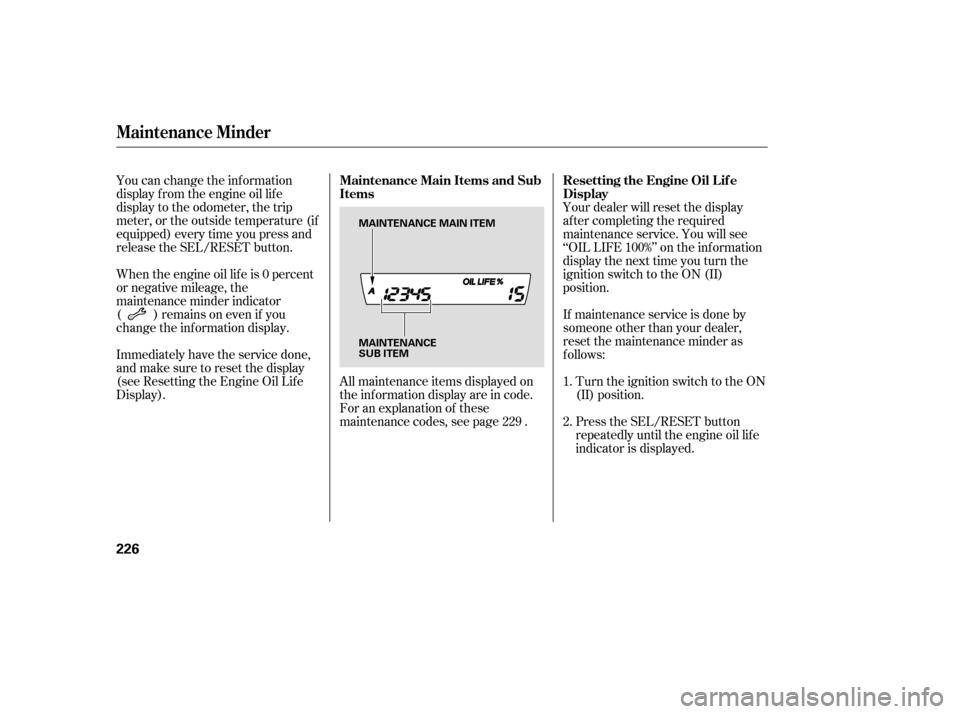
All maintenance items displayed on
the inf ormation display are in code.
For an explanation of these
maintenance codes, see page .
You can change the inf ormation
display f rom the engine oil lif e
display to the odometer, the trip
meter, or the outside temperature (if
equipped) every time you press and
release the SEL/RESET button.
When the engine oil lif e is 0 percent
or negative mileage, the
maintenance minder indicator
( )remainsonevenif you
change the inf ormation display.
Immediately have the service done,
andmakesuretoresetthedisplay
(see Resetting the Engine Oil Lif e
Display).
1. 2.
229
Maintenance Minder
Resetting the Engine Oil Lif e
Display
Maintenance Main Items and Sub
Items
226
MAINTENANCE
SUB ITEM
MAINTENANCE MAIN ITEM
�����—�����—�����y���
��
��������y���
�(�#���������y�������
�y
Page 319 of 413
�µYou may use a synthetic motor oil if
it meets the same requirements
given f or a conventional motor oil: it
displays the API certif ication seal,
and it is the proper weight. You must
f ollow the oil and f ilter change
intervals shown on the information
display.
Your vehicle does not require any oil
additives. Additives may adversely
af f ect the engine or transmission
perf ormance and durability.
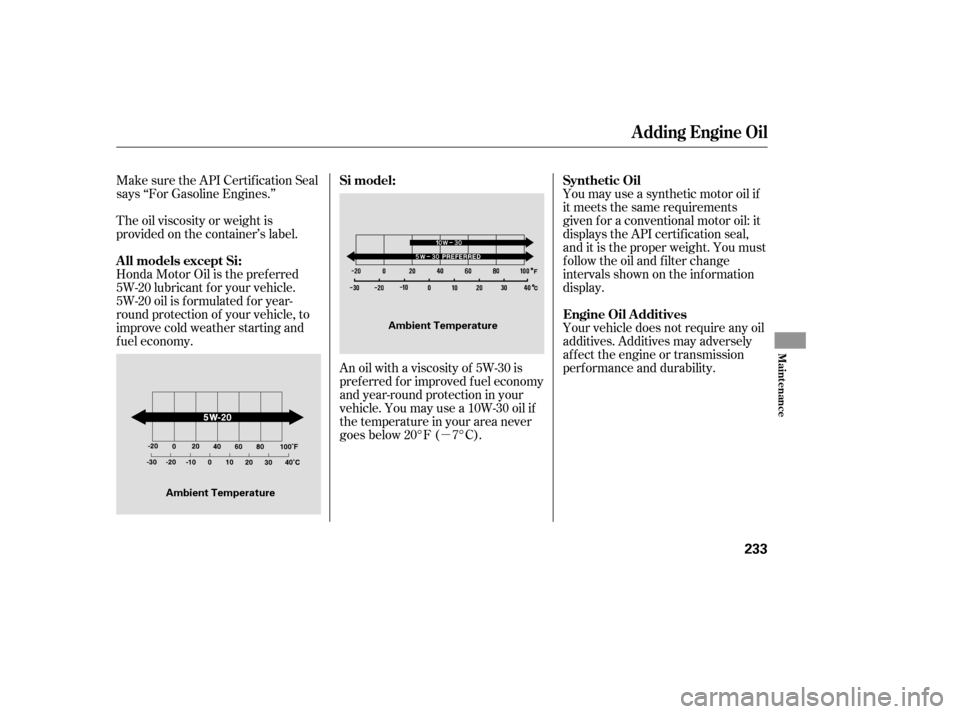
An oil with a viscosity of 5W-30 is
pref erred f or improved f uel economy
and year-round protection in your
vehicle. You may use a 10W-30 oil if
the temperature in your area never
goes below 20°F ( 7°C).
Make sure the API Certif ication Seal
says ‘‘For Gasoline Engines.’’
The oil viscosity or weight is
provided on the container’s label.
Honda Motor Oil is the pref erred
5W-20 lubricant f or your vehicle.
5W-20 oil is f ormulated f or year-
round protection of your vehicle, to
improve cold weather starting and
f uel economy.
Synthetic Oil
Engine Oil A dditives
A ll models except Si: Si model:
A dding Engine Oil
Maint enance
233
Ambient TemperatureAmbient Temperature
�����—�����—�����y���
��
��������y���
�(�#���������y���������y
Page 320 of 413
Open the hood, and remove the
engine oil f ill cap. Remove the oil
drain bolt and washer f rom the
bottom of the engine. Drain the oil
into an appropriate container.
Always change the oil and f ilter
according to the maintenance
messages shown on the inf ormation
display. The oil and f ilter collect
contaminants that can damage your
engine if they are not removed
regularly.
Changing the oil and f ilter requires
special tools and access f rom
underneath the vehicle. The vehicle
should be raised on a service station-
type hydraulic lif t f or this service.
Unless you have the knowledge and
proper equipment, you should have
this maintenance done by a skilled
mechanic.
Run the engine until it reaches
normal operating temperature,
then shut it off.
1.
2.
Changing the Engine Oil and Filter
234
WASHER
DRAIN BOLT
WASHER DRAIN BOLT
Except Si Si
�����—�����—�����y���
��
��������y���
�(�#���������y���������y