Page 358 of 413
Check the inf lation pressure of the
compact spare tire every time you
check the other tires. It should be
inf lated to:
Use the compact spare tire as a
temporary replacement only. Get
your regular tire repaired or replaced,
and put it back on your vehicle as
soon as you can.
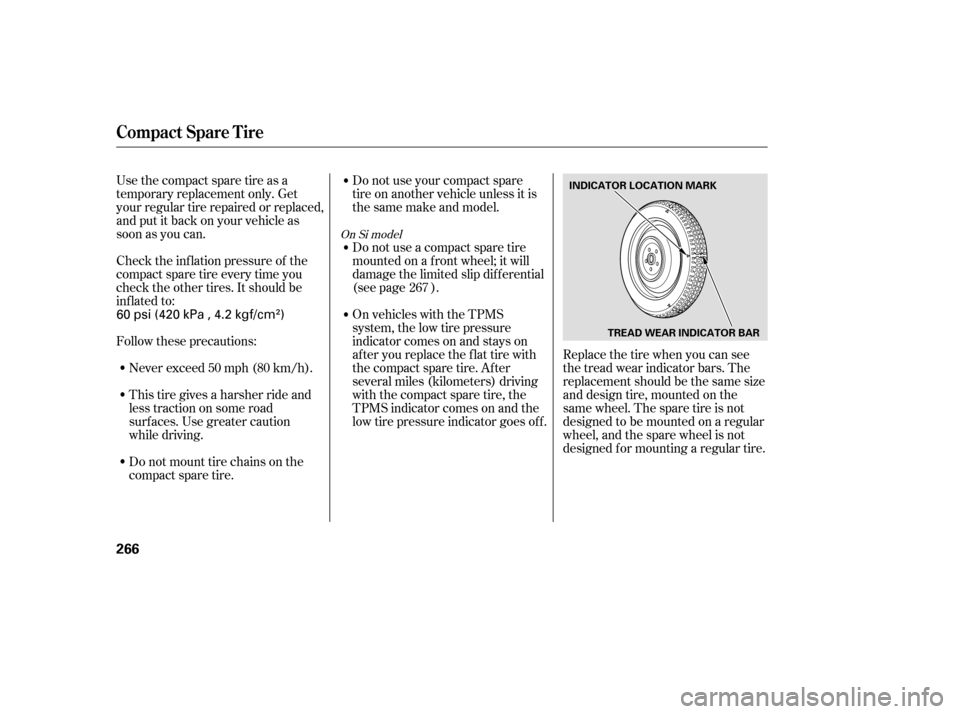
Replace the tire when you can see
the tread wear indicator bars. The
replacement should be the same size
and design tire, mounted on the
same wheel. The spare tire is not
designed to be mounted on a regular
wheel, and the spare wheel is not
designed f or mounting a regular tire.
Follow these precautions:
This tire gives a harsher ride and
less traction on some road
surf aces. Use greater caution
while driving.
Never exceed 50 mph (80 km/h).
Do not mount tire chains on the
compact spare tire. Do not use your compact spare
tire on another vehicle unless it is
thesamemakeandmodel.
Do not use a compact spare tire
mounted on a f ront wheel; it will
damage the limited slip dif f erential
(see page ).
On vehicles with the TPMS
system, the low tire pressure
indicator comes on and stays on
after you replace the flat tire with
the compact spare tire. Af ter
several miles (kilometers) driving
with the compact spare tire, the
TPMS indicator comes on and the
low tire pressure indicator goes of f .
267
On Si model
Compact Spare Tire
266
INDICATOR LOCATION MARK
TREAD WEAR INDICATOR BAR
60 psi (420 kPa , 4.2 kgf/cm)
�����—�����—�����y���
��
��������y���
�(�#���������y�������
�y
Page 359 of 413
Turn on the hazard warning lights,
and turn the ignition switch to the
LOCK (0) position. Have all
passengers get out of the vehicle
while you change the tire.
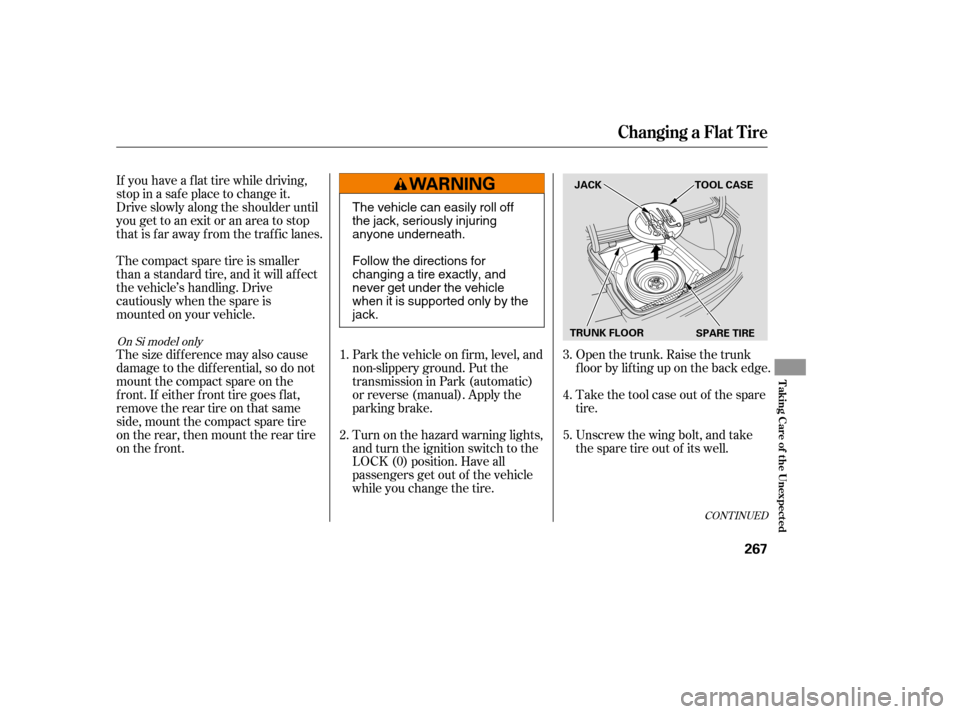
Park the vehicle on f irm, level, and
non-slippery ground. Put the
transmission in Park (automatic)
or reverse (manual). Apply the
parking brake.
Open the trunk. Raise the trunk
f loor by lif ting up on the back edge.
Take the tool case out of the spare
tire.
Unscrew the wing bolt, and take
the spare tire out of its well.
If you have a f lat tire while driving,
stop in a saf e place to change it.
Drive slowly along the shoulder until
you get to an exit or an area to stop
that is far away from the traffic lanes.
Thecompactsparetireissmaller
than a standard tire, and it will affect
the vehicle’s handling. Drive
cautiously when the spare is
mounted on your vehicle.
Thesizedifferencemayalsocause
damage to the dif f erential, so do not
mount the compact spare on the
f ront. If either f ront tire goes f lat,
removethereartireonthatsame
side, mount the compact spare tire
on the rear, then mount the rear tire
on the f ront.
5.
4.
3.
2.
1.
CONT INUED
On Si model only
Changing a Flat T ire
T aking Care of t he Unexpect ed
267
SPARE TIRE
TRUNK FLOOR JACK TOOL CASE
The vehicle can easily roll off
the jack, seriously injuring
anyone underneath.
Follow the directions for
changing a tire exactly, and
never get under the vehicle
when it is supported only by thejack.
�����—�����—�����y���
��
����
���y���
�(�#���������y���������y
Page 387 of 413

�µ
�µ �µ�µ�µ�µ�µ
�Î�Î�Î�Î�Î�Î�Î�Î
�Î
�Î�Î �Î�Î
�Î
�Î
�Î �Î
�Î
�Î
�Î �Î
Specif ications
294
Fuses
Alignment
Battery
Tires
P195/65R15 89H
Interior
Under-hood
Toe-in
Camber
Caster 7°24’0°45’
0°
0.08 in (2.0 mm)
0.00 in (0.0 mm)
See page 284 or the fuse box
cover.
See page 285 or the fuse label
attached to the inside of the fuse
box door under the steering
column.
Capacity 12 V
12 V
12 V36 AH/5 HR
38 AH/5 HR
45 AH/20 HR
47 AH/20 HR
12 V
12 V 38 AH/5 HR
47 AH/20 HR
12 V
60 psi (420 kPa , 4.2 kgf/cm
)
33 psi (230 kPa , 2.3 kgf/cm)
32 psi (220 kPa , 2.2 kgf/cm)
30 psi (210 kPa , 2.1 kgf/cm)
Size
Pressure
T135/80R16 101M
T125/70D15 95M
215/45ZR17 91W
P215/45R17 87V
P205/55R16 89H
T125/70D16 96M P195/65R15 89S
Front Rear
FrontRear
Front Front/Rear
Spare
LX, EX, EX-L
Si (all season tires)
Except Si Si
Optional for Si (summer tires)
U.S.
Vehicles
Canada
Vehicles
1:2:3:4:5:6:7:8:DX, Canadian DX-G with automatic transmission
Canadian DX-G with manual transmission
Si without VSA system Front/Rear
Spare
3
1 2 45
7
7
3
4, 6
6
7
8 1, 2
�����—�
���—�����y�
�������������y���
�(�#���������y���������y
Page 390 of 413
�µ �µ �µ �µ
�µ �µ �µ �µ �µ �µ �µ
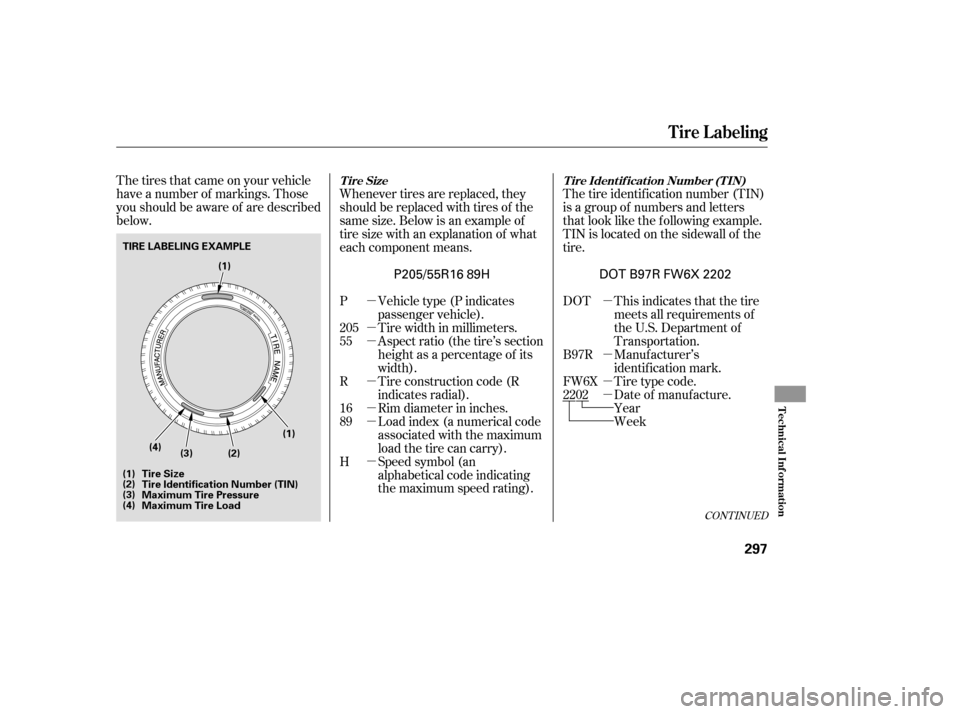
The tires that came on your vehicle
have a number of markings. Those
you should be aware of are described
below.
The tire identif ication number (TIN)
is a group of numbers and letters
that look like the f ollowing example.
TIN is located on the sidewall of the
tire.
This indicates that the tire
meets all requirements of
the U.S. Department of
Transportation.
Manuf acturer’s
identification mark.
Tire type code.
Date of manuf acture.
Whenever tires are replaced, they
should be replaced with tires of the
same size. Below is an example of
tire size with an explanation of what
each component means.
Vehicletype(Pindicates
passenger vehicle).
Tire width in millimeters.
Aspect ratio (the tire’s section
height as a percentage of its
width).
Tire construction code (R
indicates radial).
Rim diameter in inches.
Load index (a numerical code
associated with the maximum
load the tire can carry).
Speed symbol (an
alphabetical code indicating
the maximum speed rating). Year
Week
P 55R 16
DOT B97R
FW6X 2202
205 89 H
CONT INUED
T ire Ident if icat ion Number (T IN)
Tire Size
Tire Labeling
T echnical Inf ormation
297
TIRE LABELING EXAMPLE
(1)
(2)
(3)
(4) Tire Size
Maximum Tire Load
Tire Identification Number (TIN)
Maximum Tire Pressure (3)
(1)
(1)
(2)
(4)
DOT B97R FW6X 2202
P205/55R16 89H
�����—�����—�����y���
�����������y���
�(�#���������y���������y
Page 391 of 413

�µ
�µ �µAs an added safety feature, your
vehicle has been equipped with a tire
pressure monitoring system (TPMS)
that illuminates a low tire pressure
telltale
when one or more of your tires is
signif icantly under-inf lated.
Accordingly, when the low tire
pressure telltale illuminates, you
should stop and check your tires as
soon as possible, and inflate them to
the proper pressure.
The maximum air
pressurethetirecanhold.
The maximum load the
tire can carry at
maximum air pressure.
(If your vehicle has tires of a
dif f erent size than the size indicated
on the vehicle placard or tire
inf lation pressure label, you should
determine the proper tire inf lation
pressure f or those tires.)
Each tire, including the spare (if
provided), should be checked
monthly when cold and inf lated to
the inf lation pressure recommended
by the vehicle manuf acturer on the
vehicle placard or tire inf lation
pressure label.
Max Press
Max Load
U.S. models only
Tire Pressure Monitoring System
(T PMS)Maximum T ire Pressure
Maximum T ire L oad
Tire Labeling, Tire Pressure Monitoring System (TPMS) Required Fe deral Explanation
298
�����—�����—�����y���
�����������y���
�(�#���������y���������y
Page 392 of 413

�µ
�µ �µAs an added safety feature, your
vehicle has been equipped with a tire
pressure monitoring system (TPMS)
that illuminates a low tire pressure
telltale
when one or more of your tires is
signif icantly under-inf lated.
Accordingly, when the low tire
pressure telltale illuminates, you
should stop and check your tires as
soon as possible, and inflate them to
the proper pressure.
The maximum air
pressurethetirecanhold.
The maximum load the
tire can carry at
maximum air pressure.
(If your vehicle has tires of a
dif f erent size than the size indicated
on the vehicle placard or tire
inf lation pressure label, you should
determine the proper tire inf lation
pressure f or those tires.)
Each tire, including the spare (if
provided), should be checked
monthly when cold and inf lated to
the inf lation pressure recommended
by the vehicle manuf acturer on the
vehicle placard or tire inf lation
pressure label.
Max Press
Max Load
U.S. models only
Tire Pressure Monitoring System
(T PMS)Maximum T ire Pressure
Maximum T ire L oad
Tire Labeling, Tire Pressure Monitoring System (TPMS) Required Fe deral Explanation
298
�����—�����—�����y���
�����������y���
�(�#���������y���������y