Page 52 of 303

Your vehicle’s exhaust contains
carbon monoxide gas. Carbon
monoxide should not enter the
vehicle in normal driving if you
maintain your vehicle properly and
f ollow the inf ormation on this page.High levels of carbon monoxide can
collect rapidly in enclosed areas,
such as a garage. Do not run the
engine with the garage door closed.
Even with the door open, run the
engine only long enough to move the
vehicle out of the garage.With the trunk open, airf low can pull
exhaust gas into your vehicle’s
interior and create a hazardous
condition. If you must drive with the
trunk open, open all the windows and
set the heating and cooling system
as shown below.
If you must sit in your parked vehicle
with the engine running, even in an
unconf ined area, adjust the heating
and cooling system as f ollows:
Select the f resh air mode.
Select the mode.
Turn the f an on high speed.
Set the temperature control to a
comfortable setting.
Have the exhaust system inspected
f or leaks whenever:
The vehicle is raised f or an oil
change.
You notice a change in the sound
of the exhaust.
The vehicle was in an accident
that may have damaged the
underside. 1.2.3.4.
Carbon Monoxide Hazard
50
Carbon monoxide gas is toxic.
Breathing it can cause
unconsciousness and even killyou.
Avoid any enclosed areas or
activities that expose you to
carbon monoxide.
�����—�����—�
�
�y�
����
��������y���
�(�+���������y���������y
Page 56 of 303
�Î
�Î
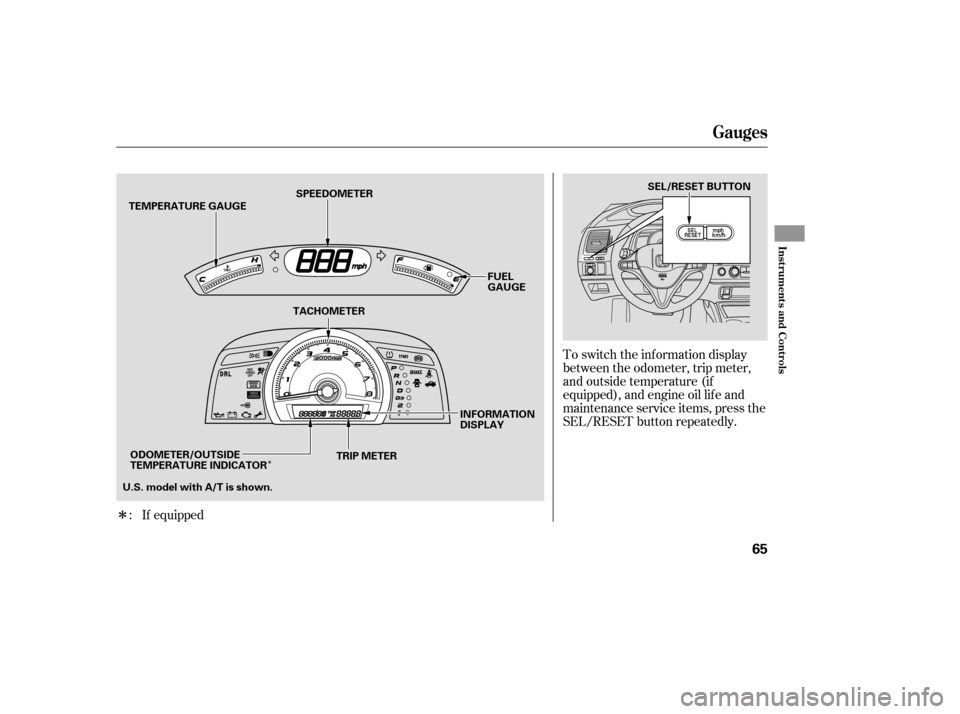
To switch the information display
between the odometer, trip meter,
and outside temperature (if
equipped), and engine oil lif e and
maintenance service items, press the
SEL/RESET button repeatedly.
If equipped
:
Gauges
Inst rument s and Cont rols
65
SPEEDOMETER
TRIP METER INFORMATION
DISPLAYFUEL
GAUGE
TACHOMETER
TEMPERATURE GAUGE
U.S. model with A/T is shown. SEL/RESET BUTTON
ODOMETER/OUTSIDE
TEMPERATURE INDICATOR
�����—�����—�
�
�y�
����
����
���y���
�(�+���������y���������y
Page 59 of 303
The inf ormation display in the
instrument panel shows you the
engine oil lif e and maintenance
service items when the ignition
switch is in the ON (II) position. This
inf ormation helps to keep you aware
of the periodic maintenance your
vehicle needs f or continued trouble-
f ree driving. Ref er to page f or
more inf ormation.
If the system still detects a leak in
your vehicle’s evaporative emissions
system, the malf unction indicator
lamp (MIL) comes on. If the f uel f ill
cap was not already tightened, turn
the engine of f , and check or
retighten the f uel f ill cap until it
clicks at least once. The MIL should
go off after several days of normal
driving once the cap is tightened or
replaced. If the MIL does not go of f ,
have your vehicle inspected by a
dealer. For more inf ormation, see
page .
282 225
Maintenance Minder
Gauges
Inst rument s and Cont rols
69
�����—�����—�
�
�y�
����
��������y���
�(�+���������y���������y
Page 60 of 303
The inf ormation display in the
instrument panel shows you the
engine oil lif e and maintenance
service items when the ignition
switch is in the ON (II) position. This
inf ormation helps to keep you aware
of the periodic maintenance your
vehicle needs f or continued trouble-
f ree driving. Ref er to page f or
more inf ormation.
If the system still detects a leak in
your vehicle’s evaporative emissions
system, the malf unction indicator
lamp (MIL) comes on. If the f uel f ill
cap was not already tightened, turn
the engine of f , and check or
retighten the f uel f ill cap until it
clicks at least once. The MIL should
go off after several days of normal
driving once the cap is tightened or
replaced. If the MIL does not go of f ,
have your vehicle inspected by a
dealer. For more inf ormation, see
page .
282 225
Maintenance Minder
Gauges
Inst rument s and Cont rols
69
�����—�����—�
�
�y�
����
��������y���
�(�+���������y���������y
Page 173 of 303
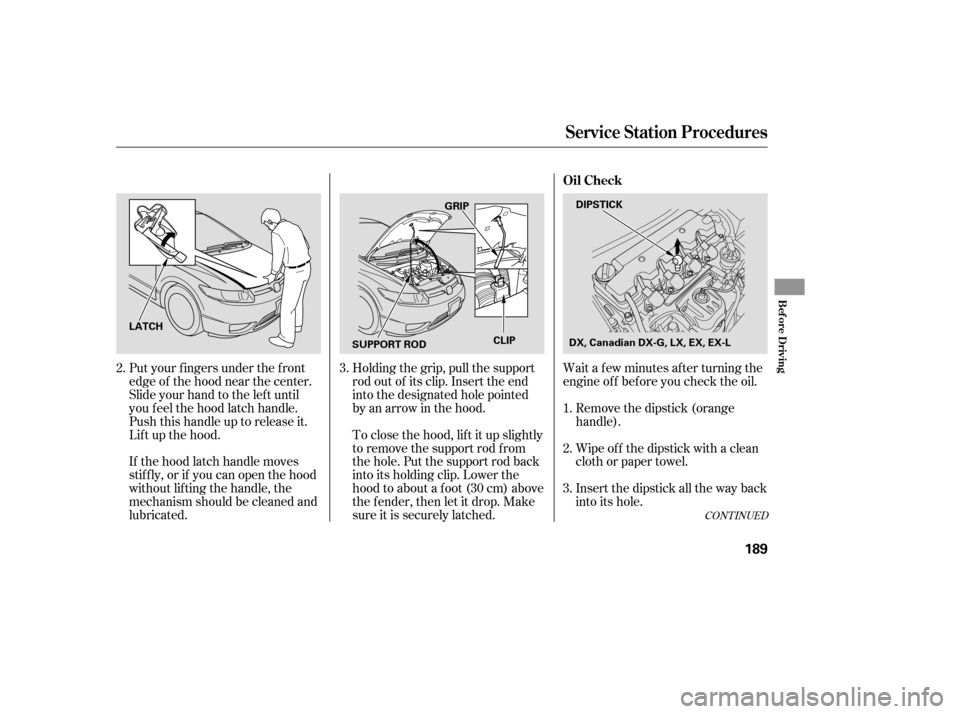
Wait a f ew minutes af ter turning the
engine of f bef ore you check the oil.
Put your f ingers under the f ront
edge of the hood near the center.
Slide your hand to the lef t until
you f eel the hood latch handle.
Push this handle up to release it.
Lif t up the hood.
If the hood latch handle moves
stif f ly, or if you can open the hood
without lifting the handle, the
mechanism should be cleaned and
lubricated. To close the hood, lif t it up slightly
to remove the support rod f rom
the hole. Put the support rod back
into its holding clip. Lower the
hood to about a f oot (30 cm) above
the fender, then let it drop. Make
sure it is securely latched.Remove the dipstick (orange
handle).
Wipe of f the dipstick with a clean
cloth or paper towel.
Insert the dipstick all the way back
into its hole.
Holding the grip, pull the support
rod out of its clip. Insert the end
into the designated hole pointed
by an arrow in the hood.
3.
1. 2.
3.
2.
CONT INUED
Service Station Procedures
Oil Check
Bef ore Driving
189
DIPSTICK
CLIP
LATCH GRIP
SUPPORT ROD DX, Canadian DX-G, LX, EX, EX-L
�����—�����—�
�
�y�
���������
���y���
�(�+���������y���
�����y
Page 174 of 303
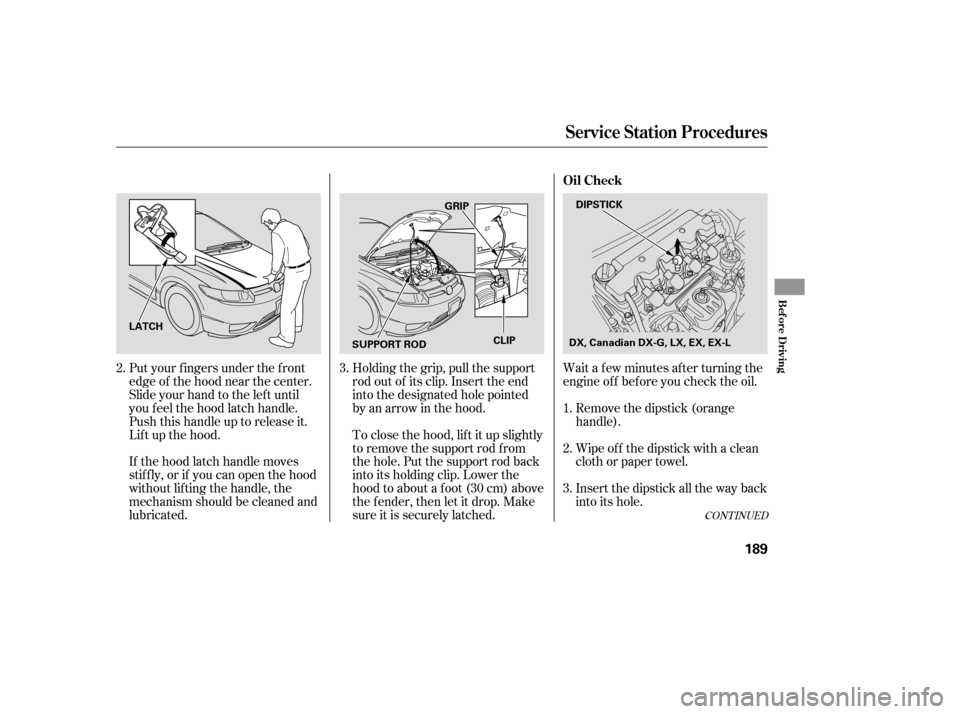
Wait a f ew minutes af ter turning the
engine of f bef ore you check the oil.
Put your f ingers under the f ront
edge of the hood near the center.
Slide your hand to the lef t until
you f eel the hood latch handle.
Push this handle up to release it.
Lif t up the hood.
If the hood latch handle moves
stif f ly, or if you can open the hood
without lifting the handle, the
mechanism should be cleaned and
lubricated. To close the hood, lif t it up slightly
to remove the support rod f rom
the hole. Put the support rod back
into its holding clip. Lower the
hood to about a f oot (30 cm) above
the fender, then let it drop. Make
sure it is securely latched.Remove the dipstick (orange
handle).
Wipe of f the dipstick with a clean
cloth or paper towel.
Insert the dipstick all the way back
into its hole.
Holding the grip, pull the support
rod out of its clip. Insert the end
into the designated hole pointed
by an arrow in the hood.
3.
1. 2.
3.
2.
CONT INUED
Service Station Procedures
Oil Check
Bef ore Driving
189
DIPSTICK
CLIP
LATCH GRIP
SUPPORT ROD DX, Canadian DX-G, LX, EX, EX-L
�����—�����—�
�
�y�
���������
���y���
�(�+���������y���
�����y
Page 175 of 303
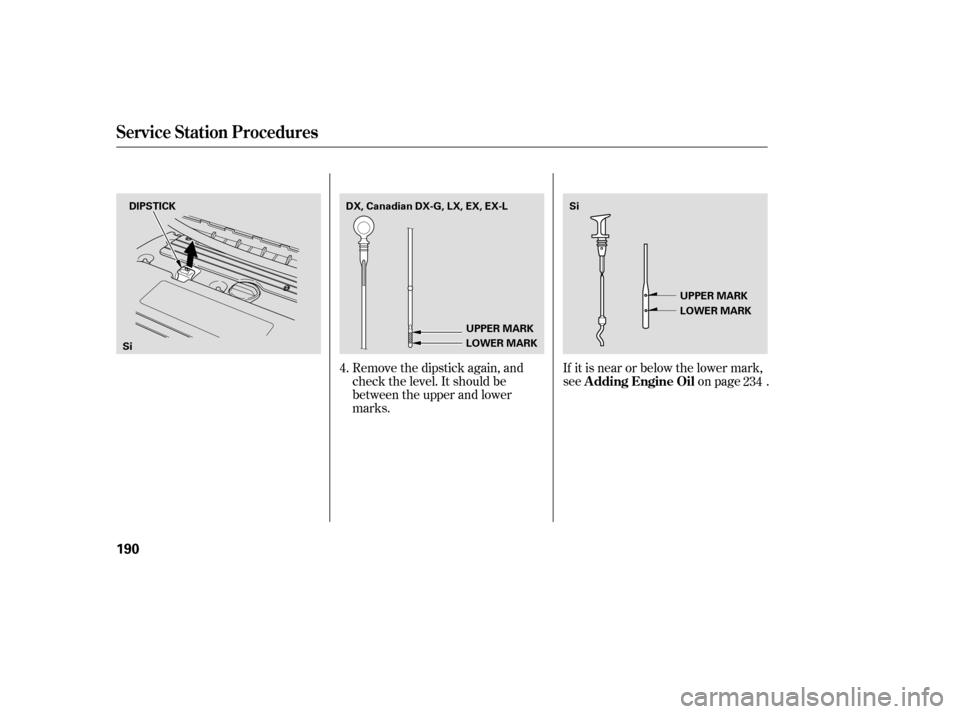
Remove the dipstick again, and
check the level. It should be
between the upper and lower
marks.If it is near or below the lower mark,
see on page .
4.
234
Service Station Procedures
A dding Engine Oil
190
LOWER MARK
UPPER MARK Si
Si DIPSTICK
UPPER MARK
LOWER MARK
DX, Canadian DX-G, LX, EX, EX-L
�����—�����—�
�
�y�
���������
���y���
�(�+���������y���
�����y
Page 178 of 303

�µ�µ
�µ �µ
�µ
�µ�µ
Aggressive driving (hard
acceleration and braking)
Excessive idling, accelerating and
braking in stop-and-go traf f ic
Cold engine operation (engines
aremoreefficientwhenwarmedup)
Driving with a heavy load or the
air conditioner running
Improperly inf lated tires
The f ollowing f actors can lower your
vehicle’s f uel economy:
A properly maintained vehicle
maximizes f uel economy. Poor
maintenance can signif icantly reduce
f uel economy. Always maintain your
vehicle according to the maintenance
messages displayed on the
inf ormation display (see
on page ).
For example: Rapid
acceleration, abrupt cornering,
and hard braking increase fuel
consumption.
Aerodynamic drag has a big ef f ect
on f uel mileage at speeds above 45
mph (75 km/h). Reduce your
speed and you reduce the drag.
Trailers, car top carriers, roof
racks and bike racks are also big
contributors to increased drag.
If your vehicle has a
manual transmission, you can
boost your f uel economy by up
shif ting as early as possible.
Idling
results in 0 miles per gallon.
An under-inf lated tire increases
‘‘rolling resistance,’’ which reduces
f uel economy.
It puts a heavier
load on the engine, increasing f uel
consumption.
In
particular, a build-up of snow or
mud on your vehicle’s underside
adds weight and rolling resistance.
Frequent cleaning helps your f uel
economy.
230
CONT INUED
Fuel Economy
Fuel Economy Factors Use the recommended viscosity motor oil, displaying the A PI
Certif ication Seal (see page).
Improving Fuel Economy Owner’s
Maintenance Checks Drive moderately
Observe the speed limit
Always drive in the highest gear
possible
Avoid excessive idling
Maintain proper tire inf lation
A void carrying excess weight in
your vehicle
K eep your vehicle clean
234
Vehicle Maint enance Drive Ef f icient ly
Bef ore Driving
193
�����—�����—�
�
�y�
�������������y���
�(�+���������y���
�����y