Page 3 of 303

Calif ornia Proposition 65 WarningThis product contains or emits chemicals known to the State of Calif ornia to cause cancer and birth
def ects or other reproductive harm.
Event Data Recorders
This data belongs to the vehicle owner and may not be accessed by anyone else
except as legally required or with the permission of the vehicle owner.
Service Diagnostic Recorders
This vehicle is equipped with service-related devices that record inf ormati on about powertrain perf ormance. The data
can be used to verif y emissions law requirements and/or help technicians diagnose and solve ser vice problems. It may
also be combined with data f rom other sources f or research purposes, but it remains conf i dential.
Introduction
WARNING:
This vehicle is equipped with one or more devices commonly ref erred to as event data recorders. These
devices record f ront seat belt use, f ront passenger seat occupancy, air bag deployment data, and the f ailure
of any airbag system component.
ii
�����—�����—�
�
�y�
�����������
�y���
�(�+���������y���������y
Page 7 of 303
�Î
�Î
�Î
�Î �Î
�Î
�Î
�Î
If equipped
:
Your Vehicle at a Glance
Your Vehicle at a Glance
3
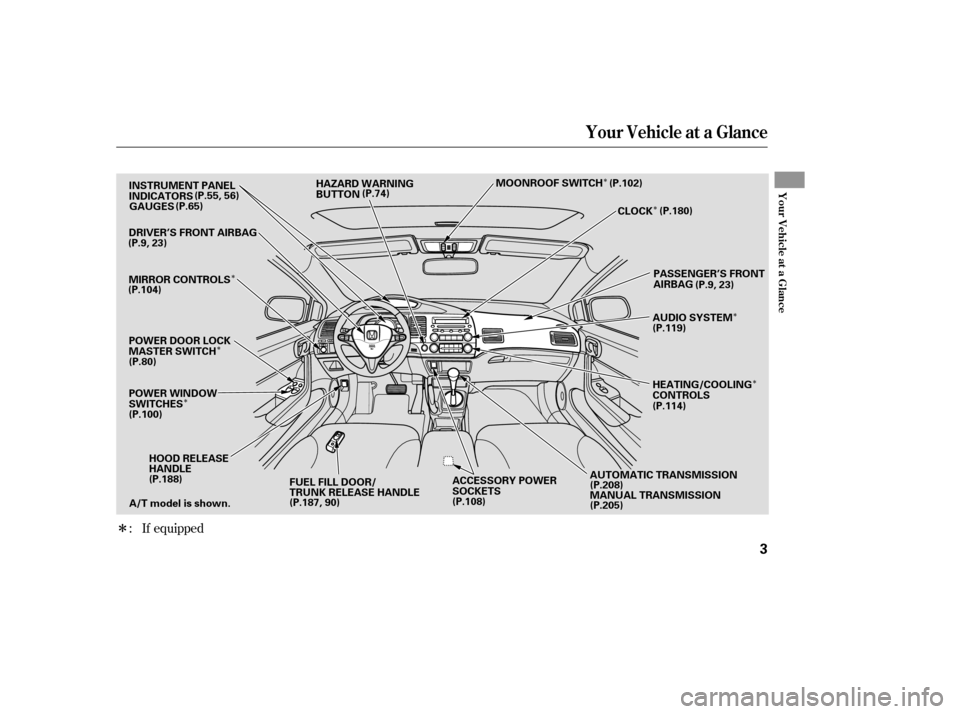
HOOD RELEASE
HANDLE
AUTOMATIC TRANSMISSION
MANUAL TRANSMISSION
GAUGES
INSTRUMENT PANEL
INDICATORS
HAZARD WARNING
BUTTON
(P.9, 23)
(P.9, 23)
ACCESSORY POWER
SOCKETS
DRIVER’S FRONT AIRBAG
FUEL FILL DOOR/
TRUNK RELEASE HANDLE PASSENGER’S FRONT
AIRBAG
A/T model is shown. (P.55, 56)
(P.65)
(P.104) (P.80)
(P.100) (P.188) (P.187, 90) (P.108)(P.208)
(P.205)(P.114)
(P.119)
(P.74)
MIRROR CONTROLS
POWER DOOR LOCK
MASTER SWITCH
POWER WINDOW
SWITCHES HEATING/COOLING
CONTROLS
AUDIO SYSTEM
CLOCK
MOONROOF SWITCH (P.102)
(P.180)
�����—�����—�
�
�y�
�������������y���
�(�+���������y���������y
Page 8 of 303
�Î �Î�Î
�Î
�Î
�Î �Î
�Î
�Î �Î�Î
Only on vehicles equipped with navigation system. Ref er to the navigati
on system manual.
To use the horn, press the center pad of the steering wheel.
If equipped.
1:2:3:
Your Vehicle at a Glance
4
HEADLIGHTS/TURN SIGNALS
REAR WINDOW
DEFOGGER
WINDSHIELD WIPERS/WASHERS
INSTRUMENT PANEL
BRIGHTNESS
SEL/RESET BUTTON
HAZARD WARNING
BUTTON
ACCESSORY POWER
SOCKET
PASSENGER AIRBAG OFF
INDICATOR
(P.29)
DISPLAY CHANGE
BUTTON
HEATED MIRRORS
CRUISE
CONTROL
BUTTONS (P.178)
NAVIGATION SYSTEM VOICE CONTROL BUTTONS
(P.72)
(P.73)(P.66)
(P.65)
(P.104)
(P.217) (P.71)
(P.177)(P.75)
(P.182) (P.105)
(P.74)
AUXILIARY INPUT JACK
MIRROR CONTROLS
VEHICLE
STABILITY
ASSIST (VSA)
SYSTEM OFF
SWITCH
STEERING WHEEL
ADJUSTMENTS
REMOTE AUDIO
CONTROLS HORN
(P.108)(P.74) 3
3
1 3
3
3 32
�����—�����—�
�
�y�
�������������y���
�(�+���������y���������y
Page 9 of 303

�µ
You’ll f ind many saf ety
recommendations throughout this
section, and throughout this manual.
Therecommendationsonthispage
are the ones we consider to be the
most important.
A seat belt is your best protection in
all types of collisions. Airbags are
designed to supplement seat belts,
not replace them. So even though
your vehicle is equipped with airbags,
make sure you and your passengers
always wear your seat belts, and
wear them properly (see page ).
Alcohol and driving don’t mix. Even
one drink can reduce your ability to
respond to changing conditions, and
your reaction time gets worse withevery additional drink. So don’t drink
and drive, and don’t let your f riends
drink and drive, either.
While airbags can save lives, they
can cause serious or fatal injuries to
occupants who sit too close to them,
or are not properly restrained.
Inf ants, young children, and short
adults are at the greatest risk. Be
sure to f ollow all instructions and
warnings in this manual.
Children age 12 and under should
ride properly restrained in a back
seat, not the front seat. Infants and
smallchildrenshouldberestrained
in a child seat. Larger children
should use a booster seat and a lap/
shoulder belt until they can use the
belt properly without a booster seat
(see pages ).
Excessive speed is a major f actor in
crash injuries and deaths. Generally,
the higher the speed, the greater the
risk, but serious injuries can also
occur at lower speeds. Never drive
f aster than is saf e f or current
conditions, regardless of the
maximum speed posted.
Having a tire blowout or a
mechanical f ailure can be extremely
hazardous. To reduce the possibility
of such problems, check your tire
pressures and condition f requently,
and perform all regularly scheduled
maintenance (see page ).
14
32 49
225
Important Saf ety Precautions
Always Wear Your Seat Belt
Don’t Drink and Drive
Be Aware of Airbag Hazards
Restrain All Children
Control Your Speed
K eep Your Vehicle in Saf e
Condition
6
�����—�����—�
�
�y�
�����������
�y���
�(�+���������y�����
�
�y
Page 10 of 303
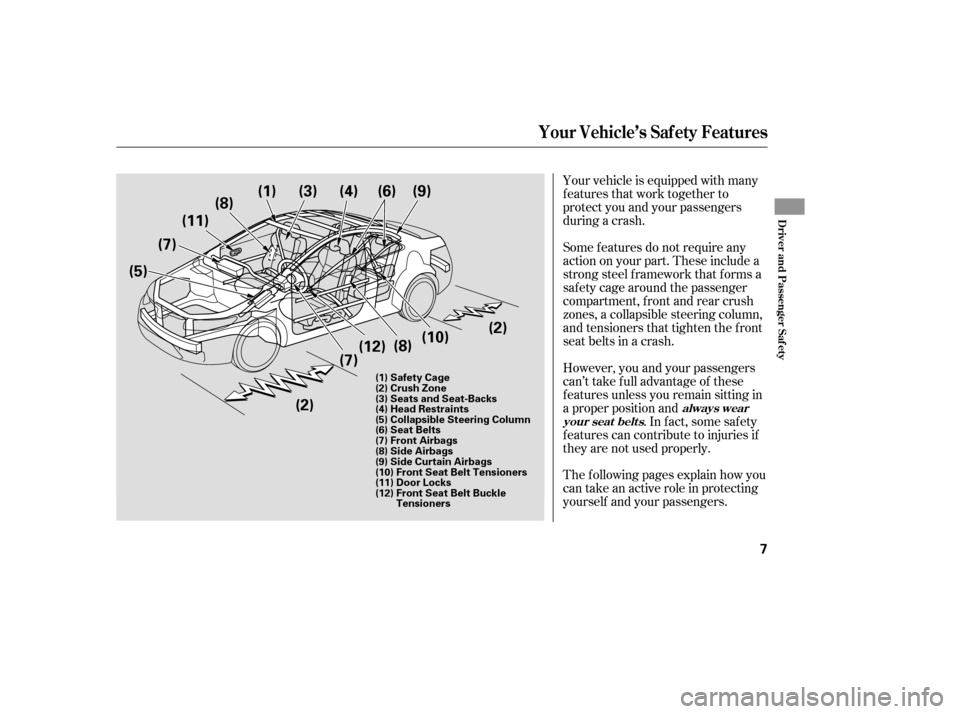
Your vehicle is equipped with many
features that work together to
protect you and your passengers
during a crash.
However, you and your passengers
can’t take f ull advantage of these
f eatures unless you remain sitting in
a proper position and. In fact, some safety
f eatures can contribute to injuries if
they are not used properly.
The f ollowing pages explain how you
cantakeanactiveroleinprotecting
yourself and your passengers.
Some f eatures do not require any
action on your part. These include a
strong steel f ramework that f orms a
saf ety cage around the passenger
compartment, front and rear crush
zones, a collapsible steering column,
and tensioners that tighten the f ront
seat belts in a crash.
Your Vehicle’s Saf ety Features
always wear
your seat belt s
Driver and Passenger Saf ety
7
(7) (2)
(6)
(4)
(7)
(5)
(2)
(11)
(9)
(10)
(12)
(8)
(1) (3)
(8)
(1) Safety Cage
(2) Crush Zone
(3) Seats and Seat-Backs
(4) Head Restraints
(5) Collapsible Steering Column
(6) Seat Belts
(7) Front Airbags
(8) Side Airbags
(9) Side Curtain Airbags
(10) Front Seat Belt Tensioners
(11) Door Locks
(12) Front Seat Belt Buckle Tensioners
�����—�����—�
�
�y�
�������������y���
�(�+���������y�����
���y
Page 11 of 303
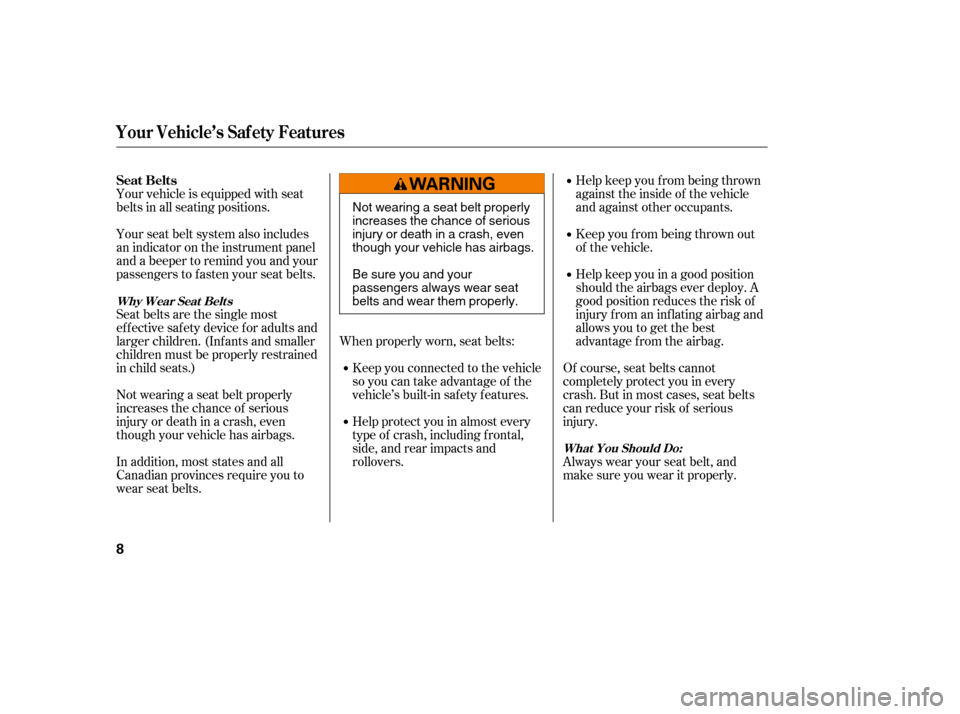
Your vehicle is equipped with seat
belts in all seating positions.
Seat belts are the single most
effectivesafetydeviceforadultsand
larger children. (Inf ants and smaller
children must be properly restrained
in child seats.)
Not wearing a seat belt properly
increases the chance of serious
injury or death in a crash, even
though your vehicle has airbags.
In addition, most states and all
Canadian provinces require you to
wear seat belts.When properly worn, seat belts:
Keep you connected to the vehicle
so you can take advantage of the
vehicle’s built-in saf ety f eatures.
Help protect you in almost every
type of crash, including f rontal,
side, and rear impacts and
rollovers. Help keep you f rom being thrown
against the inside of the vehicle
and against other occupants.
Keep you f rom being thrown out
of the vehicle.
Help keep you in a good position
should the airbags ever deploy. A
good position reduces the risk of
injury f rom an inf lating airbag and
allows you to get the best
advantage f rom the airbag.
Of course, seat belts cannot
completely protect you in every
crash.Butinmostcases,seatbelts
can reduce your risk of serious
injury.
Always wear your seat belt, and
make sure you wear it properly.
Your seat belt system also includes
an indicator on the instrument panel
and a beeper to remind you and your
passengers to f asten your seat belts.
Your Vehicle’s Saf ety Features
Seat Belts
Why Wear Seat Belt s
What You Should Do:
8
Not wearing a seat belt properly
increases the chance of serious
injury or death in a crash, even
though your vehicle has airbags.
Be sure you and your
passengers always wear seat
belts and wear them properly.
�����—�����—�
�
�y�
�������������y���
�(�+���������y�����
���y
Page 12 of 303
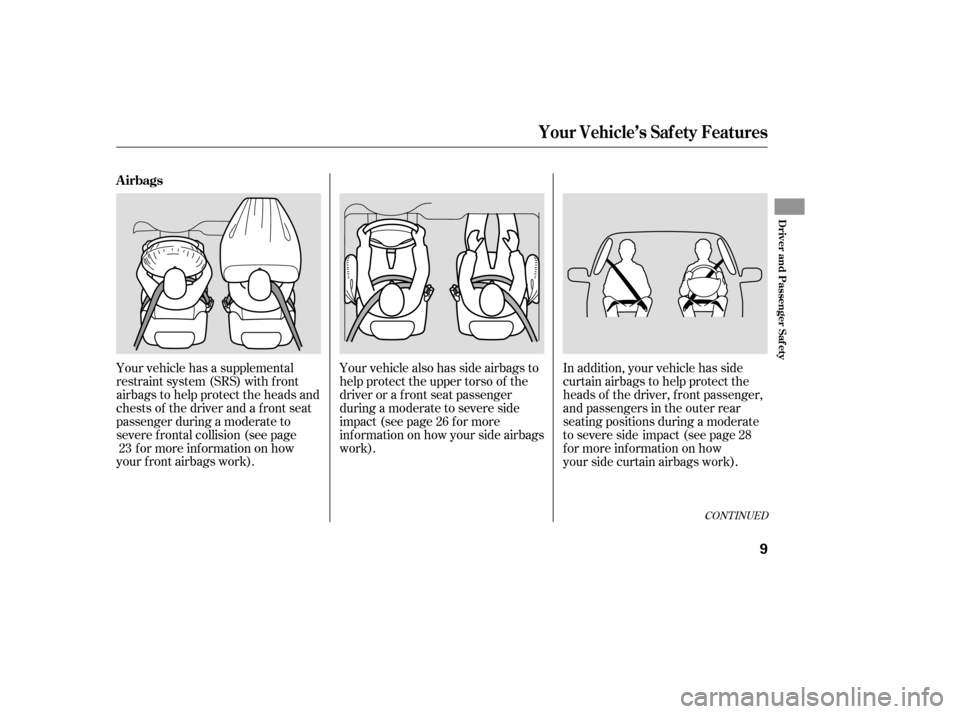
Your vehicle has a supplemental
restraint system (SRS) with f ront
airbags to help protect the heads and
chests of the driver and a front seat
passenger during a moderate to
severe f rontal collision (see pagef or more inf ormation on how
your f ront airbags work). Your vehicle also has side airbags to
help protect the upper torso of the
driver or a f ront seat passenger
during a moderate to severe side
impact (see page f or more
information on how your side airbags
work).
23 26
CONT INUED
Airbags
Your Vehicle’s Saf ety Features
Driver and Passenger Saf ety
9
�����—�����—�
�
�y�
�������������y���
�(�+���������y�����
���y
In addition, your vehicle has side
curtain airbags to help protect the
heads of the driver, f ront passenger,
and passengers in the outer rear
seating positions during a moderate
to severe side impact (see
page28
f or more inf ormation on how
your side curtain airbags work).
Page 13 of 303

The rest of this section gives more
detailed inf ormation about how you
can maximize your saf ety.
Remember, however, that no saf ety
system can prevent all injuries or
deaths that can occur in a severe
crash, even when seat belts are
properly worn and the airbags deploy.
Always wear
your seat belt properly, and sit
upright and as f ar back f rom the
steering wheel as possible while
allowing f ull control of the vehicle. A
f ront passenger should move their
seat as far back from the dashboard
as possible.
The most important things you need
to know about your airbags are:
They are designed to supplement
the seat belts.
To do
their job, airbags must inf late with
tremendous f orce. So while
airbags help save lives, they can
cause minor injuries or more
serious or even fatal injuries if
occupants are not properly
restrained or sitting properly.
Your Vehicle’s Saf ety Features
What you should do:
Airbags do not replace seat belts.
A irbags of f er no prot ect ion in rearimpact s, or minor f ront al or sidecollisions.
A irbags can pose hazards.
10
�����—�����—�
�
�y�
�������������y���
�(�+���������y�����
���y