2008 GREAT WALL FLORID power steering
[x] Cancel search: power steeringPage 143 of 281

Downloaded from www.Manualslib.com manuals search engine GWFLORID Maintenance Manual136
Fault
SymptomsMalfunction CausesTroubleshooting
Poor steering
return
Straight
movement
stability poor
1. Tire pressure insufficient.
2. Wheel counterweight falls off or other fac-
tors cause extremely poor wheel balance.
3. Lower swing arm's rubber bushing is too old,
big difference between the left and right's
rigidity.
4. The front shock absorber's support bearing
and lower swing arm ball lacks sufficient lu-
brications.
5. The four wheels' positional parameters incor-
rect.
6. Steering gear's gear rack meshing condition
worsens and causes intense reverse resis-
tance.
7. Steering column bearing and spider bearing
damaged.
8. Power steering pump's oil supply insuffi-
cient.
9. Inner portion of the steering gear's control
valve performance degradation.
1. Inflate according to the specified pressure.
2. Recalibrate the wheel's dynamic balance.
3. Replace the lower swing arm.
4. Fill with grease of the specified model num-
ber.
5. Re-measure and adjust the four wheels' posi-
tional parameters.
6. Replace the steering gear.
7. Replace the steering column assembly.
8. Replace the power steering pump.
9. Replace the power steering gear.
Page 144 of 281

Downloaded from www.Manualslib.com manuals search engine 137Steering System
Steering System Maintenance
Structure Introduction
The steering wheel has an airbag module which should only be inspected and repaired by a professional. The
steering column's upper section adopts a steel deformation and energy absorbing crumple structure which
ensures collision protection for the driver. The lower section uses a high precision sliding spline structure,
which can effectively eliminate structural interference caused by body deformation. The steering column angle
is adjustable, which can more easily adapt to the driver, and at the same time possesses reasonable reverse
efficiency to ensure the driver has a good feel for the road. Steering sys\
tem is as shown below:
Steering column assembly removal and
installation
1. Remove the airbag.
(a) Disconnect the battery's negative cable, and wait for
one minute before canceling the airbags function in
order to avoid unnecessary injury.
(b) To ensure steering column's proper installation, during
the entire removal process, the front tires must keep
straight.
(c) Remove the two hexagon screws and the airbag module.
Hexagon screw
Steering wheel
Steering column
Steering propeller shaft
PS fluid reservoir
Power steering pumpBelt
Power steering gearSteering combination pipe
Steering propeller shaft connector jacket assembly
Steering dust cover
Steering protection plate
Page 146 of 281
Downloaded from www.Manualslib.com manuals search engine 139Steering System
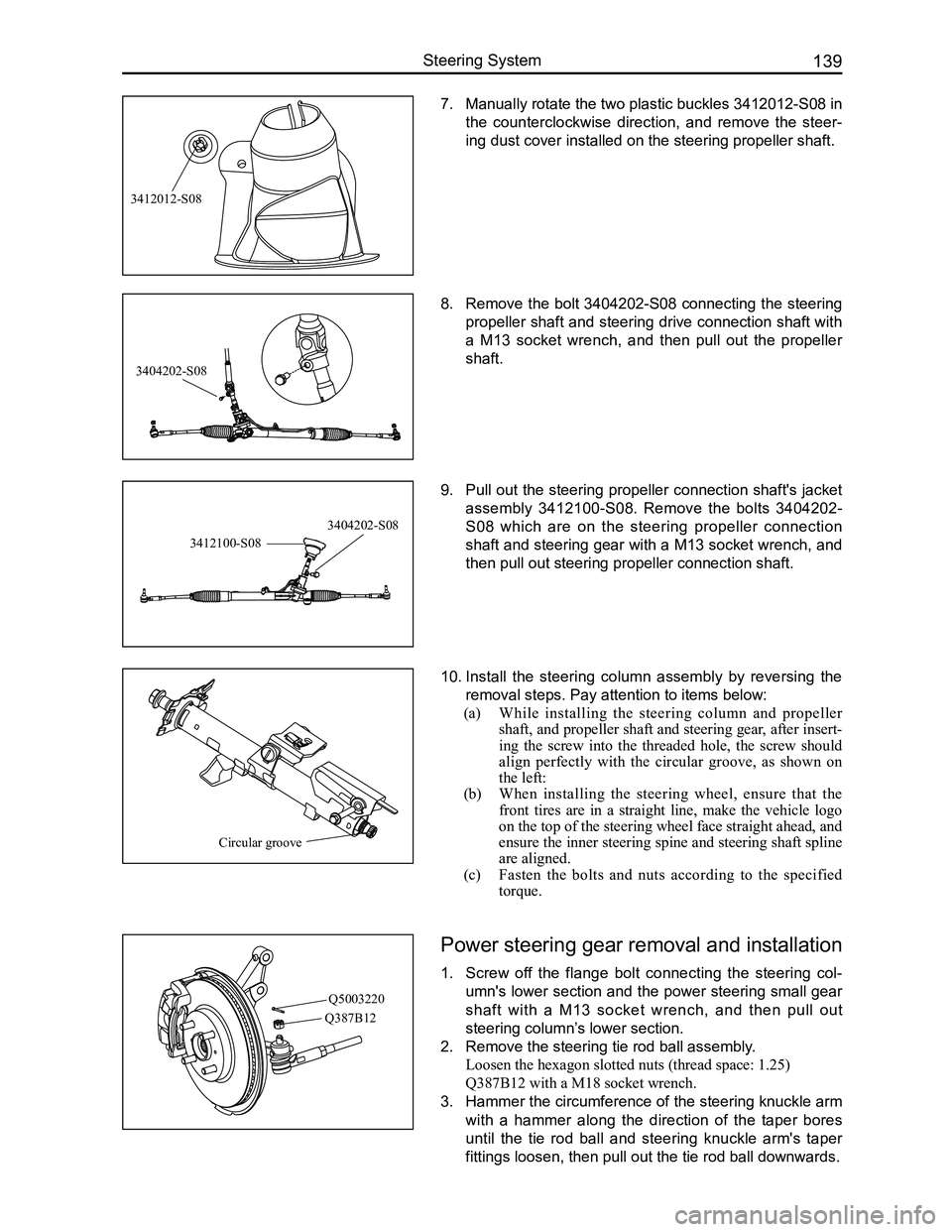
7. Manually rotate the two plastic buckles 3412012-S08 in
the counterclockwise direction, and remove the steer-
ing dust cover installed on the steering propeller shaft.
8. Remove the bolt 3404202-S08 connecting the steering
propeller shaft and steering drive connection shaft with
a M13 socket wrench, and then pull out the propeller
shaft.
9. Pull out the steering propeller connection shaft's jacket
assembly 3412100-S08. Remove the bolts 3404202-
S08 which are on the steering propeller connection
shaft and steering gear with a M13 socket wrench, and
then pull out steering propeller connection shaft.
10. Install the steering column assembly by reversing the
removal steps. Pay attention to items below:
(a) While installing the steering column and propeller
shaft, and propeller shaft and steering gear, after insert-
ing the screw into the threaded hole, the screw should
align perfectly with the circular groove, as shown on
the left:
(b) When installing the steering wheel, ensure that the
front tires are in a straight line, make the vehicle logo
on the top of the steering wheel face straight ahead, and
ensure the inner steering spine and steering shaft spline
are aligned.
(c) Fasten the bolts and nuts according to the specified
torque.
3412012-S08
Circular groove
3412100-S08
3404202-S08
Power steering gear removal and installation
1. Screw off the flange bolt connecting the steering col-
umn's lower section and the power steering small gear
shaft with a M13 socket wrench, and then pull out
steering column’s lower section.
2. Remove the steering tie rod ball assembly.
Loosen the hexagon slotted nuts (thread space: 1.25)
Q387B12 with a M18 socket wrench.
3. Hammer the circumference of the steering knuckle arm
with a hammer along the direction of the taper bores
until the tie rod ball and steering knuckle arm's taper
fittings loosen, then pull out the tie rod ball downwards.
Q5003220
Q387B12
3404202-S08
Page 147 of 281
Downloaded from www.Manualslib.com manuals search engine GWFLORID Maintenance Manual140
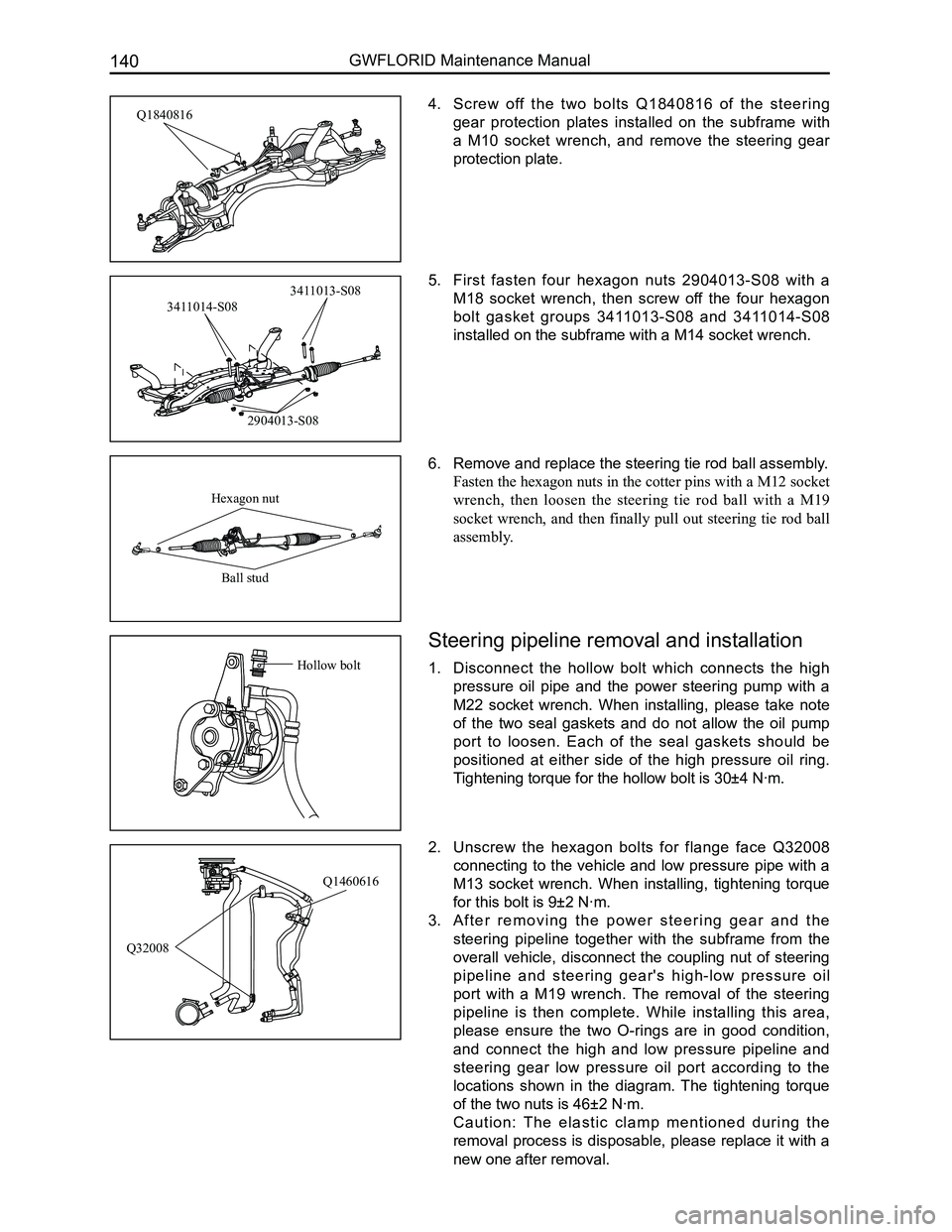
4. Screw off the two bolts Q1840816 of the steering
gear protection plates installed on the subframe with
a M10 socket wrench, and remove the steering gear
protection plate.
5. First fasten four hexagon nuts 2904013-S08 with a
M18 socket wrench, then screw off the four hexagon
bolt gasket groups 3411013-S08 and 3411014-S08
installed on the subframe with a M14 socket wrench.
6. Remove and replace the steering tie rod ball assembly.
Fasten the hexagon nuts in the cotter pins with a M12 socket
wrench, then loosen the steering tie rod ball with a M19
socket wrench, and then finally pull out steering tie rod ball
assembly.
2. Unscrew the hexagon bolts for flange face Q32008
connecting to the vehicle and low pressure pipe with a
M13 socket wrench. When installing, tightening torque
for this bolt is 9±2 N·m.
3. A f t e r r e m o v i n g t h e p o w e r s t e e r i n g g e a r a n d t h e
steering pipeline together with the subframe from the
overall vehicle, disconnect the coupling nut of steering
pipeline and steering gear's high-low pressure oil
port with a M19 wrench. The removal of the steering
pipeline is then complete. While installing this area,
please ensure the two O-rings are in good condition,
and connect the high and low pressure pipeline and
steering gear low pressure oil port according to the
locations shown in the diagram. The tightening torque
of the two nuts is 46±2 N·m.
C a u t i o n : T h e e l a s t i c c l a m p m e n t i o n e d d u r i n g t h e
removal process is disposable, please replace it with a
new one after removal.
Q1460616
Q32008
Q1840816
2904013-S08
3411014-S08
3411013-S08
Hexagon nut
Ball stud
Steering pipeline removal and installation
1. Disconnect the hollow bolt which connects the high
pressure oil pipe and the power steering pump with a
M22 socket wrench. When installing, please take note
of the two seal gaskets and do not allow the oil pump
port to loosen. Each of the seal gaskets should be
positioned at either side of the high pressure oil ring.
Tightening torque for the hollow bolt is 30±4 N·m.
Hollow bolt
Page 148 of 281
Downloaded from www.Manualslib.com manuals search engine 141Steering System
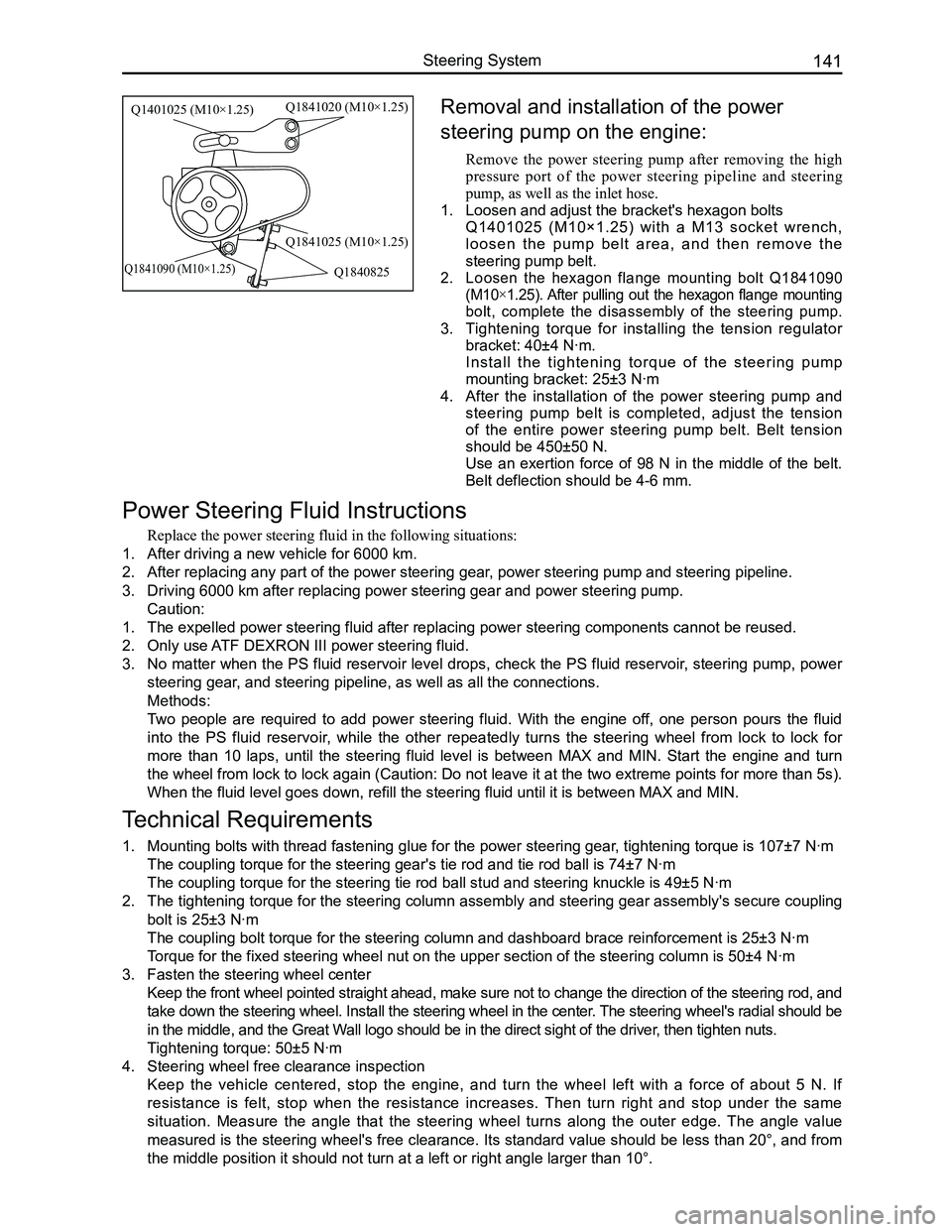
Removal and installation of the power
steering pump on the engine:
Remove the power steering pump after removing the high
pressure port of the power steering pipeline and steering
pump, as well as the inlet hose.
1. Loosen and adjust the bracket's hexagon bolts
Q1401025 (M10×1.25) with a M13 socket wrench,
l o o s e n t h e p u m p b e l t a r e a , a n d t h e n r e m o v e t h e
steering pump belt.
2. Loosen the hexagon flange mounting bolt Q1841090
(M10×1.25). After pulling out the hexagon flange mounting
bolt, complete the disassembly of the steering pump.
3. Tightening torque for installing the tension regulator
bracket: 40±4 N·m.
Install the tightening torque of the steering pump
mounting bracket: 25±3 N·m
4. After the installation of the power steering pump and
steering pump belt is completed, adjust the tension
of the entire power steering pump belt. Belt tension
should be 450±50 N.
Use an exertion force of 98 N in the middle of the belt.
Belt deflection should be 4-6 mm.
Power Steering Fluid Instructions
Replace the power steering fluid in the following situations:
1. After driving a new vehicle for 6000 km.
2. After replacing any part of the power steering gear, power steering pump and steering pipeline.
3. Driving 6000 km after replacing power steering gear and power steering p\
ump.
Caution:
1. The expelled power steering fluid after replacing power steering compone\
nts cannot be reused.
2. Only use ATF DEXRON III power steering fluid.
3. No matter when the PS fluid reservoir level drops, check the PS fluid reservoir, steering pump, power
steering gear, and steering pipeline, as well as all the connections.
Methods:
Two people are required to add power steering fluid. With the engine off, one person pours the fluid
into the PS fluid reservoir, while the other repeatedly turns the steering wheel from lock to lock for
more than 10 laps, until the steering fluid level is between MAX and MIN. Start the engine and turn
the wheel from lock to lock again (Caution: Do not leave it at the two extreme points for more than 5s).
When the fluid level goes down, refill the steering fluid until it is be\
tween MAX and MIN.
Technical Requirements
1. Mounting bolts with thread fastening glue for the power steering gear, tightening torque is 107±7 N·m
The coupling torque for the steering gear's tie rod and tie rod ball is \
74±7 N·m
The coupling torque for the steering tie rod ball stud and steering knuc\
kle is 49±5 N·m
2. The tightening torque for the steering column assembly and steering gear assembly's secure coupling
bolt is 25±3 N·m
The coupling bolt torque for the steering column and dashboard brace rei\
nforcement is 25±3 N·m
Torque for the fixed steering wheel nut on the upper section of the steer\
ing column is 50±4 N·m
3. Fasten the steering wheel center
Keep the front wheel pointed straight ahead, make sure not to change the direction of the steering rod, and
take down the steering wheel. Install the steering wheel in the center. The steering wheel's radial should be
in the middle, and the Great Wall logo should be in the direct sight of the driver, then tighten nuts.
Tightening torque: 50±5 N·m
4. Steering wheel free clearance inspection
Keep the vehicle centered, stop the engine, and turn the wheel left with a force of about 5 N. If
resistance is felt, stop when the resistance increases. Then turn right and stop under the same
situation. Measure the angle that the steering wheel turns along the outer edge. The angle value
measured is the steering wheel's free clearance. Its standard value should be less than 20°, and from
the middle position it should not turn at a left or right angle larger t\
han 10°.
Q1401025 (M10×1.25)Q1841020 (M10×1.25)
Q1841025 (M10×1.25)
Q1840825Q1841090 (M10×1.25)
Page 193 of 281

Downloaded from www.Manualslib.com manuals search engine GWFLORID Maintenance Manual186
Immobilizer System
Immobilizer system composition
This vehicle's engine immobilizer system consists of a theft deterrent ECU assembly, a theft deterrent coil as-
sembly, and two theft deterrent converter assemblies. The theft deterrent coil assembly is put on the head of
ignition lock cylinder, with the other end connected to the theft deterrent ECU assembly. The two theft deterrent
converter assemblies are separately installed inside the plastic handles\
of the two keys.
1. Position diagram
All the components of immobilizer system are assembled on the overall vehicle except for the theft deterrent
converter assemblies inside the keys. They achieve communication functions via the wire harness connections.
The following figure shows the position of each component in the overall\
vehicle.
Theft deterrent controller
Ignition lock key
Theft deterrent coil
Steering column
2. Theft deterrent controller
The theft deterrent controller assembly mainly consists of a microprocessor and peripheral components. It com-
municates with the password transmitter assembly and engine ECU. The theft deterrent controller assembly
communicates with the engine ECU via the W wire, while communicating with the theft deterrent transponder
assembly via radio frequency. The theft deterrent controller connects with the scanner via the K wire. Through
the scanner, it can initiate matching, state controlling, and malfunction diagnosti\
c on the immobilizer system.
3. Theft deterrent coil
The theft deterrent coil assembly is installed on the ignition lock cylinder, the other end of wire harness
plug is connected to the theft deterrent controller assembly. The theft deterrent coil assembly can generate
an electromagnetic field to achieve communication between the theft deterrent controller assembly and the
password transmitter assembly.
4. Transponder
The theft deterrent transponder is installed inside the key handle. It has no power supply, maintains a small size,
and long use life. It acquires electric energy and transmission signals using the stimulation of the electromagnetic
field generated by the theft deterrent coil, so as to communicate with t\
he theft deterrent controller assembly.
Page 195 of 281

Downloaded from www.Manualslib.com manuals search engine GWFLORID Maintenance Manual188
not necessarily mean that engine start failure is due to a immobilizer system malfunction. The reasons for start-
ing engine failures are numerous, including factors like fuel, gas, fire, electricity, wires, etc. If the engine cannot
start, first check if the immobilizer system is working normally. This can be judged by looking at the flashing
theft deterrent indicator lamp which is located on the dashboard in front of the driver seat: Insert the key into the
lock cylinder and turn it to the "ON" position. If a legal key is used to start the engine, once the warning lamp is
connected to the ON end and the transponder is confirmed, the LED will remain unlit. Then when the ON end is
disconnected and the key is pulled out, the LED will shine for 0.25 s and darken for 4 s, as to act as a warning.
If an illegal key is used to start up the engine or there is something wrong with the system, the alarm indicator
lamp will shine for 0.25 s and darken for 4 s. If all is normal, then check the other parts of the engine. If abnor-
mal, first perform immobilizer system troubleshooting. A scanner can be used to judge if the immobilizer system
is working normally, but the precondition is that the scanner must be able to establish communication with the
theft deterrent controller.
1. If communication cannot be established, consider the following:
(a) Check whether the battery voltage is higher than 9 V
(b) Check whether the scanner plug is well contacted to the vehicle socket
(c) Use a multimeter to check whether the 7 pin of the OBD-II plug (diagnostic plug) is connected to the theft
deterrent controller's A7 pin
(d) Check whether the power supply of the theft deterrent controller is normal. (Use a multimeter to measure
whether the voltage of the theft deterrent controller's socket A1 pin and A2 pin is higher than 9 V)
(e) Then adopt the substitution method, which is to replace the theft deterrent controller to check if there is
anything wrong with the theft deterrent controller.
• If the failure is related to the theft deterrent controller, change it and initiate re-matching.
• If the failure has nothing to do with the theft deterrent controller, remove the electronic controller which
is connected to the alarm's K wire, such as the ABS controller, engine electrojet controller, airbag ECU
assembly, etc., as to ascertain if the present fault is caused by the wire harness connected with the theft
deterrent controller's K wire.
2. If communication can be established
Connect the scanner to the vehicle diagnostic port. Insert the key into the steering lock, and turn it to the "ON"
position, then select the scanner to check the immobilizer system's trou\
ble code.
3. Security system troubleshooting
Investigate the problem and perform troubleshooting according to the tro\
uble code on the scanner:
Trouble
code
Code
significanceFailure causeTroubleshooting methods
B1000Theft deterrent
controller
internal
malfunction
Theft deterrent coil open
circuit or short circuit. Theft
deterrent controller internal
malfunction.
Check whether the theft deterrent coil's connecting plug and 1.
the theft deterrent controller is well connected.
Check whether the theft deterrent coil's wire harness plug is sliding 2.
or touching each other.
R e m o v e t h e t h e f t d e t e r r e n t c o i l p l u g , a n d t h e n u s e a 3.
multimeter to check the resistance between the B1 and B2
pins. The normal resistance is about 5-30 Ω. If the resistance
is close to zero, that means the coil has been short circuited.
If the resistance is infinite, then it means the coil's circuit is
open. Measure the resistance between pins B1 and B3, and
B2 and B3, normally they are infinite. If the resistance gains
a certain value, then it means the coil is short circuited or
leaking electricity.
If there is nothing wrong with the coil, the next step is to 4.
check the theft deterrent controller. Adopt the substitution
approach, replace it with a non-matched new theft deterrent
controller or an theft deterrent controller which has been
reset (please refer to the immobilizer system component
replacement). Insert the key into the ignition lock and turn it
to the "ON" position and read the trouble code. If there is no
9000 failure, it means the replaced controller has an internal
malfunction, and the new replaced controller must be re-
matched.
Page 230 of 281

Downloaded from www.Manualslib.com manuals search engine 223Airbags
Diagnostic procedures
StepsInspectionOperation
1
Inspect the clock spring
Warning
If not handled properly, the airbag module may deploy
and cause serious operator injury. Therefore, before
maintenance, please read the maintenance warnings
carefully.
See also airbag system maintenance warning
Are the components relating to the clock spring work-
ing normally? (The relationship between each pin is
normal, no unnecessary short or open circuit, etc.).
NormalGo to the next step
Abnormal
Replace the clock spring
See also airbag system and clock
spring removal/installation
2
Check whether the malfunction is on the driver side
airbag module or other components
Replace with a good DAB module
Install the battery's negative cable
Set the ignition switch to the "ON" position
Is the trouble code still displayed? Or can it be cleared?
Yes
Replace the driver side
airbag module
See also airbag system and
driver side airbag module
removal/installation
NoGo to the next step
3
Inspect the clock spring's wire harness connectors
Set the ignition switch to the "LOCK" position
Loosen the battery's negative cable and wait for at least
1 min
Take out the steering column housing
Loosen the clock spring connector
Is the clock spring working normally?
NormalGo to the next step
AbnormalReplace the wire harness
4
Check whether the malfunction is on the clock spring
or other components
Set the dedicated detector at 2 Ω position
Install the battery's negative cable
Set the ignition switch to the "ON" position
Is a trouble code displayed?
YesGo to the next step
No
Replace the clock spring
See also airbag system and clock
spring removal/installation
5
Check the wire harness between the clock spring and
SRS electronic control unit
Set the ignition switch to the "LOCK". position
Loosen the battery's negative cable and then wait for at
least 1 min
Take out the glove box (with the front passenger side
airbag module)
L o o s e n t h e f r o n t p a s s e n g e r s i d e a i r b a g m o d u l e
connectors
Take out the dashboard base
Loosen all the SRS airbag system unit connectors
Check the wire harness of the connectors and terminal
studs between the SRS airbag system electronic control
unit and the clock spring to determine whether they
have the following problems
• Ground
• Short connected with the power supply
• Open circuit
Is the above wire harness normal?
Normal
Replace the SRS airbag system
unit
See also SRS airbag system
SRS airbag system unit removal/
installation
AbnormalReplace the wire harness
6
Check the clock spring connector
Loosen the clock spring connector
Is the clock spring connector normal?
NormalGo to the next step
AbnormalReplace the wire harness
or connectors