2008 GMC SAVANA ECU
[x] Cancel search: ECUPage 334 of 402
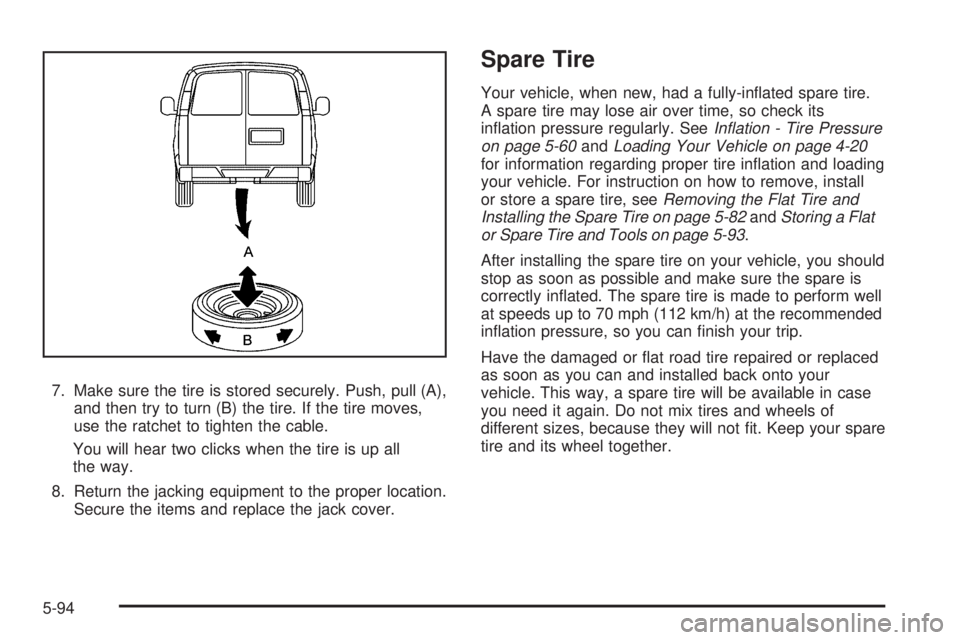
7. Make sure the tire is stored securely. Push, pull (A),
and then try to turn (B) the tire. If the tire moves,
use the ratchet to tighten the cable.
You will hear two clicks when the tire is up all
the way.
8. Return the jacking equipment to the proper location.
Secure the items and replace the jack cover.
Spare Tire
Your vehicle, when new, had a fully-inflated spare tire.
A spare tire may lose air over time, so check its
inflation pressure regularly. SeeInflation - Tire Pressure
on page 5-60andLoading Your Vehicle on page 4-20
for information regarding proper tire inflation and loading
your vehicle. For instruction on how to remove, install
or store a spare tire, seeRemoving the Flat Tire and
Installing the Spare Tire on page 5-82andStoring a Flat
or Spare Tire and Tools on page 5-93.
After installing the spare tire on your vehicle, you should
stop as soon as possible and make sure the spare is
correctly inflated. The spare tire is made to perform well
at speeds up to 70 mph (112 km/h) at the recommended
inflation pressure, so you can finish your trip.
Have the damaged or flat road tire repaired or replaced
as soon as you can and installed back onto your
vehicle. This way, a spare tire will be available in case
you need it again. Do not mix tires and wheels of
different sizes, because they will not fit. Keep your spare
tire and its wheel together.
5-94
Page 363 of 402

At Least Once a Month
Tire Ination Check
Inspect your vehicle’s tires and make sure they are
inflated to the correct pressures. Do not forget to
check the spare tire. SeeInflation - Tire Pressure on
page 5-60. Check to make sure the spare tire is stored
securely. SeeChanging a Flat Tire on page 5-78.
Tire Wear Inspection
Tire rotation may be required for high mileage highway
drivers prior to the Engine Oil Life System service
notification. Check the tires for wear and, if necessary,
rotate the tires. SeeTire Inspection and Rotation on
page 5-68.
At Least Once a Year
Starter Switch Check
{CAUTION:
When you are doing this inspection, the
vehicle could move suddenly. If the vehicle
moves, you or others could be injured.
1. Before you start, be sure you have enough room
around the vehicle.
2. Firmly apply both the parking brake and the regular
brake. SeeParking Brake on page 2-26.
Do not use the accelerator pedal, and be ready to
turn off the engine immediately if it starts.
3. Try to start the engine in each gear. The vehicle
should start only in PARK (P) or NEUTRAL (N).
If the vehicle starts in any other position, contact
your dealer/retailer for service.
6-11
Page 379 of 402
Services Provided
The following services are provided in the U.S. and
Canada up to 5 years/100,000 miles (160 000 km),
whichever occurs first, and, in Canada only, up
to a maximum coverage of $100.
•Fuel Delivery:Delivery of enough fuel for the
vehicle to get to the nearest service station
(approximately $5 in Canada). In Canada, service
to provide diesel may be restricted. For safety
reasons, propane and other alternative fuels will
not be provided through this service.
•Lock-out Service:Lock-out service will be covered
at no charge if you are unable to gain entry into
your vehicle. A remote unlock may be available if
you have an active OnStar
®subscription. To ensure
security, the driver must present personal
identification before lock-out service is provided. In
Canada, the vehicle registration is also required.
•Emergency Tow From a Public Roadway or
Highway:Tow to the nearest dealership for warranty
service or in the event of a vehicle-disabling crash.
Winch-out assistance is provided when the vehicle is
mired in sand, mud, or snow.
•Flat Tire Change:Installation of a spare tire in good
condition, when equipped and properly inflated, is
covered at no charge. The customer is responsible
for the repair or replacement of the tire if not covered
by a warrantable failure.
•Jump Start:A battery jump start is covered at no
charge if the vehicle does not start.
•Trip Routing Service:Upon request, Roadside
Assistance will send you detailed, computer
personalized maps, highlighting your choice of either
the most direct route or the most scenic route to your
destination, anywhere in North America, along with
helpful travel information pertaining to your trip.
Please allow three weeks before your planned
departure date. In Canada, trip routing requests will
be limited to six per calendar year.
7-7
Page 380 of 402
•Trip Interruption Benets and Assistance:In the
event of a warranty related vehicle disablement,
while en route and over 150 miles (250 kilometres)
from original point of departure, you may qualify for
trip interruption expense assistance. This assistance
covers reasonable reimbursement of up to a
maximum of $500. In Canada, maximums include:
(A) meals (maximum of $50/day), (B) lodging
(maximum of $100/night) and (C) alternate ground
transportation (maximum of $40/day). This benefit is
to assist you with some of the unplanned expense
you may incur while waiting for your vehicle to be
repaired.
Original detailed receipts, and a copy of the repair
order are required. In Canada, pre-authorization is
also required.
Once authorization has been given, your advisor will
help you make any necessary arrangements and
explain how to claim for trip interruption expense
assistance.
•Alternative Service (Canada only):There may be
times, when Roadside Assistance cannot provide
timely assistance. Your advisor may authorize you to
secure local emergency road service, and you will be
reimbursed up to $100 (Canadian) upon submission
of the original receipt to Roadside Assistance.In many instances, mechanical failures may be covered.
However, when other services are utilized, our Roadside
Assistance Representatives will explain any payment
obligations you might incur.
GMC and General Motors of Canada Limited reserve the
right to limit services or reimbursement to an owner or
driver when, in their sole discretion, the claims become
excessive in frequency or type of occurrence.
Calling For Assistance
For prompt and efficient assistance when calling, please
provide the following to the Roadside Assistance
Representative:
•Your name, home address, and home telephone
number
•Telephone number of your location
•Location of the vehicle.
•Model, year, color, and license plate number of the
vehicle
•Odometer reading, Vehicle Identification
Number (VIN), and delivery date of the vehicle
•Description of the problem
7-8
Page 390 of 402

OnStar®
If your vehicle has OnStar and you subscribe to the
OnStar services, please refer to the OnStar Terms and
Conditions for information on data collection and use.
Navigation System
If your vehicle has a navigation system, use of the
system may result in the storage of destinations,
addresses, telephone numbers, and other trip
information. Refer to the navigation system operating
manual for information on stored data and for deletion
instructions.
Radio Frequency
Identication (RFID)
RFID technology is used in some vehicles for functions
such as tire pressure monitoring and ignition system
security, as well as in connection with conveniences
such as key fobs for remote door locking/unlocking and
starting, and in-vehicle transmitters for garage door
openers. RFID technology in GM vehicles does not use
or record personal information or link with any other
GM system containing personal information.
7-18
Page 393 of 402

Child Restraints (cont.)
Securing a Child Restraint in a
Rear Seat Position...................................1-46
Securing a Child Restraint in the
Right Front Seat Position..................1-48, 1-52
Where to Put the Restraint...........................1-38
Cigarette Lighter.............................................3-18
Cleaning
Aluminum Wheels......................................5-100
Exterior Lamps/Lenses.................................5-98
Fabric/Carpet..............................................5-96
Finish Care.................................................5-98
Instrument Panel, Vinyl, and
Other Plastic Surfaces..............................5-97
Interior.......................................................5-95
Tires........................................................5-101
Underbody Maintenance.............................5-101
Washing Your Vehicle...................................5-98
Weatherstrips..............................................5-97
Windshield and Wiper Blades........................5-99
Climate Control System...................................3-19
Outlet Adjustment........................................3-21
Rear Air Conditioning and Heating System......3-23
Rear Heating System...................................3-22
Clock, Setting.................................................3-65
Collision Damage Repair..................................7-11
Compass.......................................................3-47
Control of a Vehicle.......................................... 4-3Coolant
Engine Temperature Gage............................3-35
Heater, Engine............................................2-21
Cooling System..............................................5-28
Cruise Control................................................3-10
Cruise Control Light........................................3-40
Customer Assistance Information
Courtesy Transportation.................................. 7-9
Customer Assistance for
Text Telephone (TTY) Users........................ 7-4
Customer Assistance Offices........................... 7-5
Customer Satisfaction Procedure..................... 7-2
GM Mobility Reimbursement Program............... 7-6
Reporting Safety Defects to General Motors.....7-15
Reporting Safety Defects to the
Canadian Government..............................7-15
Reporting Safety Defects to the
United States Government.........................7-14
Roadside Assistance Program......................... 7-6
Service Publications Ordering Information........7-15
D
Daytime Running Lamps..................................3-15
Defensive Driving............................................. 4-2
Delayed Locking............................................... 2-7
DIC Compass.................................................3-47
Disc, MP3......................................................3-77
3
Page 394 of 402

Doing Your Own Service Work........................... 5-4
Dome Lamp Override......................................3-16
Dome Lamps.................................................3-16
Door
60/40 Swing-Out Side Door...........................2-10
Automatic Door Lock..................................... 2-8
Automatic Door Unlock.................................. 2-8
Cargo Door Relocking.................................... 2-7
Delayed Locking........................................... 2-7
Locks.......................................................... 2-6
Power Door Locks......................................... 2-6
Programmable Automatic Door Locks............... 2-7
Rear Door Security Locks............................... 2-8
Rear Doors.................................................2-12
Sliding Side Door.......................................... 2-9
Driver Information Center (DIC).........................3-42
DIC Operation and Displays..........................3-42
DIC Vehicle Customization............................3-58
DIC Warnings and Messages........................3-49
Driving
At Night.....................................................4-12
Before a Long Trip......................................4-14
Defensive..................................................... 4-2
Drunken....................................................... 4-2
Highway Hypnosis.......................................4-14
Hill and Mountain Roads..............................4-15
In Rain and on Wet Roads...........................4-13
Rocking Your Vehicle to Get it Out.................4-20
Winter........................................................4-16
Dual Tire Operation.........................................5-61E
EDR .............................................................7-16
Electrical System
Add-On Equipment.....................................5-103
Engine Compartment Fuse Block.................5-106
Floor Console Fuse Block...........................5-104
Fuses and Circuit Breakers.........................5-104
Headlamp Wiring.......................................5-104
Windshield Wiper Fuses.............................5-104
Engine
Air Cleaner/Filter.........................................5-19
Check and Service Engine Soon Light............3-36
Coolant......................................................5-23
Coolant Heater............................................2-21
Coolant Temperature Gage...........................3-35
Drive Belt Routing.......................................6-17
Engine Compartment Overview......................5-14
Exhaust.....................................................2-30
Fan Noise..................................................5-34
Fuel Regulator............................................2-21
Oil .............................................................5-15
Oil Life System...........................................5-18
Overheating................................................5-26
Running While Parked..................................2-31
Starting......................................................2-20
Entry/Exit Lighting...........................................3-17
Event Data Recorders.....................................7-17
Extender, Safety Belt.......................................1-28
Exterior Lamps...............................................3-13
4
Page 396 of 402
Highbeam On Light.........................................3-40
Highway Hypnosis...........................................4-14
Hill and Mountain Roads..................................4-15
Hood
Checking Things Under................................5-12
Release.....................................................5-13
Horn............................................................... 3-6
How to Wear Safety Belts Properly...................1-15
I
Ignition Positions.............................................2-19
Infants and Young Children, Restraints...............1-32
Inflation - Tire Pressure...................................5-60
Instrument Panel
Overview..................................................... 3-4
Instrument Panel (I/P)
Brightness..................................................3-16
Cluster.......................................................3-25
J
Jump Starting.................................................5-40
K
Keyless Entry System....................................... 2-3
Keys............................................................... 2-2
L
Labeling, Tire Sidewall.....................................5-54
Lamps
Dome........................................................3-16
Dome Lamp Override...................................3-16
Reading.....................................................3-17
Lap-Shoulder Belt...........................................1-22
LATCH System
Child Restraints...........................................1-39
Light
Airbag Off..................................................3-28
Airbag Readiness........................................3-27
Antilock Brake System Warning.....................3-34
Brake System Warning.................................3-33
Charging System.........................................3-32
Cruise Control.............................................3-40
Highbeam On.............................................3-40
Malfunction Indicator....................................3-36
Oil Pressure...............................................3-39
Passenger Airbag Status Indicator..................3-30
Safety Belt Reminders..................................3-26
Security.....................................................3-40
StabiliTrak
®Indicator....................................3-34
Tire Pressure..............................................3-35
Tow/Haul Mode...........................................3-40
Lighting
Entry/Exit...................................................3-17
6