2008 FORD SUPER DUTY service
[x] Cancel search: servicePage 47 of 96
it begins to restrict the filter. The soot gathered inside the filter needs to
be periodically cleaned. The soot can be cleaned in two different ways;
passive regeneration and active regeneration. Both methods occur
automatically and require no actions from the driver/operator. During
either one of these regeneration methods you may notice an
increase/change in exhaust noise/tone.
Passive regeneration
In passive regeneration, the exhaust constituents / temperature are at an
appropriate level where some soot can be reduced or oxidized (burned)
thus cleaning the filter. This method occurs naturally as a result of
normal engine operating conditions (at varying levels due to drive
patterns).
Active regeneration
If there is not enough passive regeneration naturally occurring due to
vehicle drive patterns, the engine control system will initiate an active
regeneration. In an active regeneration, the filter is cleaned by raising
the exhaust temperature to a point where the soot is burned away. This
is accomplished through various engine actions which raise the exhaust
temperature in the oxidation catalyst/DPF system to an appropriate high
level where the soot is burned off. After the soot is burned off, the
exhaust temperature and back-pressure (restriction) fall back to normal
levels.
Filter service/maintenance
Over time a slight amount of ash will build up in the DPF which is not
removed during the regeneration process. The DPF may need to be
removed for ash cleaning at approximately 120,000 miles (193,000 km)
or greater (actual mileage can vary greatly depending upon
engine/vehicle operating conditions) and replaced with a new or
remanufactured (ash cleaned) part. The filter may need to be replaced
at approximately 250,000 miles (400,000 km) depending upon
engine/vehicle operating conditions. In both cases the engine control
system will set a service light (
) to inform you to bring the vehicle
to the dealer for service.
If there are any issues with the oxidation catalyst/DPF system a service
light (
or) will be set by the engine control system to inform
you to bring the vehicle into a dealership for service.
2008 Econoline(eco)
Supplement
USA(fus)
Maintenance and Specifications
47
Page 50 of 96
The complexity of the diesel engine makes it so the owner is discouraged
from attempting to perform maintenance other than the services
described in this supplement.
If you experience difficult starting, rough idling, excessive exhaust
smoke, a decrease in engine performance or excess fuel consumption,
perform the following checks:
•a plugged air inlet system or engine air filter element.
•water in the fuel filter/water separator.
•a clogged fuel filter.
•contaminated fuel.
•air in the fuel system, due to loose connections.
•an open or pinched sensor hose.
•low engine oil level.
•wrong fuel or oil viscosity for climactic conditions.
If these checks do not help you correct the engine performance problem
you are experiencing, consult an authorized dealer.
FUELING
Do not use starting fluid such as ether or gasoline in the diesel
air intake system. Such fluids can cause immediate explosive
damage to the engine and possible personal injury.
If you fuel your vehicle at a truck stop, you may notice that the fuel
nozzle may shut off every 5–10 seconds. This is due to the flow rates
being designed for larger heavy duty trucks. You may have to fuel at a
slower rate (don’t depress the nozzle trigger fully).
Do not run your diesel vehicle out of fuel as this will allow air to enter
the fuel system which will make restarting difficult. The engine is
designed to run roughly as the fuel tank nears Empty. This is a warning
to the driver to add fuel as soon as possible. Longer engine cranking
time may be required once air is in the fuel system. If air enters the fuel
system (either through running the fuel tank(s) empty or during a fuel
filter change), the engine will self-purge the trapped air once it starts
running. The engine may run roughly and produce white smoke while air
is in the fuel system; this is normal and should stop after a short time.
2008 Econoline(eco)
Supplement
USA(fus)
Maintenance and Specifications
50
Page 56 of 96
required maintenance using genuine Ford parts. They are committed to
meeting your service needs and to assuring your continuing satisfaction.
Protecting your investment
Maintenance is an investment that will pay dividends in the form of
improved reliability, durability and resale value. To ensure the proper
performance of your vehicle and its emission control systems, it is
imperative that scheduled maintenance be completed at the designated
intervals.
Your vehicle is very sophisticated and built with multiple complex
performance systems. Every manufacturer develops these systems using
different specifications and performance features. That’s why it’s
important to rely upon your Ford or Lincoln Mercury dealership to
properly diagnose and repair your vehicle.
Ford Motor Company has recommended maintenance intervals for
various parts and component systems based upon engineering testing.
Ford Motor Company relies upon this testing to determine the most
appropriate mileage for replacement of oils and fluids to protect your
vehicle at the lowest overall cost to you and recommends against
maintenance schedules that deviate from the scheduled maintenance
information.
Ford strongly recommends the use of genuine Ford replacement parts.
Parts other than Ford, Motorcraft or Ford authorized remanufactured
parts that are used for maintenance replacement or for the service of
components affecting emission control must be equivalent to genuine
Ford Motor Company parts in performance and durability. It is the
owner’s responsibility to determine the equivalency of such parts. Please
consult yourWarranty Guidefor complete warranty information.
Non-Ford approved chemicals or additives are not required for factory
recommended maintenance. In fact, Ford Motor Company recommends
against the use of such additive products unless specifically
recommended by Ford for a particular application.
Oils, Fluids and Flushing
In many cases, fluid discoloration is a normal operating characteristic of
the chemical compound and may not necessarily demonstrate that a fluid
needs to be changed. Oils and fluids identified in this guide should be
changed at the specified interval or in conjunction with a repair. Flushing
is a viable way to change fluid for many vehicle sub-systems during
scheduled maintenance and should only be done using the same fluid
required to finish the maintenance procedure, or a Ford approved
flushing chemical.
2008 Econoline(eco)
Supplement
USA(fus)
Scheduled Maintenance: General Information
56
Page 57 of 96
Engine Emissions label
Emissions information appears on the Engine Emissions label on the
engine valve cover. This decal identifies engine displacement and
provides certain engine specifications.
Any modification of the emissions control system could create liability
under federal law (U.S.) if made prior to sale and registration, under the
laws of some states if made thereafter. Further, federal law prohibits
vehicle manufacturers, dealers and other persons engaged in the
business of repairing, servicing, selling, leasing or trading motor vehicles
as well as fleet operations from knowingly removing or rendering an
emissions control system inoperative after sale and delivery to an
ultimate purchaser. In Canada, modifications of the emissions control
system could create liability under applicable federal or provincial laws.
Genuine Ford Parts and Service
When planning your maintenance services, consider your Ford and
Lincoln Mercury dealership for all your vehicle’s needs.
Get the most from your service and maintenance visits
There are a lot of reasons why your Ford and Lincoln Mercury dealership
is a great way to help keep your vehicle running great.
Convenience
To make your service visit even more convenient, in many cases, you’ll
find extended evening hours and Saturday hours. How’s that for quality
service?
Factory-trained Technicians
Ford and Lincoln Mercury service technicians participate in extensive
factory-sponsored training to help them become the experts on the
operation of your vehicle. Many participate in Ford-sponsored training to
become certified. Ask your dealer about the training and certification
their technicians have received.
Factory Authorized Systems Checks
In the event that your vehicle experiences a component related concern,
please contact your Ford or Lincoln Mercury dealership. The Ford Motor
Company Trained Technicians who work at Ford or Lincoln Mercury
dealerships are specifically trained to understand your vehicle.
A proper repair begins with a thorough system check. A Factory
Authorized Systems Check can ONLY be found at a Ford or Lincoln
Mercury dealership. In some circumstances, the technician may need to
2008 Econoline(eco)
Supplement
USA(fus)
Scheduled Maintenance: General Information
57
Page 58 of 96
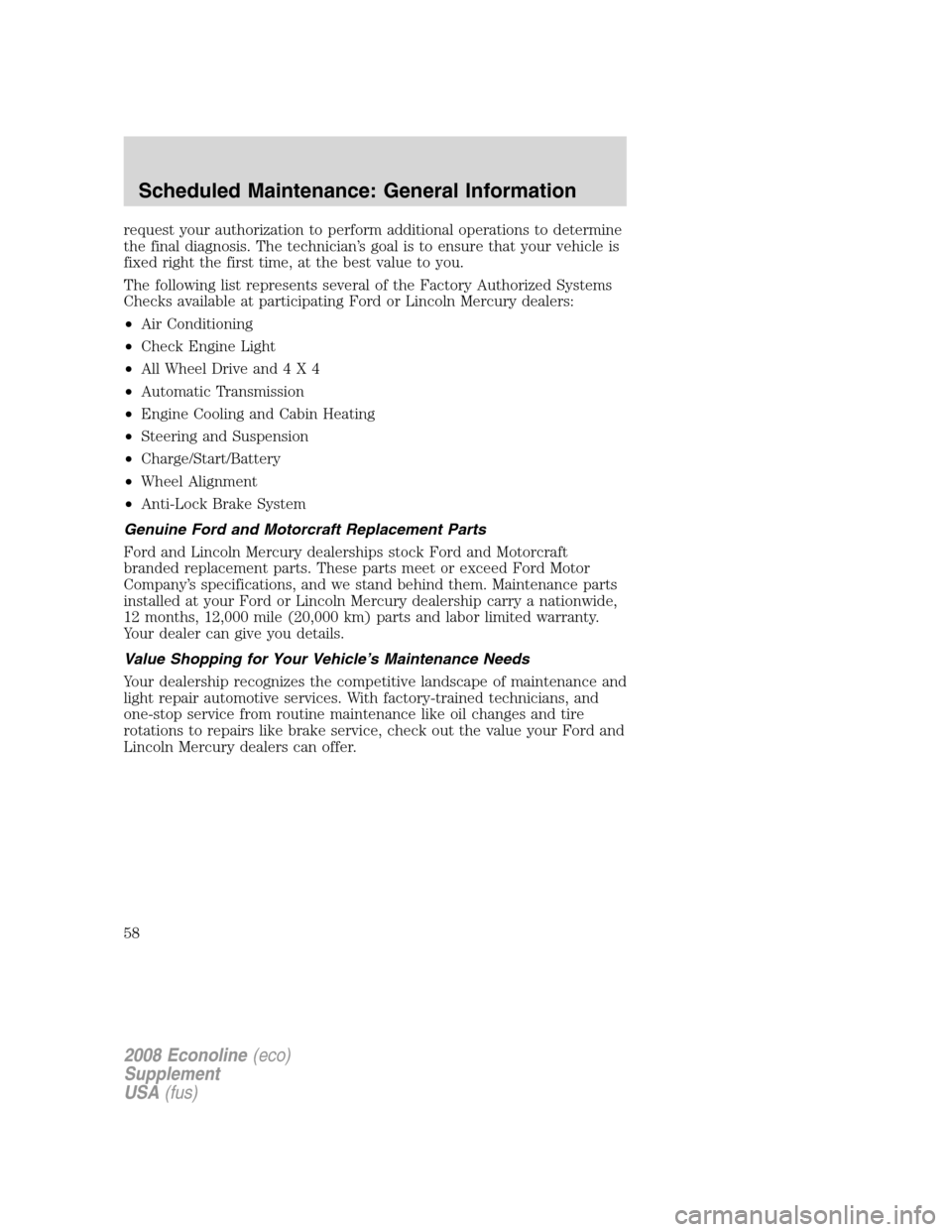
request your authorization to perform additional operations to determine
the final diagnosis. The technician’s goal is to ensure that your vehicle is
fixed right the first time, at the best value to you.
The following list represents several of the Factory Authorized Systems
Checks available at participating Ford or Lincoln Mercury dealers:
•Air Conditioning
•Check Engine Light
•All Wheel Drive and4X4
•Automatic Transmission
•Engine Cooling and Cabin Heating
•Steering and Suspension
•Charge/Start/Battery
•Wheel Alignment
•Anti-Lock Brake System
Genuine Ford and Motorcraft Replacement Parts
Ford and Lincoln Mercury dealerships stock Ford and Motorcraft
branded replacement parts. These parts meet or exceed Ford Motor
Company’s specifications, and we stand behind them. Maintenance parts
installed at your Ford or Lincoln Mercury dealership carry a nationwide,
12 months, 12,000 mile (20,000 km) parts and labor limited warranty.
Your dealer can give you details.
Value Shopping for Your Vehicle’s Maintenance Needs
Your dealership recognizes the competitive landscape of maintenance and
light repair automotive services. With factory-trained technicians, and
one-stop service from routine maintenance like oil changes and tire
rotations to repairs like brake service, check out the value your Ford and
Lincoln Mercury dealers can offer.
2008 Econoline(eco)
Supplement
USA(fus)
Scheduled Maintenance: General Information
58
Page 59 of 96
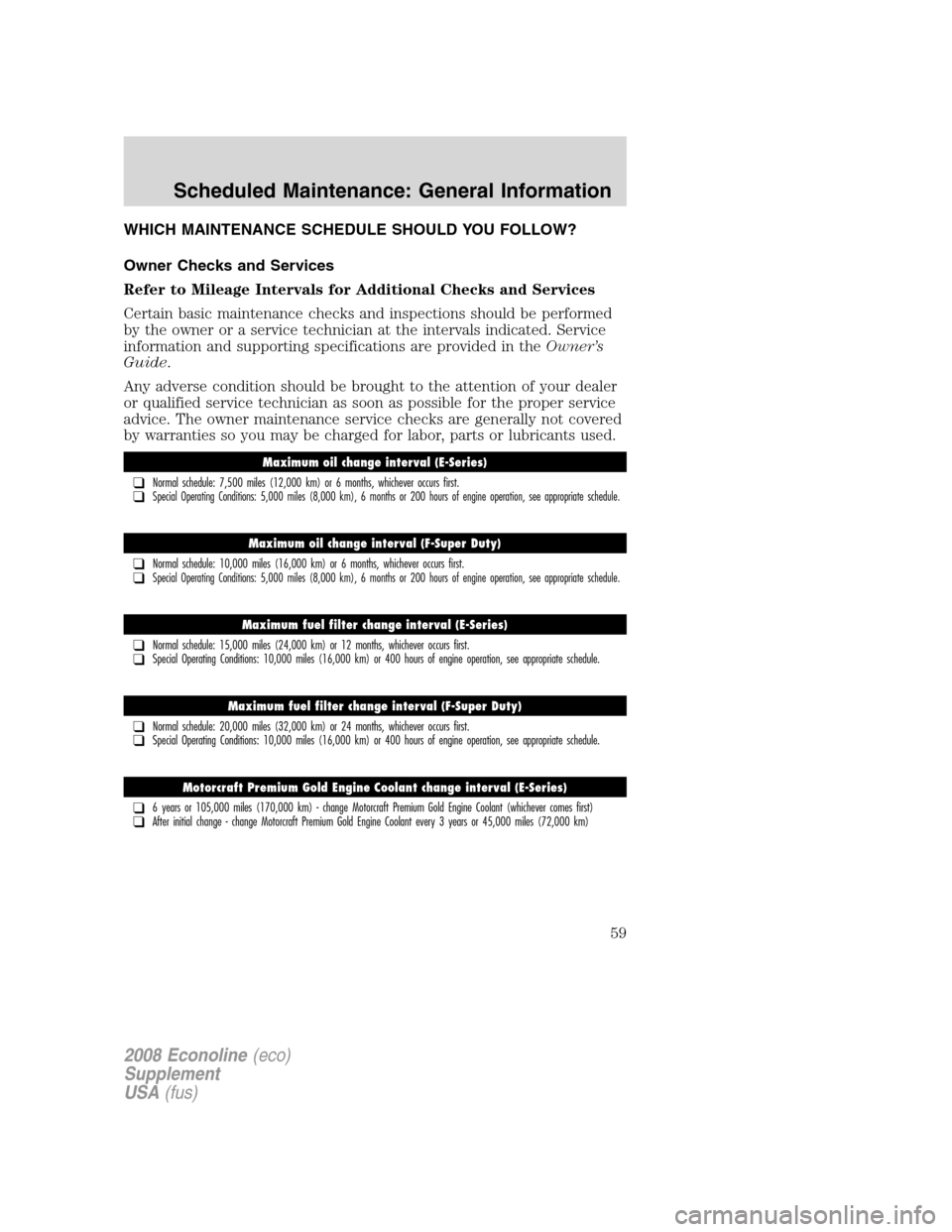
WHICH MAINTENANCE SCHEDULE SHOULD YOU FOLLOW?
Owner Checks and Services
Refer to Mileage Intervals for Additional Checks and Services
Certain basic maintenance checks and inspections should be performed
by the owner or a service technician at the intervals indicated. Service
information and supporting specifications are provided in theOwner’s
Guide.
Any adverse condition should be brought to the attention of your dealer
or qualified service technician as soon as possible for the proper service
advice. The owner maintenance service checks are generally not covered
by warranties so you may be charged for labor, parts or lubricants used.
Maximum oil change interval (E-Series)
❑Normal schedule: 7,500 miles (12,000 km) or 6 months, whichever occurs first.❑Special Operating Conditions: 5,000 miles (8,000 km), 6 months or 200 hours of engine operation, see appropriate schedule.
Maximum oil change interval (F-Super Duty)
❑Normal schedule: 10,000 miles (16,000 km) or 6 months, whichever occurs first.❑Special Operating Conditions: 5,000 miles (8,000 km), 6 months or 200 hours of engine operation, see appropriate schedule.
Maximum fuel filter change interval (E-Series)
❑Normal schedule: 15,000 miles (24,000 km) or 12 months, whichever occurs first.❑Special Operating Conditions: 10,000 miles (16,000 km) or 400 hours of engine operation, see appropriate schedule.
Maximum fuel filter change interval (F-Super Duty)
❑Normal schedule: 20,000 miles (32,000 km) or 24 months, whichever occurs first.❑Special Operating Conditions: 10,000 miles (16,000 km) or 400 hours of engine operation, see appropriate schedule.
Motorcraft Premium Gold Engine Coolant change interval (E-Series)
❑6 years or 105,000 miles (170,000 km) - change Motorcraft Premium Gold Engine Coolant (whichever comes first)❑After initial change - change Motorcraft Premium Gold Engine Coolant every 3 years or 45,000 miles (72,000 km)
2008 Econoline(eco)
Supplement
USA(fus)
Scheduled Maintenance: General Information
59
Page 62 of 96
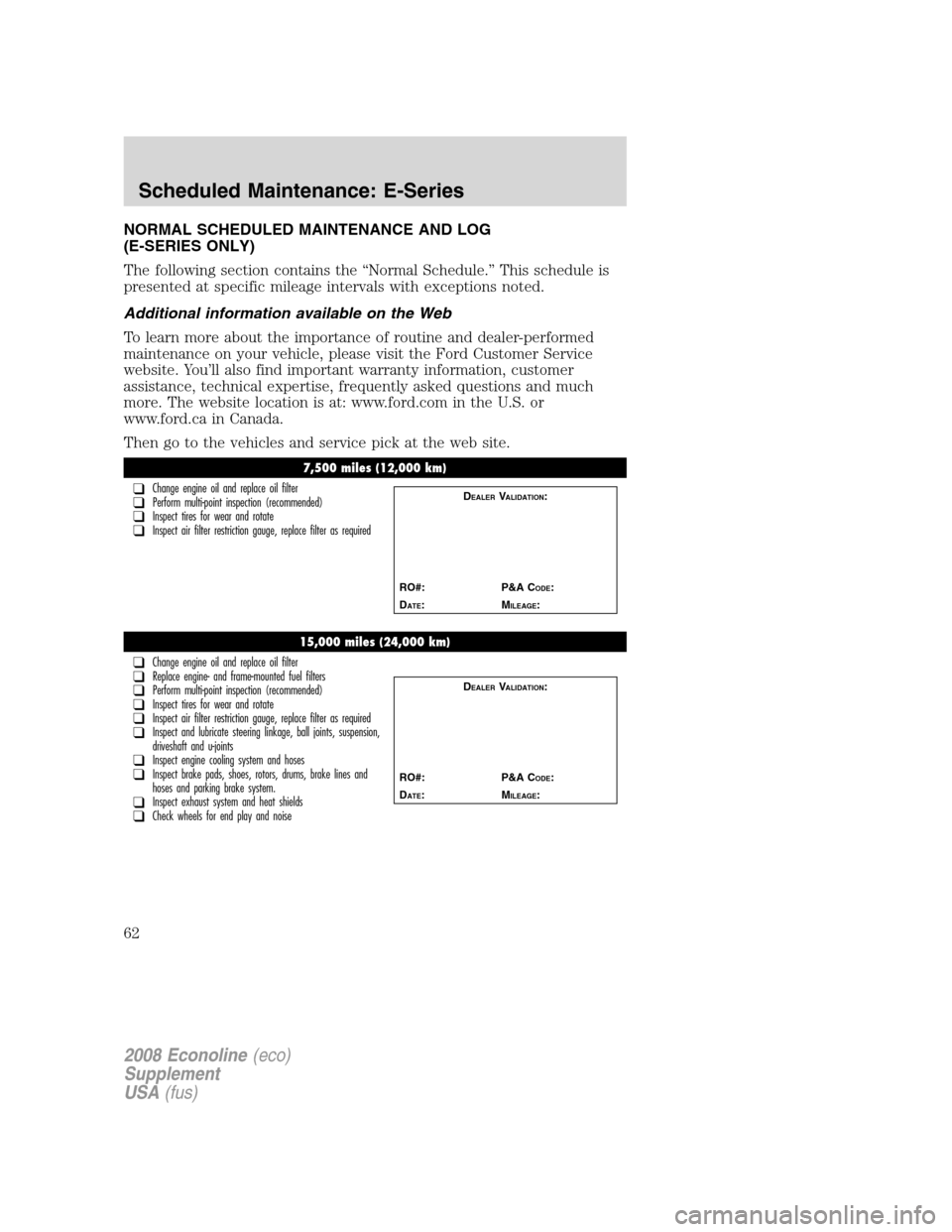
NORMAL SCHEDULED MAINTENANCE AND LOG
(E-SERIES ONLY)
The following section contains the “Normal Schedule.” This schedule is
presented at specific mileage intervals with exceptions noted.
Additional information available on the Web
To learn more about the importance of routine and dealer-performed
maintenance on your vehicle, please visit the Ford Customer Service
website. You’ll also find important warranty information, customer
assistance, technical expertise, frequently asked questions and much
more. The website location is at: www.ford.com in the U.S. or
www.ford.ca in Canada.
Then go to the vehicles and service pick at the web site.
7,500 miles (12,000 km)
❑Change engine oil and replace oil filter❑Perform multi-point inspection (recommended)❑Inspect tires for wear and rotate❑Inspect air filter restriction gauge, replace filter as required
DEALERVALIDATION:
RO#: P&A C
ODE:
D
ATE:MILEAGE:
15,000 miles (24,000 km)
❑Change engine oil and replace oil filter❑Replace engine- and frame-mounted fuel filters❑Perform multi-point inspection (recommended)❑Inspect tires for wear and rotate❑Inspect air filter restriction gauge, replace filter as required❑Inspect and lubricate steering linkage, ball joints, suspension,
driveshaft and u-joints
❑Inspect engine cooling system and hoses❑Inspect brake pads, shoes, rotors, drums, brake lines and
hoses and parking brake system.
❑Inspect exhaust system and heat shields❑Check wheels for end play and noise
DEALERVALIDATION:
RO#: P&A C
ODE:
D
ATE:MILEAGE:
2008 Econoline(eco)
Supplement
USA(fus)
Scheduled Maintenance: E-Series
62
Page 72 of 96
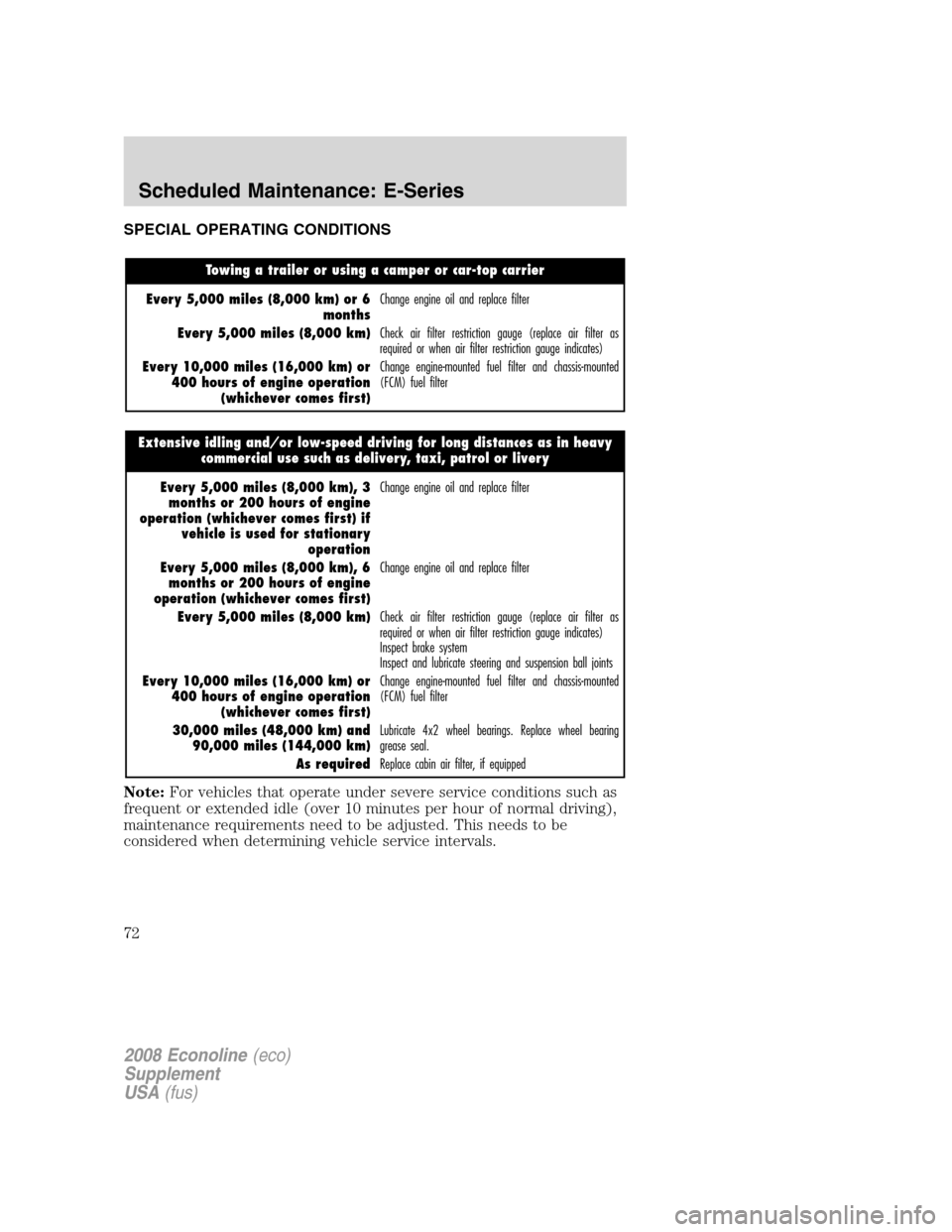
SPECIAL OPERATING CONDITIONS
Towing a trailer or using a camper or car-top carrier
Every 5,000 miles (8,000 km) or 6
monthsChange engine oil and replace filter
Every 5,000 miles (8,000 km)Check air filter restriction gauge (replace air filter as
required or when air filter restriction gauge indicates)
Every 10,000 miles (16,000 km) or
400 hours of engine operation
(whichever comes first)Change engine-mounted fuel filter and chassis-mounted
(FCM) fuel filter
Extensive idling and/or low-speed driving for long distances as in heavy
commercial use such as delivery, taxi, patrol or livery
Every 5,000 miles (8,000 km), 3
months or 200 hours of engine
operation (whichever comes first) if
vehicle is used for stationary
operationChange engine oil and replace filter
Every 5,000 miles (8,000 km), 6
months or 200 hours of engine
operation (whichever comes first)Change engine oil and replace filter
Every 5,000 miles (8,000 km)Check air filter restriction gauge (replace air filter as
required or when air filter restriction gauge indicates)
Inspect brake system
Inspect and lubricate steering and suspension ball joints
Every 10,000 miles (16,000 km) or
400 hours of engine operation
(whichever comes first)Change engine-mounted fuel filter and chassis-mounted
(FCM) fuel filter
30,000 miles (48,000 km) and
90,000 miles (144,000 km)Lubricate 4x2 wheel bearings. Replace wheel bearing
grease seal.
As requiredReplace cabin air filter, if equipped
Note:For vehicles that operate under severe service conditions such as
frequent or extended idle (over 10 minutes per hour of normal driving),
maintenance requirements need to be adjusted. This needs to be
considered when determining vehicle service intervals.
2008 Econoline(eco)
Supplement
USA(fus)
Scheduled Maintenance: E-Series
72