Page 4 of 96
•On F-Super Duty vehicles (6.4L engine),a frame-mounted
Horizontal Fuel Conditioner Module (HFCM)
•an engine-mounted secondary fuel filter
•a unit injector for each cylinder
The FCM/HFCM acts as a primary fuel filter/water separator which
removes both water and impurities from the fuel. The engine-mounted
fuel filter and the FCM/HFCM filter should be changed at the
recommended service interval. Refer to thescheduled maintenance
informationin this supplement for more information.
The FCM/HFCM should be drained at regular intervals or when the
WATER IN FUEL light illuminates in the instrument cluster (E-Series) or
when the WATER IN FUEL message appears in the message center
(F-Super Duty).
The fuel injectors are located in the center of the combustion chambers
in the cylinder head between the rocker arm assemblies. The glow plug
system and fuel injection system are controlled through the Powertrain
Control Module (PCM) and Fuel Injection Control Module (FICM) (6.0L
engine only).
Fuel is drawn from the fuel tank by a frame-mounted electric fuel pump.
The fuel pump provides pressurized fuel to the engine and is
electronically controlled by the fuel pump PCM relay. The fuel pump
contains a pressure relief valve for overpressure protection in the event
of restricted flow.
Engine protection mode
Ford diesel engines are equipped with engine protection and emission
control systems. These systems monitor critical temperatures and
pressures and modify engine operation accordingly. These features are
intended to modify engine performance characteristics. If these modified
engine performance characteristics persist for an extended period or the
Check Engine (
) or Powertrain malfunction/Reduced
power/Electronic throttle control light (
) is illuminated, seek
service from your authorized dealer.
Lubrication system
Extended oil change intervals can negatively affect engine performance,
fuel economy and engine life. Refer to the engine oil specification chart
located underEngine oil specificationsin theMaintenance and
Specificationschapter of this supplement.
2008 Econoline(eco)
Supplement
USA(fus)
Introduction
4
Page 7 of 96
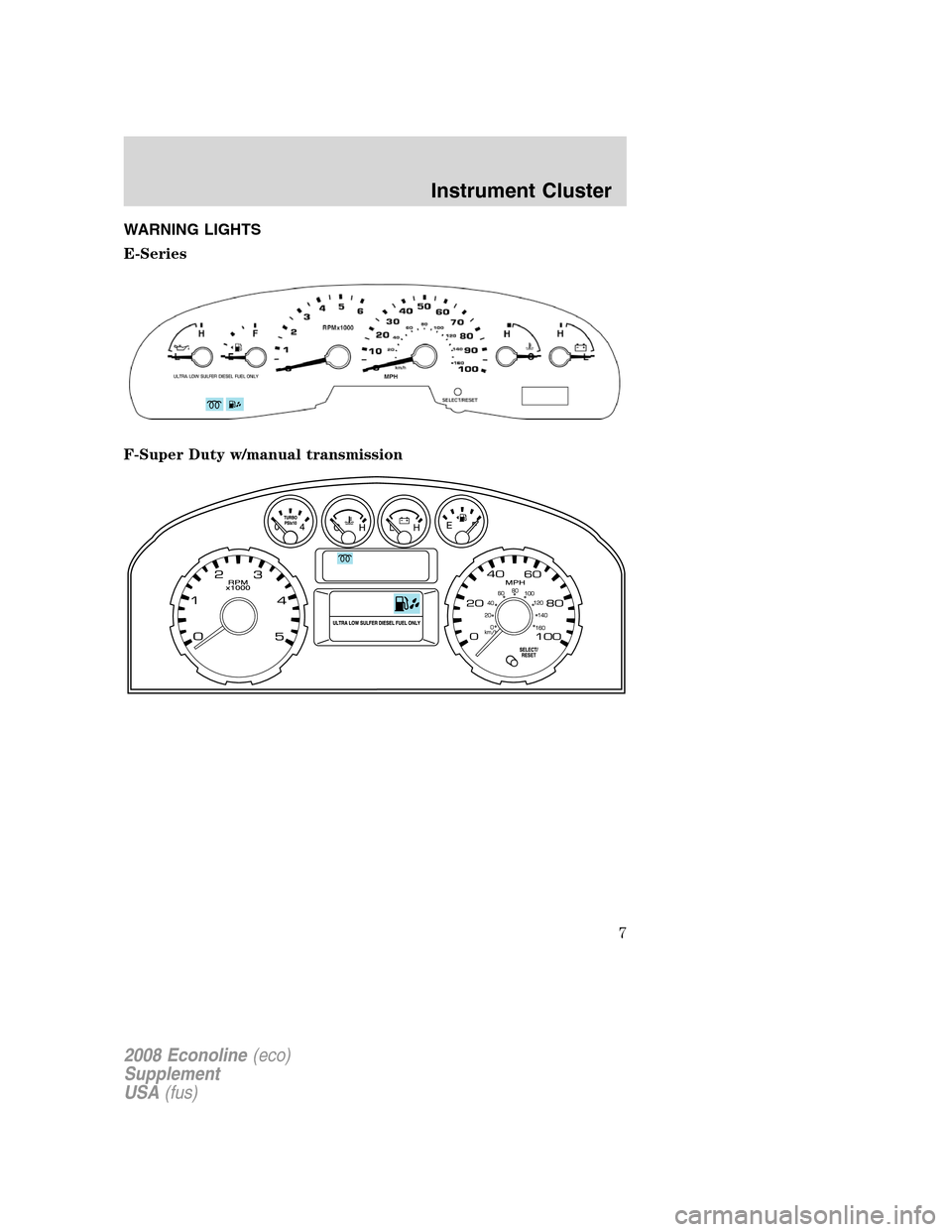
WARNING LIGHTS
E-Series
F-Super Duty w/manual transmission
2008 Econoline(eco)
Supplement
USA(fus)
Instrument Cluster
7
Page 8 of 96
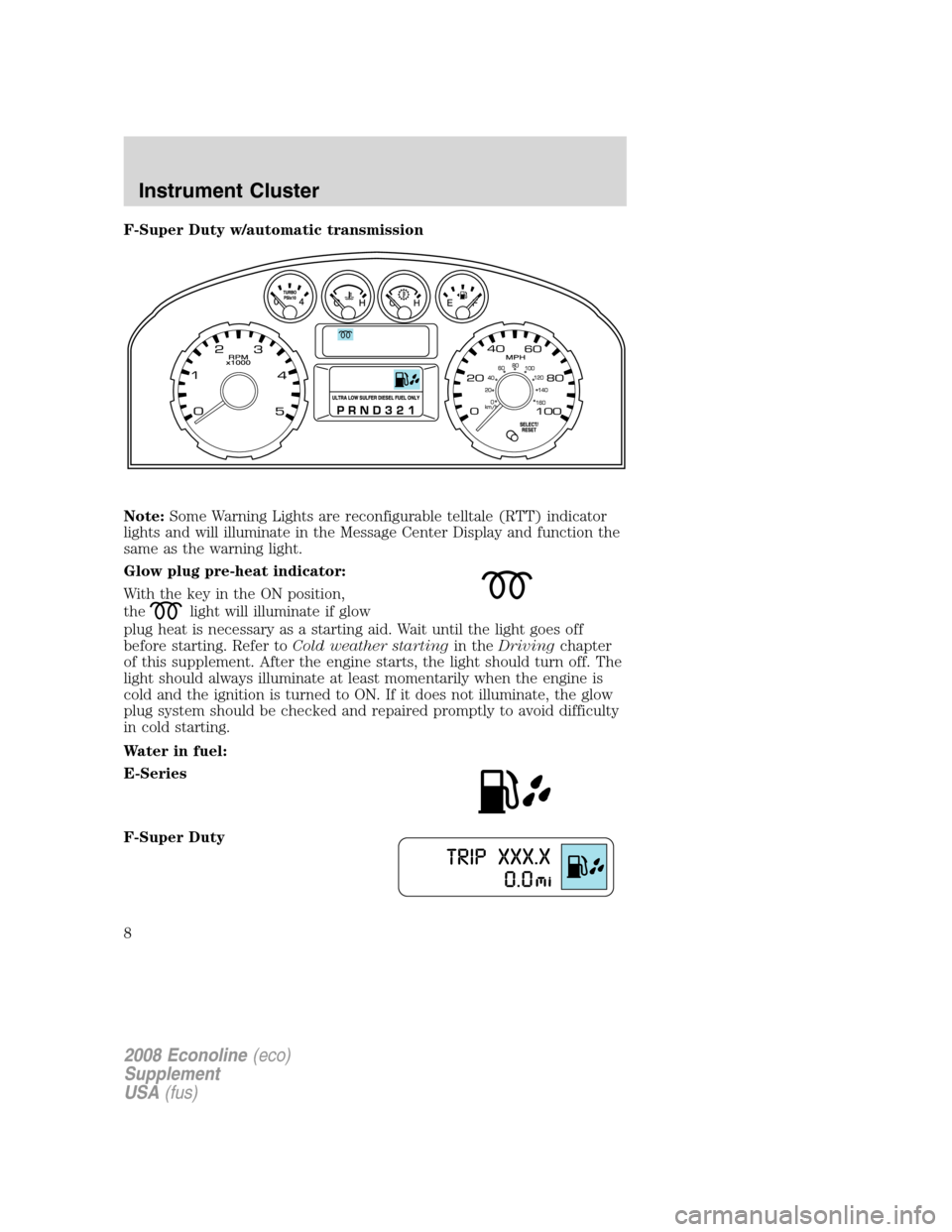
F-Super Duty w/automatic transmission
Note:Some Warning Lights are reconfigurable telltale (RTT) indicator
lights and will illuminate in the Message Center Display and function the
same as the warning light.
Glow plug pre-heat indicator:
With the key in the ON position,
the
light will illuminate if glow
plug heat is necessary as a starting aid. Wait until the light goes off
before starting. Refer toCold weather startingin theDrivingchapter
of this supplement. After the engine starts, the light should turn off. The
light should always illuminate at least momentarily when the engine is
cold and the ignition is turned to ON. If it does not illuminate, the glow
plug system should be checked and repaired promptly to avoid difficulty
in cold starting.
Water in fuel:
E-Series
F-Super Duty
2008 Econoline(eco)
Supplement
USA(fus)
Instrument Cluster
8
Page 9 of 96
During refueling, it is possible for water-contaminated diesel fuel to be
pumped into your tank. Your vehicle’s fuel system is equipped with a fuel
filter/water separator to remove water from the fuel. The WATER IN
FUEL RTT will illuminate when the ignition is turned to START (as part
of the light function check) and when the FCM/HFCM has a significant
quantity of water in it.
If the light illuminates when the engine is running, stop the vehicle as
soon as safely possible, shut off the engine, then drain the FCM/HFCM.
Refer toDraining the FCM/HFCM and changing the engine and
vehicle fuel filtersin theMaintenance and Specificationschapter of
this supplement for the drain procedure. Allowing water to stay in the
system could result in extensive damage to, or failure of, the fuel
injection system.
Do not drain the water separator while the engine is running.
Fuel may ignite if the separator is drained while the engine is
running or the vehicle is moving.
Engine oil pressure (F-Super
Duty only):
Illuminates when the oil pressure
falls below the normal range. Refer
toEngine oilin theMaintenance
and Specificationschapter for more information.
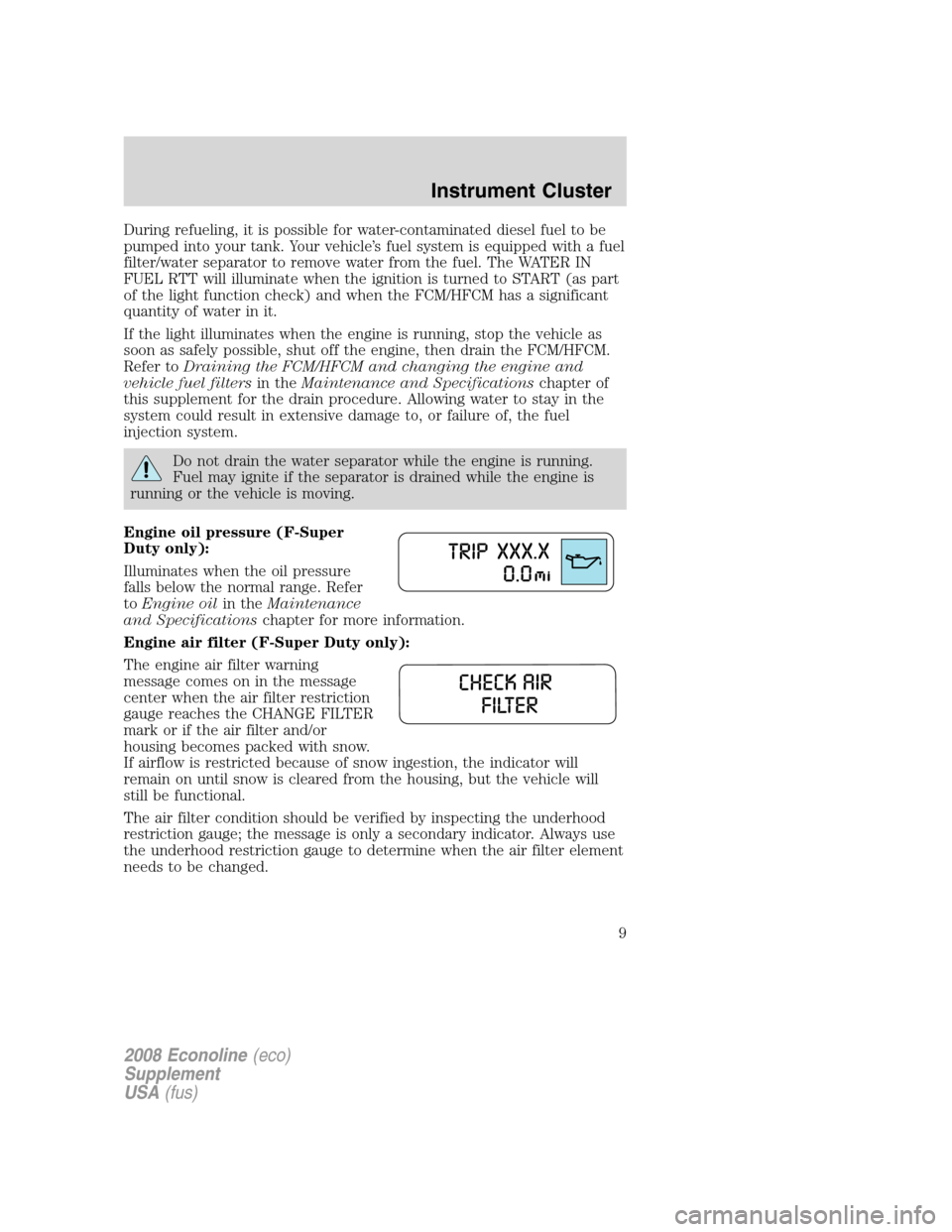
Engine air filter (F-Super Duty only):
The engine air filter warning
message comes on in the message
center when the air filter restriction
gauge reaches the CHANGE FILTER
mark or if the air filter and/or
housing becomes packed with snow.
If airflow is restricted because of snow ingestion, the indicator will
remain on until snow is cleared from the housing, but the vehicle will
still be functional.
The air filter condition should be verified by inspecting the underhood
restriction gauge; the message is only a secondary indicator. Always use
the underhood restriction gauge to determine when the air filter element
needs to be changed.
2008 Econoline(eco)
Supplement
USA(fus)
Instrument Cluster
9
Page 12 of 96
Do not use starting fluid, such as ether, in the air intake system
(see air filter decal). Such fluid could cause immediate explosive
damage to the engine and possible personal injury.
Do not add gasoline, gasohol or alcohol to diesel fuel. This
practice creates a serious fire hazard and causes engine
performance problems.
1. Turn the key to ON without turning the key to START.Do not start
the engineuntil the glow-plug pre-heat indicator
turns off.
2. When the glow plug pre-heat
indicator turns off, turn the key to
START, then release the key as soon
as the engine starts. The glow plugs
will continue to be activated for two minutes after the glow plug pre-heat
indicator
has turned off. If the engine is not started before the
glow plug activation time ends, the glow plugs will need to be reset by
turning the key to OFF.
3. After the engine starts, allow it to idle for about 15 seconds. Do not
increase engine speed until the oil pressure gauge indicates normal
pressure.
STOPPING THE ENGINE
Turn the ignition to 3 (OFF).
On E-Series vehicles:To prolong engine life (after extended high
speed or maximum GVW operation), it is recommended that a hot engine
be allowed to operate at low idle for about 7–10 minutes which would
allow sufficient time for the turbocharged engine to cool down.
On F-Super Duty vehicles:To prolong engine life (especially after
extended high speed, high ambient temperature, or high GVW/GCW
operation), it is recommended that a hot engine be idled for 3-5 minutes
which will allow the turbocharged engine to cool down.
COLD WEATHER OPERATION
Changing to a lighter grade engine oil also makes starting easier under
these conditions. Refer toEngine oil specificationsin theMaintenance
and Specificationschapter of this supplement.
At temperatures below 20°F (–7°C), Number 2–D diesel fuel may thicken
enough to clog the fuel filter. Your vehicle is equipped with either an
2008 Econoline(eco)
Supplement
USA(fus)
Driving
12
Page 20 of 96
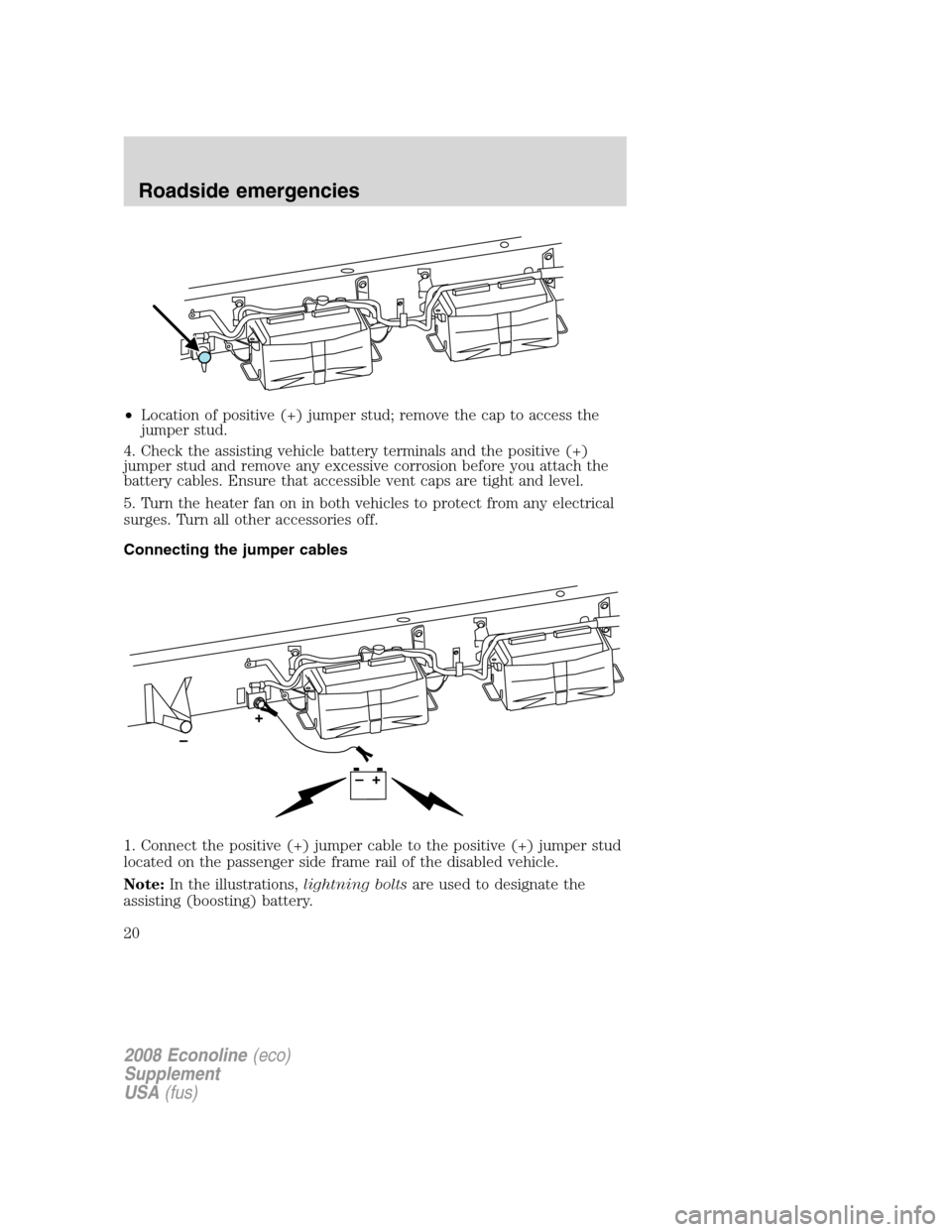
•Location of positive (+) jumper stud; remove the cap to access the
jumper stud.
4. Check the assisting vehicle battery terminals and the positive (+)
jumper stud and remove any excessive corrosion before you attach the
battery cables. Ensure that accessible vent caps are tight and level.
5. Turn the heater fan on in both vehicles to protect from any electrical
surges. Turn all other accessories off.
Connecting the jumper cables
1. Connect the positive (+) jumper cable to the positive (+) jumper stud
located on the passenger side frame rail of the disabled vehicle.
Note:In the illustrations,lightning boltsare used to designate the
assisting (boosting) battery.
2008 Econoline(eco)
Supplement
USA(fus)
Roadside emergencies
20
Page 23 of 96
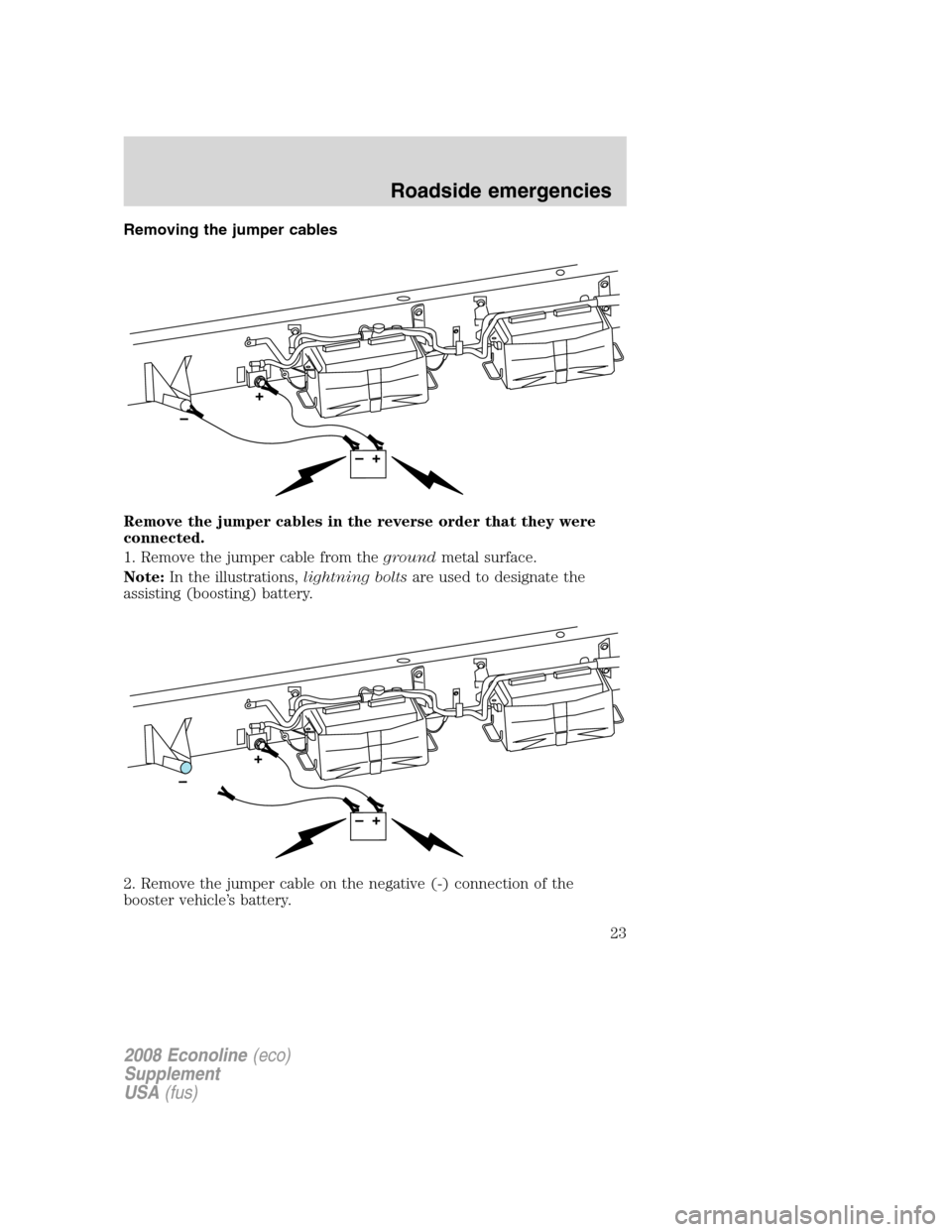
Removing the jumper cables
Remove the jumper cables in the reverse order that they were
connected.
1. Remove the jumper cable from thegroundmetal surface.
Note:In the illustrations,lightning boltsare used to designate the
assisting (boosting) battery.
2. Remove the jumper cable on the negative (-) connection of the
booster vehicle’s battery.
2008 Econoline(eco)
Supplement
USA(fus)
Roadside emergencies
23
Page 25 of 96
ENGINE
Engines are more efficient when they are clean because grease and dirt
buildup keep the engine warmer than normal. When washing:
•Take care when using a power washer to clean the engine. The
high-pressure fluid could penetrate the sealed parts and cause
damage.
•Do not spray a hot engine with cold water to avoid cracking the
engine block or other engine components.
•Spray Motorcraft Engine Shampoo and Degreaser (ZC-20) on all parts
that require cleaning and pressure rinse clean.
•Never wash or rinse the engine while it is running; water in the
running engine may cause internal damage.
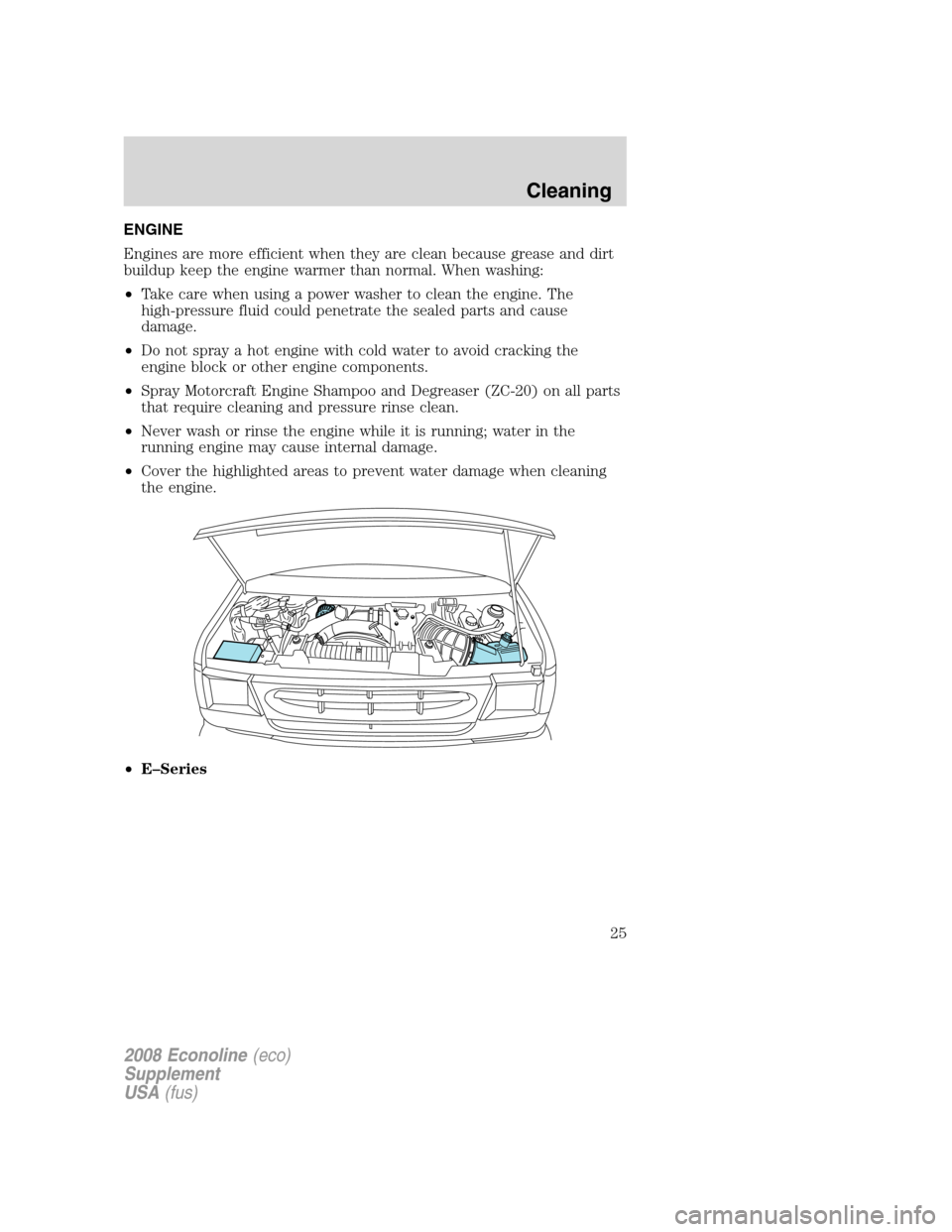
•Cover the highlighted areas to prevent water damage when cleaning
the engine.
•E–Series
2008 Econoline(eco)
Supplement
USA(fus)
Cleaning
25