2008 FORD SUPER DUTY check engine
[x] Cancel search: check enginePage 39 of 96
On E-Series vehicles:After replacing the fuel filter, the engine will
purge the trapped air as it runs. The engine may run roughly and smoke
until the air is completely eliminated.
On F-Super Duty vehicles:Turn the ignition key to ON for 30 seconds,
then turn it to OFF. Do this a total of six times in a row to purge any
trapped air from the fuel system.
Using a fuel which has more than average impurities may require
the fuel filter to be replaced more frequently than the service
interval specifies.
ENGINE OIL
Checking the engine oil level
Because it is normal to add some oil between oil changes, check your
engine oil level each time you stop for fuel. To check the engine oil level
consistently and accurately, the following procedure is recommended:
1. Have engine at normal operating temperature (at least into the
NORMAL range on the engine coolant temperature gauge).
2. Park the vehicle on a level surface, then turn off the engine and open
the hood.
3. Allow at least20 minutesafter engine shutdown to ensure that the
oil contained in the upper parts of the engine has returned to the oil
pan.
4. Protecting yourself from engine heat, pull out the dipstick, wipe it
clean and reinsert fully.
5. Read oil level on both sides of dipstick and use highest level (reading)
for the actual engine oil level.
6. Maintain the oil level between MIN and MAX or the ADD and
OPERATING RANGE on the dipstick by adding oil as required. The
distance from MIN to MAX or ADD to OPERATING RANGE on the
dipstick represents 2.0 quarts (1.9L). Do not overfill. If the oil level
exceeds MAX or OPERATING RANGE, oil consumption may result.
Engine oil specifications
To help achieve acceptable engine performance and durability, it is
important that only engine oils of good quality are used in your diesel
engine and it is changed at the recommended interval. For normal or
severe service, use Motorcraft oil or an equivalent oil conforming to Ford
specification WSS-M2C171–E or API service categories CJ-4 or CJ-4/SM.
2008 Econoline(eco)
Supplement
USA(fus)
Maintenance and Specifications
39
Page 43 of 96
AIR FILTER RESTRICTION GAUGE AND AIR FILTER
REPLACEMENT
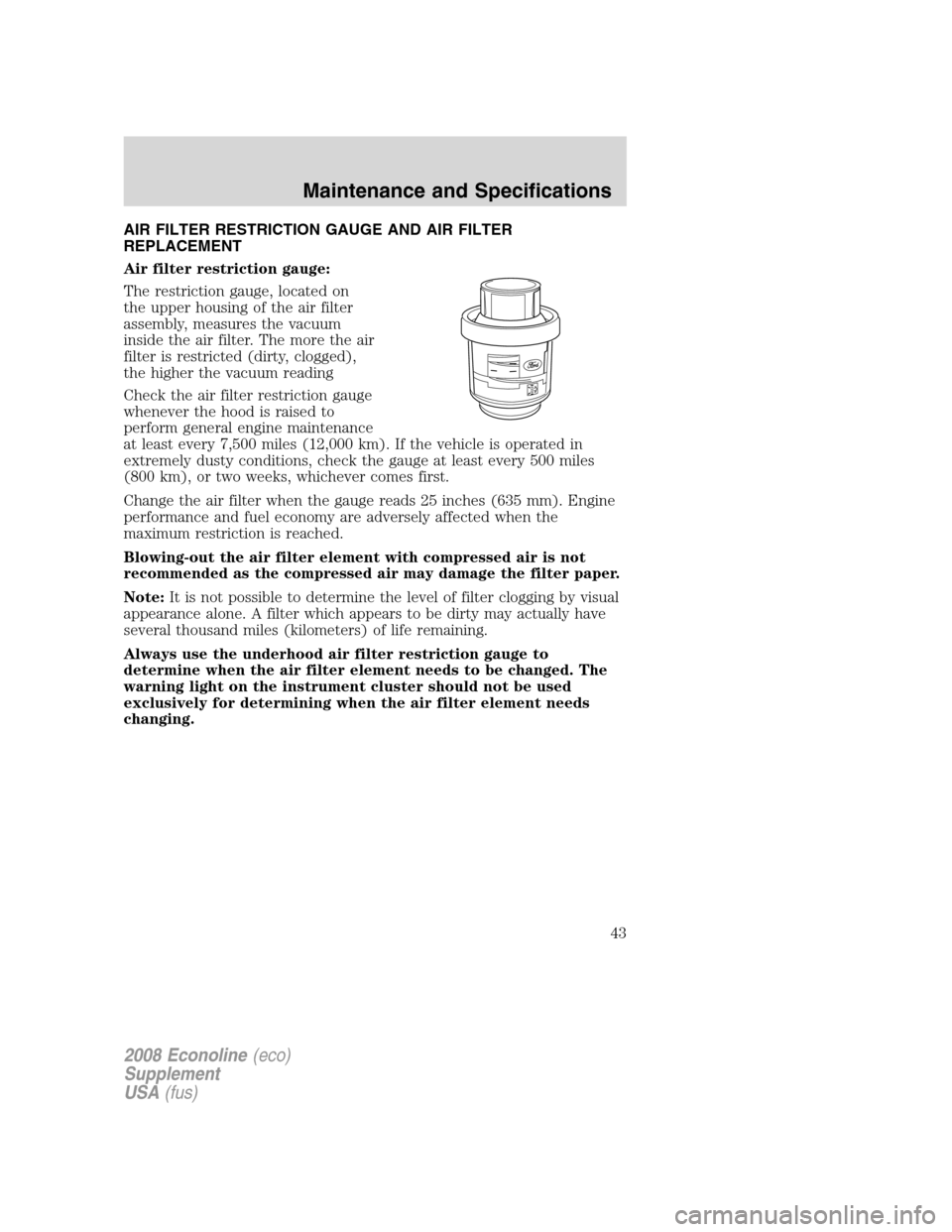
Air filter restriction gauge:
The restriction gauge, located on
the upper housing of the air filter
assembly, measures the vacuum
inside the air filter. The more the air
filter is restricted (dirty, clogged),
the higher the vacuum reading
Check the air filter restriction gauge
whenever the hood is raised to
perform general engine maintenance
at least every 7,500 miles (12,000 km). If the vehicle is operated in
extremely dusty conditions, check the gauge at least every 500 miles
(800 km), or two weeks, whichever comes first.
Change the air filter when the gauge reads 25 inches (635 mm). Engine
performance and fuel economy are adversely affected when the
maximum restriction is reached.
Blowing-out the air filter element with compressed air is not
recommended as the compressed air may damage the filter paper.
Note:It is not possible to determine the level of filter clogging by visual
appearance alone. A filter which appears to be dirty may actually have
several thousand miles (kilometers) of life remaining.
Always use the underhood air filter restriction gauge to
determine when the air filter element needs to be changed. The
warning light on the instrument cluster should not be used
exclusively for determining when the air filter element needs
changing.
2008 Econoline(eco)
Supplement
USA(fus)
Maintenance and Specifications
43
Page 46 of 96
•F-Super Duty air filter:
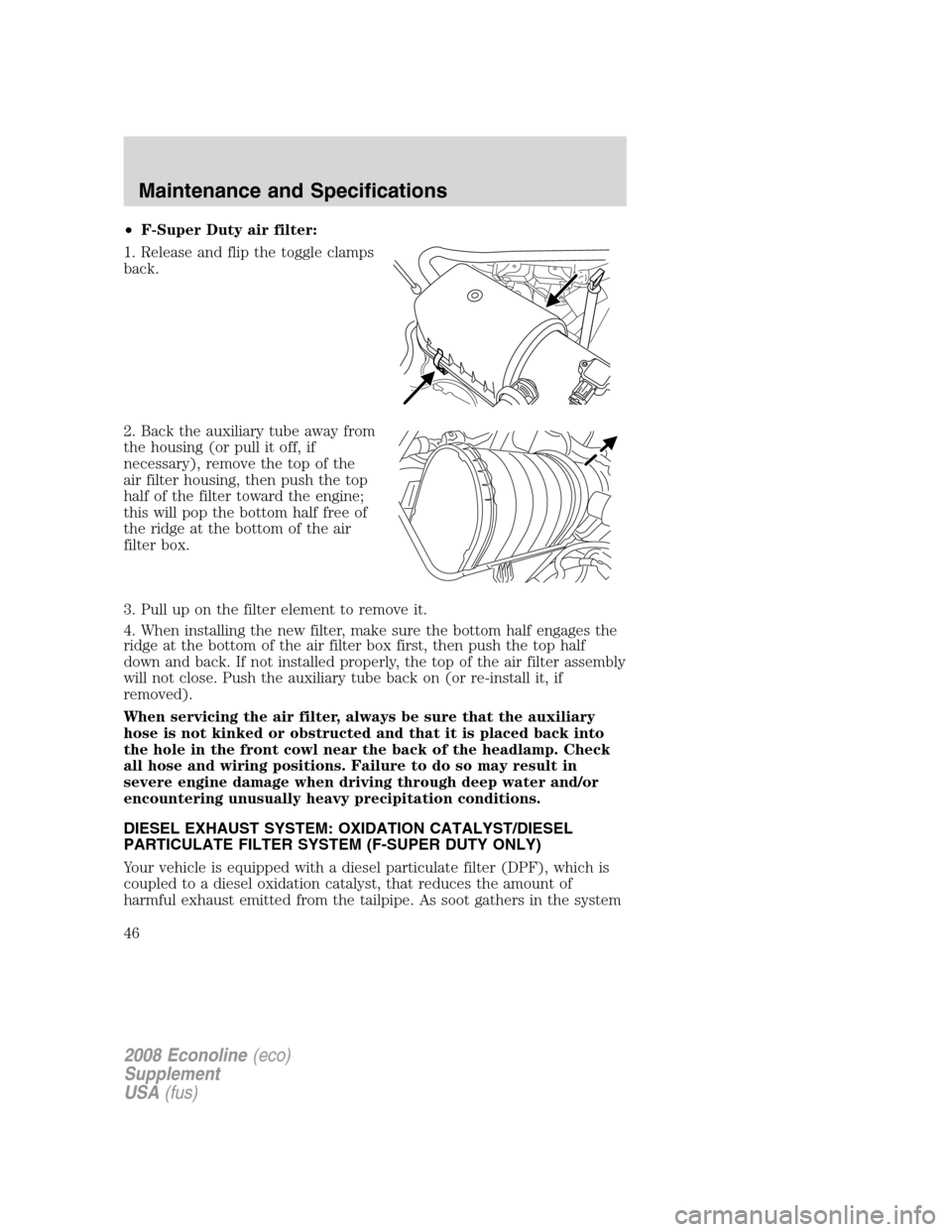
1. Release and flip the toggle clamps
back.
2. Back the auxiliary tube away from
the housing (or pull it off, if
necessary), remove the top of the
air filter housing, then push the top
half of the filter toward the engine;
this will pop the bottom half free of
the ridge at the bottom of the air
filter box.
3. Pull up on the filter element to remove it.
4. When installing the new filter, make sure the bottom half engages the
ridge at the bottom of the air filter box first, then push the top half
down and back. If not installed properly, the top of the air filter assembly
will not close. Push the auxiliary tube back on (or re-install it, if
removed).
When servicing the air filter, always be sure that the auxiliary
hose is not kinked or obstructed and that it is placed back into
the hole in the front cowl near the back of the headlamp. Check
all hose and wiring positions. Failure to do so may result in
severe engine damage when driving through deep water and/or
encountering unusually heavy precipitation conditions.
DIESEL EXHAUST SYSTEM: OXIDATION CATALYST/DIESEL
PARTICULATE FILTER SYSTEM (F-SUPER DUTY ONLY)
Your vehicle is equipped with a diesel particulate filter (DPF), which is
coupled to a diesel oxidation catalyst, that reduces the amount of
harmful exhaust emitted from the tailpipe. As soot gathers in the system
2008 Econoline(eco)
Supplement
USA(fus)
Maintenance and Specifications
46
Page 50 of 96
The complexity of the diesel engine makes it so the owner is discouraged
from attempting to perform maintenance other than the services
described in this supplement.
If you experience difficult starting, rough idling, excessive exhaust
smoke, a decrease in engine performance or excess fuel consumption,
perform the following checks:
•a plugged air inlet system or engine air filter element.
•water in the fuel filter/water separator.
•a clogged fuel filter.
•contaminated fuel.
•air in the fuel system, due to loose connections.
•an open or pinched sensor hose.
•low engine oil level.
•wrong fuel or oil viscosity for climactic conditions.
If these checks do not help you correct the engine performance problem
you are experiencing, consult an authorized dealer.
FUELING
Do not use starting fluid such as ether or gasoline in the diesel
air intake system. Such fluids can cause immediate explosive
damage to the engine and possible personal injury.
If you fuel your vehicle at a truck stop, you may notice that the fuel
nozzle may shut off every 5–10 seconds. This is due to the flow rates
being designed for larger heavy duty trucks. You may have to fuel at a
slower rate (don’t depress the nozzle trigger fully).
Do not run your diesel vehicle out of fuel as this will allow air to enter
the fuel system which will make restarting difficult. The engine is
designed to run roughly as the fuel tank nears Empty. This is a warning
to the driver to add fuel as soon as possible. Longer engine cranking
time may be required once air is in the fuel system. If air enters the fuel
system (either through running the fuel tank(s) empty or during a fuel
filter change), the engine will self-purge the trapped air once it starts
running. The engine may run roughly and produce white smoke while air
is in the fuel system; this is normal and should stop after a short time.
2008 Econoline(eco)
Supplement
USA(fus)
Maintenance and Specifications
50
Page 51 of 96
MINOR TROUBLESHOOTING GUIDE
Air purge procedure
Turn the key on for 30 seconds, then turn off. Repeat procedure four or
five times.
If the engine won’t crank
Turn on the headlights. If the lights are dim, do not go on at all or when
the ignition is turned to START the lights become dim or go out, the
battery connections may be loose or corroded, or the battery may be
discharged. If there is a clicking or stuttering sound coming from the
engine compartment when you turn the key to START, this may also
indicate a loose or corroded battery connection.
Check the battery connections at the battery posts, cable connection to
the engine grounding point and at the starter connection.
If a discharged battery is suspected, have it checked and corrected.
Battery posts, terminals and related accessories contain lead and
lead compounds.Wash hands after handling.
•For vehicles with manual transmissions,the clutch pedalmustbe
fully depressed in order for the starter to operate.
•For vehicles with automatic transmissions,the gearshift lever
must be in P (Park) or N (Neutral) in order for the starter to operate.
•Try operating the starter switch several times. Should the switch be
corroded, this operation may clean the contacts or make the switch
temporarily operable until you can reach the dealer.
•If all electrical connections are tight and you need assistance to start,
refer toJump startingin theRoadside Emergencieschapter of your
Owner’s Guide(F-Super Duty) or refer to theJump startingsection
in theRoadside Emergencieschapter of this supplement (E-Series).
If engine cranks but won’t start
Prolonged starter cranking (in excess of 30 seconds) could cause
damage to the starter motor.
•Check the fuel gauge. You may be out of fuel. If the gauge shows that
there is fuel in the tank, the trouble may be in the electrical system or
the fuel system. If equipped with an auxiliary tank, be sure that the
tank control switch is set for the tank with fuel and not on an empty
tank.
2008 Econoline(eco)
Supplement
USA(fus)
Maintenance and Specifications
51
Page 52 of 96
•Leaving the ignition key turned to ON for over two minutes without
starting may make starting difficult because the glow plugs will cease
activation. Reset the system by turning the ignition key to OFF and
then back to ON again.
If the engine runs hot
The following could cause the engine to overheat:
•Lack of coolant.
•Dirty cooling system.
•Plugged radiator fins, charge air cooler, A/C condenser and/or oil
cooler.
•Driving with frozen coolant.
•Sticking thermostat.
•Overloading or pulling heavy trailers during hot weather.
•Grill or radiator air blockage.
•Slipping or missing drive belt.
•Plugged or very dirty air filter.
If fuses burn out
Burned-out or blown fuses usually indicate an electrical short-circuit,
although a fuse may occasionally burn out from vibration. Insert a second
fuse. If this fuse immediately burns out and you cannot locate the cause,
return your vehicle to your dealer for a circuit check.
Replacement fuses and circuit breakers must always be the same
rating as the original equipment shown. Never replace a fuse or
circuit breaker with one of a higher rating. Higher rated fuses or circuit
breakers could allow circuit overloading in the event of a circuit
malfunction, resulting in severe vehicle damage or personal injury due
to fire.
Refer to theOwner’s Guidefor replacement of fuses.
2008 Econoline(eco)
Supplement
USA(fus)
Maintenance and Specifications
52
Page 57 of 96
Engine Emissions label
Emissions information appears on the Engine Emissions label on the
engine valve cover. This decal identifies engine displacement and
provides certain engine specifications.
Any modification of the emissions control system could create liability
under federal law (U.S.) if made prior to sale and registration, under the
laws of some states if made thereafter. Further, federal law prohibits
vehicle manufacturers, dealers and other persons engaged in the
business of repairing, servicing, selling, leasing or trading motor vehicles
as well as fleet operations from knowingly removing or rendering an
emissions control system inoperative after sale and delivery to an
ultimate purchaser. In Canada, modifications of the emissions control
system could create liability under applicable federal or provincial laws.
Genuine Ford Parts and Service
When planning your maintenance services, consider your Ford and
Lincoln Mercury dealership for all your vehicle’s needs.
Get the most from your service and maintenance visits
There are a lot of reasons why your Ford and Lincoln Mercury dealership
is a great way to help keep your vehicle running great.
Convenience
To make your service visit even more convenient, in many cases, you’ll
find extended evening hours and Saturday hours. How’s that for quality
service?
Factory-trained Technicians
Ford and Lincoln Mercury service technicians participate in extensive
factory-sponsored training to help them become the experts on the
operation of your vehicle. Many participate in Ford-sponsored training to
become certified. Ask your dealer about the training and certification
their technicians have received.
Factory Authorized Systems Checks
In the event that your vehicle experiences a component related concern,
please contact your Ford or Lincoln Mercury dealership. The Ford Motor
Company Trained Technicians who work at Ford or Lincoln Mercury
dealerships are specifically trained to understand your vehicle.
A proper repair begins with a thorough system check. A Factory
Authorized Systems Check can ONLY be found at a Ford or Lincoln
Mercury dealership. In some circumstances, the technician may need to
2008 Econoline(eco)
Supplement
USA(fus)
Scheduled Maintenance: General Information
57
Page 58 of 96
request your authorization to perform additional operations to determine
the final diagnosis. The technician’s goal is to ensure that your vehicle is
fixed right the first time, at the best value to you.
The following list represents several of the Factory Authorized Systems
Checks available at participating Ford or Lincoln Mercury dealers:
•Air Conditioning
•Check Engine Light
•All Wheel Drive and4X4
•Automatic Transmission
•Engine Cooling and Cabin Heating
•Steering and Suspension
•Charge/Start/Battery
•Wheel Alignment
•Anti-Lock Brake System
Genuine Ford and Motorcraft Replacement Parts
Ford and Lincoln Mercury dealerships stock Ford and Motorcraft
branded replacement parts. These parts meet or exceed Ford Motor
Company’s specifications, and we stand behind them. Maintenance parts
installed at your Ford or Lincoln Mercury dealership carry a nationwide,
12 months, 12,000 mile (20,000 km) parts and labor limited warranty.
Your dealer can give you details.
Value Shopping for Your Vehicle’s Maintenance Needs
Your dealership recognizes the competitive landscape of maintenance and
light repair automotive services. With factory-trained technicians, and
one-stop service from routine maintenance like oil changes and tire
rotations to repairs like brake service, check out the value your Ford and
Lincoln Mercury dealers can offer.
2008 Econoline(eco)
Supplement
USA(fus)
Scheduled Maintenance: General Information
58