Page 5 of 96
On E-Series vehicles (6.0L engine),it is important to change the
engine oil at the recommended service intervals, because oil viscosity is
important in maintaining the oil pressure required to actuate the fuel
injectors.
On F-Super Duty vehicles (6.4L engine),it is important to change
the engine oil at the recommended service intervals to maintain oil
viscosity with the addition of the Diesel Particulate Filter (DPF)
Fast start glow plug system
The glow plug system consists of:
•eight glow plugs
•the glow plug control module (GPCM)
•engine oil temperature (EOT) sensor
•barometric pressure (BARO) sensor
The glow plug system is
electronically controlled by the
PCM. The GPCM energizes the glow
plugs immediately after the ignition
is placed in the ON position, then determines how long the glow plugs
will be on according to the EOT and BARO sensors. The required time
for the glow plugs to be energized decreases as the engine oil
temperature and barometric pressure increase.
Engine cooling system
The engine cooling system contains an engine oil cooler which is
mounted in the center valley of the engine. The cooler’s function is to
regulate engine oil temperature.
Fuel and turbocharger cooling system (F-Super Duty only)
The fuel and turbocharger cooling system contains a cooler which is
mounted on the turbo interstage U-tube on the left side of the engine.
The cooler’s function is to regulate engine fuel temperature and cool the
electronics that support the turbocharger. You may hear the auxiliary
coolant pump running up to 10 minutes after the ignition is turned OFF
in hot weather or if you are towing heavy loads. This is to control the
temperature of the turbocharger.
2008 Econoline(eco)
Supplement
USA(fus)
Introduction
5
Page 45 of 96
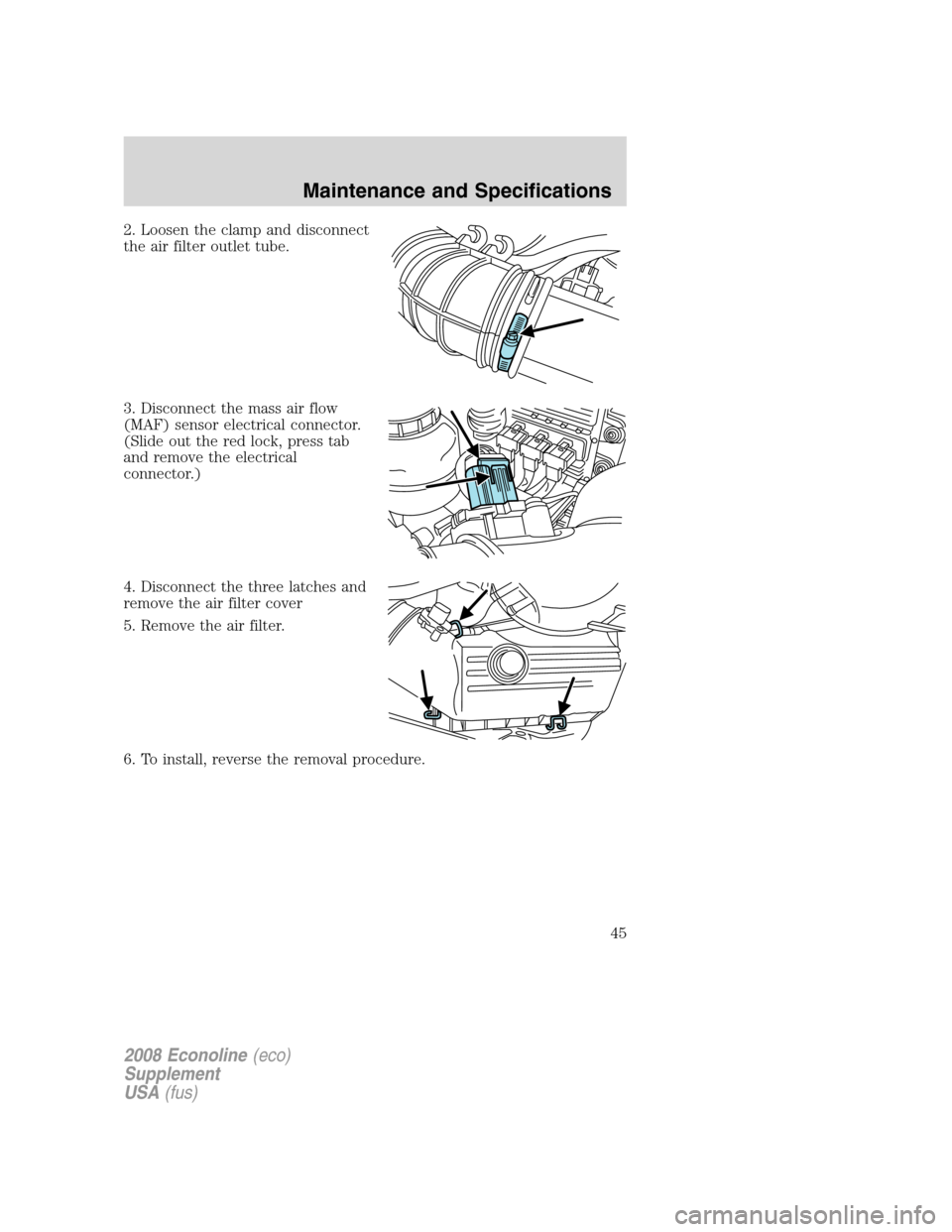
2. Loosen the clamp and disconnect
the air filter outlet tube.
3. Disconnect the mass air flow
(MAF) sensor electrical connector.
(Slide out the red lock, press tab
and remove the electrical
connector.)
4. Disconnect the three latches and
remove the air filter cover
5. Remove the air filter.
6. To install, reverse the removal procedure.
2008 Econoline(eco)
Supplement
USA(fus)
Maintenance and Specifications
45
Page 50 of 96
The complexity of the diesel engine makes it so the owner is discouraged
from attempting to perform maintenance other than the services
described in this supplement.
If you experience difficult starting, rough idling, excessive exhaust
smoke, a decrease in engine performance or excess fuel consumption,
perform the following checks:
•a plugged air inlet system or engine air filter element.
•water in the fuel filter/water separator.
•a clogged fuel filter.
•contaminated fuel.
•air in the fuel system, due to loose connections.
•an open or pinched sensor hose.
•low engine oil level.
•wrong fuel or oil viscosity for climactic conditions.
If these checks do not help you correct the engine performance problem
you are experiencing, consult an authorized dealer.
FUELING
Do not use starting fluid such as ether or gasoline in the diesel
air intake system. Such fluids can cause immediate explosive
damage to the engine and possible personal injury.
If you fuel your vehicle at a truck stop, you may notice that the fuel
nozzle may shut off every 5–10 seconds. This is due to the flow rates
being designed for larger heavy duty trucks. You may have to fuel at a
slower rate (don’t depress the nozzle trigger fully).
Do not run your diesel vehicle out of fuel as this will allow air to enter
the fuel system which will make restarting difficult. The engine is
designed to run roughly as the fuel tank nears Empty. This is a warning
to the driver to add fuel as soon as possible. Longer engine cranking
time may be required once air is in the fuel system. If air enters the fuel
system (either through running the fuel tank(s) empty or during a fuel
filter change), the engine will self-purge the trapped air once it starts
running. The engine may run roughly and produce white smoke while air
is in the fuel system; this is normal and should stop after a short time.
2008 Econoline(eco)
Supplement
USA(fus)
Maintenance and Specifications
50