2008 FORD F150 tow
[x] Cancel search: towPage 264 of 400
•Finally, have the engine block heater system checked during your fall
tune-up to be sure it’s in good working order.
How to use the engine block heater
Ensure the receptacle terminals are clean and dry prior to use. To clean
them, use a dry cloth.
Depending on the type of factory installed equipment, your engine block
heater system may consume anywhere between 400 watts or 1000 watts
of energy per hour. Your factory installed block heater system does not
have a thermostat; however, maximum temperature is attained after
approximately 3 hours of operation. Block heater operation longer than
3 hours will not improve system performance and will unnecessarily use
additional electricity.
Make sure system is unplugged and properly stowed before driving the
vehicle. While not in use, make sure the protective cover seals the
prongs of the engine block heater cord plug.
BRAKES
Occasional brake noise is normal. If a metal-to-metal, continuous grinding
or continuous squeal sound is present, the brake linings may be worn-out
and should be inspected by an authorized dealer. If the vehicle has
continuous vibration or shudder in the steering wheel while braking, the
vehicle should be inspected by an authorized dealer.
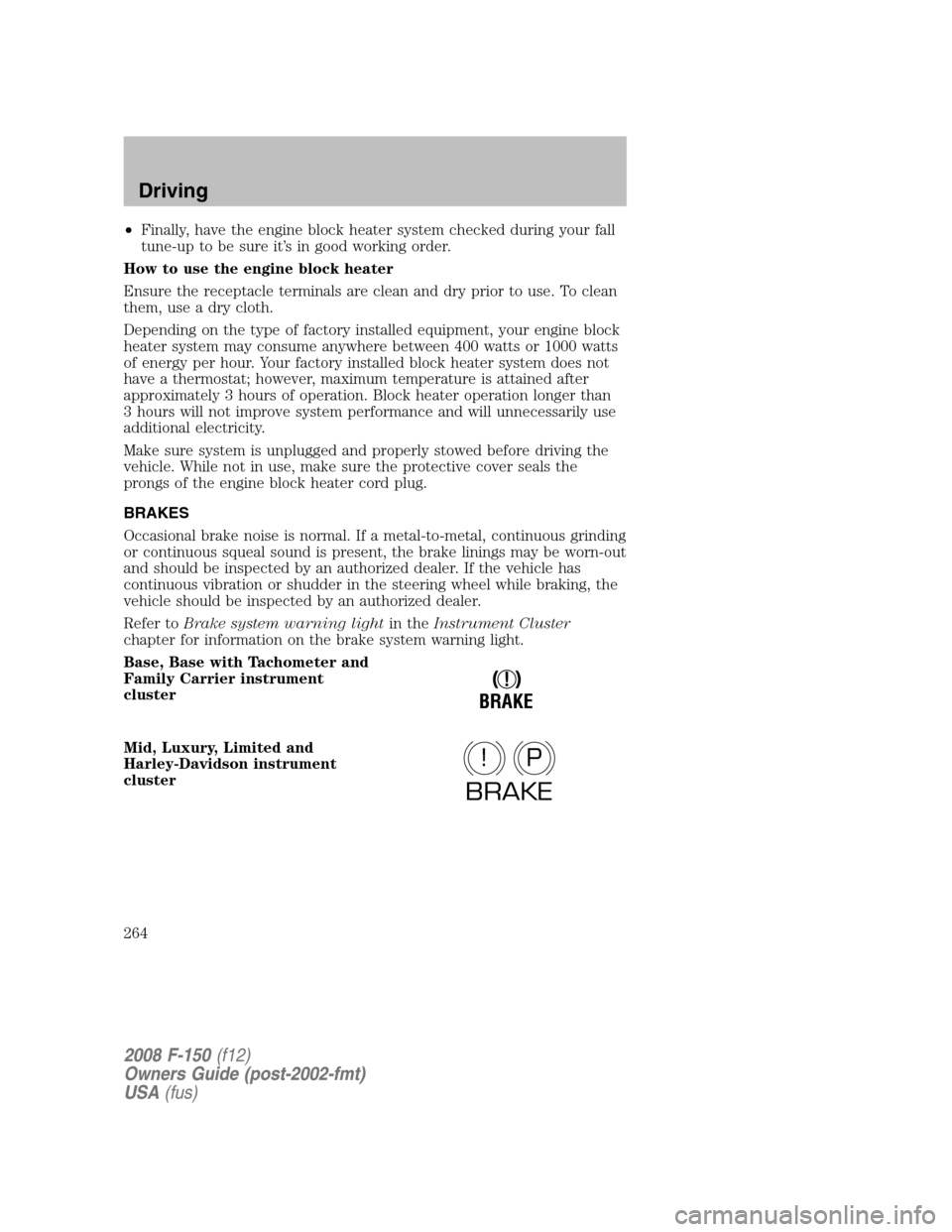
Refer toBrake system warning lightin theInstrument Cluster
chapter for information on the brake system warning light.
Base, Base with Tachometer and
Family Carrier instrument
cluster
Mid, Luxury, Limited and
Harley-Davidson instrument
cluster
!
BRAKE
P!
BRAKE
2008 F-150(f12)
Owners Guide (post-2002-fmt)
USA(fus)
Driving
264
Page 274 of 400
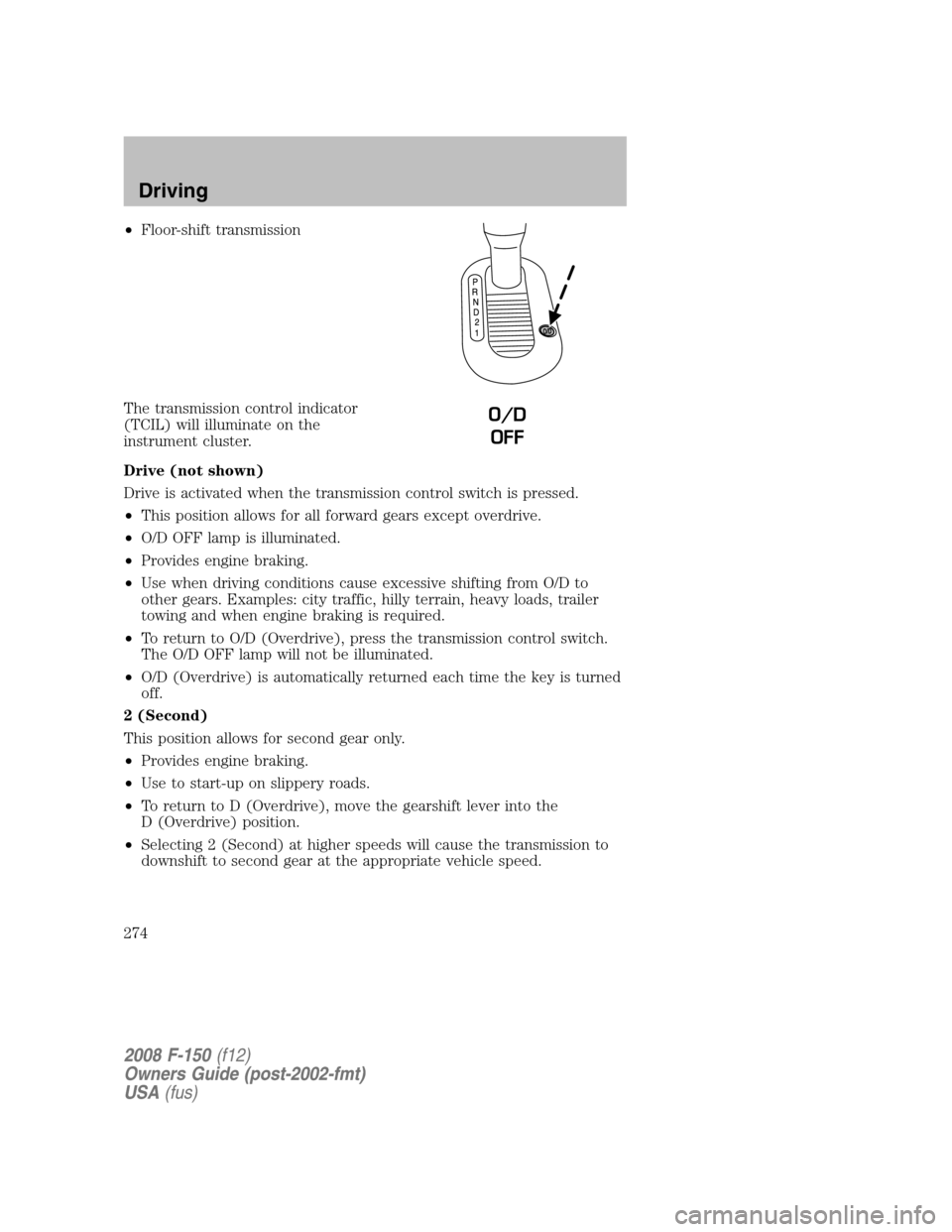
•Floor-shift transmission
The transmission control indicator
(TCIL) will illuminate on the
instrument cluster.
Drive (not shown)
Drive is activated when the transmission control switch is pressed.
•This position allows for all forward gears except overdrive.
•O/D OFF lamp is illuminated.
•Provides engine braking.
•Use when driving conditions cause excessive shifting from O/D to
other gears. Examples: city traffic, hilly terrain, heavy loads, trailer
towing and when engine braking is required.
•To return to O/D (Overdrive), press the transmission control switch.
The O/D OFF lamp will not be illuminated.
•O/D (Overdrive) is automatically returned each time the key is turned
off.
2 (Second)
This position allows for second gear only.
•Provides engine braking.
•Use to start-up on slippery roads.
•To return to D (Overdrive), move the gearshift lever into the
D (Overdrive) position.
•Selecting 2 (Second) at higher speeds will cause the transmission to
downshift to second gear at the appropriate vehicle speed.
O/D
OFF
2008 F-150(f12)
Owners Guide (post-2002-fmt)
USA(fus)
Driving
274
Page 281 of 400
Use the side mirrors and rear view mirror to get better coverage on both
sides and rear of the vehicle. When shifting out of reverse and into any
other gear, the image will remain on for a few seconds before it shuts off
to assist in parking or trailer hookup.
When towing, the reverse camera system will only see what is being
towed behind the vehicle; this might not provide adequate coverage as it
usually provides in normal operation and some objects might not be
seen.
The camera lens for the reverse camera system is located on the tailgate,
near the tailgate handle. Keep the lens clean so the video image remains
clear and undistorted. Clean the lens with a soft, lint-free cloth and
non-abrasive cleaner.
Note:If the reverse camera system image is not clear or seems
distorted, it may be covered with water droplets, snow, mud or any other
substance. If this occurs, clean the camera lens before using the reverse
camera system.
The reverse camera system is a reverse aid supplement device
that still requires the driver to use it in conjunction with the rear
view mirror and the side mirrors for maximum coverage.
Objects that are close to either corner of the bumper or under
the bumper, might not be seen on the screen due to the limited
coverage of the reverse camera system.
Backup as slow as possible since higher speeds might limit your
reaction time to stop the vehicle.
Do not use the reverse camera system with the tailgate open.
If the back end of the vehicle is hit or damaged, then check with your
authorized dealer to have your rear video system checked for proper
coverage and operation.
Nighttime and dark area use
At night time or in dark areas, the reverse camera system relies on the
reverse lamp lighting to produce an image. Therefore it is necessary that
both reverse lamps are operating in order to get a clear image in the
2008 F-150(f12)
Owners Guide (post-2002-fmt)
USA(fus)
Driving
281
Page 284 of 400
Note:Some noise may be heard as the system shifts or engages; this is
normal.
Note:For proper operation in 4WD Low, ensure the transfer case shift
lever is moved entirely rearward in to the 4L (4WD Low) position and
that the 4x4 Low light is illuminated.
Note:Ideal 4L (4WD Low) shift conditions occur when the vehicle is
rolling at a speed below 3 mph (5 km/h) and the transmission is in N
(Neutral).
Using the N (Neutral) position
The transfer case N (Neutral) position overrides the transmission
and puts the vehicle in neutral regardless of transmission
gearshift lever position. The vehicle can move forward or
backward.
This position should only be used when towing the vehicle.
Do not leave the vehicle unattended with the transfer case in the
N (Neutral) position. Always set the parking brake fully and turn
off the ignition when leaving the vehicle.
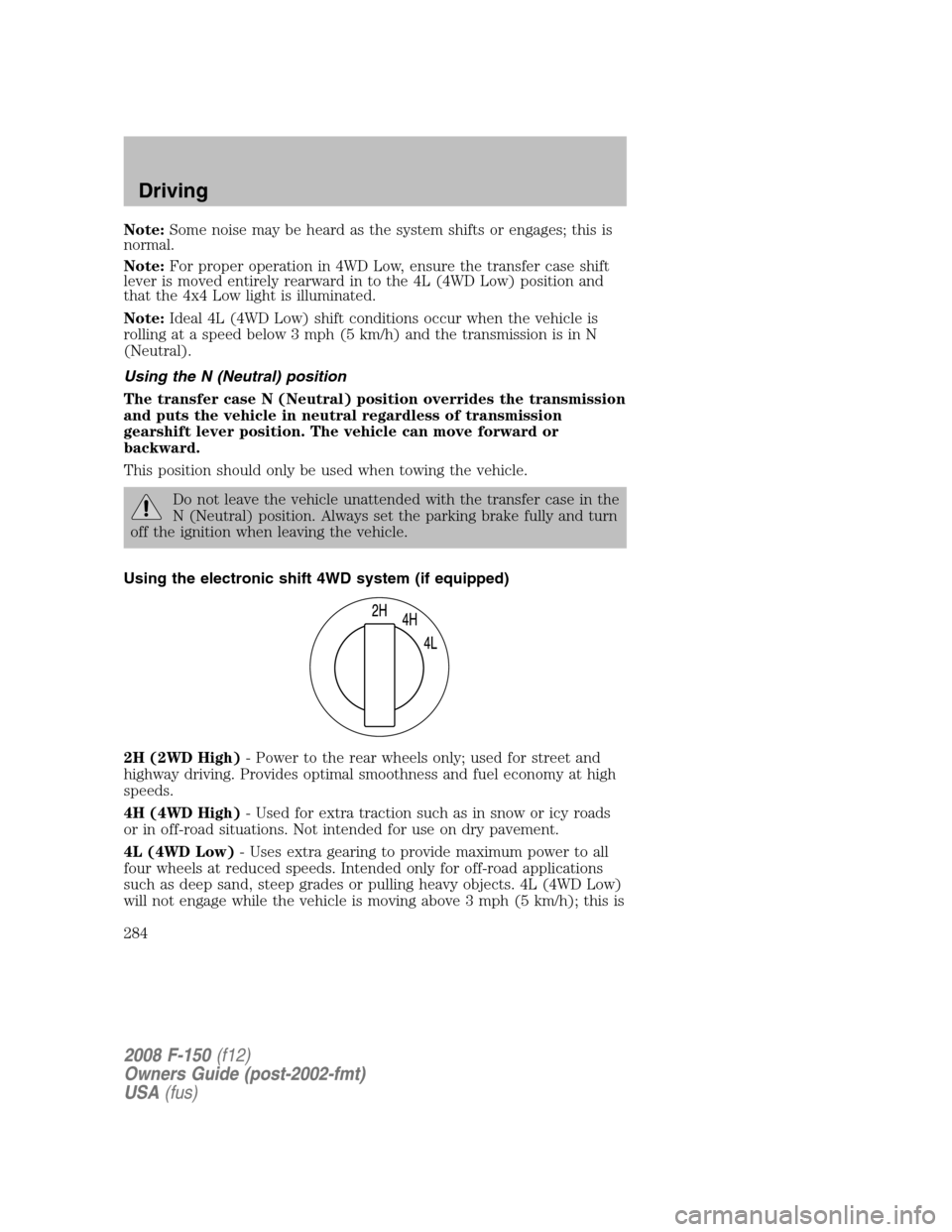
Using the electronic shift 4WD system (if equipped)
2H (2WD High)- Power to the rear wheels only; used for street and
highway driving. Provides optimal smoothness and fuel economy at high
speeds.
4H (4WD High)- Used for extra traction such as in snow or icy roads
or in off-road situations. Not intended for use on dry pavement.
4L (4WD Low)- Uses extra gearing to provide maximum power to all
four wheels at reduced speeds. Intended only for off-road applications
such as deep sand, steep grades or pulling heavy objects. 4L (4WD Low)
will not engage while the vehicle is moving above 3 mph (5 km/h); this is
2008 F-150(f12)
Owners Guide (post-2002-fmt)
USA(fus)
Driving
284
Page 296 of 400
ROADSIDE ASSISTANCE
Getting roadside assistance
To fully assist you should you have a vehicle concern, Ford Motor
Company offers a complimentary roadside assistance program. This
program is separate from the New Vehicle Limited Warranty. The service
is available:
•24–hours, seven days a week
•for the coverage period listed on the Roadside Assistance Card
included in your Owner Guide portfolio.
Roadside assistance will cover:
•a flat tire change with a good spare (except vehicles that have been
supplied with a tire inflation kit)
•battery jump start
•lock-out assistance (key replacement cost is the customer’s
responsibility)
•fuel delivery – Independent Service Contractors, if not prohibited by
state, local or municipal law shall deliver up to 2.0 gallons (7.5L) of
gasoline or 5 gallons (18.9L) of diesel fuel to a disabled vehicle. Fuel
delivery service is limited to two no-charge occurrences within a
12-month period.
•winch out – available within 100 feet (30.5 meters) of a paved or
county maintained road, no recoveries.
•towing – Ford/Mercury/Lincoln eligible vehicle towed to an authorized
dealer within 35 miles (56.3 km) of the disablement location or to the
nearest authorized dealer. If a member requests to be towed to an
authorized dealer more than 35 miles (56.3 km) from the disablement
location, the member shall be responsible for any mileage costs in
excess of 35 miles (56.3 km).
Trailers shall be covered up to $200 if the disabled eligible vehicle
requires service at the nearest authorized dealer. If the trailer is disabled,
but the towing vehicle is operational, the trailer does not qualify for any
roadside services.
2008 F-150(f12)
Owners Guide (post-2002-fmt)
USA(fus)
Roadside Emergencies
296
Page 297 of 400
Canadian customers refer to your Customer Information Guide
for information on:
•coverage period
•exact fuel amounts
•towing of your disabled vehicle
•emergency travel expense reimbursement
•travel planning benefits
Using roadside assistance
Complete the roadside assistance identification card and place it in your
wallet for quick reference. In the United States, this card is found in the
Owner Guide portfolio in the glove compartment. In Canada, the card is
found in theCustomer Information Guidein the glove compartment.
U.S. Ford or Mercury vehicle customers who require roadside assistance,
call 1–800–241–3673; Lincoln vehicle customers call 1–800–521–4140.
Canadian customers who require roadside assistance, call
1–800–665–2006.
If you need to arrange roadside assistance for yourself, Ford Motor
Company will reimburse a reasonable amount for towing to the nearest
dealership within 35 miles. To obtain reimbursement information, U.S.
Ford or Mercury vehicle customers call 1–800–241–3673; Lincoln vehicle
customers call 1–800–521–4140. Customers will be asked to submit their
original receipts.
Canadian customers who need to obtain reimbursement information, call
1–800–665–2006.
Roadside coverage beyond basic warranty
In the United States, you may purchase additional roadside assistance
coverage beyond this period through the Ford Auto Club by contacting
your authorized dealer or by calling 1–800–FORD–CLUB.
Similarly in Canada, for uninterrupted Roadside Assistance coverage, you
may purchase extended coverage prior to your Basic Warranty’s Roadside
Assistance expiring. For more information and enrollment, contact
1–877–294–2582 or visit our website at www.ford.ca.
2008 F-150(f12)
Owners Guide (post-2002-fmt)
USA(fus)
Roadside Emergencies
297
Page 302 of 400
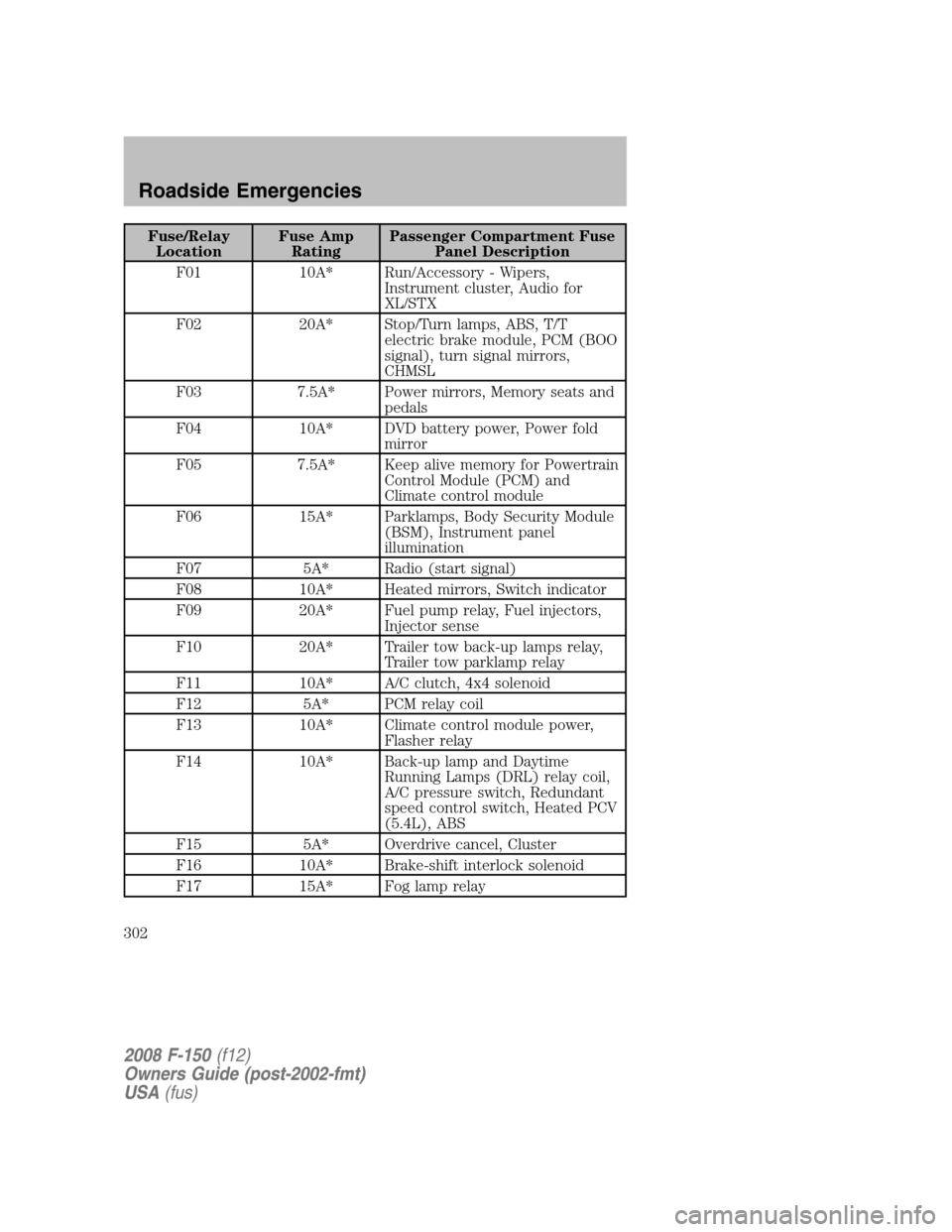
Fuse/Relay
LocationFuse Amp
RatingPassenger Compartment Fuse
Panel Description
F01 10A* Run/Accessory - Wipers,
Instrument cluster, Audio for
XL/STX
F02 20A* Stop/Turn lamps, ABS, T/T
electric brake module, PCM (BOO
signal), turn signal mirrors,
CHMSL
F03 7.5A* Power mirrors, Memory seats and
pedals
F04 10A* DVD battery power, Power fold
mirror
F05 7.5A* Keep alive memory for Powertrain
Control Module (PCM) and
Climate control module
F06 15A* Parklamps, Body Security Module
(BSM), Instrument panel
illumination
F07 5A* Radio (start signal)
F08 10A* Heated mirrors, Switch indicator
F09 20A* Fuel pump relay, Fuel injectors,
Injector sense
F10 20A* Trailer tow back-up lamps relay,
Trailer tow parklamp relay
F11 10A* A/C clutch, 4x4 solenoid
F12 5A* PCM relay coil
F13 10A* Climate control module power,
Flasher relay
F14 10A* Back-up lamp and Daytime
Running Lamps (DRL) relay coil,
A/C pressure switch, Redundant
speed control switch, Heated PCV
(5.4L), ABS
F15 5A* Overdrive cancel, Cluster
F16 10A* Brake-shift interlock solenoid
F17 15A* Fog lamp relay
2008 F-150(f12)
Owners Guide (post-2002-fmt)
USA(fus)
Roadside Emergencies
302
Page 304 of 400

Fuse/Relay
LocationFuse Amp
RatingPassenger Compartment Fuse
Panel Description
F33 15A* Shift solenoid, CMS #12 and #22,
Ignition coils
F34 15A* PCM power, IMRC (4.2L)
F35 20A* Instrument cluster high beam
indicator, High beam headlamps,
DRL disable relay
F36 10A* Trailer tow right turn/stop lamps
37 20A* Rear power point
38 25A* Subwoofer power
39 — Not used
40 20A* Low beam headlamps, DRL
41 — Not used
42 10A* Trailer tow left turn/stop lamps
F101 30A** Starter solenoid
F102 20A** Ignition switch feed
F103 20A** ABS valves
F104 — Not used
F105 30A** Electric trailer brakes
F106 30A** Trailer tow battery charge
F107 30A** Power door locks (BSM)
F108 30A** Passenger power seat
F109 30A** Driver power seat, Adjustable
pedals, Memory module (pedals,
seats)
F110 20A** Cigar lighter, Diagnostic connector
power
F111 30A** 4x4 motor relays
F112 40A** ABS pump power
F113 30A** Wipers and washer pump
F114 40A** Heated backlite, Heated mirror
power
F115 20A** Moonroof
2008 F-150(f12)
Owners Guide (post-2002-fmt)
USA(fus)
Roadside Emergencies
304