2008 FORD F150 trailer
[x] Cancel search: trailerPage 367 of 400

•Warming up a vehicle on cold mornings is not required and may
reduce fuel economy.
•Resting your foot on the brake pedal while driving may reduce fuel
economy.
•Combine errands and minimize stop-and-go driving.
Maintenance
•Keep tires properly inflated and use only recommended size.
•Operating a vehicle with the wheels out of alignment will reduce fuel
economy.
•Use recommended engine oil. Refer toMaintenance product
specifications and capacitiesin this chapter.
•Perform all regularly scheduled maintenance items. Follow the
recommended maintenance schedule and owner maintenance checks
found inscheduled maintenance information.
Conditions
•Heavily loading a vehicle or towing a trailer may reduce fuel economy
at any speed.
•Carrying unnecessary weight may reduce fuel economy (approximately
1 mpg [0.4 km/L] is lost for every 400 lb [180 kg] of weight carried).
•Adding certain accessories to your vehicle (for example bug
deflectors, rollbars/light bars, running boards, ski/luggage racks) may
reduce fuel economy.
•To maximize the fuel economy, drive with the tonneau cover installed
(if equipped).
•Using fuel blended with alcohol may lower fuel economy.
•Fuel economy may decrease with lower temperatures during the first
8–10 miles (12–16 km) of driving.
•Driving on flat terrain offers improved fuel economy as compared to
driving on hilly terrain.
•Transmissions give their best fuel economy when operated in the top
cruise gear and with steady pressure on the gas pedal.
•Four-wheel-drive operation (if equipped) is less fuel efficient than
two-wheel-drive operation.
•Close windows for high speed driving.
EPA window sticker
Every new vehicle should have the EPA window sticker. Contact your
authorized dealer if the window sticker is not supplied with your vehicle.
2008 F-150(f12)
Owners Guide (post-2002-fmt)
USA(fus)
Maintenance and Specifications
367
Page 373 of 400
weather or pulling a trailer, the vehicle should be turned off for about 30
minutes to allow fluid to cool before checking.
1. Drive the vehicle 20 miles (30 km) or until it reaches normal operating
temperature.
2. Park the vehicle on a level surface and engage the parking brake.
3. With the parking brake engaged and your foot on the brake pedal,
start the engine and move the gearshift lever through all of the gear
ranges. Allow sufficient time for each gear to engage.
4. Latch the gearshift lever in P (Park) and leave the engine running.
5. Remove the dipstick, wiping it clean with a clean, dry lint free rag. If
necessary, refer toIdentifying components in the engine compartment
in this chapter for the location of the dipstick.
6. Install the dipstick making sure it is fully seated in the filler tube.
7. Remove the dipstick and inspect the fluid level. The fluid should be in
the designated area for normal operating temperature or ambient
temperature.
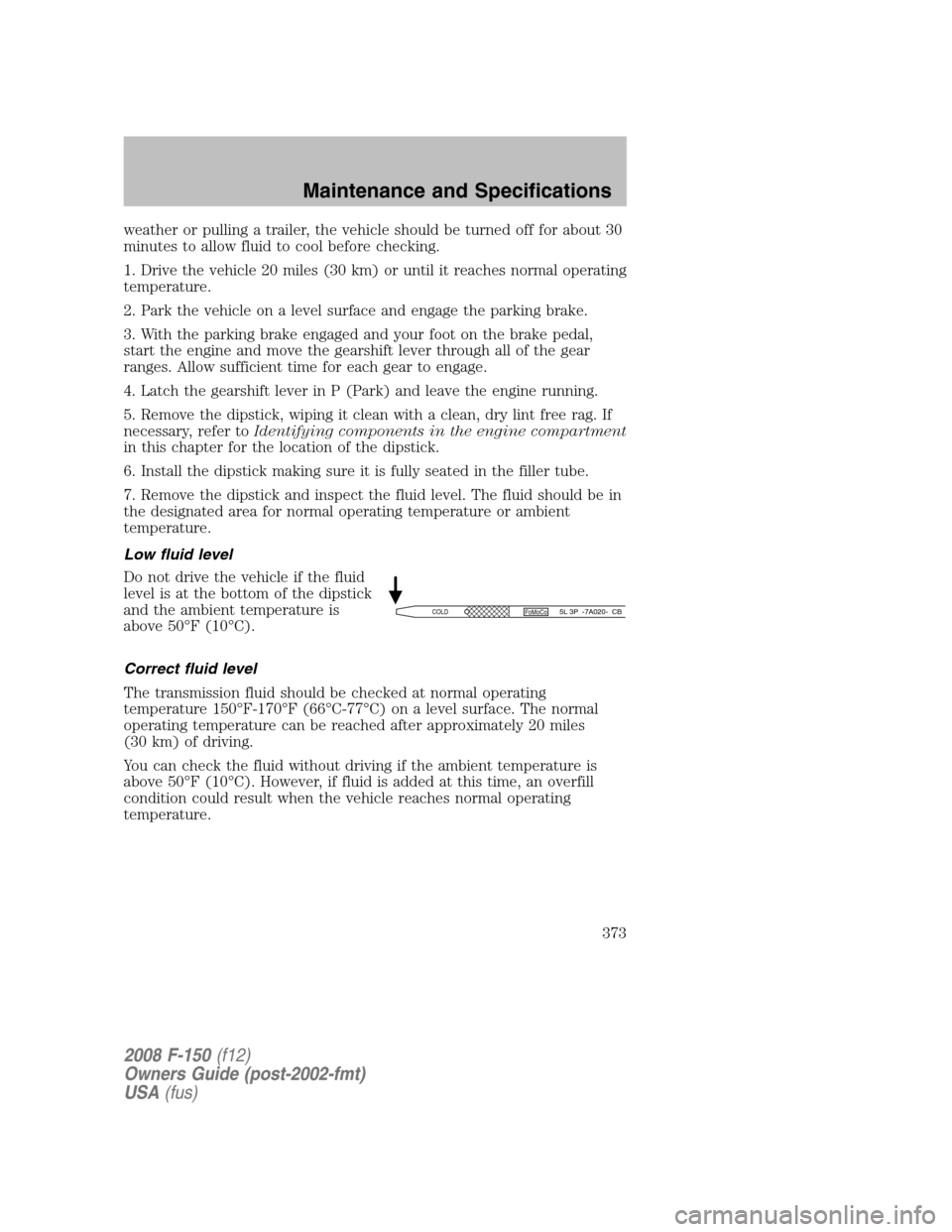
Low fluid level
Do not drive the vehicle if the fluid
level is at the bottom of the dipstick
and the ambient temperature is
above 50°F (10°C).
Correct fluid level
The transmission fluid should be checked at normal operating
temperature 150°F-170°F (66°C-77°C) on a level surface. The normal
operating temperature can be reached after approximately 20 miles
(30 km) of driving.
You can check the fluid without driving if the ambient temperature is
above 50°F (10°C). However, if fluid is added at this time, an overfill
condition could result when the vehicle reaches normal operating
temperature.
FoMoCo COLD5L 3P -7A020- CB
2008 F-150(f12)
Owners Guide (post-2002-fmt)
USA(fus)
Maintenance and Specifications
373
Page 390 of 400

Lifestyle
Ash cup / smoker’s package
Bedliners and bedmats
Cargo organization and management
Towing mirrors
Trailer hitches, wiring harnesses and accessories
Peace of mind
Mobile-Ease™ hands free communication system
Remote start
Vehicle security systems
Wheel locks
For maximum vehicle performance, keep the following information in
mind when adding accessories or equipment to your vehicle:
•When adding accessories, equipment, passengers and luggage to your
vehicle, do not exceed the total weight capacity of the vehicle or of
the front or rear axle (GVWR or GAWR as indicated on the Safety
Compliance Certification label). Consult your authorized dealer for
specific weight information.
•The Federal Communications Commission (FCC) and Canadian Radio
Telecommunications Commission (CRTC) regulate the use of mobile
communications systems — such as two-way radios, telephones and
theft alarms - that are equipped with radio transmitters. Any such
equipment installed in your vehicle should comply with FCC or CRTC
regulations and should be installed only by a qualified service
technician.
•Mobile communications systems may harm the operation of your
vehicle, particularly if they are not properly designed for automotive
use.
•To avoid interference with other vehicle functions, such as anti-lock
braking systems, amateur radio users who install radios and antennas
onto their vehicle should not locate the Amateur Radio Antennas in
the area of the driver’s side hood.
•Electrical or electronic accessories or components that are added to
the vehicle by the authorized dealer or the owner may adversely affect
battery performance and durability.
2008 F-150(f12)
Owners Guide (post-2002-fmt)
USA(fus)
Accessories
390
Page 396 of 400

Safety Compliance
Certification Label ....................386
Satellite Radio Information ........48
Seats ..........................................158
child safety seats ....................196
cleaning ...................................336
heated ................................87, 162
memory seat ...................149, 161
SecuriLock passive
anti-theft system ...............155–156
Servicing your vehicle ..............339
Setting the clock
AM/FM stereo ...........................28
AM/FM/CD .................................31
AM/FM/In-dash 6 CD ................38
Snowplowing .................7, 293–294
Spark plugs,
specifications .....................380, 385
Special notice
ambulance conversions ..............7
four-wheel drive vehicles .......295
utility-type vehicles ....................8
Specification chart,
lubricants ...................................381
Speed control ............................115
Starting a flex fuel vehicle .......261
Starting your
vehicle ........................258–259, 261
jump starting ..........................315
Steering wheel
controls ....................................117
tilting .......................................103
T
Tailgate ..............................134–135Temperature control
(see Climate control) .................81
Tilt steering wheel ....................103
Tire Pressure Monitoring
System (TPMS)
Tires, Wheels and Loading ....226
Tires ...........................211–212, 307
alignment ................................219
care ..........................................215
changing ..........................307, 310
checking the pressure ............215
inflating ...................................213
label .........................................225
replacing ..................................217
rotating ....................................219
safety practices .......................218
sidewall information ...............221
snow tires and chains ............236
spare tire .................................307
terminology .............................212
tire grades ...............................212
treadwear ........................211, 216
Towing .......................................243
recreational towing .................257
trailer towing ..........................243
Traction control ........................266
Traction-lok rear axle ...............268
Transfer case
fluid checking .........................376
Transmission .............................269
brake-shift interlock
(BSI) ................................269–270
fluid, checking and adding
(automatic) .............................372
fluid, checking and adding
(manual) .................................375
fluid, refill capacities ..............381
lubricant specifications ..........381
manual operation ....................275
Turn signal ..................................95
2008 F-150(f12)
Owners Guide (post-2002-fmt)
USA(fus)
Index
396