2008 FIAT DOBLO Starting
[x] Cancel search: StartingPage 107 of 222
106DRIVING YOUR VEHICLE
ENGINE
STARTING3)Press the clutch pedal fully down,
without pressing the accelerator.
4) Turn the ignition key to AVV
and let it go the moment the engine
starts.
If the engine does not start at the
first attempt, return the ignition key
to STOPbefore trying to start the
engine again.
If the warning lights ¢(Y) and U
stay on when the ignition key is at
MAR, turn the key to STOPand
then to MARagain; if the warning light
stays on, try with the other keys pro-
vided.
If you are still unable to start the en-
gine, perform the emergency start-up
procedure (see section “In an emer-
gency”) and go to a Fiat Dealership.
IMPORTANTNever leave the ig-
nition key at MARwhen the engine is
off.HOW TO START DIESEL
VERSIONS
1) Ensure that the handbrake is up.
2)Put the gear lever into neutral.
3)Turn the ignition key to MAR. In-
strument panel warning lights U, m
and ¢(Y) will come on.
4)Wait for warning lights Uand ¢
(Y) to turn off.
5) Wait for the instrument panel
warning light mto go out. The hot-
ter the engine is, the quicker this will
happen.
6)Press the clutch pedal down to
the floor without touching the accel-
erator.
7) Turn the key to AVVimmedi-
ately after the mwarning light goes
out. If you wait to long, you will lose
the benefit of the work done by the
glow plugs.
D D
R R
I I
V V
I I
N N
G G
Y Y
O O
U U
R R
V V
E E
H H
I I
C C
L L
E E
It is dangerous to let the
engine run in a garage or
other closed area. The
engine consumes oxygen and
gives off carbon dioxide, carbon
monoxide and other poisonous
fumes.
Do not touch the high
voltage cables (spark plug
leads) when the engine is
running.
STARTING PROCEDURE FOR
PETROL VERSIONS
1) Ensure that the handbrake is up.
2)Put the gear lever into neutral.
106-118 Doblo GB 9-05-2008 12:09 Pagina 106
Page 112 of 222

DRIVING STYLE
Starting
Do not warm the engine when the
vehicle is stationary or at high or low
revs: in this way the engine will warm
up gradually increasing consumption
and emissions. You should drive off
slowly straight away avoiding high revs
so that the engine will warm up more
quickly.
Unnecessary actions
Avoid revving the engine when
stopped at traffic lights or before
switching off the engine and avoid dou-
bling the clutch as these actions have
no purpose of modern vehicles and
serve only to increase consumption
and pollution.
Gear selection
As soon as the traffic and road con-
ditions allow it, shift to a higher gear.
Using a lower gear to liven up accel-
eration greatly increases consumption.
In the same way, improper use of the
higher gears will increase consump-tion, emissions and wear and tear on
the engine.
Top speed
Fuel consumption increases consid-
erably as speed increases. For exam-
ple, when accelerating from 90 to 120
km/h, fuel consumption increases up
to approximately +30%. Your speed
should be kept as even as possible and
superfluous braking and acceleration
avoided as this increases both con-
sumption and emissions. A “smooth”
driving style should be adopted by at-
tempting to anticipate manoeuvres to
avoid imminent danger and to keep a
safe distance from the vehicle in front
to avoid braking sharply.
Acceleration
Accelerating violently increasing the
revs will greatly effect consumption
and emission: acceleration should be
gradual and not exceed the maximum
torque.CONDITIONS OF USE
Cold starting
Frequent cold starting will not enable
the engine to reach optimal running
temperature. It follows, therefore, that
consumption will be higher (from +15
to +30% in towns) as will the pro-
duction of toxic emissions.
Traffic situations and road
conditions
Heavy traffic and higher consumption
are synonymous: for example, when
driving slowly with frequent use of
lower gears or in towns where there
are numerous traffic lights.
Also twisting roads, mountain roads
and rough road surfaces pay a heavy toll
on consumption.
Traffic hold-ups
During prolonged stops (traffic lights,
level crossings, etc.) the engine should
be switched off.
111DRIVING YOUR VEHICLE
106-118 Doblo GB 9-05-2008 12:09 Pagina 111
Page 113 of 222

112DRIVING YOUR VEHICLE
CHEAP RUNNING
THAT RESPECTS THE ENVIRONMENT
LOOKING
AFTER EMISSION
CONTROL DEVICES
The correct use of pollution control
devices not only ensures respect for
the environment but also has an effect
on the vehicle’s performance. Keeping
these devices in good condition is
therefore a fundamental rule for dri-
ving that is easy on your pocket and
on the environment too.
The first step to take is to follow the
SERVICE SCHEDULE to the letter.
If your vehicle has a petrol engine use
only unleaded petrol.
If you have trouble starting, do not
keep turning the ignition key for long
periods. Be especially careful to avoid
bump starting the vehicle by pushing,
towing or rolling downhill: these are
all manoeuvres that can damage the
catalytic exhaust. Use an auxiliary bat-
tery for start-ups only.If the engine begins to “loose its
smoothness”, when travelling, contin-
ue your journey but reduce the de-
mands you are making on the engine
and have the vehicle seen to at a Fi-
at Dealershipas soon as possible.
When the instrument panel fuel re-
serve warning light comes on, fill up as
soon as possible. A low level of fuel
can cause an uneven supply of fuel to
the engine with the inevitable increase
in the temperature of the exhaust gas
and serious damage to the catalytic
converter.
Never run the engine with one or
more spark plugs disconnected, even
for testing purposes.
Do not warm up the engine by let-
ting it idle for a while before moving
off unless the outside temperature is
very low and, even in this case, only
do so for less than 30 seconds.
Do not install other heat shields and
do not remove those already fitted to
the catalytic converter and exhaust
pipe. Environmental protection has been
one of the guiding principles in the
production of the Fiat Doblò. It is no
accident that its pollution control
equipment is much more effective than
that required by current legislation.
Nonetheless, the environment can-
not get by without a concerted effort
from everyone.
By following a few simple rules you
can avoid harming the environment
and often cut down fuel consumption
at the same time.
On this subject, a few useful tips have
been given below to supplement those
marked by symbol #, at various points
of the handbook.
You are asked to read both the for-
mer and the latter carefully.
106-118 Doblo GB 9-05-2008 12:09 Pagina 112
Page 121 of 222
120IN AN EMERGENCY
If the battery is flat, you can use an-
other battery to start the engine. Its
capacity must be the same or slightly
greater than the flat battery.
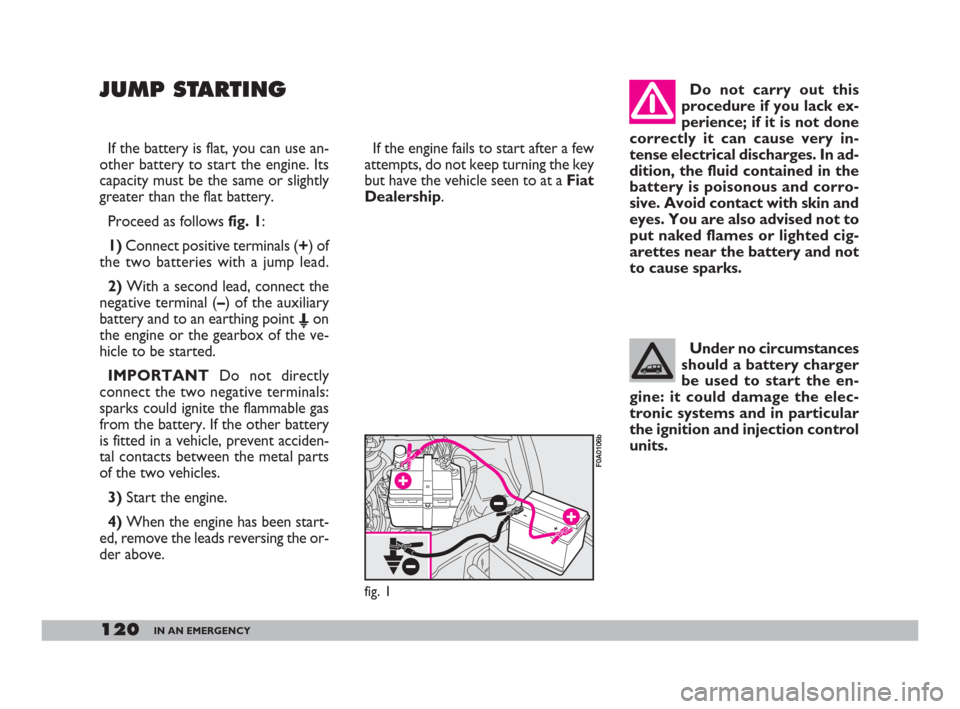
Proceed as follows fig. 1:
1) Connect positive terminals (+) of
the two batteries with a jump lead.
2)With a second lead, connect the
negative terminal (–) of the auxiliary
battery and to an earthing point E
on
the engine or the gearbox of the ve-
hicle to be started.
IMPORTANTDo not directly
connect the two negative terminals:
sparks could ignite the flammable gas
from the battery. If the other battery
is fitted in a vehicle, prevent acciden-
tal contacts between the metal parts
of the two vehicles.
3) Start the engine.
4)When the engine has been start-
ed, remove the leads reversing the or-
der above.If the engine fails to start after a few
attempts, do not keep turning the key
but have the vehicle seen to at a Fiat
Dealership.
JUMP STARTING
fig. 1
F0A0106b
Do not carry out this
procedure if you lack ex-
perience; if it is not done
correctly it can cause very in-
tense electrical discharges. In ad-
dition, the fluid contained in the
battery is poisonous and corro-
sive. Avoid contact with skin and
eyes. You are also advised not to
put naked flames or lighted cig-
arettes near the battery and not
to cause sparks.
Under no circumstances
should a battery charger
be used to start the en-
gine: it could damage the elec-
tronic systems and in particular
the ignition and injection control
units.
119-148 Doblo GB 9-05-2008 12:09 Pagina 120
Page 122 of 222

121IN AN EMERGENCY
BUMP STARTING IF A TYRE IS
PUNCTURED
GENERAL INSTRUCTIONS
Wheel changing and correct use of
the jack and spare wheel call for some
precautions as listed below. Catalysed vehicles must
not be bump started
(pushed, towed or coast-
ed down hill) as this could cause
fuel to flow into the catalytic ex-
haust system and damage it be-
yond repair.
Remember that until
the engine has started the
brake booster and hy-
draulic power steering systems
will not work and a greater effort
will therefore be required to de-
press the brake pedal or turn the
steering wheel.
Alert other drivers that
the vehicle is stationary in
compliance with local
regulations: hazard warning
lights, warning triangle etc.
Passengers on board should
leave the vehicle, especially if it is
heavily laden. Passengers should
stay away from oncoming traffic
while the wheel is being changed.
If the wheel is being changed on
a steep or badly surfaced road,
place wedges or other suitable
material under the wheels to
stop the vehicle.
The spare wheel is vehicle-spe-
cific. Never use the wheel on oth-
er models. Never fit other mod-
el spare wheels on your vehicle.
Do not use the jack for
loads over the value indi-
cated on the plate.
The jack should only be used to
change a wheel on the vehicle for
which it was designed. It should
not be put to other uses or em-
ployed to raise other models of
vehicle. Under no circumstances
should it be used when carrying
out repairs under the vehicle.
An incorrectly positioned jack
may cause the vehicle to fall.
119-148 Doblo GB 9-05-2008 12:09 Pagina 121
Page 145 of 222

144IN AN EMERGENCY
IF THE BATTERY
IS FLAT
First of all, read the “Vehicle main-
tenance” section for the steps to be
taken to avoid the battery running
down and to ensure it has a long life.
IF THE BATTERY IS FLAT
Charging should be slow at a low
amp rating for 24 hours. Charging for
a longer time may damage the battery.
Proceed as follows:
1) Disconnect the electrical system
from the battery terminals.
IMPORTANTWhere relevant,
switch the electronic alarm off with
the remote control.2)Connect the charger cables to the
battery terminals.
3)Turn on the charger.
4)When you have finished, turn the
charger off before disconnecting the
battery.
5)Reconnect the cables to the bat-
tery terminals. Make sure the polari-
ty is correct.JUMP STARTING
See “Jump starting”, in this chapter.
The liquid in the battery
is poisonous and corro-
sive. Do not let it touch
the skin or eyes. Recharging the
battery should be done in a well-
ventilated area away from naked
flames or possible sources of
sparks: explosion and fire risk.
Do not attempt to
recharge a frozen bat-
tery. Thaw it first other-
wise it could explode. If the bat-
tery froze, make sure that the in-
ternal elements are not broken
(short-circuit risk) and that the
casing is not cracked (risk of
spilling the poisonous and corro-
sive fluid).
Under no circumstances
should a battery charger
be used to start the en-
gine: it could damage the elec-
tronic systems and in particular
the ignition and injection control
units.
119-148 Doblo GB 9-05-2008 12:09 Pagina 144
Page 148 of 222

147IN AN EMERGENCY
IF AN ACCIDENT
OCCURS
– It is important to keep calm.
– If you are not directly involved in
the accident, stop at least ten metres
away from the accident.
– If you are on a motorway, do not
obstruct the emergency lane with
your vehicle.
– Turn off the engine and turn on the
hazard lights.
– At night, illuminate the scene of the
accident with your headlights.
– Act carefully, you must not risk be-
ing run over.
– Mark the accident by putting the
red triangle at the regulatory distance
from the vehicle where it can be clear-
ly seen.
– Call for rescue making the infor-
mation you give as accurate as you
can. On the motorway use the special
column-mounted emergency phones. When towing the vehi-
cle, you must comply with
the specific traffic regula-
tions regarding the tow hitch and
how to tow on the road.
Before starting to tow,
turn the ignition key to
MAR and then to STOP.
Do not remove the key. If the key
is removed, the steering lock en-
gages automatically which pre-
vents the wheels being turned.
While the vehicle is be-
ing towed with the engine
off, remember that the
brake pedal and steering will re-
quire more effort as you no
longer have the benefit of the
power brakes and power steer-
ing. Do not use flexible cables to
tow. Avoid jerking. Whilst tow-
ing, ensure that the coupling to
the vehicle does not damage the
surrounding components.
fig. 47
F0A0417b
B-fig. 47- Rear ring for towing an-
other vehicle.
119-148 Doblo GB 9-05-2008 12:09 Pagina 147
Page 167 of 222

166VEHICLE MAINTENANCE
ELECTRONIC
CONTROL UNITS
When the vehicle is being used nor-
mally, special measures are not neces-
sary.
The following instructions must be
followed very carefully, however, if
you work on the electrical system or
in cases where emergency starting is
necessary:
– Never disconnect the battery from
the electrical system while the engine
is running.
– Disconnect the battery from the
electrical system if you are recharg-
ing it. The modern battery chargers
can discharge voltage up to 20V.
– Never perform emergency start-
ups with a battery charger. Always use
an auxiliary battery.
– Be particularly careful when con-
necting the battery to the electrical
system. Ensure the battery posts are
connected up to the right leads (the Battery Maximum
admitted
stand-by intake
40 Ah 24 mA
50 Ah 30 mA
60 Ah 36 mApolarity is correct) and check that the
connection has been made properly.
– Do not connect or disconnect the
terminals of the electronic units while
the ignition key is at MAR.
– Do not check polarity through
sparking.
– Disconnect the electronic units if
you are electrically welding the vehi-
cle body. Remove the units if temper-
atures exceed 80°C (special opera-
tions on the bodywork, etc.).
IMPORTANTIf the sound system
or alarm systems are not installed cor-
rectly, they can interfere with the
working of the electronic control
units.
Modifications or repairs
to the electrical system
carried out incorrectly
and without bearing the features
of the system in mind can cause
malfunctions with the risk of fire.
The total intake of these systems
(factory and after-market) must be less
than 0.6 mA x Ah (of the battery) as
shown in the following table:
149-173 Doblo GB 9-05-2008 12:10 Pagina 166