Page 226 of 303

Brake System
In order to assure brake system performance, all brake
system components should be inspected periodically.
Recommended service intervals can be found in the
ªMaintenance Schedulesº in this manual.
WARNING!
Riding the brakes can lead to brake failure and
possibly an accident. Driving with your foot resting
or riding on the brake pedal can result in abnormally
high brake temperatures, excessive lining wear, and
possible brake damage. You wouldn't have your full
braking capacity in an emergency.
Brake and Power Steering Hoses
When servicing the vehicle for scheduled maintenance,
inspect surface of hoses and nylon tubing for evidence of
heat and mechanical damage. Hard and brittle rubber,cracking, checking, tears, cuts, abrasion, and excessive
swelling suggest deterioration of the rubber. Particular
attention should be made to examining those hose sur-
faces nearest to high heat sources, such as the exhaust
manifold.
Insure nylon tubing in these areas has not melted or
collapsed.
Inspect all hose clamps and couplings to make sure they
are secure and no leaks are present.
NOTE:
²Often, fluid such as oil, power steering fluid, and
brake fluid are used during assembly plant operations
to facilitate the assembly of hoses to couplings. There-
fore, oil wetness at the hose-coupling area is not
necessarily an indication of leakage. Actual dripping
of hot fluid when systems are under pressure (during
vehicle operation), should be noted before a hose is
replaced based on leakage.
MAINTAINING YOUR VEHICLE 225
7
Page 227 of 303

²Inspect the brake hoses whenever the brake system is
serviced and at every engine oil change. Inspect hy-
draulic brake hoses for surface cracking, scuffing, or
worn spots. If there is any evidence of cracking,
scuffing, or worn spots, the hose should be replaced
immediately! Eventual deterioration of the hose can
take place resulting in a possibility of a burst failure.
WARNING!
Worn brake hoses can burst and cause brake failure.
You could have an accident. If you see any signs of
cracking, scuffing, or worn spots, have the brake
hoses replaced immediately.
Master Cylinder - Brake Fluid Level Check
Check the fluid level in the master cylinder immediately
if the brake system warning light indicates system fail-
ure.
Check the fluid level in the master cylinder when per-
forming underhood services.
Clean the top of the master cylinder area before removing
the cap. If necessary, add fluid to bring the fluid level up
to the requirements described on the brake fluid reser-
voir.
Overfilling of fluid is not recommended because it may
cause leaking in the system.
With disc brakes, fluid level can be expected to fall as the
brake pads wear. However, low fluid level may be caused
by a leak and a checkup may be needed.
226 MAINTAINING YOUR VEHICLE
Page 228 of 303

Use only the manufacturer's recommended brake fluid.
Refer to ªFluids, Lubricants, and Genuine Partsº for the
correct fluid type. Use of a brake fluid that may have a
lower initial boiling point or unidentified as to specifica-
tion, may result in sudden brake failure during hard
prolonged braking.
WARNING!
Overfilling the brake fluid reservoir can result in
spilling brake fluid on hot engine parts and the
brake fluid catching fire.
Use only brake fluid that has been in a tightly closed
container to avoid contamination from foreign matter.
CAUTION!
²Do not allow petroleum base fluid to contaminate
the brake fluid, all brake seal components could
be damaged causing partial or complete brake
failure.
²Brake fluid can damage the finish of your vehicle.
Do not allow brake fluid to contact any painted
surface.
Change Brake Fluid
Brake fluid will tend to absorb moisture from the atmo-
sphere over time. If the fluid becomes contaminated with
water, brake performance will deteriorate. Therefore, the
brake fluid must be changed at the intervals specified in
the ªMaintenance Schedulesº in this manual. See your
authorized dealer for service.
MAINTAINING YOUR VEHICLE 227
7
Page 235 of 303
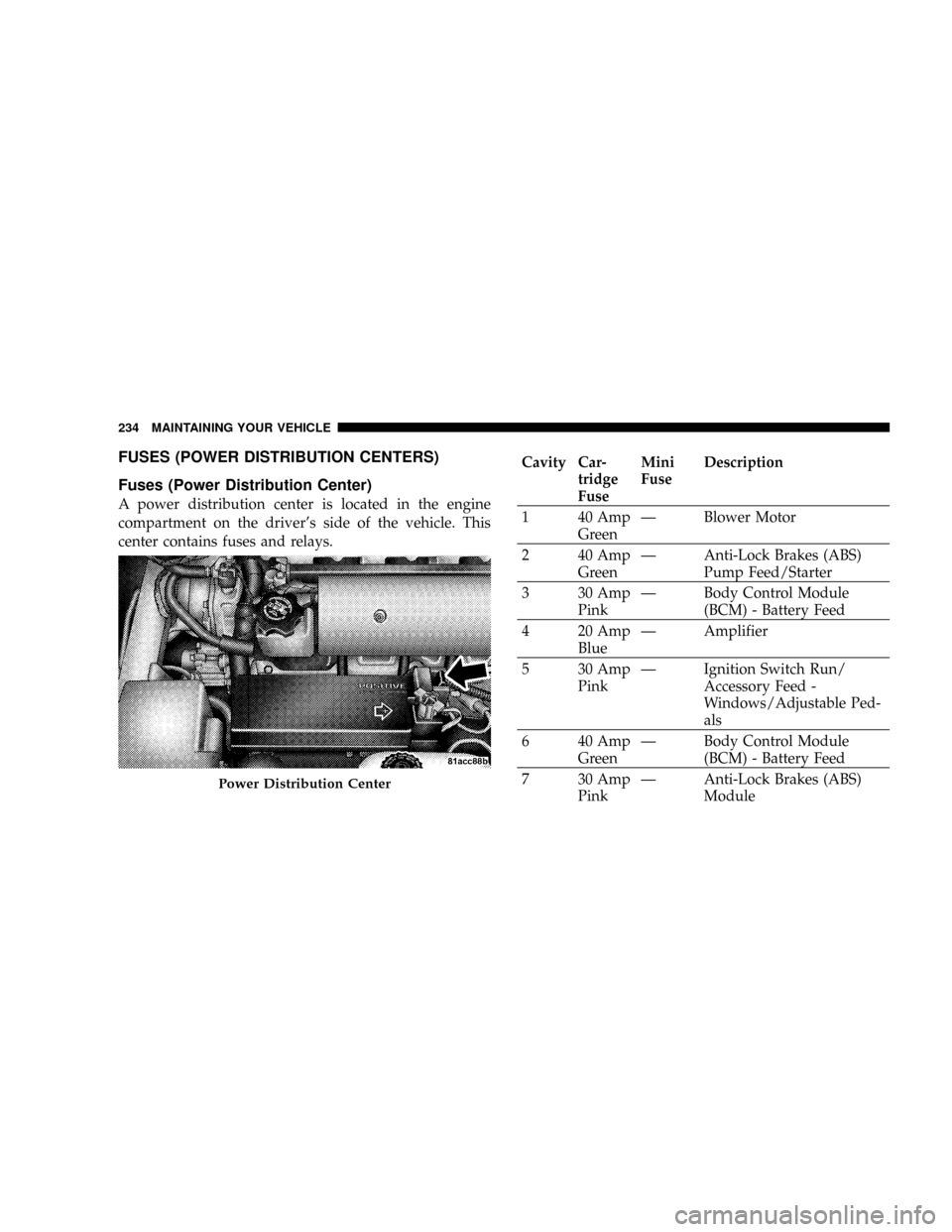
FUSES (POWER DISTRIBUTION CENTERS)
Fuses (Power Distribution Center)
A power distribution center is located in the engine
compartment on the driver's side of the vehicle. This
center contains fuses and relays.
Cavity Car-
tridge
FuseMini
FuseDescription
1 40 Amp
GreenÐ Blower Motor
2 40 Amp
GreenÐ Anti-Lock Brakes (ABS)
Pump Feed/Starter
3 30 Amp
PinkÐ Body Control Module
(BCM) - Battery Feed
4 20 Amp
BlueÐ Amplifier
5 30 Amp
PinkÐ Ignition Switch Run/
Accessory Feed -
Windows/Adjustable Ped-
als
6 40 Amp
GreenÐ Body Control Module
(BCM) - Battery Feed
7 30 Amp
PinkÐ Anti-Lock Brakes (ABS)
Module
Power Distribution Center
234 MAINTAINING YOUR VEHICLE
Page 239 of 303

VEHICLE STORAGE
We recommend that you follow these guidelines for
storing your vehicle for extended periods.
²Fill the fuel tank. This will prevent water condensation
inside the tank. If you plan to store your vehicle more
than 2 months, add an anti-oxidant fuel stabilizer to
the fuel tank.
²Change the oil to remove any corrosive combustion
related acids in the crankcase.
²Check that the radiator coolant level of protection is to
at least -20ÉF (-29ÉC).
²Make sure that all tires are inflated to the optimum
pressure. (See page 158 for more information.)
²Wash and wax the vehicle to protect the finish.
²Store the vehicle in a dry, well-ventilated location.
²Move the wiper blades away from the windshield.
²Block the wheels. Do not apply the Parking Brake.
²Cut blocks of plywood about the same size of the tires.
Cover each block with indoor/outdoor carpeting and
place them between the tires and concrete. This will
prevent tire flat spotting.
²For long-term storage, remove the tires and put the
vehicle up on blocks. Stack the tires on plywood and
cover with a tarp to prevent flat spotting.
²If the vehicle will be subjected to freezing tempera-
tures, either remove the battery and store it in a dry,
well ventilated area or connect a trickle charger (1.5
Amp) with automatic shutdown / overcharge protec-
tion to the battery. However, do not leave the trickle
charger hooked up to the battery without being
plugged in to a 110 volt AC outlet, as this will result in
further drain on the vehicle's battery. If the vehicle is
not going to be driven in the next 3 weeks, perform the
battery recharge procedure in the Service Manual.
238 MAINTAINING YOUR VEHICLE
Page 254 of 303
Chassis
Component Fluid, Lubricant, or Genuine Part
Transmission MopartATF+4 Automatic Transmission Fluid.
Rear Axle MopartSynthetic Gear and Axle Lubricant SAE 75W-140 or equivalent, with
Limited Slip Additive Friction Modifier
Brake Master Cylinder MopartBrake & Clutch Fluid DOT 4 Motor Vehicle or equivalent.
Power Steering Reservoir MopartPower Steering Fluid + 4, MopartATF+4 Automatic Transmission
Fluid.
MAINTAINING YOUR VEHICLE 253
7
Page 255 of 303
Body
Component Fluid, Lubricant, or Genuine Part
Hinges:
Door, Trunk & Hood Springs and
LinksMopartSpray White Lube or equivalent.
Latches:
Door, Hood & Trunk MopartMulti-Purpose Lube NLGI Grade 2 or equivalent.
Door Hinge Check Spring Lubriplate Mo-Lith No. 2 Grease or Petrocan Multiflex Moly EP 2 Grease or
equivalent.
Seat Regulator & Track MopartMulti-Purpose Lube NLGI Grade 2 or equivalent.
Window System Components MopartSpray White Lube or equivalent.
Lock Cylinders MopartSpray White Lube or equivalent.
Parking Brake Mechanism MopartSpray White Lube or equivalent.
254 MAINTAINING YOUR VEHICLE
Page 259 of 303

At Each Stop for Fuel
²Check the engine oil level about 5 minutes after a fully
warmed engine is shut off. Checking the oil level while
the vehicle is on level ground will improve the accu-
racy of the oil level reading. Add oil only when the
level is at or below the ADD or MIN mark.
²Check the windshield washer solvent and add if
required.
Once a Month
²Check tire pressure and look for unusual wear or
damage.
²Inspect the battery, and clean and tighten the terminals
as required.
²Check the fluid levels of the coolant reservoir, brake
master cylinder, power steering, and transmission,
and add as needed.
²Check all lights and all other electrical items for correct
operation.
At Each Oil Change
²Change the engine oil filter.
²Inspect the exhaust system.
NOTE:Also, inspect the exhaust system if you notice a
change in the sound of the exhaust system, or if the
exhaust fumes can be detected inside the vehicle.
²Inspect the brake hoses.
²Inspect the suspension components.
²Lubricate door hinges and check springs.
²Check the engine coolant level, hoses, and clamps.
²Check power steering fluid level.
258 MAINTENANCE SCHEDULES
8
M
A
I
N
T
E
N
A
N
C
E
S
C
H
E
D
U
L
E
S