Page 397 of 527
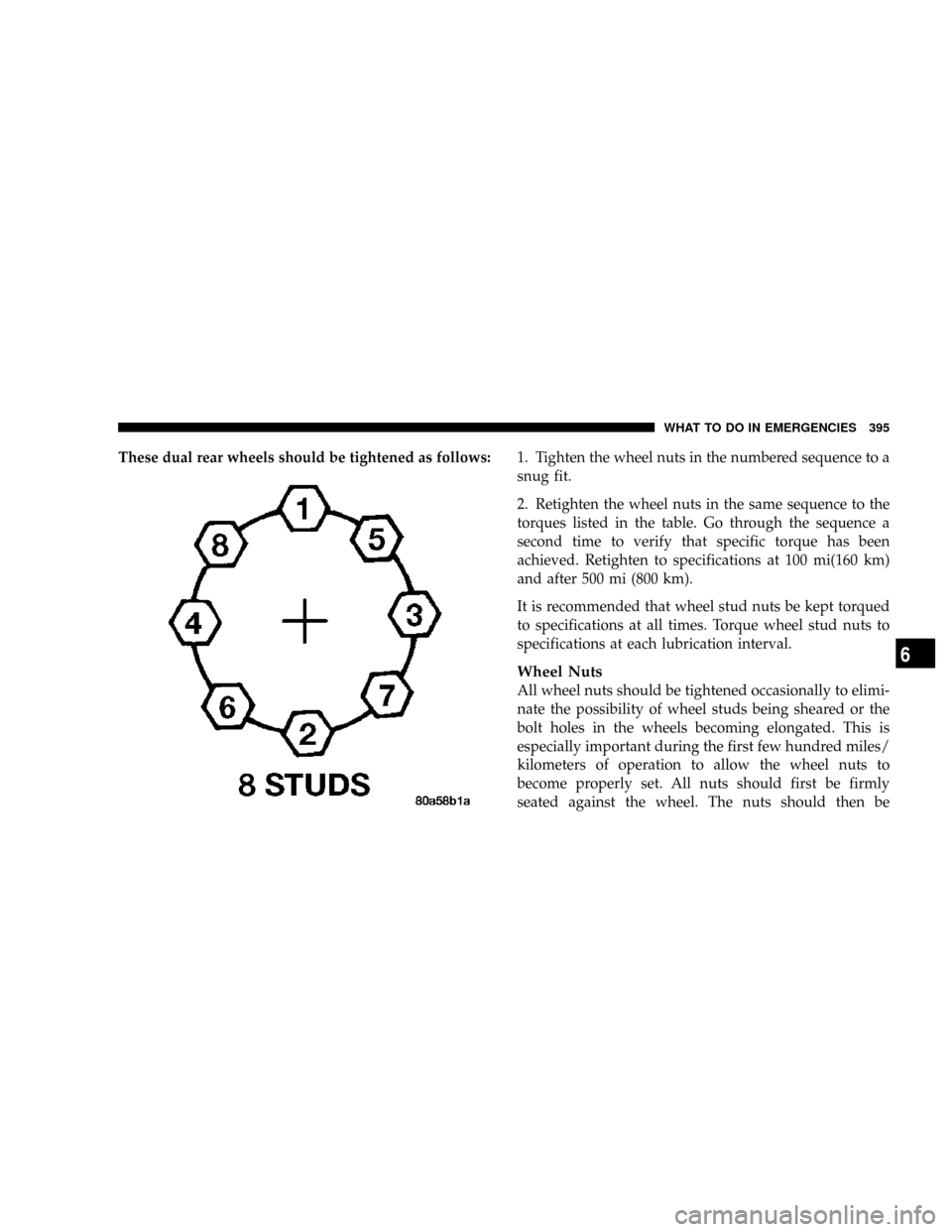
These dual rear wheels should be tightened as follows:1. Tighten the wheel nuts in the numbered sequence to a
snug fit.
2. Retighten the wheel nuts in the same sequence to the
torques listed in the table. Go through the sequence a
second time to verify that specific torque has been
achieved. Retighten to specifications at 100 mi(160 km)
and after 500 mi (800 km).
It is recommended that wheel stud nuts be kept torqued
to specifications at all times. Torque wheel stud nuts to
specifications at each lubrication interval.
Wheel Nuts
All wheel nuts should be tightened occasionally to elimi-
nate the possibility of wheel studs being sheared or the
bolt holes in the wheels becoming elongated. This is
especially important during the first few hundred miles/
kilometers of operation to allow the wheel nuts to
become properly set. All nuts should first be firmly
seated against the wheel. The nuts should then be
WHAT TO DO IN EMERGENCIES 395
6
Page 398 of 527
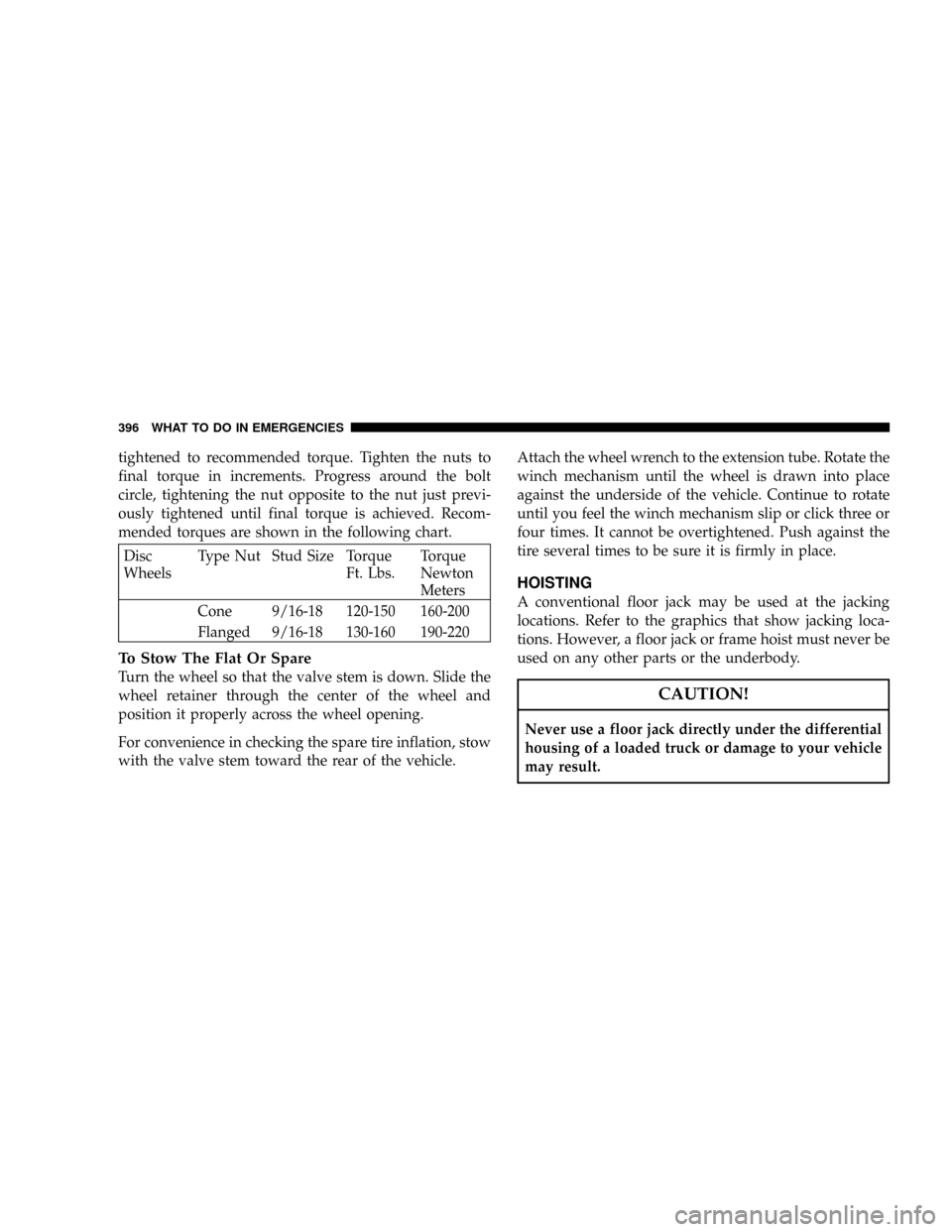
tightened to recommended torque. Tighten the nuts to
final torque in increments. Progress around the bolt
circle, tightening the nut opposite to the nut just previ-
ously tightened until final torque is achieved. Recom-
mended torques are shown in the following chart.
Disc
WheelsType Nut Stud Size Torque
Ft. Lbs.Torque
Newton
Meters
Cone 9/16-18 120-150 160-200
Flanged 9/16-18 130-160 190-220
To Stow The Flat Or Spare
Turn the wheel so that the valve stem is down. Slide the
wheel retainer through the center of the wheel and
position it properly across the wheel opening.
For convenience in checking the spare tire inflation, stow
with the valve stem toward the rear of the vehicle.Attach the wheel wrench to the extension tube. Rotate the
winch mechanism until the wheel is drawn into place
against the underside of the vehicle. Continue to rotate
until you feel the winch mechanism slip or click three or
four times. It cannot be overtightened. Push against the
tire several times to be sure it is firmly in place.
HOISTING
A conventional floor jack may be used at the jacking
locations. Refer to the graphics that show jacking loca-
tions. However, a floor jack or frame hoist must never be
used on any other parts or the underbody.
CAUTION!
Never use a floor jack directly under the differential
housing of a loaded truck or damage to your vehicle
may result.
396 WHAT TO DO IN EMERGENCIES
Page 430 of 527
CATALYST FULL SERVICE REQD
If the particulate filter reaches 99% of its capacity, the
overhead console in your vehicle will chime twice and
display the message CATALYST FULL SERVICE REQD.
At this point the engine PCM will register a fault code,
the instrument panel will display a MIL light and the
engine PCM will derate the truck, reducing its horse-
power and torque output.
The PCM derates the engine in order to limit the likeli-
hood of permanent damage to the aftertreatment system.
If this condition is not corrected and a dealer service is
not performed, extensive exhaust aftertreatment damage
can occur. In order to correct this condition it will be
necessary to have the truck serviced by your local
authorized dealer.
Maintenance Free Batteries
The top of the maintenance free batteries are perma-
nently sealed. You will never have to add water, nor is
periodic maintenance required.
NOTE:Replacement batteries should both be of equal
capacity to prevent damage to the vehicle's charging
system.
428 MAINTAINING YOUR VEHICLE
Page 450 of 527
CAUTION!
Using a transmission fluid other than the manufac-
turers recommended fluid may cause deterioration in
transmission shift quality and/or torque converter
shudder. Using a transmission fluid other than the
manufacturers recommended fluid will result in
more frequent fluid and filter changes. Refer to
Fluids, Lubricants and Genuine Parts for correct
fluid type.
Fluid Level Check
If equipped with a dipstick, use the following procedure.
If your vehicle has a capped dipstick tube, it is sealed and
should not be tampered with. Your authorized dealer has
the proper tools to ensure that the fluid level is set
properly. The fluid level should be checked when theengine is fully warmed up and the fluid in the transmis-
sion is at normal operating temperature. Operation of the
transmission with an improper fluid level will greatly
reduce the life of the transmission and of the fluid. Check
the fluid level whenever the vehicle is serviced.
Procedure For Checking Fluid Level
To properly check the automatic transmission fluid level,
the following procedure must be used:
1. Operate the engine at idle speed and normal operating
temperature.
2. The vehicle must be on level ground.
3. Fully apply the parking brake and press the brake
pedal.
4. Place the gear selector momentarily in each gear
position ending with the lever in PARK.
448 MAINTAINING YOUR VEHICLE
Page 523 of 527
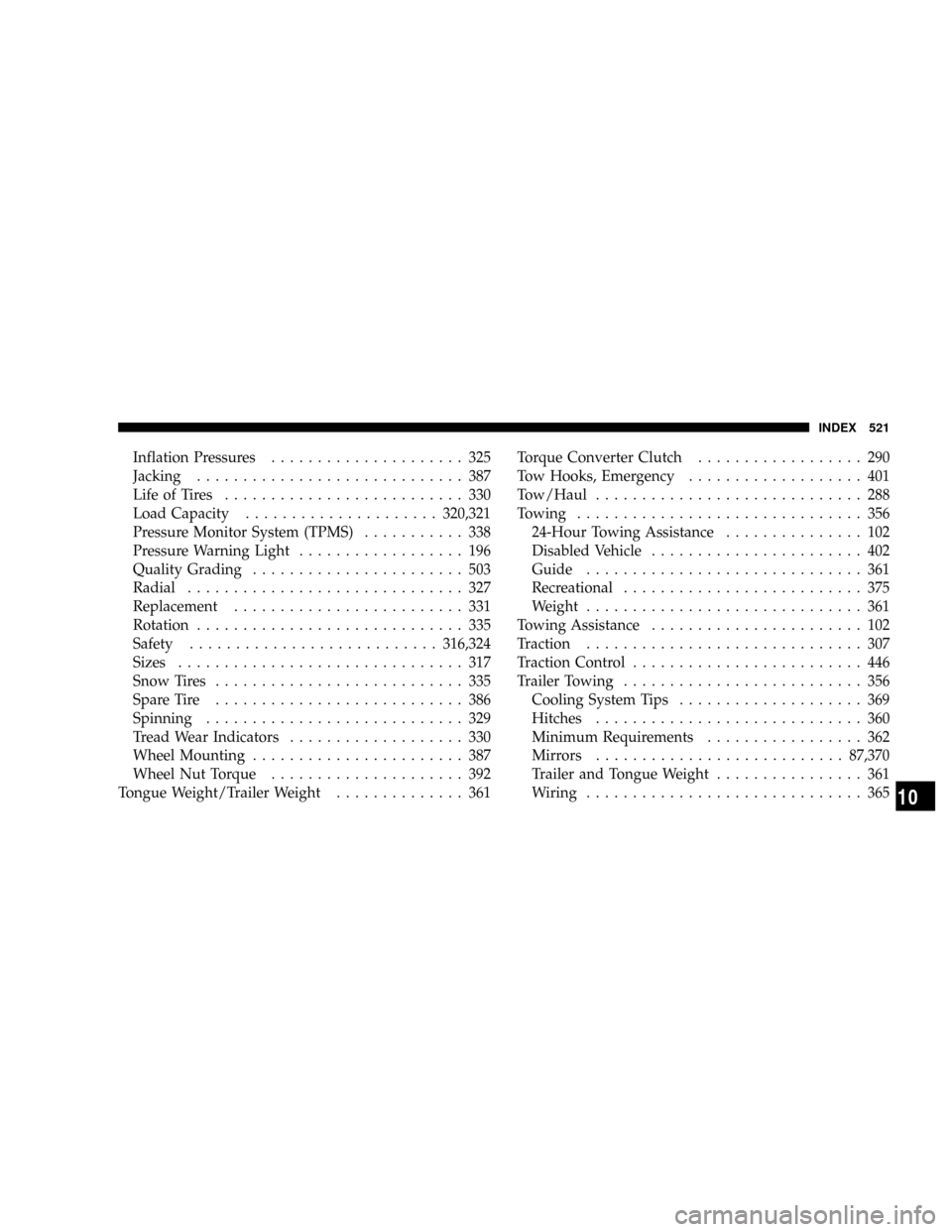
Inflation Pressures..................... 325
Jacking............................. 387
Life of Tires.......................... 330
Load Capacity.....................320,321
Pressure Monitor System (TPMS)........... 338
Pressure Warning Light.................. 196
Quality Grading....................... 503
Radial.............................. 327
Replacement......................... 331
Rotation............................. 335
Safety...........................316,324
Sizes............................... 317
Snow Tires........................... 335
Spare Tire........................... 386
Spinning............................ 329
Tread Wear Indicators................... 330
Wheel Mounting....................... 387
Wheel Nut Torque..................... 392
Tongue Weight/Trailer Weight.............. 361Torque Converter Clutch.................. 290
Tow Hooks, Emergency................... 401
Tow/Haul............................. 288
Towing............................... 356
24-Hour Towing Assistance............... 102
Disabled Vehicle....................... 402
Guide.............................. 361
Recreational.......................... 375
Weight.............................. 361
Towing Assistance....................... 102
Traction.............................. 307
Traction Control......................... 446
Trailer Towing.......................... 356
Cooling System Tips.................... 369
Hitches............................. 360
Minimum Requirements................. 362
Mirrors...........................87,370
Trailer and Tongue Weight................ 361
Wiring.............................. 365
INDEX 521
10
Page 525 of 527
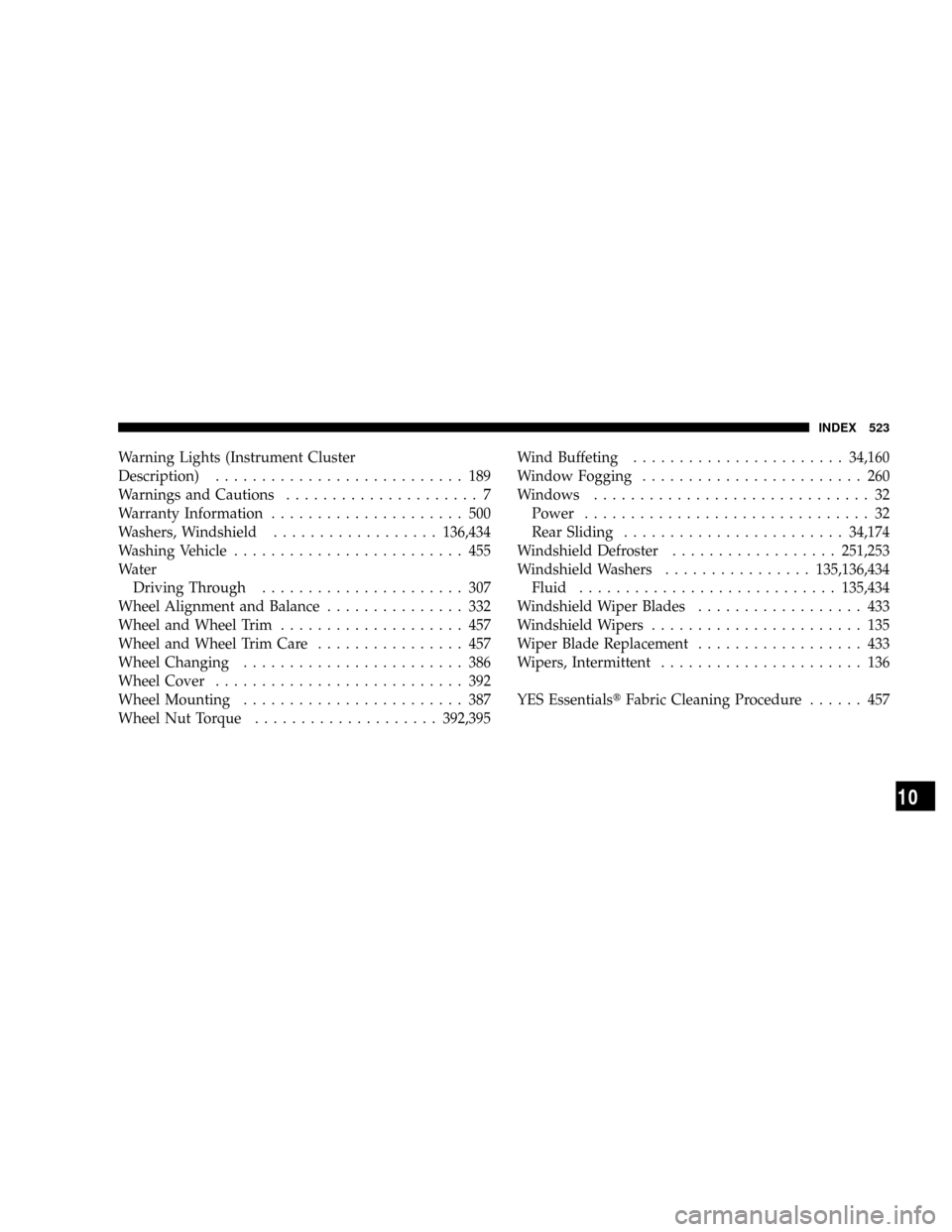
Warning Lights (Instrument Cluster
Description)........................... 189
Warnings and Cautions..................... 7
Warranty Information..................... 500
Washers, Windshield..................136,434
Washing Vehicle......................... 455
Water
Driving Through...................... 307
Wheel Alignment and Balance............... 332
Wheel and Wheel Trim.................... 457
Wheel and Wheel Trim Care................ 457
Wheel Changing........................ 386
Wheel Cover........................... 392
Wheel Mounting........................ 387
Wheel Nut Torque....................392,395Wind Buffeting.......................34,160
Window Fogging........................ 260
Windows.............................. 32
Power............................... 32
Rear Sliding........................34,174
Windshield Defroster..................251,253
Windshield Washers................135,136,434
Fluid............................135,434
Windshield Wiper Blades.................. 433
Windshield Wipers....................... 135
Wiper Blade Replacement.................. 433
Wipers, Intermittent...................... 136
YES EssentialstFabric Cleaning Procedure...... 457
INDEX 523
10