Page 360 of 527

Weight-Distributing Hitch
A weight-distributing system works by applying lever-
age through spring (load) bars. They are typically used
for heavier loads, to distribute trailer tongue weight to
the tow vehicle's front axle and the trailer axle(s). When
used in accordance with the manufacturers' directions, it
provides for a more level ride, offering more consistent
steering and brake control thereby enhancing towing
safety. The addition of a friction / hydraulic sway control
also dampens sway caused by traffic and crosswinds and
contributes positively to tow vehicle and trailer stability.
Trailer sway control and a weight distributing (load
equalizing) hitch are recommended for heavier Tongue
Weights (TW) and may be required depending on Vehicle
and Trailer configuration / loading to comply with gross
axle weight rating (GAWR) requirements.WARNING!
An improperly adjusted Weight Distributing Hitch
system may reduce handling, stability, braking per-
formance, and could result in an accident.
Weight Distributing Systems may not be compatible
with Surge Brake Couplers. Consult with your hitch
and trailer manufacturer or a reputable Recreational
Vehicle dealer for additional information.
358 STARTING AND OPERATING
Page 378 of 527

Recreational Towing Procedure Ð Manual Shift
Transfer Case Ð If Equipped
Use the following procedure to prepare your vehicle for
recreational towing:
CAUTION!
It is necessary to follow these steps to be certain that
the transfer case is fully in NEUTRAL before recre-
ational towing to prevent damage to internal parts.
1. Bring the vehicle to a complete stop.
2. Shut OFF the engine.
3. Depress the brake pedal.
4. Shift automatic transmission to NEUTRAL, or depress
the clutch on manual transmissions.5. Shift transfer case lever into NEUTRAL.
6. Start the engine.
7. Shift automatic transmission into REVERSE.
8. Release brake pedal for five seconds and ensure that
there is no vehicle movement.
9. Repeat steps 7 and 8 with the transmission in DRIVE.
10. Shut OFF the engine and place the ignition key in the
unlocked OFF position.
11. Shift automatic transmission into PARK or 1st gear
on manual transmissions.
12. Apply the parking brake.
13. Attach vehicle to tow vehicle with tow bar.
14. Release the parking brake.
376 STARTING AND OPERATING
Page 380 of 527
CAUTION!
²Do not use a bumper-mounted clamp-on tow bar
on your vehicle. The bumper face bar will be
damaged.
²Do not disconnect the rear driveshaft because
fluid will leak from the transfer case and damage
the internal parts.
Recreational Towing Procedure Ð Electronic Shift
Transfer Case Ð If Equipped
Use the following procedure to prepare your vehicle for
recreational towing:
CAUTION!
It is necessary to follow these steps to be certain that
the transfer case is fully in NEUTRAL before recre-
ational towing, to prevent damage to internal parts.
1. Bring vehicle to a complete stop.
2. Shut OFF the engine.
3. Turn the ignition key to the ON position, but do not
start the engine.
4. Depress the brake pedal.
5. Shift automatic transmission to NEUTRAL or depress
clutch on manual transmission.
6. Using the point of a ballpoint pen or similar object,
depress the recessed transfer case NEUTRAL button for
four seconds.
378 STARTING AND OPERATING
Page 381 of 527

7. After shift is completed and the NEUTRAL light
comes on, release the NEUTRAL button.
8. Start engine.
9. Shift automatic transmission into REVERSE.
10. Release brake pedal for five seconds and ensure that
there is no vehicle movement.
11. Repeat steps 9 and 10 with the transmission in
DRIVE.
12. Shut engine OFF and place ignition key in the
unlocked OFF position.
13. Shift automatic transmission into PARK or 1st gear
on manual transmissions.
14. Apply parking brake.
15. Attach vehicle to tow vehicle with tow bar.
16. Release parking brake.NOTE:Steps 1 through 5 are requirements that must be
met prior to depressing the NEUTRAL selection button,
and must continue to be met until the four seconds
elapses and the shift has been completed. If any of these
requirements (with the exception of 3 - Key ON) are not
met prior to depressing the NEUTRAL button or are no
longer met during the four second timer, then the NEU-
TRAL indicator light will flash continuously until all
requirements are met or until the NEUTRAL button is
released.
NOTE:The ignition key must be ON for a shift to take
place and for the position indicator lights to be operable.
If the key in not ON, the shift will not take place and no
position indicator lights will be on or flashing.
NOTE:Flashing NEUTRAL position indicator light
indicates that shift requirements have not been met.
STARTING AND OPERATING 379
5
Page 384 of 527
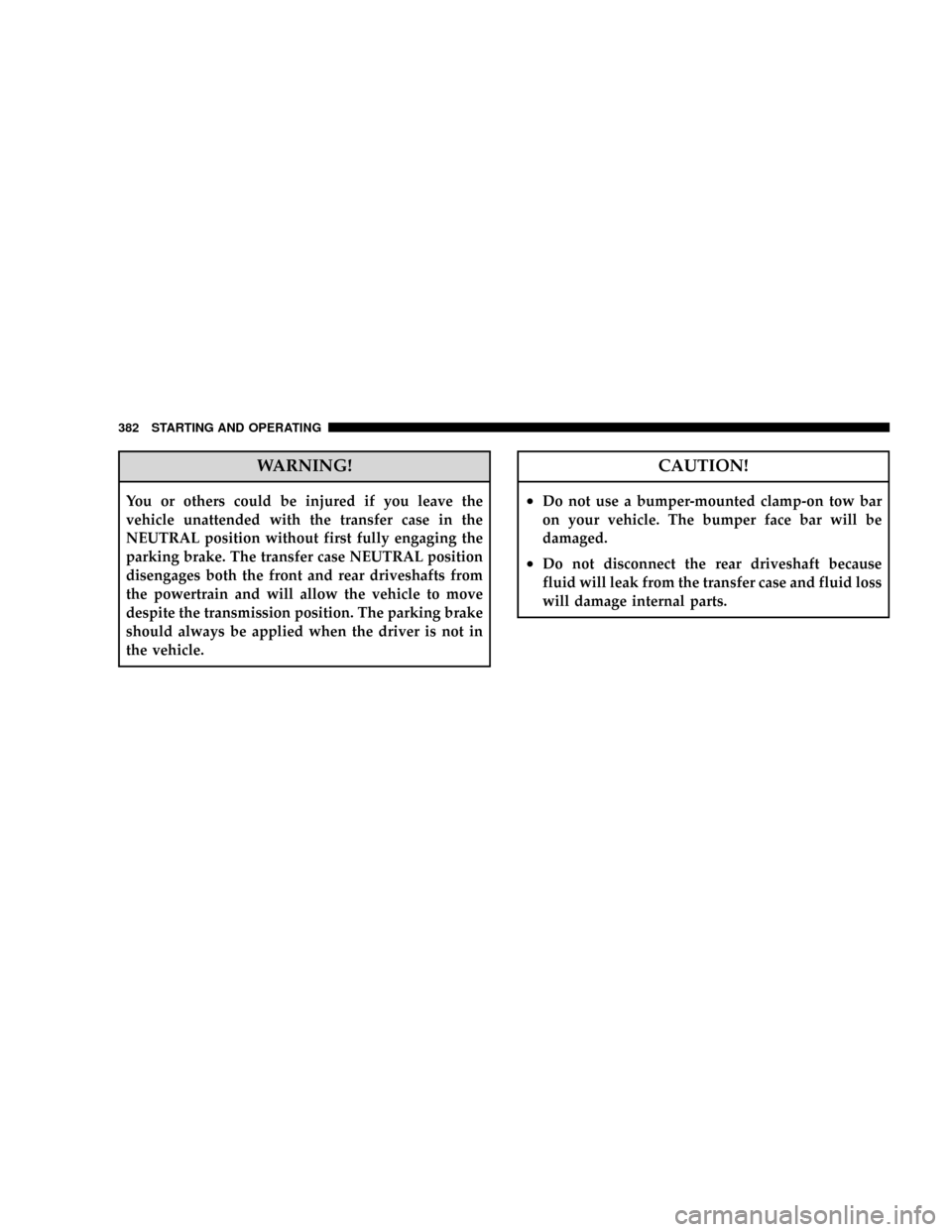
WARNING!
You or others could be injured if you leave the
vehicle unattended with the transfer case in the
NEUTRAL position without first fully engaging the
parking brake. The transfer case NEUTRAL position
disengages both the front and rear driveshafts from
the powertrain and will allow the vehicle to move
despite the transmission position. The parking brake
should always be applied when the driver is not in
the vehicle.
CAUTION!
²Do not use a bumper-mounted clamp-on tow bar
on your vehicle. The bumper face bar will be
damaged.
²Do not disconnect the rear driveshaft because
fluid will leak from the transfer case and fluid loss
will damage internal parts.
382 STARTING AND OPERATING
Page 404 of 527

CAUTION!
Tow hooks are for emergency use only, to rescue a
vehicle stranded off-road. Do not use tow hooks for
tow truck hookup or highway towing. You could
damage your vehicle.
TOWING A DISABLED VEHICLE
Proper towing or lifting equipment is required to prevent
damage to your vehicle. Use only tow bars and other
equipment designed for the purpose, following equip-
ment manufacturer's instructions. Use of safety chains is
mandatory. Attach a tow bar or other towing device to
the main structural members of the vehicleÐnot to
bumpers or associated brackets. State and local laws
applying to vehicles under tow must be observed.
4-Wheel Drive Vehicles
CAUTION!
To avoid damage to the transfer case while towing,
always use one of the following methods.
NOTE:The transfer case must be in the neutral position,
and the transmission must be in PARK (automatic trans-
mission), or in gear (manual transmission) to tow a 4WD
vehicle with one end of the vehicle raised.
The manufacturer recommends towing with all wheels
OFFthe ground. Acceptable methods are to tow the
vehicle on a flatbed or with one end of vehicle raised and
the opposite end on a towing dolly.
402 WHAT TO DO IN EMERGENCIES
Page 517 of 527
Power Door........................... 27
Steering Wheel......................... 18
Lower Anchors and Tether for CHildren
(LATCH).............................. 65
Lubrication, Body....................... 433
Lug Nuts............................. 392
Lumbar Support........................ 119
Maintenance........................... 410
Maintenance Procedures................... 412
Maintenance Schedule.................... 484
Manual, Service......................... 501
Manual Transmission..................291,447
Fluid Level Check...................446,447
Lubricant Selection..................... 482
Shift Speeds.......................... 292
Map/Reading Lights..................... 142
Mirrors................................ 84
Automatic Dimming..................... 85Electric Powered....................... 86
Outside.............................. 85
Rearview............................. 84
Trailer Towing......................87,370
Modifications/Alterations, Vehicle............. 8
Monitor, Tire Pressure System............... 338
Mopar Parts.........................409,500
Multi-Function Control Lever............... 133
Navigation Radio........................ 238
Navigation System....................... 238
New Vehicle Break-In Period................ 74
Noise Control
Maintenance.......................... 452
Tampering Prohibited................... 452
Noise Emission Warranty...............451,453
Occupant Restraints....................... 35
Odometer..........................192,199
INDEX 515
10