2008 DODGE MAGNUM SRT radiator cap
[x] Cancel search: radiator capPage 399 of 476

damaged, have a competent mechanic inspect the com-
plete exhaust system and adjacent body areas for broken,
damaged, deteriorated, or mispositioned parts. Open
seams or loose connections could permit exhaust fumes
to seep into the passenger compartment. In addition,
inspect the exhaust system each time the vehicle is raised
for lubrication or oil change. Replace as required.
WARNING!
Exhaust gases can injure or kill. They contain carbon
monoxide (CO), which is colorless and odorless.
Breathing it can make you unconscious and can
eventually poison you. To avoid breathing CO, refer
to “Exhaust Gas” under “Safety Tips” in Section 2.
Cooling System
WARNING!
•When working near the radiator cooling fan, dis-
connect the fan motor lead or turn the ignition
switch to the LOCK position. The fan is tempera-
ture controlled and can start at any time the
ignition switch is in the ON position.
•You or others can be badly burned by hot coolant
or steam from your radiator. If you see or hear
steam coming from under the hood, don’t open the
hood until the radiator has had time to cool. Never
try to open a cooling system pressure cap when the
radiator is hot.
MAINTAINING YOUR VEHICLE 397
7
Page 400 of 476

Coolant Checks
Check engine coolant (antifreeze) protection every 12
months (before the onset of freezing weather, where
applicable). If coolant is dirty or rusty in appearance, the
system should be drained, flushed, and refilled with
fresh coolant. Check the front of the A/C condenser for
any accumulation of bugs, leaves, etc. If dirty, clean by
gently spraying water from a garden hose vertically
down the face of the condenser.
Check the coolant recovery bottle tubing for brittle rub-
ber, cracking, tears, cuts, and tightness of the connection
at the bottle and radiator. Inspect the entire system for
leaks.
With the engine at normal operating temperature (but
not running), check the cooling system pressure cap for
proper vacuum sealing by draining a small amount of
coolant from the radiator drain cock. If the cap is sealing
properly, the engine coolant (antifreeze) will begin todrain from the coolant recovery bottle. DO NOT RE-
MOVE THE COOLANT PRESSURE CAP WHEN THE
COOLING SYSTEM IS HOT.
Cooling System — Drain, Flush, and Refill
The system should be drained, flushed, and refilled at the
intervals shown in the “Maintenance Schedule” in Sec-
tion 8.
If the solution is dirty or contains a considerable amount
of sediment, clean and flush with a reliable cooling
system cleaner. Follow with a thorough rinsing to remove
all deposits and chemicals. Properly dispose of old
antifreeze solution.
Selection of Coolant
Use only the manufacturer’s recommended coolant. Re-
fer to “Fluids, Lubricants, and Genuine Parts” in this
section for the correct coolant type.
398 MAINTAINING YOUR VEHICLE
Page 402 of 476

•Use only high purity water such as distilled or deion-
ized water when mixing the water/engine coolant
solution. The use of lower quality water will reduce
the amount of corrosion protection in the engine
cooling system.
Please note that it is the owner’s responsibility to main-
tain the proper level of protection against freezing ac-
cording to the temperatures occurring in the area where
the vehicle is operated.
NOTE:Mixing coolant types will decrease the life of the
engine coolant and will require more frequent coolant
changes.
Cooling System Pressure Cap
The cap must be fully tightened to prevent loss of coolant
and to ensure that coolant will return to the radiator from
the coolant recovery bottle.The cap should be inspected and cleaned if there is any
accumulation of foreign material on the sealing surfaces.
WARNING!
•The warning words “DO NOT OPEN HOT” on
the cooling system pressure cap are a safety pre-
caution. Never add coolant when the engine is
overheated. Do not loosen or remove the cap to
cool an overheated engine. Heat causes pressure to
build up in the cooling system. To prevent scald-
ing or injury, do not remove the pressure cap while
the system is hot or under pressure.
•Do not use a pressure cap other than the one
specified for your vehicle. Personal injury or en-
gine damage may result.
400 MAINTAINING YOUR VEHICLE
Page 403 of 476

Disposal of Used Coolant
Used ethylene glycol-based engine coolant is a regulated
substance requiring proper disposal. Check with your
local authorities to determine the disposal rules for your
community. To prevent ingestion by animals or children,
do not store ethylene glycol-based engine coolant in open
containers or allow it to remain in puddles on the
ground. If ingested by a child, contact a physician
immediately. Clean up any ground spills immediately.
Coolant Level
The coolant bottle provides a quick visual method for
determining that the coolant level is adequate. With the
engine OFF and cold, the level of the coolant in the bottle
should be between the ranges indicated on the bottle.
The radiator normally remains completely full, so there is
no need to remove the radiator cap unless checking for
coolant freeze point or replacing coolant. Advise yourservice attendant of this. As long as the engine operating
temperature is satisfactory, the coolant bottle need only
be checked once a month.
When additional coolant is needed to maintain the
proper level, it should be added to the coolant bottle. Do
not overfill.
Points to Remember
NOTE:When the vehicle is stopped after a few miles
(kilometers) of operation, you may observe vapor coming
from the front of the engine compartment. This is nor-
mally a result of moisture from rain, snow, or high
humidity accumulating on the radiator and being vapor-
ized when the thermostat opens, allowing hot coolant to
enter the radiator.
If an examination of your engine compartment shows no
evidence of radiator or hose leaks, the vehicle may be
safely driven. The vapor will soon dissipate.
MAINTAINING YOUR VEHICLE 401
7
Page 456 of 476
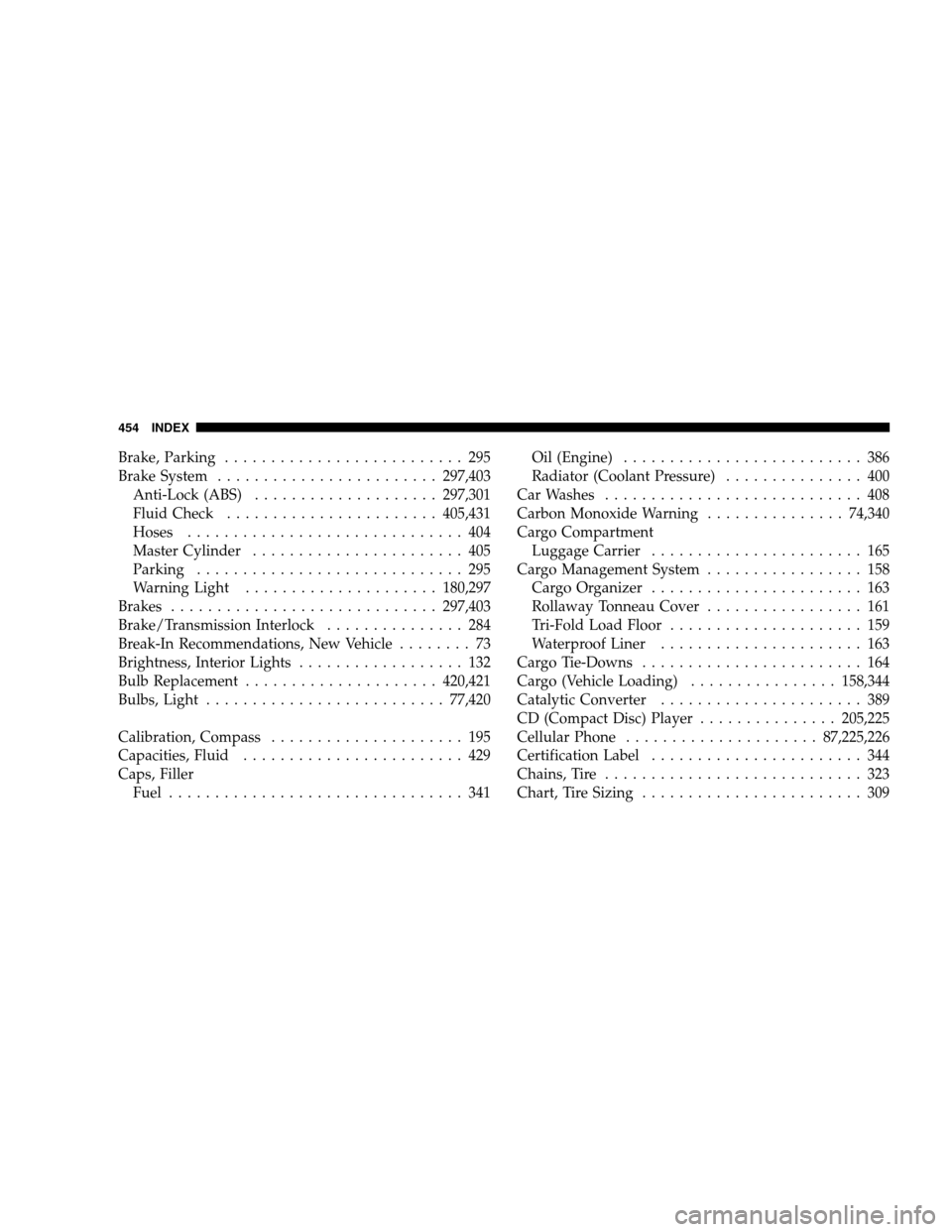
Brake, Parking.......................... 295
Brake System........................297,403
Anti-Lock (ABS)....................297,301
Fluid Check.......................405,431
Hoses.............................. 404
Master Cylinder....................... 405
Parking............................. 295
Warning Light.....................180,297
Brakes.............................297,403
Brake/Transmission Interlock............... 284
Break-In Recommendations, New Vehicle........ 73
Brightness, Interior Lights.................. 132
Bulb Replacement.....................420,421
Bulbs,Light .......................... 77,420
Calibration, Compass..................... 195
Capacities, Fluid........................ 429
Caps, Filler
Fuel................................ 341Oil (Engine).......................... 386
Radiator (Coolant Pressure)............... 400
Car Washes............................ 408
Carbon Monoxide Warning............... 74,340
Cargo Compartment
Luggage Carrier....................... 165
Cargo Management System................. 158
Cargo Organizer....................... 163
Rollaway Tonneau Cover................. 161
Tri-Fold Load Floor..................... 159
Waterproof Liner...................... 163
Cargo Tie-Downs........................ 164
Cargo (Vehicle Loading)................158,344
Catalytic Converter...................... 389
CD (Compact Disc) Player...............205,225
Cellular Phone..................... 87,225,226
Certification Label....................... 344
Chains, Tire............................ 323
Chart, Tire Sizing........................ 309
454 INDEX
Page 457 of 476

Check Engine Light (Malfunction
Indicator Light)......................... 382
Checking Your Vehicle For Safety............. 74
Checks, Safety........................... 74
Child Restraint.................... 63,65,69,70
Child Restraint Tether Anchors............. 67,69
Child Safety Locks........................ 30
Clean Air Gasoline....................... 338
Cleaning
Wheels............................. 410
Windshield Wiper Blades................. 395
Climate Control......................... 258
Clock ........................207,210,226,231
CoinHolder ........................... 157
Cold Weather Operation................... 279
Compact Disc (CD) Maintenance............. 257
Compass.............................. 195
Compass Calibration..................... 195
Compass Variance....................... 196Computer, Trip/Travel.................... 189
Connector
UCI ................................ 251
Universal Consumer Interface (UCI)......... 251
Console, Floor.......................... 157
Console, Overhead....................... 142
Contract, Service........................ 445
Converter, Catalytic...................... 389
Coolant Pressure Cap (Radiator Cap).......... 400
Cooling System......................... 397
Adding Coolant (Antifreeze).............. 399
Coolant Capacity...................... 429
Coolant Level......................398,401
Disposal of Used Coolant................ 401
Drain, Flush, and Refill.................. 398
Inspection........................... 401
Points to Remember.................... 401
Pressure Cap......................... 400
Radiator Cap......................... 400
INDEX 455
10
Page 467 of 476

PaintCare ............................. 408
Panic Alarm............................ 22
Parking Brake.......................... 295
Parking On Hill......................... 295
Passing Light........................... 131
Pedals, Adjustable....................... 137
Personal Settings........................ 201
Pets.................................. 73
Phone, Cellular.................... 87,225,226
Phone, Hands-Free (UConnect™)........ 87,225,226
Placard, Tire and Loading Information......... 312
Port
Universal Serial Bus (USB).............205,225
USB .............................205,225
Power
Brakes.............................. 297
Distribution Center (Fuses)............... 413
Door Locks........................... 28
Mirrors .............................. 85Outlet (Auxiliary Electrical Outlet).......... 153
Seats............................... 118
Steering............................. 299
Steering, Checking..................... 394
Sunroof............................. 150
Windows............................. 32
Power Steering Fluid..................394,431
Pregnant Women and Seat Belts.............. 48
Pretensioners
Seat Belts............................. 45
Programmable Electronic Features............ 201
Programming Transmitters
(Remote Keyless Entry).................... 20
Radial Ply Tires......................... 319
Radiator Cap (Coolant Pressure Cap).......... 400
Radio Broadcast Signals................... 204
Radio, Navigation....................... 225
Radio Operation...................206,226,257
INDEX 465
10