Page 63 of 476

NOTE:Perchlorate Material — special handling may ap-
ply. See www.dtsc.ca.gov/hazardouswaste/perchlorate.
Airbag Warning Light
You will want to have the airbags ready to
inflate for your protection in an impact. While
the airbag system is designed to be mainte-
nance free, if any of the following occurs, have
an authorized dealer service the system promptly:
•The Airbag Warning Light does not come on or flickers
during the six to eight seconds when the ignition
switch is first turned ON.
•The light remains on or flickers after the six to eight
second interval.
•The light flickers or comes on and remains on while
driving.
Event Data Recorder (EDR)
In the event of an accident, your vehicle is designed to
record up to five seconds of specific vehicle data param-
eters (see the following list) in an event data recorder
prior to the moment of airbag deployment, or near
deployment, and up to a quarter second of high-speed
deceleration data during and/or after airbag deploy-
ment. EDR data are ONLY recorded if an airbag deploys,
or nearly deploys, and are otherwise unavailable.
NOTE:
1. A near-deployment event occurs when the airbag
sensor detects severe vehicle deceleration usually indica-
tive of a crash, but not severe enough to warrant airbag
deployment.
2. Under certain circumstances, EDR data may not be
recorded (e.g., loss of battery power).
THINGS TO KNOW BEFORE STARTING YOUR VEHICLE 61
2
Page 65 of 476

Data Parameters that May Be Recorded:
•Diagnostic trouble code(s) and warning light status for
electronically-controlled safety systems, including the
airbag system
•Airbag disable light status (if equipped)
•�Ti m e�of airbag deployment (in terms of ignition
cycles and vehicle mileage)
•Airbag deployment level (if applicable)
•Impact acceleration and angle
•Seat belt status
•Brake status (service and parking brakes)
•Accelerator status (including vehicle speed)
•Engine control status (including engine speed)
•Transmission gear selection
•Cruise control status
•Traction/stability control status
•Tire Pressure Monitoring System status (if equipped)
Child Restraint
Everyone in your vehicle needs to be buckled up all the
time, including babies and children. Every state in the
United States and all Canadian provinces require that
small children ride in proper restraint systems. This is the
law, and you can be prosecuted for ignoring it.
Children 12 years and younger should ride properly
buckled up in a rear seat, if available. According to crash
statistics, children are safer when properly restrained in
the rear seats rather than in the front.
THINGS TO KNOW BEFORE STARTING YOUR VEHICLE 63
2
Page 78 of 476

Safety Checks You Should Make Inside The
Vehicle
Seat Belts
Inspect the belt system periodically, checking for cuts,
frays, and loose parts. Damaged parts must be replaced
immediately. Do not disassemble or modify the system.
Front seat belt assemblies must be replaced after a
collision. Rear seat belt assemblies must be replaced after
a collision if they have been damaged (bent retractor, torn
webbing, etc. If there is any question regarding belt or
retractor condition, replace the belt.
Airbag Warning Light
The light should come on and remain on for six to eight
seconds as a bulb check when the ignition switch is first
turned ON. If the light is not lit during starting, see your
authorized dealer. If the light stays on, flickers, or comes
on while driving, have the system checked by an autho-
rized dealer.
Defroster
Check operation by selecting the defrost mode and place
the blower control on high speed. You should be able to
feel the air directed against the windshield. See your
authorized dealer for service if your defroster is inoper-
able.
Periodic Safety Checks You Should Make Outside
The Vehicle
Tires
Examine tires for excessive tread wear and uneven wear
patterns. Check for stones, nails, glass, or other objects
lodged in the tread. Inspect the tread and sidewall for
cuts and cracks. Check the wheel nuts for tightness.
Check the tires (including spare) for proper pressure.
76 THINGS TO KNOW BEFORE STARTING YOUR VEHICLE
Page 79 of 476
Lights
Have someone observe the operation of exterior lights
while you work the controls. Check turn signal and high
beam indicator lights on the instrument panel.
Door Latches
Check for positive closing, latching, and locking.
Fluid Leaks
Check area under vehicle after overnight parking for fuel,
engine coolant, oil, or other fluid leaks. Also, if gasoline
fumes are detected or if fuel, power steering fluid, or
brake fluid leaks are suspected, the cause should be
located and corrected immediately.
THINGS TO KNOW BEFORE STARTING YOUR VEHICLE 77
2
Page 82 of 476

▫Things You Should Know About Your UConnect�
System.............................105
▫General Information...................113
�Voice Recognition System (VR) — If Equipped . . 113
▫Voice Recognition System (VR) Operation....113
▫Commands..........................114
▫VoiceTraining........................117
�Seats................................118
▫Power Seats.........................118
▫Power Reclining Seats..................119
▫Lumbar Support......................120
▫Head Restraints......................121
▫Heated Seats........................122▫Folding Rear Seat.....................123
�To Open And Close The Hood.............124
�Lights...............................126
▫Headlight Switch.....................126
▫Automatic Headlights — If Equipped.......127
▫Headlights On With Wipers (Available With
Auto Headlights Only).................128
▫Headlight Time Delay..................128
▫Daytime Running Lights — If Equipped.....129
▫Lights-On Reminder...................129
▫Fog Lights..........................129
▫Multifunction Lever...................129
▫Overhead Console Map/Reading Lights.....131
80 UNDERSTANDING THE FEATURES OF YOUR VEHICLE
Page 83 of 476
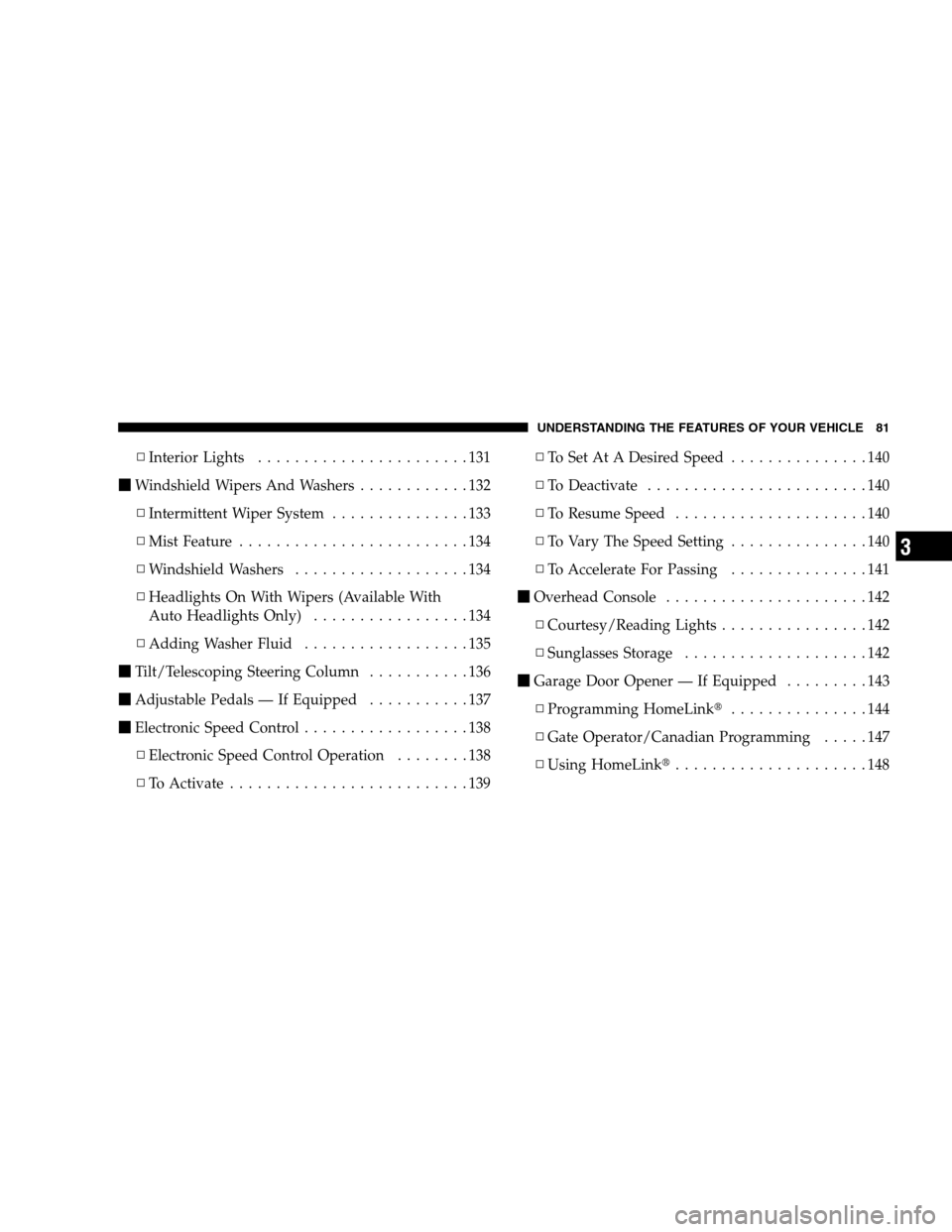
▫Interior Lights.......................131
�Windshield Wipers And Washers............132
▫Intermittent Wiper System...............133
▫Mist Feature.........................134
▫Windshield Washers...................134
▫Headlights On With Wipers (Available With
Auto Headlights Only).................134
▫Adding Washer Fluid..................135
�Tilt/Telescoping Steering Column...........136
�Adjustable Pedals — If Equipped...........137
�Electronic Speed Control..................138
▫Electronic Speed Control Operation........138
▫To Activate..........................139▫To Set At A Desired Speed...............140
▫To Deactivate........................140
▫To Resume Speed.....................140
▫To Vary The Speed Setting...............140
▫To Accelerate For Passing...............141
�Overhead Console......................142
▫Courtesy/Reading Lights................142
▫Sunglasses Storage....................142
�Garage Door Opener — If Equipped.........143
▫Programming HomeLink�...............144
▫Gate Operator/Canadian Programming.....147
▫Using HomeLink�.....................148
UNDERSTANDING THE FEATURES OF YOUR VEHICLE 81
3
Page 85 of 476
MIRRORS
Inside Day/Night Mirror
Adjust the mirror to center on the view through the rear
window. A two-point pivot system allows for horizontal
and vertical mirror adjustment.Annoying headlight glare can be reduced by moving the
small control under the mirror to the night position
(toward rear of vehicle). The mirror should be adjusted
while set in the day position (toward windshield).
Automatic Dimming Inside Mirror — If Equipped
This mirror automatically adjusts for annoying headlight
glare from vehicles behind you. You can turn the feature
on or off by pressing the button at the base of the mirror.
A light next to the button will illuminate to indicate when
the dimming feature is activated.
Adjusting Rearview Mirror
UNDERSTANDING THE FEATURES OF YOUR VEHICLE 83
3
Page 86 of 476
CAUTION!
To avoid damage to the mirror during cleaning, never
spray any cleaning solution directly onto the mirror.
Apply the solution onto a clean cloth and wipe the
mirror clean.
Outside Mirrors
To receive maximum benefit, adjust the outside mirror(s)
to center on the adjacent lane of traffic and a slight
overlap of the view obtained from the inside mirror.
NOTE:The passenger-side convex outside mirror will
give a much wider view to the rear, and especially of the
lane next to your vehicle.
WARNING!
Vehicles and other objects seen in the passenger-side
convex mirror will look smaller and farther away
than they really are. Relying too much on your
passenger-side convex mirror could cause you to
collide with another vehicle or other object. Use your
inside mirror when judging the size or distance of a
vehicle seen in the passenger-side convex mirror.
Automatic Dimming Mirror
84 UNDERSTANDING THE FEATURES OF YOUR VEHICLE


