Page 9 of 426
THINGS TO KNOW BEFORE STARTING YOUR VEHICLE
CONTENTS
mA Word About Your Keys..................12
NIgnition Key Removal...................12
NLocking Doors With The Key..............14
mSentry Key............................14
NReplacement Keys......................16
NCustomer Key Programming..............16
NGeneral Information....................18
mSteering Wheel Lock Ð If Equipped..........18NIf You Wish To Manually Lock The
Steering Wheel........................18
NTo Release The Steering Wheel Lock.........18
NAutomatic Transmission Ignition
Interlock System.......................19
mSecurity Alarm System Ð If Equipped.........19
NTo Set The Alarm......................19
NTo Disarm The System...................19
2
Page 12 of 426
A WORD ABOUT YOUR KEYS
The dealer that sold you your new vehicle has the key
code numbers for your vehicle locks. These numbers can
be used to order duplicate keys from your dealer. Ask
your dealer for these numbers and keep them in a safe
place.
Ignition Key Removal
Automatic Transmission
Place the shift lever in PARK. Turn the ignition switch to
the LOCK position, and remove the key.
NOTE:If you try to remove the key before you place the
lever in PARK, the key may become trapped temporarily
Ignition Key
Ignition Switch Positions
12 THINGS TO KNOW BEFORE STARTING YOUR VEHICLE
Page 19 of 426

Automatic Transmission Ignition Interlock System
This system prevents the key from being removed unless
the shift lever is in PARK. It also prevents shifting out of
PARK unless the key is in the ACC, or ON positions, and
the brake pedal is depressed.
SECURITY ALARM SYSTEM Ð IF EQUIPPED
This system monitors the vehicle doors and ignition for
unauthorized operation. When the alarm is activated, the
system provides both audible and visual signals. The
horn will sound repeatedly for 3 minutes and the head-
lights and security light in the instrument cluster will
flash for an additional 15 minutes. The engine will not
run until the system is disarmed.
To Set the Alarm:
The alarm will set when you use the power door locks or
use the Keyless Entry transmitter to lock the doors. After
all the doors are locked and closed, the security light in
the instrument cluster will flash rapidly to signal that thesystem is arming. The security light in the instrument
panel cluster will flash rapidly for about 15 seconds to
indicate that the alarm is being set. After the alarm is set,
the security light will flash at a slower rate to indicate
that the system is armed.
NOTE:If the security light stays on continuously during
vehicle operation, have the system checked by your
dealer.
To Disarm the System:
Use the Remote Keyless Entry transmitter to unlock the
doors. If something has triggered the system in your
absence, the horn will sound three times when you
unlock the doors. Check the vehicle for tampering.
The security system will also disarm, if the vehicle is
started with a programmed Sentry Key. If an unpro-
grammed Sentry Key is used to start a vehicle, the engine
will start and run for 2 seconds and then shut down.
After six unsuccessful attempts at starting the engine, the
THINGS TO KNOW BEFORE STARTING YOUR VEHICLE 19
2
Page 124 of 426
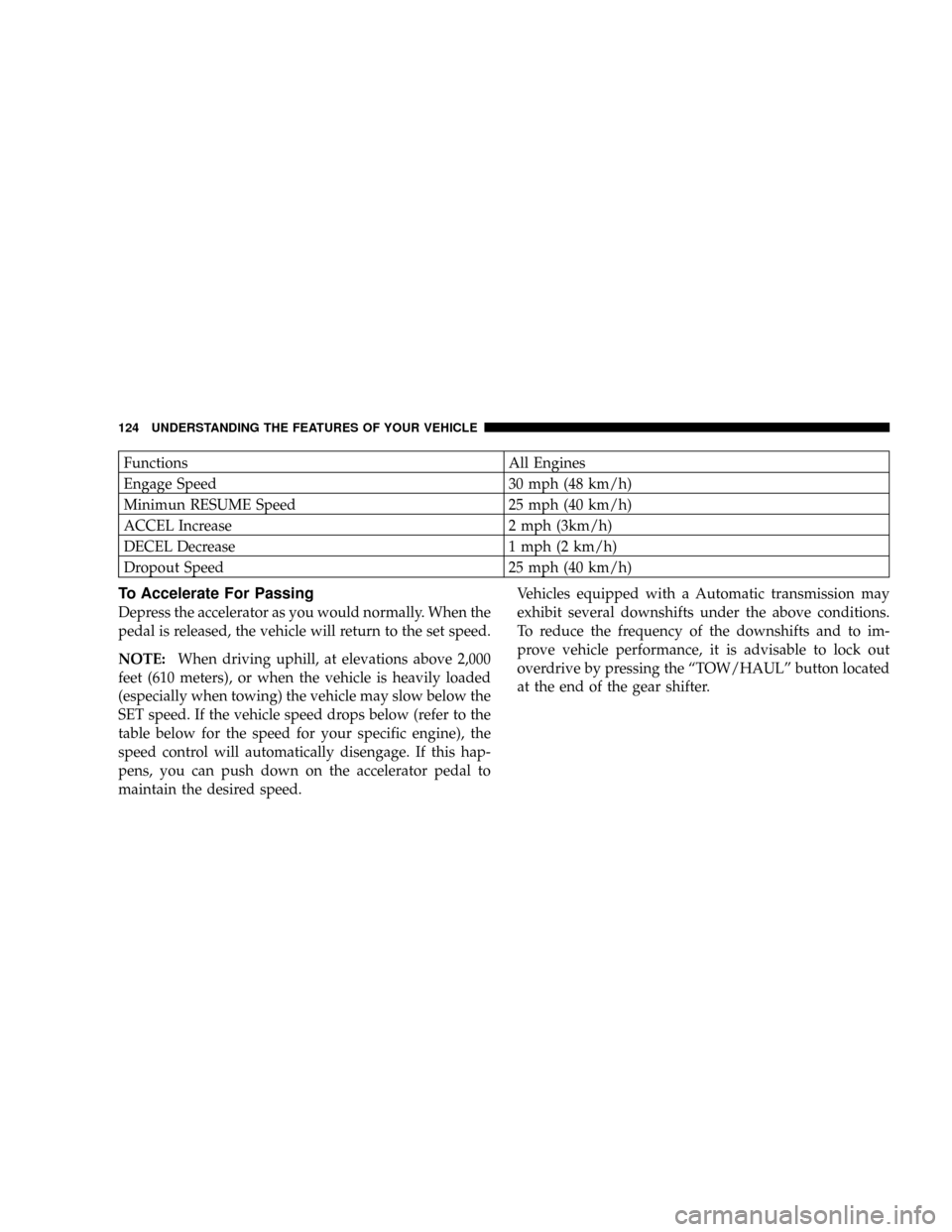
Functions All Engines
Engage Speed 30 mph (48 km/h)
Minimun RESUME Speed 25 mph (40 km/h)
ACCEL Increase 2 mph (3km/h)
DECEL Decrease 1 mph (2 km/h)
Dropout Speed 25 mph (40 km/h)
To Accelerate For Passing
Depress the accelerator as you would normally. When the
pedal is released, the vehicle will return to the set speed.
NOTE:When driving uphill, at elevations above 2,000
feet (610 meters), or when the vehicle is heavily loaded
(especially when towing) the vehicle may slow below the
SET speed. If the vehicle speed drops below (refer to the
table below for the speed for your specific engine), the
speed control will automatically disengage. If this hap-
pens, you can push down on the accelerator pedal to
maintain the desired speed.Vehicles equipped with a Automatic transmission may
exhibit several downshifts under the above conditions.
To reduce the frequency of the downshifts and to im-
prove vehicle performance, it is advisable to lock out
overdrive by pressing the ªTOW/HAULº button located
at the end of the gear shifter.
124 UNDERSTANDING THE FEATURES OF YOUR VEHICLE
Page 161 of 426

12. Engine Oil Pressure Indicator Light
This light indicates that the engine oil pressure has
become too low. For a bulb check, this light will
come on momentarily when the ignition is turned On. If
the light turns on while driving, stop the vehicle and shut
off the engine as soon as possible. Immediate service
should be obtained.
13. Tachometer
This gauge measures engine revolutions-per-minute
(rpm x 1000).
14. Gear Selector
The electronic gear selector display is self-contained
within the instrument cluster. It displays the position of
the automatic transmission shift lever, and the relation of
each position to all other positions. For a good signal the
display will place a box around the selected transmission
range (PRND21). If the PRNDL displays only the char-
acters PRND21 (no boxes), have the system checked by
an authorized dealer.15. Trip Odometer
The odometer shows the total distance the vehicle has
been driven. U.S. federal regulations require that upon
transfer of vehicle ownership, the seller certify to the
purchaser the correct mileage that the vehicle has been
driven. Therefore, if the odometer reading is changed
during repair or replacement, be sure to keep a record of
the reading before and after the service so that the correct
mileage can be determined.
The two trip odometers show individual trip mileage. To
switch from odometer to trip odometers, press and
release the Trip Odometer button.
To reset a trip odometer, display the desired trip odom-
eter to be reset then push and hold the button until the
display resets (approximately 2 seconds).
INSTRUMENT PANEL AND CONTROLS 161
4
Page 164 of 426

on for 15 seconds as a bulb check. If the light does not
come on during starting, have the system checked by an
authorized dealer.
20. BRAKE System Warning Light
This light will light when the ignition key is turned to the
ON position and will remain on for a few seconds. If the
light stays on, it may be an indication that the parking
brake has not been released, or there is a low brake fluid
level. If the light remains on when the parking brake has
been disengaged, and the fluid level is at the full mark on
the master cylinder reservoir, it indicates a possible brake
hydraulic system malfunction. In this case, the light will
remain on until the condition has been corrected. If the
parking brake is applied, the light will flash when the
gear position is out of park for automatic transmissions.
If brake failure is indicated, immediate repair is neces-
sary. Operating the vehicle in this condition is danger-
ous!21. Malfunction Indicator Light
This light is part of an onboard diagnostic system
which monitors the emissions and engine control
system. If the vehicle is ready for emissions
testing the light will come on when the ignition is first
turned on and remain on, as a bulb check, until the
engine is started. If the vehicle is not ready for emissions
testing the light will come on when the ignition is first
turned on and remain on for 15 seconds, then blink for 5
seconds, and remain on until the vehicle is started. If the
bulb does not come on during starting, have the condi-
tion investigated promptly.
If this light comes on and remains on while driving, it
suggests a potential engine control problem and the need
for system service.
Although your vehicle will usually be drivable and not
need towing, see your dealer for service as soon as
possible.
164 INSTRUMENT PANEL AND CONTROLS
Page 217 of 426
STARTING AND OPERATING
CONTENTS
mStarting Procedures.....................221
NManual Transmission..................221
NAutomatic Transmission................221
NNormal Starting......................222
NIf Engine Fails To Start.................222
NAfter Starting........................223
mEngine Block Heater Ð If Equipped.........224
mAutomatic Transmission..................224
NBrake/Transmission Interlock System.......225NAutomatic Transmission................225
mManual Transmission....................230
NRecommended Shift Speeds..............231
NDownshifting........................232
mFour-Wheel Drive Operation...............233
NNV233/243 GII Transfer Case Operating
Information/Precautions................233
NShifting Procedure - NV233/243
Transfer Case........................237
5
Page 221 of 426
STARTING PROCEDURES
The starter should not be operated for more than 15
second intervals. Waiting a few seconds between such
intervals will protect the starter from overheating.
WARNING!
Be sure to turn off the engine and remove the key
from the ignition switch if you want to rest or sleep
in your car. Accidents can be caused by inadvertently
moving the gear selection lever or by pressing the
accelerator pedal. This may cause excessive heat in
the exhaust system, resulting in overheating and
vehicle fire which may cause serious or fatal injuries.
WARNING!
Do not leave children or animals inside parked
vehicles in hot weather. Interior heat build up may
cause serious injury or death.
Manual Transmission
Apply the parking brake, place the gearshift control lever
in NEUTRAL and depress clutch pedal to the floor before
starting the vehicle. This vehicle is equipped with a
clutch interlocking ignition system. It will not start unless
the clutch is depressed.
Automatic Transmission
Start the engine with the shift lever in NEUTRAL or
PARK position. Apply the brake before shifting to any
driving range.
STARTING AND OPERATING 221
5