2008 DODGE DAKOTA oil level
[x] Cancel search: oil levelPage 338 of 426
These items should be inspected if a malfunction is
observed or suspected.
Engine Oil
Checking Engine Oil Level
To assure proper lubrication of your vehicle's engine, the
engine oil must be maintained at the correct level. The
best time to check the engine oil level is about 5 minutes
after a fully warmed up engine is shut off or before
starting the engine after it has sat overnight.
Checking the oil while the vehicle is on level ground will
improve the accuracy of the oil level readings. Always
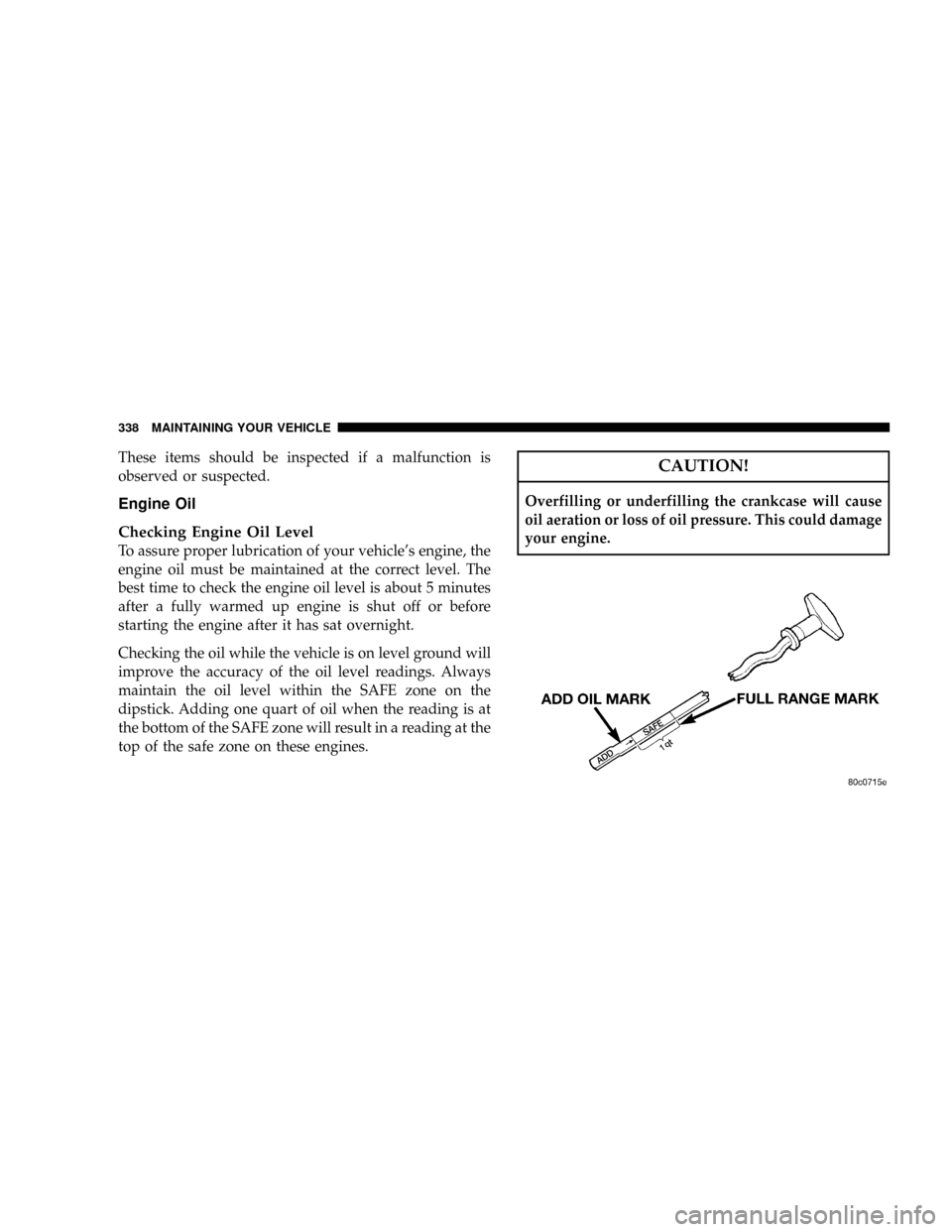
maintain the oil level within the SAFE zone on the
dipstick. Adding one quart of oil when the reading is at
the bottom of the SAFE zone will result in a reading at the
top of the safe zone on these engines.
CAUTION!
Overfilling or underfilling the crankcase will cause
oil aeration or loss of oil pressure. This could damage
your engine.
338 MAINTAINING YOUR VEHICLE
Page 349 of 426
Windshield Wiper Blades
The rubber edges of the wiper blades and the windshield
should be cleaned periodically with a sponge or soft cloth
and a mild nonabrasive cleaner. This will remove accu-
mulations of salt or road film.
Operation of the wipers on dry glass for long periods
may cause deterioration of the wiper blades. Always use
washer fluid when using the wipers to remove salt or dirt
from a dry windshield.
Avoid using the wiper blades to remove frost or ice from
the windshield. Keep the blade rubber out of contact with
petroleum products such as engine oil, gasoline, etc.
Windshield Washers
The fluid reservoir should be checked for fluid level at
regular intervals. When freezing weather is anticipated,
flush out the water in the reservoir by operating thesystem. Fill the reservoir with windshield washer anti-
freeze (not radiator antifreeze), and operate the system
for a few seconds to flush out the residual water.
To prevent freeze-up of your windshield washer system
in cold weather, select a solution or mixture that meets or
exceeds the temperature range of your climate. This
rating information can be found on most washer fluid
containers.
WARNING!
Commercially available windshield washer solvents
are flammable. They could ignite and burn you. Care
must be exercised when filling or working around
the washer solution.
MAINTAINING YOUR VEHICLE 349
7
Page 357 of 426
attempt to clean the oil PCV valve!Check ventilating
hose for indication of damage or plugging with deposits.
Replace if necessary.
Brake System
Power Disc Brakes (Front)
Disc brakes do not require adjustment; however, several
hard stops during the break-in period are recommended
to seat the linings and wear off any foreign material.
Brake Master Cylinders
The fluid level in the master cylinders should be checked
whenever the vehicle is serviced, or immediately if the
brake system warning light is on. If necessary, add fluid
to bring level to the full mark on the side of the reservoir
of the brake master cylinder. Be sure to clean the top of
the master cylinder area before removing the cap. With
disc brakes, fluid level can be expected to fall as the brakepads wear. Brake fluid level should be checked when
pads are replaced. If the brake fluid level is abnormally
low, check system for leaks.
Refer to Fluids, Lubricants and Genuine Parts for correct
fluid type.
WARNING!
Use of brake fluid that may have a lower initial
boiling point, or is unidentified as to specifications,
may result in sudden brake failure during hard
prolonged braking. You could have an accident.
MAINTAINING YOUR VEHICLE 357
7
Page 360 of 426

2. The vehicle must be on level ground.
3. Fully apply the parking brake and press the brake
pedal.
4. Place the gear selector momentarily in each gear
position ending with the lever in P (Park).
5. Remove the dipstick, wipe it clean and reinsert it until
seated.
6. Remove the dipstick again and note the fluid level on
both sides. The fluid level should be between the ªHOTº
(upper) reference holes on the dipstick at normal operat-
ing temperature. Verify that solid coating of oil is seen on
both sides of the dipstick. If the fluid is low, add as
required into the dipstick tube.Do not overfill.After
adding any quantity of oil through the oil fill tube, wait
a minimum of two (2) minutes for the oil to fully drain
into the transmission before rechecking the fluid level.NOTE:If it is necessary to check the transmissionbelow
the operating temperature, the fluid level should be
between the two ªCOLDº (lower) holes on the dipstick
with the fluid at approximately 70ÉF ( 21ÉC) (room
temperature). If the fluid level is correctly established at
room temperature, it should be between the ªHOTº
(upper) reference holes when the transmission reaches
180ÉF ( 82ÉC). Remember it is best to check the level at the
normal operating temperature.
CAUTION!
Be aware that if the fluid temperature is below 50ÉF
(10ÉC) it may not register on the dipstick. Do not add
fluid until the temperature is elevated enough to
produce an accurate reading.
7. Check for leaks. Release parking brake.
360 MAINTAINING YOUR VEHICLE
Page 362 of 426

Transfer Case
Inspect the transfer case for fluid leaks. If a fluid leak is
evident the transfer case fluid level may be low. Have the
transfer case serviced immediately.
CAUTION!
Damage may result from operation of the vehicle
with low transfer case fluid.
The transfer case fluid should be drained and refilled at
the intervals specified.
Lubricant Selection
Refer to Fluids, Lubricants and Genuine Parts for correct
fluid type.
Axles
Refer to Fluids, Lubricants and Genuine Parts for correct
fluid type.
The manufacturer does not recommend regularly sched-
uled oil changes for axles in vehicles whose operation is
classified as normal truck service.
NOTE:The presence of water in the gear lubricant will
result in corrosion and possible failure of differential
components. Operation of the vehicle in water, as may be
encountered in some off-highway types of service, will
require draining and refilling the axle to avoid damage.
Rear Axle
Rear Axle Limited-slip differentials require the use of
Mopar limited-slip additive. Refer to Recommended Flu-
ids, Lubricants and Genuine Parts for correct fluid type.
This should be added to the gear lubricant whenever a
fluid change is made, when equipped with limited-slip
362 MAINTAINING YOUR VEHICLE
Page 389 of 426
²Change your engine oil more often if you drive your
vehicle off-road for an extended period of time.
²Under no circumstances should oil change intervals
exceed 6,000 miles (10,000 km) or 6 months, whichever
comes first.
Your dealer will reset the oil change indicator message
after completing the scheduled oil change. If this sched-
uled oil change is performed by someone other than your
dealer the message can be reset by referring to the steps
described under ªOil Change Requiredº in ªUse Factory
Settingsº of the EVIC section in this manual or under
ªOdometer/Trip Odometerº in the ªInstrument Cluster
Descriptions section of this manual.
At Each Stop for Fuel
²Check the engine oil level about 5 minutes after a fully
warmed engine is shut off. Checking the oil level whilethe vehicle is on level ground will improve the accu-
racy of the oil level reading. Add oil only when the
level is at or below the ADD or MIN mark.
²Check the windshield washer solvent and add if
required.
Once a Month
²Check tire pressure and look for unusual wear or
damage.
²Inspect the battery and clean and tighten the terminals
as required.
²Check the fluid levels of coolant reservoir, brake
master cylinder, power steering and transmission and
add as needed.
²Check all lights and other electrical items for correct
operation.
MAINTENANCE SCHEDULES 389
8
M
A
I
N
T
E
N
A
N
C
E
S
C
H
E
D
U
L
E
S
Page 390 of 426
At Each Oil Change
²Change the engine oil filter.
²Inspect the brake hoses and lines.
²Check the Manual Transmission fluid level.
CAUTION!
Failure to perform the required maintenance items
may result in damage to the vehicle.
Required Maintenance Intervals
NOTE:** Vehicles built with the 4.7L engine are
equipped with sixteen spark plugs, one set is located on
the top of the engine under the coils and the second set is
located on the side of the engine.
The spark plugs located under the coils are a standard
plug and must be change every 30,000 miles (50 000 km)
The spark plugs located on the side of the engine are a
premium plug and must be changed every 102,000 miles
(170 000 km).
390 MAINTENANCE SCHEDULES
8
M
A
I
N
T
E
N
A
N
C
E
S
C
H
E
D
U
L
E
S
Page 413 of 426

Flexible Fuel Vehicles
Cruising Range........................ 287
Engine Oil........................... 286
Fuel Requirements..................284,285
Maintenance.......................... 287
Replacement Parts..................... 287
Starting............................. 286
Flooded Engine Starting................... 222
Floor Console.......................... 140
Fluid, Brake........................... 386
Fluid Capacities......................... 384
Fluid Level Checks
Automatic Transmission................. 359
Brake............................... 357
Engine Oil........................... 338
Power Steering........................ 347
Transfer Case......................... 362
Fluids, Lubricants and Genuine Parts.......... 385
Fog Lights.......................... 116,383Four Wheel Drive....................... 233
Operation........................... 233
Four-Way Hazard Flasher.................. 312
Freeing A Stuck Vehicle................... 325
Front Axle (Differential)................... 363
Fuel................................. 278
Adding............................. 282
Filter............................... 343
Gauge.............................. 158
Octane Rating......................278,385
Requirements......................278,384
Tank Capacity........................ 384
Fuel, Flexible.............See Flexible Fuel Vehicles
Fueling............................... 282
Fuses................................ 367
Garage Door Opener (HomeLinkt) ........... 132
Gas Cap (Fuel Filler Cap)...............283,335
Gas Gauge (Fuel Gauge)................... 158
INDEX 413
10