Page 336 of 426

Your vehicle has a simple ignition key actuated test
which you can use prior to going to the test station. To
check if your vehicle's OBD system is ready, you must do
the following:
1. Insert your ignition key into the ignition switch.
2. Turn the ignition to the ON position, but do not crank
or start the engine. If you crank or start the engine, you
will have to start this test over.
3. As soon as you turn your key to the ON position, you
will see your MIL symbol come on as part of a normal
bulb check.
4. Approximately 15 seconds later, one of two things will
happen:
a. The MIL light will blink for approximately 5 sec-
onds and then remain on until the first engine crank or
the key is turned off. This means that your vehicle's
OBD system isnot readyand you shouldnotproceed
to the I/M station.b. The MIL light will remain fully illuminated until the
first engine crank or the key is turned off. This means
that your vehicle's OBD system isreadyand you can
proceed to the I/M station.
If your OBD system isnot readyyou should see your
dealer or repair facility. If your vehicle was recently
serviced or had a battery failure or replacement, you may
need to do nothing more than drive your vehicle as you
normally would in order for your OBD system to update.
A recheck with the above test routine may then indicate
that the system is now ready.
Regardless of whether your vehicle's OBD system is
ready or not ready, if the MIL symbol is illuminated
during normal vehicle operation, you should have your
vehicle serviced before going to the I/M station. The I/M
station can fail your vehicle because the MIL symbol is on
with the engine running.
336 MAINTAINING YOUR VEHICLE
Page 357 of 426

attempt to clean the oil PCV valve!Check ventilating
hose for indication of damage or plugging with deposits.
Replace if necessary.
Brake System
Power Disc Brakes (Front)
Disc brakes do not require adjustment; however, several
hard stops during the break-in period are recommended
to seat the linings and wear off any foreign material.
Brake Master Cylinders
The fluid level in the master cylinders should be checked
whenever the vehicle is serviced, or immediately if the
brake system warning light is on. If necessary, add fluid
to bring level to the full mark on the side of the reservoir
of the brake master cylinder. Be sure to clean the top of
the master cylinder area before removing the cap. With
disc brakes, fluid level can be expected to fall as the brakepads wear. Brake fluid level should be checked when
pads are replaced. If the brake fluid level is abnormally
low, check system for leaks.
Refer to Fluids, Lubricants and Genuine Parts for correct
fluid type.
WARNING!
Use of brake fluid that may have a lower initial
boiling point, or is unidentified as to specifications,
may result in sudden brake failure during hard
prolonged braking. You could have an accident.
MAINTAINING YOUR VEHICLE 357
7
Page 361 of 426

To prevent dirt and water from entering the transmission
after checking or replenishing fluid, make certain that the
dipstick cap is properly reseated. It is normal for the
dipstick cap to spring back slightly from its fully seated
position, as long as its seal remains engaged in the
dipstick tube.
Automatic Transmission Fluid And Filter Change
Follow the proper Maintenance Schedule for your type of
driving.
Selection of Lubricant
It is important that the proper lubricant is used in the
transmission to assure optimum transmission perfor-
mance. Use only manufacturer 's recommended transmis-
sion fluid; refer to Fluids, Lubricants and Genuine Parts
for correct fluid type. It is important that the transmission
fluid be maintained at the prescribed level using the
recommended fluid.
CAUTION!
Using a transmission fluid other than the manufac-
turers recommended fluid may cause deterioration in
transmission shift quality and/or torque converter
shudder. Using a transmission fluid other than the
manufacturers recommended fluid will result in
more frequent fluid and filter changes.
Special Additives
Automatic Transmission Fluid (ATF) is an engineered
product and its performance may be impaired by supple-
mental additives. Therefore, do not add any fluid addi-
tives to the transmission. The only exception to this
policy is the use of special dyes to aid in detecting fluid
leaks. In addition, avoid using transmission sealers as
they may adversely affect seals.
MAINTAINING YOUR VEHICLE 361
7
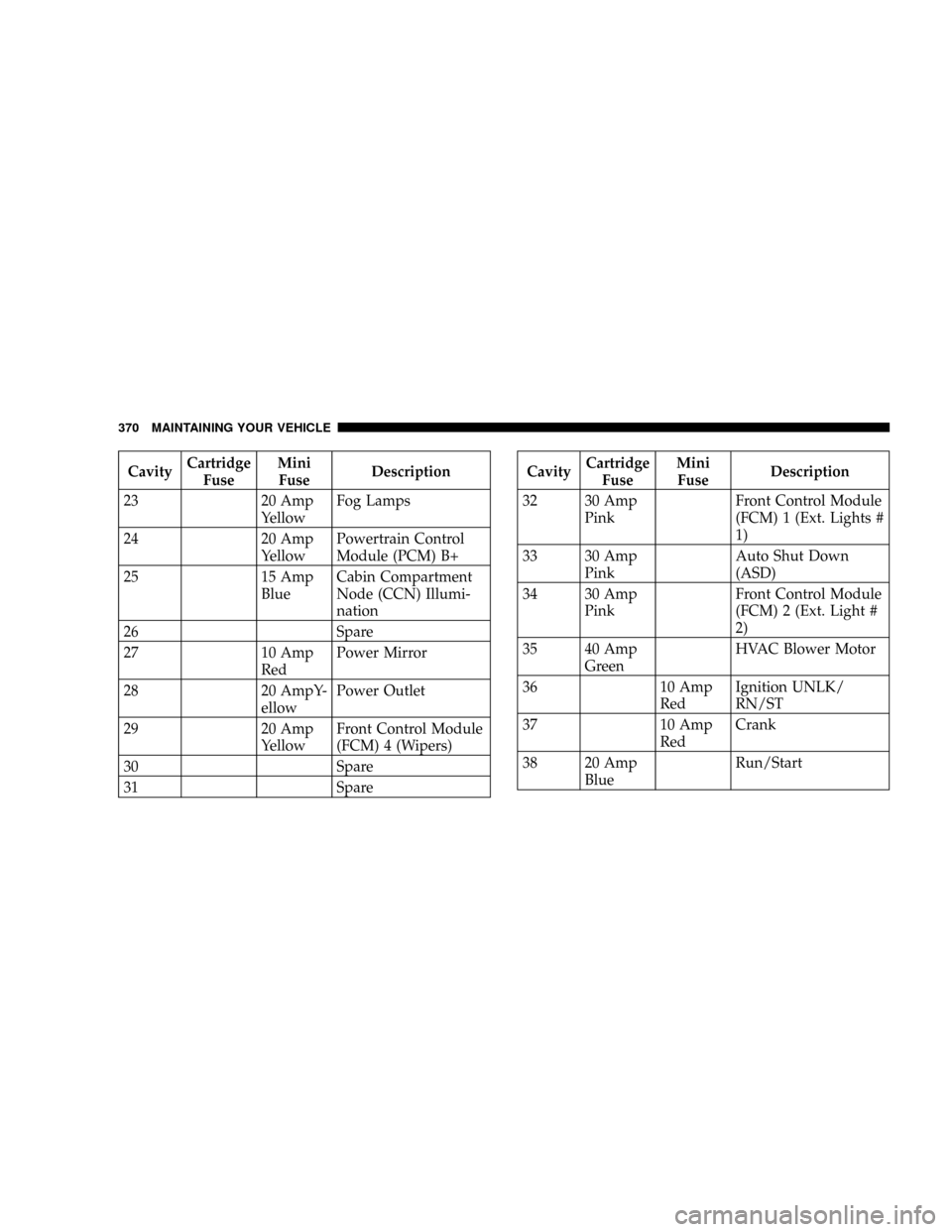
Page 370 of 426
CavityCartridge
FuseMini
FuseDescription
23 20 Amp
YellowFog Lamps
24 20 Amp
YellowPowertrain Control
Module (PCM) B+
25 15 Amp
BlueCabin Compartment
Node (CCN) Illumi-
nation
26 Spare
27 10 Amp
RedPower Mirror
28 20 AmpY-
ellowPower Outlet
29 20 Amp
YellowFront Control Module
(FCM) 4 (Wipers)
30 Spare
31 SpareCavityCartridge
FuseMini
FuseDescription
32 30 Amp
PinkFront Control Module
(FCM) 1 (Ext. Lights #
1)
33 30 Amp
PinkAuto Shut Down
(ASD)
34 30 Amp
PinkFront Control Module
(FCM) 2 (Ext. Light #
2)
35 40 Amp
GreenHVAC Blower Motor
36 10 Amp
RedIgnition UNLK/
RN/ST
37 10 Amp
RedCrank
38 20 Amp
BlueRun/Start
370 MAINTAINING YOUR VEHICLE
Page 373 of 426

fuse to be disconnected, without removing it from the
fuse block. Pressing the I.O.D. fuse back into the cavity
reconnects it.
VEHICLE STORAGE
If you are storing your vehicle for more than 21 days, we
recommend that you take the following steps to mini-
mize the drain on your vehicle's battery:
²Disconnect the Ignition-Off Draw fuse (I.O.D.) fuse
located in the Power Distribution Center (PDC). The
I.O.D. cavity includes a snap-in retainer that allows the
fuse to be disconnected, without removing it from the
fuse block.
²The transfer case should be placed in the 4HI mode
and kept in this position to minimize the battery drain.
²As an alternative to the above steps you may discon-
nect the negative cable from the battery.
REPLACEMENT LIGHT BULBS
LIGHT BULBS Ð Interior Bulb No.
Dome Light........................WL212±2
Cargo Light............................ 921
Overhead Console Lights................... 192
Reading Light.......................WL212±2
LIGHT BULBS Ð Outside Bulb No.
Headlight............................. H13
Front Park/Turn/Sidemarker.............3157NA
Back-Up..............................3157
Center High Mounted Stoplight.............. 921
Fog Lamp.............................9145
License Plate Light....................... 168
Rear Tail, Stop, Turn Signal.................3057
MAINTAINING YOUR VEHICLE 373
7
Page 374 of 426
BULB REPLACEMENT
Headlight (Halogen)/Front Park and Turn Lights
CAUTION!
This is a halogen bulb. Avoid touching the glass with
your fingers. Reduced bulb life will result.
1. Open the hood
2. Remove the three (3) bolts from the front of the
headlight housing.
3. Grasp the headlight and pull firmly to disengage the
headlight housing from the fender panel.
374 MAINTAINING YOUR VEHICLE
Page 375 of 426
4. While firmly holding the headlight housing in your
hands unlock and disconnect headlight bulb connector.
5. Twist 1/4 turn and remove headlight bulb from hous-
ing and replace.NOTE:It is not necessary to disconnect the connector to
replace the park/turn signal bulb. If the bulb socket
needs replacement disconnect the connector.
NOTE:The headlight bulb is a Halogen bulb. Take care
not to touch the bulb with your fingers. Body oils from
your fingers could cause excessive heat buildup which
reduces bulb life.
To remove the park/turn signal bulb, rotate bulb socket
1/4 turn and remove socket from housing. Pull bulb
straight from socket.
Unlocking Headlight Connector
MAINTAINING YOUR VEHICLE 375
7
Page 389 of 426

²Change your engine oil more often if you drive your
vehicle off-road for an extended period of time.
²Under no circumstances should oil change intervals
exceed 6,000 miles (10,000 km) or 6 months, whichever
comes first.
Your dealer will reset the oil change indicator message
after completing the scheduled oil change. If this sched-
uled oil change is performed by someone other than your
dealer the message can be reset by referring to the steps
described under ªOil Change Requiredº in ªUse Factory
Settingsº of the EVIC section in this manual or under
ªOdometer/Trip Odometerº in the ªInstrument Cluster
Descriptions section of this manual.
At Each Stop for Fuel
²Check the engine oil level about 5 minutes after a fully
warmed engine is shut off. Checking the oil level whilethe vehicle is on level ground will improve the accu-
racy of the oil level reading. Add oil only when the
level is at or below the ADD or MIN mark.
²Check the windshield washer solvent and add if
required.
Once a Month
²Check tire pressure and look for unusual wear or
damage.
²Inspect the battery and clean and tighten the terminals
as required.
²Check the fluid levels of coolant reservoir, brake
master cylinder, power steering and transmission and
add as needed.
²Check all lights and other electrical items for correct
operation.
MAINTENANCE SCHEDULES 389
8
M
A
I
N
T
E
N
A
N
C
E
S
C
H
E
D
U
L
E
S