2008 DODGE DAKOTA instrument panel
[x] Cancel search: instrument panelPage 214 of 426

Summer Operation
Air conditioned vehicles must be protected with a high
quality antifreeze coolant during summer to provide
proper corrosion protection and to raise the boiling point
of the coolant for protection against overheating. A 50%
concentration of engine coolant to distilled water is
recommended. See ªCooling Systemº in the Maintaining
Your Vehicle section of your Owner's Manual.
When using the air conditioner in extremely heavy traffic
in hot weather especially when towing a trailer, addi-
tional engine cooling may be required. If this situation is
encountered, operate the transmission in a lower gearand set the air conditioner to recirculation mode. Oper-
ating the air conditioner in recirculation mode provides
the maximum performance from your air conditioning.
When stopped in heavy traffic, it may be necessary to
shift into NEUTRAL and depress the accelerator slightly
for fast idle operation.
Winter Operation
When operating the system during the winter months,
make sure the air intake, located directly in front of the
windshield, is free of ice, slush, snow, or other obstruc-
tions. This will help prevent snow going into the ducts.
214 INSTRUMENT PANEL AND CONTROLS
Page 215 of 426

Operation Tips Chart
INSTRUMENT PANEL AND CONTROLS 215
4
Page 233 of 426
CAUTION!
Failure to follow the recommended downshifting
speeds may cause the engine to over speed and / or
damage the clutch disc even if the clutch pedal is
depressed.
FOUR-WHEEL DRIVE OPERATION
NV233/243 GII Transfer Case Operating
Information/Precautions
The NV233/243 is an electric shift transfer case and is
operated by the 4WD Control Switch (Transfer Case
Switch), which is located on the instrument panel.
The NV233/243 transfer case provides 4 mode positions:
2 (rear) wheel drive high range, 4 wheel drive high range,
4 wheel drive low range, and neutral.The NV233/243 transfer case is designed to be driven in
the 2 wheel drive position (2WD) for normal street and
highway conditions (dry hard surfaced roads).
When additional traction is required, the transfer case
4WD LOCK and 4WD LOW positions can be used to lock
the front and rear driveshafts together and force the front
and rear wheels to rotate at the same speed. This is
accomplished by rotating the 4WD Control Switch to the
desired position - see Shifting Procedure section for
specific shifting instructions. The 4WD LOCK and 4WD
LOW positions are designed for loose or slippery road
surfaces only. Driving in the 4WD LOCK and 4WD LOW
positions on dry hard-surfaced roads may cause in-
creased tire wear and damage to the driveline compo-
nents.
The transfer case Neutral (N) position is selected by
depressing the recessed button located on the lower left
hand corner of the 4WD Control Switch.
STARTING AND OPERATING 233
5
Page 239 of 426

4. After the desired position indicator light is ON (not
flashing), shift transmission back into gear (release clutch
on manual transmissions).
NOTE:If steps 1 or 2 of either the Preferred or Alternate
Procedure are not satisfied prior to attempting the shift or
if they no longer are being met while the shift attempt is
in process, then the indicator light will flash and the
current transfer case position will be maintained. To retry
the selection, turn the control knob back to the current
position, wait five (5) seconds, and retry shift.
NOTE:The ignition key must be ON for a shift to take
place and for the position indicator lights to be operable.
If the key is not ON then the shift will not take place and
no position indicator lights will be on or flashing.NV 244 Generation II Transfer Case Operating
Information / Precautions
The NV 244 Generation II is an electric shift transfer case
and is operated by the 4WD Control Switch, which is
located on the instrument panel.
The NV 244 Generation II transfer case provides 4 mode
positions - Normal four-wheel-drive (4WD) high range,
four-wheel-drive lock (4WD LOCK), four-wheel-drive
low (4WD LOW) range, and neutral (N).
This transfer case is equipped with an inter-axle differ-
ential that allows driving the vehicle in the normal
all-wheel-drive position (4WD) at all times on any given
road surface, including dry hard surfaced roads. The
4WD mode allows the front and rear wheels to rotate at
different speeds. This eliminates driveline binding and
component wear normally associated with driving the
vehicle in the 4WD LOCK position on dry hard surfaced
STARTING AND OPERATING 239
5
Page 247 of 426
WARNING!
²Driving through standing water limits your vehi-
cle's traction capabilities. Do not exceed 5 mph (8
km/h) when driving through standing water.
²Driving through standing water limits your vehi-
cle's braking capabilities, which increases stop-
ping distances. Therefore, after driving through
standing water, drive slowly and lightly press on
the brake pedal several times to dry the brakes.
²Getting water inside your vehicle's engine can
cause it to lockup and stall out and leave you
stranded.
²Failure to follow these warnings may result in
injuries that are serious or fatal to you, your
passengers, and others around you.
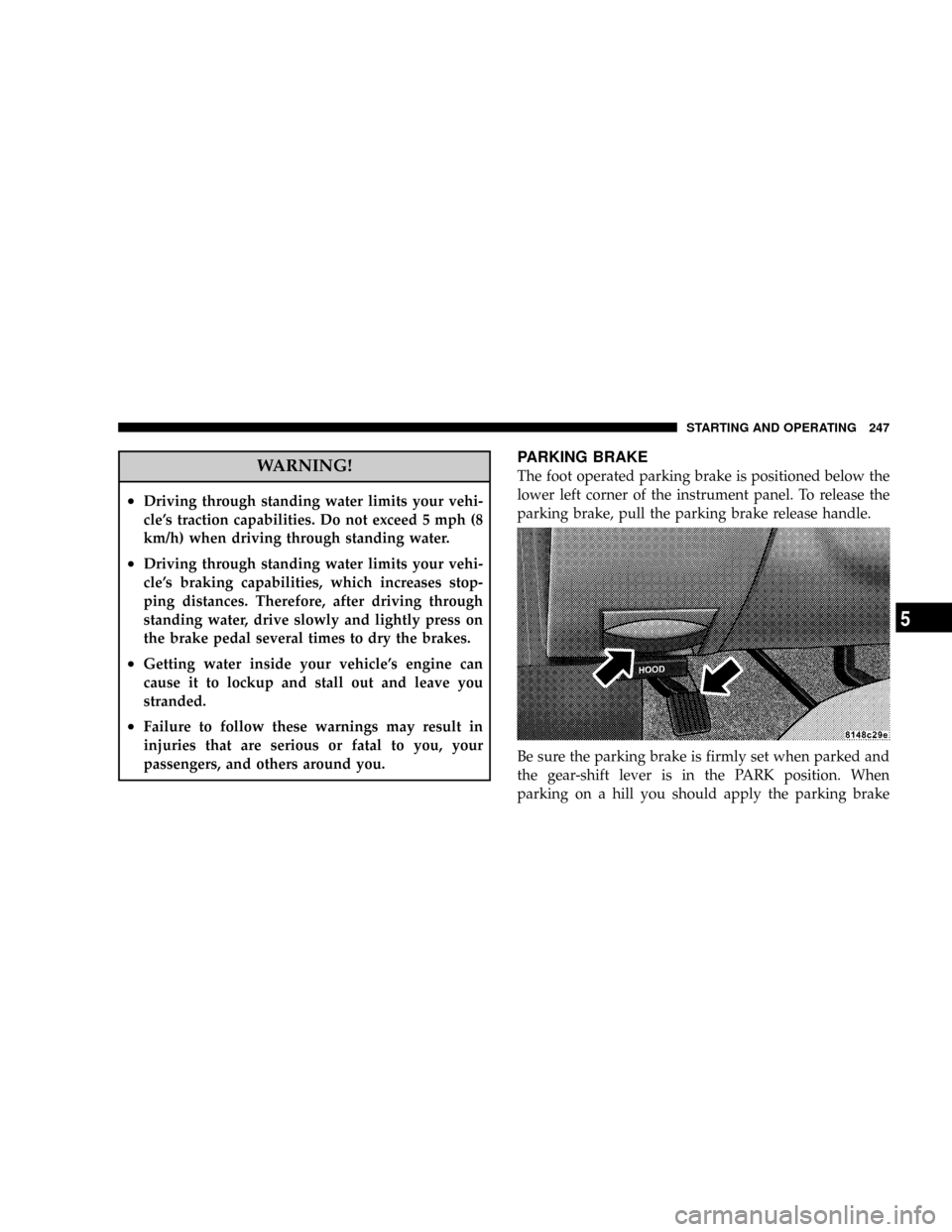
PARKING BRAKE
The foot operated parking brake is positioned below the
lower left corner of the instrument panel. To release the
parking brake, pull the parking brake release handle.
Be sure the parking brake is firmly set when parked and
the gear-shift lever is in the PARK position. When
parking on a hill you should apply the parking brake
STARTING AND OPERATING 247
5
Page 367 of 426

Instrument Panel Bezels
CAUTION!
When installing hanging air fresheners in your ve-
hicle, read the installation instructions carefully.
Some air fresheners will damage the finish of
painted or decorated parts if allowed to directly
contact any surface.
Cleaning Plastic Instrument Cluster Lenses
The lenses in front of the instruments in this vehicle are
molded in clear plastic. When cleaning the lenses, care
must be taken to avoid scratching the plastic.
1. Clean with a wet soft rag. A mild soap solution may be
used, but do not use high alcohol content or abrasive
cleaners. If soap is used, wipe clean with a clean damp
rag.2. Dry with a soft tissue.
Seat Belt Maintenance
Do not bleach, dye or clean the belts with chemical
solvents or abrasive cleaners. This will weaken the fabric.
Sun damage will also weaken the fabric.
If the belts need cleaning, use a mild soap solution or
lukewarm water. Do not remove the belts from the car to
wash them.
Replace the belts if they appear frayed or worn or if the
buckles do not work properly.
FUSES (POWER DISTRIBUTION CENTER)
Your vehicle is equipped with an electrical power distri-
bution center located on the left side of the engine
compartment.
MAINTAINING YOUR VEHICLE 367
7
Page 415 of 426

Hoses................................ 356
Ignition............................... 12
Key ................................. 12
Ignition Key Removal..................... 12
Illuminated Entry........................ 20
Immobilizer (Sentry Key)................... 14
Infant Restraint........................55,56
Inflation Pressure Tires.................... 270
Inside Rearview Mirror.................... 77
Instrument Cluster....................... 158
Instrument Panel and Controls.............. 156
Instrument Panel Lens Cleaning............. 367
Interior Appearance Care.................. 366
Interior Lights.......................... 113
Intermittent Wipers (Delay Wipers)........... 119
Introduction............................. 4
Jack Operation.......................313,318Jacking Instructions...................... 319
Key, Programming........................ 16
Key, Replacement........................ 16
Key, Sentry (Immobilizer)................... 14
Keyless Entry System...................... 21
Keys................................. 12
Knee Bolster............................ 45
Lane Change and Turn Signals......... 117,158,377
Lap/Shoulder Belts....................... 36
LATCH
(Lower Anchors and Tether for CHildren)....... 59
Life of Tires............................ 267
Lights..............................71,112
Airbag............................53,166
Anti-Lock Warning..................... 160
Back-Up............................. 377
Brake Warning........................ 164
INDEX 415
10
Page 426 of 426

INTRODUCTION INTRODUCTION HOW TO USE THIS MANUAL WARNINGS AND CAUTIONS VEHICLE IDENTIFICATION NUMBER VEHICLE MODIFICATIONS/ALTERATIONS THINGS TO KNOW BEFORE STARTING YOUR VEHICLE A WORD ABOUT YOUR KEYS
Ignition Key RemovalLocking Doors With The KeySENTRY KEY Replacement KeysCustomer Key ProgrammingGeneral InformationSTEERING WHEEL LOCK - IF EQUIPPED If You Wish To Manually Lock The Steering WheelTo Release The Steering Wheel LockAutomatic
Transmission Ignition Interlock SystemSECURITY ALARM SYSTEM - IF EQUIPPED To Set the AlarmTo Disarm the SystemILLUMINATED ENTRY Vehicles EquippedWith Power Door LocksREMOTE KEYLESS ENTRY To unlock the doorsTo lock the doorsUsing the Panic
AlarmGeneral InformationProgramming Additional TransmittersBattery ReplacementREMOTE STARTING SYSTEM - IF EQUIPPED DOOR LOCKS Manual Door LocksPower Door LocksChild Protection Door LockWINDOWS Power Windows Auto Down (Drivers Side Only)
Window Lockout SwitchWIND BUFFETINGOCCUPANT RESTRAINTS Lap/Shoulder BeltsAdjustable Upper Shoulder Belt AnchorageAutomatic Locking Retractors (ALR) Mode - If EquippedCenter Lap BeltsSeat Belt PretensionersEnhanced Driver Seat Belt Reminder
System (BeltAlert) Seat Belts and Pregnant WomenSeat Belt ExtenderDriver And Right Front Passenger Supplemental Restraint System (SRS) - Airbags Event Data Recorder (EDR)Child RestraintENGINE BREAK-IN RECOMMENDATIONS SAFETY TIPS Exhaust System
Safety Checks You Should Make Inside The VehicleSafety Checks You Should Make Outside The VehicleUNDERSTANDING THE FEATURES OF YOUR VEHICLE MIRRORSInside Day/Night MirrorOutside MirrorsExterior Mirrors Folding Feature - If EquippedElectric
Remote-Control MirrorsHANDS-FREE COMMUNICATION (UConnect) - IF EQUIPPED OperationPhone Call FeaturesUConnect System FeaturesAdvanced Phone ConnectivityThings You Should Know About Your UConnect SystemGeneral InformationSEATS Manual Seat
AdjustmentFront Seats Manual Seat ReclinersManual Lumbar Support Adjustment - If EquippedAdjustable Head Restraints - Front Seating Positions6 -Way Power Seat Adjuster - Drivers Side OnlyExtended Cab/Crew Cab Rear SeatHeated Seats - If EquippedTO OPEN
AND CLOSE THE HOOD LIGHTS Interior Lights Battery SaverHeadlamp DelayHeadlights, Parking Lights, Panel LightsDaytime Running Lights (Canada - Standard and US Fleet Vehicles - If Equipped)Lights-on ReminderFog Lights - If EquippedCARGO Light - If Equipped
Multifunction Control LeverWINDSHIELD WIPERS AND WASHERS Windshield Wipers Windshield WashersTILT STEERING COLUMN ELECTRONIC SPEED CONTROL - IFEQUIPPED To ActivateTo Set At A Desired SpeedTo DeactivateTo Resume SpeedTo Vary The
Speed SettingTo Accelerate For PassingOVERHEAD CONSOLE Courtesy/Reading LightsCOMPASS/TEMPERATURE MINI-TRIP COMPUTER US/M ButtonRESET Button Global ResetStep Button Average Fuel Economy (AVG ECO)Distance To Empty (DTE)Trip Odometer
(ODO)Elapsed Time (ET)C/T Button Compass/Temperature DisplayAutomatic Compass CalibrationManual Compass CalibrationTo Put Into a CalibrationModeOutside TemperatureGARAGE DOOR OPENER - IF EQUIPPED Programming HomeLinkGate Operator/Canadian
ProgrammingUsing HomeLinkReprogramming a Single HomeLink ButtonSecurityTroubleshooting TipsGeneral InformationELECTRICAL POWER OUTLETS Electrical Outlet Use With Engine OFF
(Battery Fed Configuration)FLOOR CONSOLE - IF EQUIPPED Floor Console FeaturesCENTER STORAGE COMPARTMENT - IF EQUIPPED CUP HOLDERS REAR STORAGE - IFEQUIPPED Rear Convenience Storage CratesPlastic Grocery Bag Retainers REAR
WINDOW FEATURES Rear Window Defroster - If EquippedSliding Rear Window - If Equipped TAILGATE Tailgate RemovalTwo Position Tailgate / Upper Load PlatformREAR CARGO AREA UTILITY RAILS SLIDE-IN CAMPERS Camper ApplicationsGeneral Information
Carbon Monoxide Warning Vehicles Equipped With A Cap or Slide-In CampersINSTRUMENT PANEL AND CONTROLS INSTRUMENTS AND CONTROLS INSTRUMENT CLUSTERINSTRUMENT CLUSTER DESCRIPTION ELECTRONIC DIGITAL CLOCK Clock Setting
ProcedureRADIO GENERAL INFORMATION Radio Broadcast SignalsTwo Types of SignalsElectrical DisturbancesAM ReceptionFM ReceptionSALES CODE RES -AM/FM STEREO RADIO WITH CD PLAYER (MP3 AUX JACK) Operating Instructions - Radio ModeOperation
Instructions - CD MODE for CD and MP3 Audio PlayNotes On Playing MP3 FilesLIST Button (CD Mode for MP3 Play)INFO Button (CD Mode for MP3 Play)SALES CODE REQ - AM/FM STEREO RADIO AND 6-DISC CD/DVD CHANGER (MP3/WMA AUX JACK) Operating
Instructions - Radio ModeOperation Instructions - (DISC MODE for CD and MP3/WMA Audio Play, DVD-VIDEO)Notes On Playing MP3/WMA FilesLIST Button (DISC Mode for MP3/WMA Play)INFO Button (DISC Mode for MP3/WMA Play)SALES CODE RER - MULTIMEDIA
SYSTEM - IF EQUIPPED Operating Instructions - Satellite RadioOperating Instructions - Hands-Free Communication (UConnect) (If Equipped)Clock Setting ProcedureSATELLITE RADIO (RSC) - IF EQUIPPED (RER/REQ/REN RADIOS ONLY) System ActivationElectronic
Serial Number/Sirius Identification Number (ENS/SID)Selecting Satellite ModeSatellite AntennaReception QualityOperating Instructions - Satellite ModeOperating Instructions - Hands Free Phone (If Equipped)Operating Instructions - Video Entertainment System (VES) (If
Equipped)REMOTE SOUND SYSTEM CONTROLS - IF EQUIPPED Radio OperationCD PlayerCOMPACT DISC MAINTENANCE SOUND BOX OPERATION RADIO OPERATION AND CELLULAR PHONES CLIMATE CONTROLS Air Conditioning And Heater Operating
TipsOperation Tips Chart STARTING AND OPERATING STARTING PROCEDURES Manual TransmissionAutomatic TransmissionNormal StartingIf Engine Fails To StartAfter StartingEngine Block Heater - If Equipped AUTOMATIC TRANSMISSION Brake/Transmission
Interlock SystemAutomatic TransmissionMANUAL TRANSMISSION Recommended Shift SpeedsDownshiftingFOUR-WHEEL DRIVE OPERATION NV233/243 GII Transfer Case Operating Information/PrecautionsShifting Procedure - NV233/243 Transfer Case NV 244
Generation II Transfer Case Operating Information / PrecautionsShifting Procedure - NV 244 Generation II Transfer Case LIMITED-SLIP REAR AXLE DIFFERENTIAL - IF EQUIPPED DRIVING ON SLIPPERY SURFACES DRIVING THROUGH WATER Flowing/Rising Water
Shallow Standing WaterPARKING BRAKE BRAKE SYSTEM Rear Wheel Anti-Lock Brake System - If EquippedFour-Wheel Anti-Lock Brake SystemPOWER STEERING TIRE SAFETY INFORMATION Tire Markings Tire Identification Number (TIN)Tire Loading and Tire
PressureTIRES - GENERAL INFORMATION Tire PressureTire Inflation PressuresRadial-Ply TiresCompact Spare Tire - If EquippedLimited Use Spare - If EquippedTire SpinningTread Wear IndicatorsLife of TireReplacement TiresAlignment And BalanceSUPPLEMENTAL
TIRE PRESSURE
INFORMATION - IF EQUIPPED TIRE CHAINS SNOW TIRES TIRE ROTATION RECOMMENDATIONS TIRE PRESSURE MONITOR SYSTEM (TPMS) - IF EQUIPPED Base System - If EquippedGeneral InformationFUEL REQUIREMENTS Reformulated Gasoline
Gasoline/Oxygenate BlendsMMT In GasolineMaterials Added To FuelFuel System CautionsCarbon Monoxide WarningsADDING FUEL Fuel Filler Cap (Gas Cap)FLEXIBLE FUEL - IF EQUIPPED E-85 General InformationETHANOL FUEL (E-85)Fuel RequirementsSelection
Of Engine Oil For Flexible Fuel Vehicles (E-85) and Gasoline VehiclesStartingCruising RangeReplacement PartsMaintenanceVEHICLE LOADING Certification LabelCurb WeightLoadingTRAILER TOWING Common Towing DefinitionsTrailer Hitch ClassificationTrailer Towing
Weights
(Maximum Trailer Weight Ratings)Trailer and Tongue WeightTowing RequirementsTowing TipsSNOWPLOW Snowplow UsageRECREATIONAL TOWING (BEHIND MOTORHOME, ETC.) Recreational Towing 2WD ModelsRecreational Towing 4WD ModelsEQUIPMENT
IDENTIFICATION PLATE WHAT TO DO IN EMERGENCIES HAZARD WARNING FLASHER ADDING FUEL CHANGING A FLAT TIRE Jack LocationRemoving The Spare TireTire Changing ProcedureJUMP STARTING FREEING A STUCK VEHICLE EMERGENCY TOW
HOOKS - IF EQUIPPED TOWING A DISABLED VEHICLE Four-Wheel Drive VehiclesTwo-Wheel Drive VehiclesMAINTAINING YOUR VEHICLE 3.7L ENGINE COMPARTMENT 4.7L ENGINE COMPARTMENT ONBOARD DIAGNOSTIC SYSTEM - OBD II Loose Fuel Filler
Cap MessageEMISSIONS INSPECTION AND MAINTENANCE PROGRAMS REPLACEMENT PARTS DEALER SERVICE MAINTENANCE PROCEDURES Engine OilEngine Oil FilterDrive Belts - Check Condition and TensionSpark PlugsEngine Air Cleaner FilterEngine
Fuel FilterCatalytic ConverterMaintenance Free BatteryAir Conditioner MaintenancePower Steering - Fluid CheckFront Suspension Ball JointsDrive Shaft Constant Velocity JointsBody LubricationWindshield Wiper BladesWindshield WashersExhaust SystemCooling System
Emission Related ComponentsBrake SystemClutch Hydraulic SystemManual TransmissionAutomatic TransmissionTransfer CaseAxlesAppearance Careand Protection from CorrosionFUSES (POWER DISTRIBUTION CENTER) VEHICLE STORAGE REPLACEMENT
LIGHT BULBS BULB REPLACEMENT Headlight (Halogen)/Front Park and Turn LightsRear Side Marker, Taillamps/Stoplamp, and Turn Signal Bulbs - ReplacementCenter High-Mounted Stoplamp And Cargo LampLicense LampsFog LampsFLUIDS AND CAPACITIES
FLUIDS, LUBRICANTS AND GENUINE PARTS EngineChassisMAINTENANCE SCHEDULES EMISSION CONTROL SYSTEM MAINTENANCE MAINTENANCE SCHEDULE Required Maintenance IntervalsIF YOU NEED CONSUMER ASSISTANCE SUGGESTIONS FOR
OBTAINING SERVICE FOR YOUR VEHICLE Prepare For The AppointmentPrepare A ListBe Reasonable With RequestsIF YOU NEED ASSISTANCE WARRANTY INFORMATION (U.S. Vehicles Only) MOPAR PARTS REPORTING SAFETY DEFECTS In Canada
PUBLICATION ORDER FORMS DEPARTMENT OF TRANSPORTATION UNIFORM TIRE QUALITY GRADES TreadwearTraction GradesTemperature GradesINDEX