Page 273 of 467

CAUTION!DO NOT race the engine when shifting from PARK
or NEUTRAL positions into another gear range as
this can damage the drivetrain.
REVERSE
Use this range for moving the vehicle rearward. Shift into
this range only after the vehicle has come to a complete
stop.
NEUTRAL
Engine may be started in this range. WARNING!Do not coast in NEUTRAL and never turn off the
ignition to coast down a hill. These are unsafe
practices that limit your response to changing traffic
or road conditions. You might lose control of the
vehicle and have an accident.
DRIVE Ð 6 Speed Transaxle
This range should be used for most city and highway
driving, it provides the smoothest upshifts, downshifts,
and best fuel economy. However, use the AutoStick t
mode and select the ª5º range when frequent transaxle
shifting occurs while using the DRIVE range, such as
when operating the vehicle under heavy loading condi-
tions, (i.e. in hilly terrain, traveling into strong head
winds or while towing heavy trailers). Under these STARTING AND OPERATING 271
5
Page 274 of 467
conditions, using the ª5º range will improve perfor-
mance and extend transaxle life by reducing excessive
shifting and heat build-up.
OVERDRIVEÐ 4 Speed Transaxle
This range should be used for most city and highway
driving, it provides the smoothest upshifts, downshifts,
and best fuel economy. However, select the ª3º DRIVE
range when frequent transaxle shifting occurs while
using the OVERDRIVE range, such as when operating
the vehicle under heavy loading conditions, (i.e. in hilly
terrain, traveling into strong head winds or while towing
heavy trailers). Under these conditions, using the ª3º
DRIVE range will improve performance and extend
transaxle life by reducing excessive shifting and heat
build-up. DRIVE Ð 4 Speed Transaxle
This range eliminates shifts into OVERDRIVE. The trans-
axle will operate normally in First, Second, and Third
while in this range. The ª3º DRIVE range should also be
used when descending steep grades to prevent brake
system distress.
NOTE: Using the ª3º DRIVE range while operating the
vehicle under heavy operating conditions will improve
performance and extend transaxle life by reducing exces-
sive shifting and heat build up.
LOW Ð 4 Speed Transaxle
This range should be used for engine braking when
descending very steep grades. In this range, upshifts will
occur only to prevent engine overspeed while downshifts
occur earlier than other gear range selections.272 STARTING AND OPERATING
Page 276 of 467

AUTOSTICK T Ð IF EQUIPPED
AutoStick t is a driver-interactive transaxle that offers six
manual ratio changes to provide you with more control.
AutoStick t allows you to maximize engine braking,
eliminate undesirable upshifts and downshifts, and im-
prove overall vehicle performance. This system can also
provide you with more control during passing, city
driving, cold slippery conditions, mountain driving,
trailer towing, and many other situations.
AutoStick T Operation
By placing the gear selector lever one shift-level below
the DRIVE position, it can be moved from side to side.
This allows the driver to select a higher or lower range of
gears. Moving the selector lever to the Left (-) triggers a
downshift and to the Right (+) an upshift. The gear
position will display in the instrument cluster on the
transaxle range indicator. NOTE: In Autostick t mode, the transaxle will only shift
up or down when the driver moves the selector lever to
the Right (+) or Left (-).
AutoStick t is deactivated when the gear selector lever is
shifted from the AutoStick (+/-) position into the DRIVE
position.
AutoStick T General Information
² You can start out in first or second gear. The system
will ignore attempts to upshift at too low of a vehicle
speed.
² The transmission will automatically downshift to first
gear when coming to a stop.
² Starting out in second gear is helpful in snowy or icy
conditions.
² Avoid using speed control when Autostick t is en-
gaged.274 STARTING AND OPERATING
Page 279 of 467
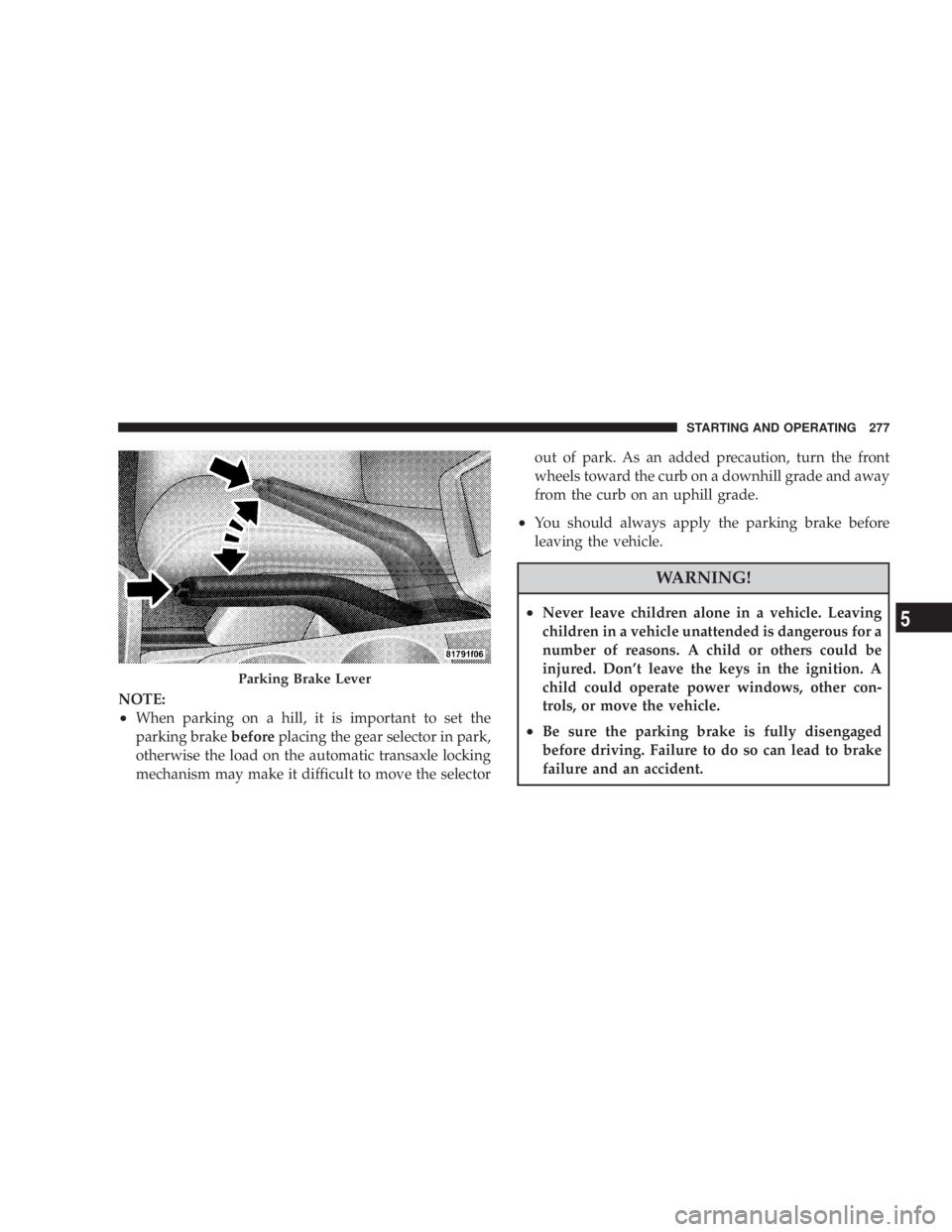
NOTE:
² When parking on a hill, it is important to set the
parking brake before placing the gear selector in park,
otherwise the load on the automatic transaxle locking
mechanism may make it difficult to move the selector out of park. As an added precaution, turn the front
wheels toward the curb on a downhill grade and away
from the curb on an uphill grade.
² You should always apply the parking brake before
leaving the vehicle.
WARNING!² Never leave children alone in a vehicle. Leaving
children in a vehicle unattended is dangerous for a
number of reasons. A child or others could be
injured. Don't leave the keys in the ignition. A
child could operate power windows, other con-
trols, or move the vehicle.
² Be sure the parking brake is fully disengaged
before driving. Failure to do so can lead to brake
failure and an accident.Parking Brake Lever STARTING AND OPERATING 277
5
Page 298 of 467
Loading
The vehicle maximum load on the tire must not exceed
the load carrying capacity of the tire on your vehicle. You
will not exceed the tire's load carrying capacity if you
adhere to the loading conditions, tire size, and cold tire
inflation pressures specified on the Tire and Loading
Information placard and in the ªVehicle Loadingº section
of this manual.
NOTE: Under a maximum loaded vehicle condition,
gross axle weight ratings (GAWRs) for the front and rear
axles must not be exceeded. For further information on
GAWRs, vehicle loading, and trailer towing, refer to
ªVehicle Loadingº in this section.
To determine the maximum loading conditions of your
vehicle, locate the statement, ªThe combined weight of
occupants and cargo should never exceed XXX kg or XXX
lbs.º on the Tire and Loading Information placard. The combined weight of occupants, cargo/luggage and
trailer tongue weight (if applicable) should never exceed
the weight referenced here.
Steps for Determining Correct Load Limit
1. Locate the statement, ªThe combined weight of occu-
pants and cargo should never exceed XXX kg or XXX lbsº
on your vehicle's placard.
2. Determine the combined weight of the driver and
passengers that will be riding in your vehicle.
3. Subtract the combined weight of the driver and pas-
sengers from XXX kg or XXX lbs.
4. The resulting figure equals the available amount of
cargo and luggage load capacity. For example, if ªXXXº
amount equals 1,400 lbs (635 kg) and there will be five
each 150 lb (68 kg) passengers in your vehicle, the296 STARTING AND OPERATING
Page 299 of 467
![DODGE AVENGER 2008 Owners Manual amount of available cargo and luggage load capacity is
650 lbs (295 kg) (since 5 x 150 = 750, and 1400 ± 750 = 650
lbs [295 kg]).
5. Determine the combined weight of luggage and cargo
being loaded on](/manual-img/12/58705/w960_58705-298.png "DODGE AVENGER 2008 Owners Manual amount of available cargo and luggage load capacity is
650 lbs (295 kg) (since 5 x 150 = 750, and 1400 ± 750 = 650
lbs [295 kg]).
5. Determine the combined weight of luggage and cargo
being loaded on")
amount of available cargo and luggage load capacity is
650 lbs (295 kg) (since 5 x 150 = 750, and 1400 ± 750 = 650
lbs [295 kg]).
5. Determine the combined weight of luggage and cargo
being loaded on the vehicle. That weight may not safely
exceed the available cargo and luggage load capacity
calculated in Step 4.
6. If your vehicle will be towing a trailer, load from your
trailer will be transferred to your vehicle. Consult this
manual to determine how this reduces the available
cargo and luggage load capacity of your vehicle. NOTE: The following table shows examples on how to
calculate total load, cargo/luggage, and towing capaci-
ties of your vehicle with varying seating configurations
and number and size of occupants. This table is for
illustration purposes only and may not be accurate for
the seating and load carrying capacity of your vehicle.
NOTE: For the following example, the combined weight
of occupants and cargo should never exceed 865 lbs (392
kg). STARTING AND OPERATING 297
5
Page 335 of 467
Figure out the weight on the front and rear of the vehicle
separately. It is important that you distribute the load
evenly over the front and rear axles.
Overloading can cause potential safety hazards and
shorten useful service life. Heavier axles or suspension
components do not necessarily increase the vehicle's
GVWR.
Loading
To load your vehicle properly, first figure out its empty
weight, axle by axle and side by side. Store heavier items
down low and be sure you distribute their weight as
evenly as possible. Stow all loose items securely before
driving. If weighing the loaded vehicle shows that you
have exceeded either GAWR, but the total load is within
the specified GVWR, you must redistribute the weight.
Improper weight distribution can have an adverse effect
on the way your vehicle steers and handles and the way
the brakes operate. A loaded vehicle is shown in the illustration. Note that
neither the GVWR nor the GAWR capacities have been
exceeded.
Vehicle with a GVWR of 4480
EXAMPLE ONLY Front Axle Rear Axle
Empty Weight 1853 lbs
(841 kg) 1631 lbs
(740 kg )
Load (Including driver,
passengers, and cargo) 271 lbs
(123 kg) 579 lbs
(263 kg)
Total 2124 lbs
(963 kg) 2210 lbs
(1002 kg)
GAWR 2195 lbs
(997 kg) 2285 lbs
(1036 kg)
NOTE: Refer to the ªVehicle Certification Labelº at-
tached to the rear of the driver's door for your vehicle's
GVWR and GAWR. This table is only an example. STARTING AND OPERATING 333
5
Page 336 of 467
TRAILER TOWING
In this section, you will find safety tips and information
on limits to the type of towing you can reasonably do
with your vehicle. Before towing a trailer, carefully
review this information to tow your load as efficiently
and safely as possible.
To maintain warranty coverage, follow the requirements
and recommendations in this manual concerning ve-
hicles used for trailer towing.
If you have any questions or concerns after reviewing
this section, please consult your dealer to for full details
on the towing capabilities of the vehicle.
Common Towing Definitions
The following trailer towing related definitions will assist
you in understanding the following information: Gross Vehicle Weight Rating (GVWR)
The GVWR is the total allowable weight of your vehicle.
This includes driver, passengers, cargo, and tongue
weight. The total load must be limited so that you do not
exceed the GVWR.
Gross Trailer Weight (GTW)
The GTW is the weight of the trailer plus the weight of all
cargo, consumables and equipment (permanent or tem-
porary) loaded in or on the trailer in its 9 loaded and
ready for operation 9 condition. The recommended way to
measure GTW is to put your fully loaded trailer on a
vehicle scale. The entire weight of the trailer must be
supported by the scale.
Gross Combination Weight Rating (GCWR)
The GCWR is the total permissible weight of your vehicle
and trailer when weighed in combination. (Note that
GCWR ratings include a 150 lbs (68 kg) allowance for the
presence of a driver).334 STARTING AND OPERATING