Page 313 of 531
AUTOMATIC TEMPERATURE CONTROL (ATC) Ð
IF EQUIPPED
²
Front Three Zone ATC allows both the driver and front
occupant and rear seat occupants to select individual
comfort settings
²Occupants in the vehicle select AUTO mode operation
and a comfort temperature setting, using rotary knobs
on the control unit.
²The system provides set-and-forget operation for op-
timum comfort and convenience.
²The system can be controlled manually if desired.
²SYNC feature links the controls for all three zones,
allowing one comfort setting for the cabin, if desired.The Infrared Three-Zone ATC System automatically
maintains the interior comfort level desired by the driver
and all passengers. This is accomplished by an infrared
sensor, located in the forward overhead console. Based
on the sensor input, the system automatically adjusts the
air temperature, the airflow volume, and amount of
outside air recirculation. This maintains a comfortable
temperature even under changing conditions.
UNDERSTANDING YOUR INSTRUMENT PANEL 311
4
Page 347 of 531
Electronic Stability Program (ESP)
This system enhances directional control and stability of
the vehicle under various driving conditions. ESP cor-
rects for over/under steering of the vehicle by applying
the brake of the appropriate wheel to assist in counter-
acting the over/under steer condition. Engine power
may also be reduced to help the vehicle maintain the
desired path.
ESP uses sensors in the vehicle to determine the vehicle
path intended by the driver and compares it to the actual
path of the vehicle. When the actual path does not match
the intended path, ESP applies the brake of the appropri-
ate wheel to assist in counteracting the oversteer or
understeer condition.
²Oversteer - when the vehicle is turning more than
appropriate for the steering wheel position.
²Understeer - when the vehicle is turning less than
appropriate for the steering wheel position.ESP ON
This is the normal operating mode for ESP on 2WD
vehicles. Whenever the vehicle is started, the ESP system
will be in this mode. This mode should be used for most
driving situations. ESP should only be turned off for
specific reasons as noted below.
ESP Partial OFF
This mode is entered by momentarily depressing the ESP
OFF switch (located in the center switch bank, next to the
hazard flasher switch).
When in Partial OFF mode, the TCS portion of
ESP, except for the ªlimited slipº feature de-
scribed in the TCS section, has been disabled
and the ESP/TCS Indicator Light will be illu-
minated. All other stability features of the ESP function
normally. This mode is intended to be used if the vehicle
is in deep snow, sand or gravel conditions and more
wheel spin than ESP would normally allow is required to
STARTING AND OPERATING 345
5
Page 373 of 531
increased to the recommended cold tire placard pressure
in order for the TPMS warning lamp to be turned off. The
system will automatically update and the TPMS warning
lamp will extinguish once the updated tire pressures
have been received. The vehicle may need to be driven
for up to 10 minutes above 15 mph (25 km/h) to receive
this information.
For example, your vehicle may have a recommended
cold (parked for more than three hours) tire pressure of
35 psi (241 kPa). If the ambient temperature is 68ÉF (20ÉC)
and the measured tire pressure is 30 psi (207 kPa), a
temperature drop to 20ÉF (-7ÉC) will decrease the tire
pressure to approximately 26 psi (179 kPa). This tire
pressure is sufficiently low enough to turn on the TPMS
Warning Light. Driving the vehicle may cause the tire
pressure to rise to approximately 30 psi (207 kPa), but the
TPMS Warning Light will still be on. In this situation, theTPMS Warning Light will turn off only after the tires
have been inflated to the vehicle's recommended cold tire
pressure value.
CAUTION!
The TPMS has been optimized for the original
equipment tires and wheels. TPMS pressures have
been established for the tire size equipped on your
vehicle. Undesirable system operation or sensor
damage may result when using replacement equip-
ment that is not of the same size, type, and/or style.
Aftermarket wheels can cause sensor damage. Do not
use aftermarket sealants or balance beads if your
vehicle is equipped with a TPMS, as damage to the
sensors may result.
STARTING AND OPERATING 371
5
Page 374 of 531
CAUTION!
After inspecting or adjusting the tire pressure always
reinstall the valve stem cap. This will prevent mois-
ture and dirt from entering the valve stem, which
could damage the TPMS SENSOR.
NOTE:
²The TPMS is not intended to replace normal tire care
and maintenance, or to provide warning of a tire
failure or condition.
²The TPMS should not be used as a tire pressure gauge
while adjusting your tire pressure.
²Driving on a significantly under-inflated tire causes
the tire to overheat and can lead to tire failure.
Under-inflation also reduces fuel efficiency and tire
tread life, and may affect the vehicle's handling and
stopping ability.
²The TPMS is not a substitute for proper tire mainte-
nance, and it is the driver's responsibility to maintain
correct tire pressure, using an accurate tire pressure
gage, even if under-inflation has not reached the level
to trigger illumination of the TPMS Warning Lamp.
NOTE:Seasonal temperature changes will affect tire
pressure, and the TPMS will monitor the actual tire
pressure in the tire.
BASIC TPMS WITHOUT EVIC Ð IF EQUIPPED
The TPMS uses wireless technology with wheel rim
mounted electronic sensors to monitor tire pressure lev-
els. Sensors, mounted to each wheel as part of the valve
stem, transmit tire pressure readings to the Receiver
Module.
NOTE:It is particularly important, for you to check the
tire pressure in all of your tires regularly and to maintain
the proper pressure.
372 STARTING AND OPERATING
Page 375 of 531
The Basic TPMS consists of the following components:
²Receiver Module
²Four Wheel Sensors
²TPMS Telltale Warning Light
The TPMS Telltale Warning Light will illumi-
nate in the instrument cluster, and an audible
chime will be activated when one or more of
the four active road tire pressures are low.
Should this occur, you should stop as soon as possible,
check the inflation pressure of each tire on your vehicle,
and inflate each tire to the vehicle's recommended cold
tire pressure value (located on the placard on the
driver's-side B-Pillar). The system will automatically
update and the TPMS Warning Lamp will extinguish
once the updated tire pressures have been received.NOTE:The vehicle may need to be driven for up to 10
minutes above 15 mph (25 km/h) to receive this infor-
mation.
The TPMS Warning Lamp will flash on and off for 75
seconds, and remain on sold when a system fault is
detected. The system fault will also sound a chime. If the
ignition key is cycled, this sequence will repeat, provid-
ing the system fault still exists. The TPMS Warning Lamp
will turn off when the fault condition no longer exists. A
system fault can occur with any of the following sce-
narios:
1. Jamming due to electronic devices or driving next to
facilities emitting the same radio frequencies as the TPMS
sensors.
2. Installing some form of aftermarket window tinting
that affects radio wave signals.
STARTING AND OPERATING 373
5
Page 376 of 531

3. Accumulation of excessive snow and/or ice around
the wheels or wheel housings.
4. Using tire chains on the vehicle.
5. Using wheels/tires not equipped with TPMS sensors.
NOTE:
1. The compact spare tire (if equipped) does not have a
TPMS sensor. Therefore the TPMS will not monitor the
pressure in the compact spare tire.
2. If you install the compact spare tire in place of a road
tire that has a pressure below the low-pressure warning
limit, upon the next ignition key cycle, a chime will
sound and the TPMS Telltale Warning Light will turn on.
3. After driving for up to 10 minutes above 15 mph (25
km/h), the TPMS Telltale Warning Light will flash on
and off for 75 seconds and then remain on solid.4. For each subsequent ignition key cycle, a chime will
sound and the TPMS Telltale Warning Light will remain
on solid.
5. Once you repair or replace the original road tire and
reinstall it on the vehicle in place of the compact spare
tire, the TPMS will automatically update, and the TPMS
Telltale Warning Light will turn off as long as no tire
pressure is below the low-pressure warning limit in any
of the four active road tires. The vehicle may need to be
driven for up to 10 minutes above 15 mph (25 km/h) for
the TPMS to receive this information.
PREMIUM TPMS WITH EVIC Ð IF EQUIPPED
The TPMS uses wireless technology with wheel rim-
mounted electronic sensors to monitor tire pressure lev-
els. Sensors mounted to each wheel as part of the valve
stem, transmit tire pressure readings to the Receiver
Module.
374 STARTING AND OPERATING
Page 377 of 531
NOTE:It is particularly important to regularly check
and maintain proper tire pressure in all the tires.
The Premium TPMS consists of the following compo-
nents:
²Receiver Module
²Four TPMS Sensors
²Three Trigger Modules (mounted in three of the four
wheel wells)
²Various TPMS Messages, which display in the Elec-
tronic Vehicle Information Center (EVIC), and graph-
ics displaying tire pressures
²Yellow TPMS Telltale Warning Light
TPMS Low Pressure Warnings
The TPMS Telltale Warning Light will illuminate in the
instrument cluster, and an audible chime will be acti-
vated when one or more of the four active road tirepressures are low. In addition, the EVIC will display one
or more Low Pressure messages (Left Front, Left Rear,
Right Front, Right Rear) for three seconds, and a graphic
display of the pressure value(s) with the low tire(s)
flashing.Low Tire Pressure Display
STARTING AND OPERATING 375
5
Page 378 of 531
Should a low tire condition occur on any of the four
active road tire(s), you should stop as soon as possible,
and inflate the low tire(s) that is flashing on the graphic
display to the vehicle's recommended cold tire pressure
value. The system will automatically update, the graphic
display of the pressure value(s) will stop flashing, and
the TPMS Telltale Warning Light will extinguish once the
updated tire pressure(s) have been received. The vehicle
may need to be driven for up to 10 minutes above 15 mph
(25 km/h) to receive this information.
Check TPMS Message
The TPMS Telltale Warning Light will flash on and off for
75 seconds, and remain on solid when a system fault is
detected. The system fault will also sound a chime. The
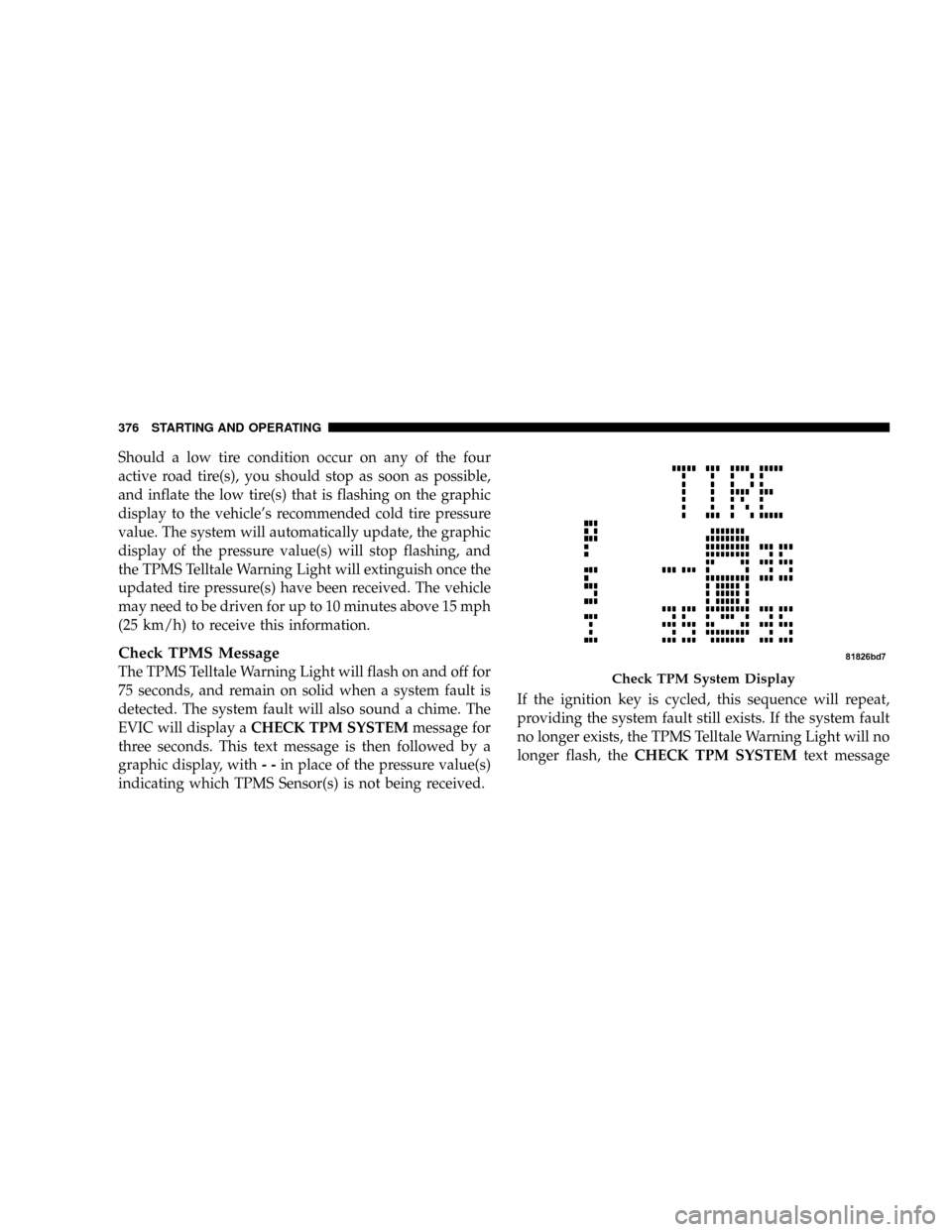
EVIC will display aCHECK TPM SYSTEMmessage for
three seconds. This text message is then followed by a
graphic display, with--in place of the pressure value(s)
indicating which TPMS Sensor(s) is not being received.If the ignition key is cycled, this sequence will repeat,
providing the system fault still exists. If the system fault
no longer exists, the TPMS Telltale Warning Light will no
longer flash, theCHECK TPM SYSTEMtext messageCheck TPM System Display
376 STARTING AND OPERATING