Page 273 of 494
WARNING!
It is dangerous to shift the gear selector lever out of
PARK or NEUTRAL if the engine speed is higher
than idle speed. If your foot is not firmly on the
brake pedal, the vehicle could accelerate quickly
forward or in REVERSE. You could lose control of the
vehicle and hit someone or something. Only shift the
gear selector lever into gear when the engine is idling
normally and when your right foot is firmly on the
brake pedal.
WARNING!
Unintended movement of a vehicle could injure
those in and near the vehicle. As with all vehicles,
you should never exit a vehicle while the engine is
running. Before exiting a vehicle, you should always
shift the gear selector lever into PARK, remove the
key from the ignition, and apply the parking brake.
Once the key is removed from the ignition, the gear
selector lever is locked in the PARK position, secur-
ing the vehicle against unwanted movement. Further-
more, you should never leave children unattended
inside a vehicle.
STARTING AND OPERATING 271
5
Page 274 of 494
BRAKE/TRANSAXLE INTERLOCK
This system prevents you from moving the gear selector
lever out of PARK and into any gear unless the brake
pedal is pressed. This system is active only while the
ignition switch is in the ON position.Always press the
brake pedal first, before moving the gear selector lever
out of PARK.
NOTE:If a malfunction occurs, the transaxle will not
shift out of PARK. Battery power is required to release the
brake/transaxle interlock system. However, there is an
override system that allows you to shift out of PARK in
case of loss of power. To activate the override system:
•Firmly apply the parking brake
•Insert the ignition key and rotate it to the ON position
•Remove the cup holder liner
•Insert a key, screwdriver, or finger into the front hole
then push and hold the manual override release lever
forward.
•While holding the release lever forward, move the
gear selector lever from PARK to NEUTRAL. Release
the manual override lever.
NOTE:If this occurs, even if the override is successful,
it is recommended that you visit a dealer at your earliest
possible convenience. Your dealer has diagnostic equip-
ment to determine if the problem could recur.
AUTOMATIC TRANSAXLE IGNITION INTERLOCK
SYSTEM
This system prevents the key from being removed unless
the gear selector lever is in PARK. It also prevents shifting
out of PARK unless the key is in the ON position and the
brake pedal is applied.
272 STARTING AND OPERATING
Page 277 of 494
![CHRYSLER SEBRING SEDAN 2008 3.G Owners Manual these conditions, using the[5]range will improve perfor-
mance and extend transaxle life by reducing excessive
shifting and heat build-up.
RESET MODE — Electronic Transaxle
The transaxle is monitore](/manual-img/25/8551/w960_8551-276.png "CHRYSLER SEBRING SEDAN 2008 3.G Owners Manual these conditions, using the[5]range will improve perfor-
mance and extend transaxle life by reducing excessive
shifting and heat build-up.
RESET MODE — Electronic Transaxle
The transaxle is monitore")
these conditions, using the[5]range will improve perfor-
mance and extend transaxle life by reducing excessive
shifting and heat build-up.
RESET MODE — Electronic Transaxle
The transaxle is monitored electronically for abnormal
conditions. If a condition is detected that could cause
damage, the transaxle automatically shifts into second
gear. The transaxle remains in second gear (third gear
with a six-speed automatic) despite the forward gear
selected. PARK, REVERSE, AND NEUTRAL will con-
tinue to operate. This RESET feature allows the vehicle to
be driven to a dealer for service without damaging the
transaxle.
In the event that the problem has been momentary, the
transaxle can be reset to regain all forward gears.
1. Stop the vehicle.
2. Shift the gear selector lever into PARK.3. Turn the ignition key to the LOCK position then restart
the engine.
4. Shift the gear selector lever into the desired gear range
and resume driving.
NOTE:Even if the transaxle can be reset, it is recom-
mended that you visit a dealer at your earliest possible
convenience. Your authorized dealer has diagnostic
equipment to determine if the problem could recur.
If the transaxle cannot be reset, authorized dealer service
is required.
AUTOSTICK�— IF EQUIPPED
AutoStick�is a driver-interactive transaxle that offers six
manual ratio changes to provide you with more control.
AutoStick�allows you to maximize engine braking,
eliminate undesirable upshifts and downshifts, and im-
prove overall vehicle performance. This system can also
provide you with more control during passing, city
STARTING AND OPERATING 275
5
Page 336 of 494
WARNING!
•Never have any smoking materials lit in or near the
vehicle when the gas cap is removed or the tank filled.
•Never add fuel when the engine is running. This is in
violation of most state and federal fire regulations
and doing so will cause the malfunction indicator
light to turn on.
•A fire may result if gasoline is pumped into a
portable container that is inside of a vehicle. You
could be burned. Always place gas containers on the
ground while filling.
NOTE:
•Tighten the gas cap until you hear a “clicking” sound.
This is an indication that the gas cap is tightened
properly. The Malfunction Indicator Light in the in-
strument cluster may turn on if the gas cap is notsecured properly. Make sure that the gas cap is tight-
ened each time the vehicle is refueled.
•When the fuel nozzle “clicks” or shuts off, the fuel
tank is full.
Loose Fuel Filler Cap Message
If the vehicles diagnostic system determines that the fuel
filler cap in loose, improperly installed, or damaged, a
“GASCAP” or “FUEL CAP OFF” message will be dis-
played in the instrument cluster. Tighten the gas cap until
a “clicking” sound is heard. This is an indication that the
gas cap is properly tightened. Press the trip odometer
reset button to turn off the message. If the problem
persists, the message will appear the next time the
vehicle is started. This might indicate a damaged cap. If
the problem is detected twice in a row, the system will
turn on the Malfunction Indicator Light (MIL). Resolving
the problem will turn the MIL light off.
334 STARTING AND OPERATING
Page 339 of 494
Loading
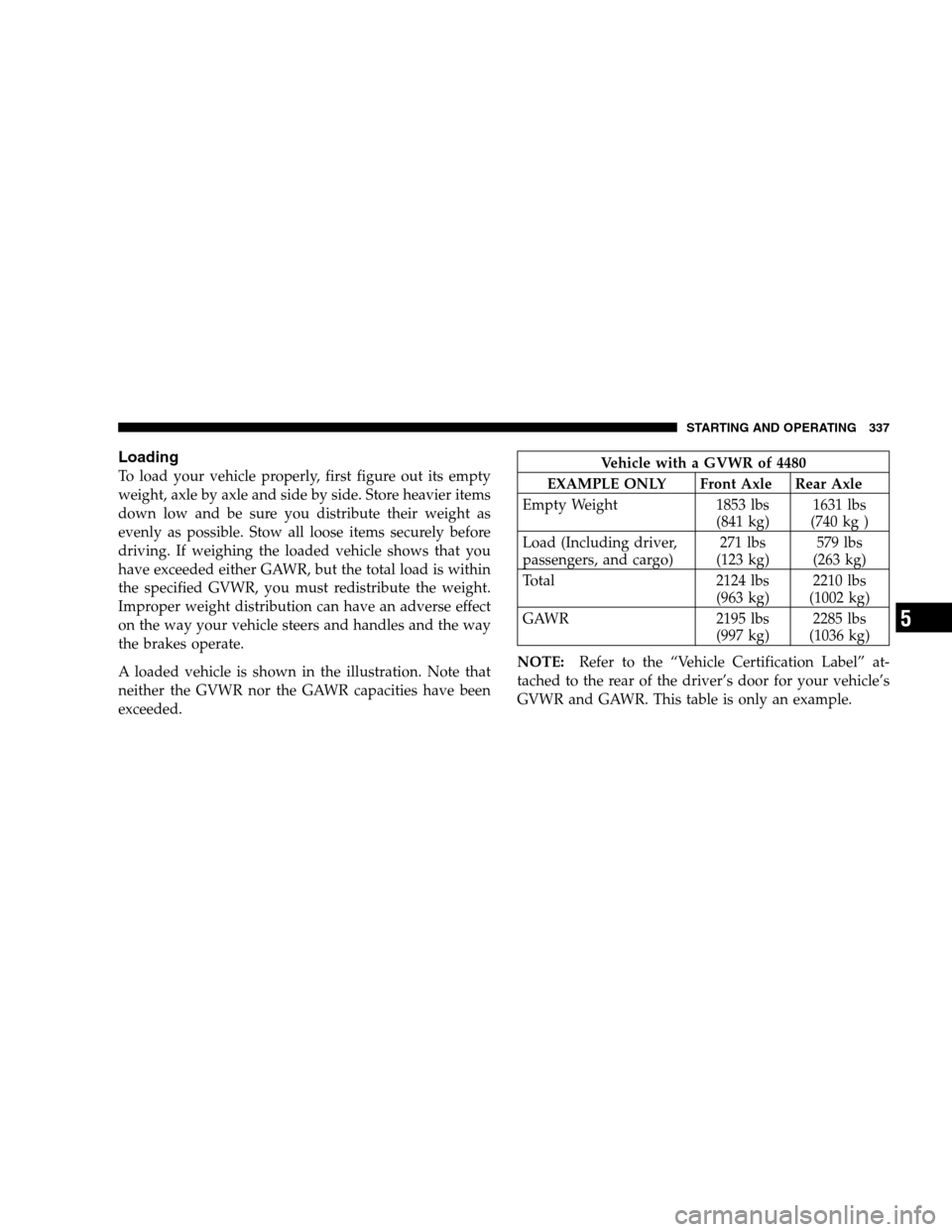
To load your vehicle properly, first figure out its empty
weight, axle by axle and side by side. Store heavier items
down low and be sure you distribute their weight as
evenly as possible. Stow all loose items securely before
driving. If weighing the loaded vehicle shows that you
have exceeded either GAWR, but the total load is within
the specified GVWR, you must redistribute the weight.
Improper weight distribution can have an adverse effect
on the way your vehicle steers and handles and the way
the brakes operate.
A loaded vehicle is shown in the illustration. Note that
neither the GVWR nor the GAWR capacities have been
exceeded.Vehicle with a GVWR of 4480
EXAMPLE ONLY Front Axle Rear Axle
Empty Weight 1853 lbs
(841 kg)1631 lbs
(740 kg )
Load (Including driver,
passengers, and cargo)271 lbs
(123 kg)579 lbs
(263 kg)
Total 2124 lbs
(963 kg)2210 lbs
(1002 kg)
GAWR 2195 lbs
(997 kg)2285 lbs
(1036 kg)
NOTE:Refer to the “Vehicle Certification Label” at-
tached to the rear of the driver’s door for your vehicle’s
GVWR and GAWR. This table is only an example.
STARTING AND OPERATING 337
5
Page 346 of 494
WARNING!
Improper towing can lead to an injury accident.
Follow these guidelines to make your trailer towing
as safe as possible:
Make certain that the load is secured in the trailer
and that it will not shift during travel. When traile-
ring cargo that is not fully secured, dynamic load
shifts can occur that may be difficult for the driver to
control. You could lose control of your vehicle and
have an accident.
•When hauling cargo, or towing a trailer, do not
overload your vehicle or trailer. Overloading can cause
a loss of control, poor performance, or damage to
brakes, axle, engine, transaxle, steering, suspension,
chassis structure, or tires.
•Safety chains must always be used between your
vehicle and trailer. Always connect the chains to the
frame or hook retainers of the vehicle hitch. Cross the
chains under the trailer tongue and allow enough
slack for turning corners.
•Vehicles with trailers should not be parked on a grade.
When parking, apply the parking brake on the tow
vehicle. Put the tow vehicle automatic transaxle in P
for Park. Always, block or�chock�the trailer wheels.
•GCWR must not be exceeded.
•Total weight must be distributed between the tow
vehicle and the trailer such that the following four
ratings are not exceeded:
1. GVWR
2. GTW
3. GAWR
344 STARTING AND OPERATING
Page 361 of 494
WARNING!
Carefully follow these tire changing warnings to
help prevent personal injury or damage to your
vehicle:
•Never start or run the engine with the vehicle on a
jack.
•Do not let anyone sit in the vehicle when it is on a
jack.
•Do not get under the vehicle when it is on a jack.
•Only use the jack in the positions indicated and
for lifting this vehicle during a tire change.
WARNING!
Carefully follow these tire changing warnings to
help prevent personal injury or damage to your
vehicle:
•If working on or near a roadway, be extremely
careful of motor traffic.
•To assure that spare tires, flat or inflated are
securely stowed, spares must be stowed with the
valve stem facing the ground.
•Turn on the Hazard warning flasher.
WHAT TO DO IN EMERGENCIES 359
6
Page 364 of 494
CAUTION!
Do not attempt to raise the vehicle by jacking on
locations other than those indicated in step 3.
3. There are two front jacking locations and two rear
jacking locations on each side of the body (as pictured
above).
4. Turn the jack screw to the left until the jack can be
placed under the jacking location. Once the jack is
positioned, turn the jack screw to the right until the jack
head is properly engaged with the lift area closest to the
wheel to be changed. Do not raise the vehicle until you
are sure the jack is securely engaged.
WARNING!
Raising the vehicle higher than necessary can make
the vehicle less stable. It could slip off the jack and
hurt someone near it. Raise the vehicle only enough
to remove the tire.
5. Raise the vehicle by turning the jack screw to the right,
using the swivel wrench. Raise the vehicle only until the
tire just clears the surface and enough clearance is
obtained to install the spare tire. Minimum tire lift
provides maximum stability.
6. Remove the wheel nuts, and pull the wheel and wheel
covers (where applicable) off the hub. Install the spare
wheel and wheel nuts with the cone shaped end of the
nuts toward the wheel. Lightly tighten the nuts. To avoid
the risk of forcing the vehicle off the jack, do not tighten
the nuts fully until the vehicle has been lowered.
362 WHAT TO DO IN EMERGENCIES