Page 384 of 454

WARNING!
²Overfilling the brake fluid reservoir can result in
spilling brake fluid on hot engine parts and the
brake fluid catching fire.
²Use of a brake fluid that has a lower initial boiling
point than the recommended MOPARtDOT 3
product or a brake fluid that is unidentified as to
FMVSS specification may result in sudden brake
failure during hard prolonged braking. You could
have an accident.
Use only brake fluid that has been in a tightly closed
container to avoid contamination from foreign matter or
moisture.
CAUTION!
Do not allow petroleum base fluid to contaminate the
brake fluid, all brake seal components could be
damaged causing partial or complete brake failure.
Automatic Transaxle
The automatic transaxle and differential assembly are
contained within a single housing.
The fluid level in the automatic transaxle should be
checked whenever the vehicle is serviced. Operation with
an improper fluid level will greatly reduce the life of the
transaxle and the fluid.
Fluid Level Check Ð Vehicles with 3.5L Engine
The automatic transaxle has no dipstick and is dealer
serviced only.
384 MAINTAINING YOUR VEHICLE
Page 385 of 454

Fluid Level Check Ð Vehicles with 2.4L and 2.7L
Engines
Use the following procedure to check the automatic
transaxle fluid level properly:
1. Park the vehicle on level ground.
2. Run the engine at curb idle speed for a minimum of 60
seconds.
3. Apply the parking brake fully.
4. Place the gear selector momentarily in each gear
position ending with the lever in PARK.
5. Wipe the area around the dipstick clean to eliminate
the possibility of dirt entering the transaxle.
6. Remove the dipstick and determine if the fluid is hot
or cold. Hot fluid is approximately 180É F (82É C), which
is the normal operating temperature after the vehicle isdriven at least 15 miles (24 km). Hot fluid cannot be held
comfortably between the fingertips. Cold fluid is at a
temperature below 80ÉF (27ÉC).
7. Wipe the dipstick clean and reinsert until seated. Then,
remove dipstick and note the reading.
a. If the fluid is hot, the reading should be in the
crosshatched area marked ªHOTº (between the upper
two holes in the dipstick).
b. If the fluid is cold, the fluid level should be between
the lower two holes in the area marked ªCOLD.º
If the fluid level is low, add sufficient fluid through the
filler (dipstick) tube to bring it to the proper level. Do not
overfill.
MAINTAINING YOUR VEHICLE 385
7
Page 389 of 454

²If your vehicle is damaged due to an accident or
similar cause, which destroys the paint and protective
coating, have your vehicle repaired as soon as pos-
sible. The cost of such repairs is considered the respon-
sibility of the owner.
²If you carry special cargo such as chemicals, fertilizers,
de-icer salt, etc., be sure that such materials are well
packaged and sealed.
²If a lot of driving is done on gravel roads, consider
mud or stone shields behind each wheel.
²Use Moparttouchup paint on scratches as soon as
possible. Your dealer has touch up paint to match the
color of your vehicle.
Wheel and Wheel Trim Care
All wheels and wheel trim, especially aluminum and
chrome plated wheels should be cleaned regularly with a
mild soap and water to prevent corrosion. To removeheavy soil and/or excessive brake dust, use Mopart
Wheel Cleaner (05066247AB) or equivalent or select a
nonabrasive, non-acidic cleaner. Do not use scouring
pads, steel wool, a bristle brush, or metal polishes. Only
Mopartor equivalent is recommended. Do not use oven
cleaner. Avoid automatic car washes that use acidic
solutions or harsh brushes that may damage the wheels'
protective finish.
Interior Care
Instrument Panel Cover
The instrument panel cover has a low glare surface,
which minimizes reflections in the windshield. Do not
use protectants or other products, which may cause
undesirable reflections. Use soap and warm water to
restore the low glare surface.
Cleaning Interior Trim
Interior Trim should be cleaned starting with a damp
cloth, a damp cloth with MopartTotal Clean, then
MAINTAINING YOUR VEHICLE 389
7
Page 396 of 454
Cavity Cartridge
FuseMini
FuseDescription
1 40 Amp
GreenÐ Battery Feed Ð
Power Top Module
2 Ð 20 Amp
YellowÐ
3 Ð 10 Amp
RedBattery Feed Ð Cen-
ter High Mounted
Stop Light (CHMSL)/
Brake Switch
4 Ð 10 Amp
RedBattery Feed Ð Igni-
tion Switch
5 Ð 20 Amp
YellowTrailer Tow ± if
equipped
6 Ð 10 Amp
RedPower Mirror Switch/
Climate Controls
7 Ð 30 Amp
GreenIgnition Off Draw
(IOD) Sense 1Cavity Cartridge
FuseMini
FuseDescription
8 Ð 30 Amp
GreenIgnition Off Draw
(IOD) Sense 2
9 40 Amp
GreenÐ Battery Feed Ð
Power Seats - if
equipped
10 Ð 20 Amp
YellowBattery Feed Ð Cabin
Compartment Node
(CCN)
11 Ð 15 Amp
Lt BlueSelectable Power Out-
let
12 Ð 20 Amp
YellowÐ
13 Ð 20 Amp
YellowÐ
14 Ð 10 Amp
RedCabin Compartment
Node (CCN)/ Interior
Lighting
396 MAINTAINING YOUR VEHICLE
Page 398 of 454
Cavity Cartridge
FuseMini
FuseDescription
27 Ð 10 Amp
RedIgnition Run Ð Occu-
pant Classification
Module (OCM)/
Occupant Restraint
Controller (ORC)
28 Ð 10 Amp
RedIgnition Run Ð Occu-
pant Classification
Module (OCM)/
Occupant Restraint
Controller (ORC)
29 Ð Ð Hot Car (No Fuse Re-
quired)
30 Ð 20 Amp
YellowIgnition Run Ð
Heated Seats - if
equipped
31 Ð 10 Amp
RedÐCavity Cartridge
FuseMini
FuseDescription
32 30 Amp
PinkÐ Auto Shutdown
(ASD) Relay Feed 1
33 Ð 10 Amp
RedBattery Feed Ð
Switch Bank/
Diagnostic Link
Connector/
Powertrain Control
Module (PCM)
34 30 Amp
PinkÐ Battery Feed Ð Anti-
Lock Brakes (ABS)
Module - if
equipped/Electronic
Stability Program
(ESP) Module - if
equipped
398 MAINTAINING YOUR VEHICLE
Page 399 of 454
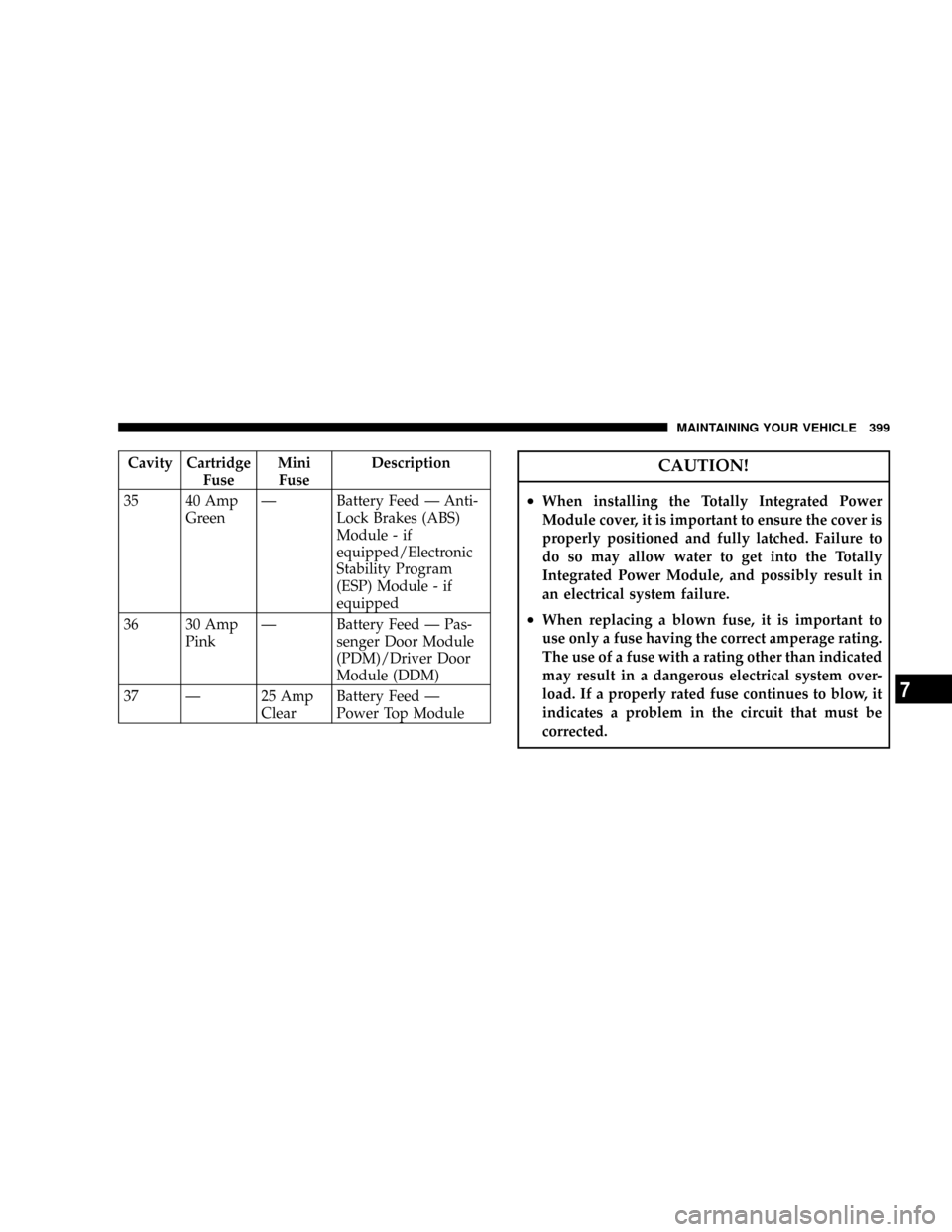
Cavity Cartridge
FuseMini
FuseDescription
35 40 Amp
GreenÐ Battery Feed Ð Anti-
Lock Brakes (ABS)
Module - if
equipped/Electronic
Stability Program
(ESP) Module - if
equipped
36 30 Amp
PinkÐ Battery Feed Ð Pas-
senger Door Module
(PDM)/Driver Door
Module (DDM)
37 Ð 25 Amp
ClearBattery Feed Ð
Power Top ModuleCAUTION!
²When installing the Totally Integrated Power
Module cover, it is important to ensure the cover is
properly positioned and fully latched. Failure to
do so may allow water to get into the Totally
Integrated Power Module, and possibly result in
an electrical system failure.
²When replacing a blown fuse, it is important to
use only a fuse having the correct amperage rating.
The use of a fuse with a rating other than indicated
may result in a dangerous electrical system over-
load. If a properly rated fuse continues to blow, it
indicates a problem in the circuit that must be
corrected.
MAINTAINING YOUR VEHICLE 399
7
Page 412 of 454
Chassis
Component Fluids, Lubricants and Genuine Parts
Automatic Transaxle MopartATF+4 Automatic Transmission Fluid.
Brake Master CylinderMopartDOT 3 and SAE J1703 should be used. If DOT 3 brake fluid is not
available, then DOT 4 is acceptable. Use only recommended brake fluids.
Power Steering Reservoir MopartATF+4 Automatic Transmission Fluid.
412 MAINTAINING YOUR VEHICLE
Page 416 of 454
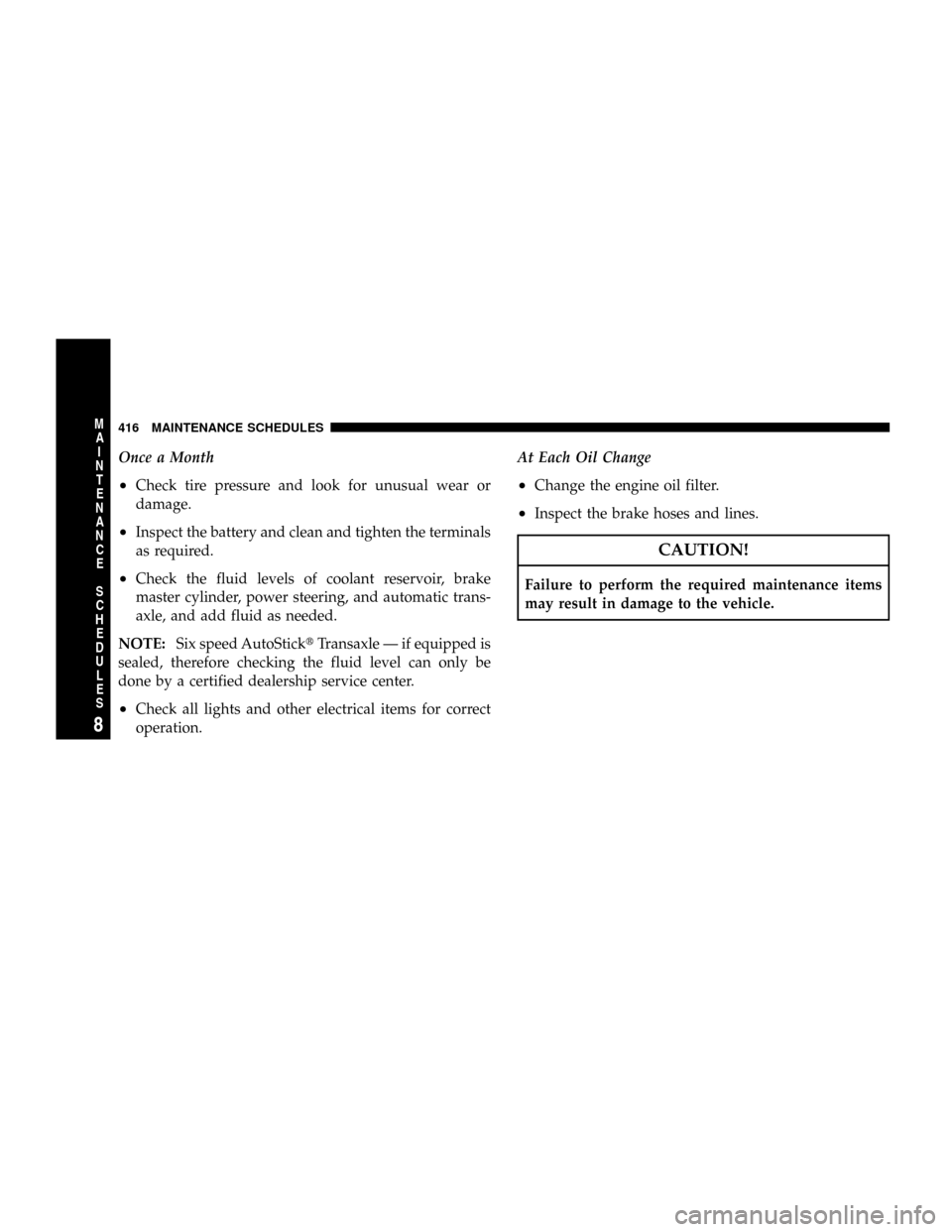
Once a Month
²Check tire pressure and look for unusual wear or
damage.
²Inspect the battery and clean and tighten the terminals
as required.
²Check the fluid levels of coolant reservoir, brake
master cylinder, power steering, and automatic trans-
axle, and add fluid as needed.
NOTE:Six speed AutoSticktTransaxle Ð if equipped is
sealed, therefore checking the fluid level can only be
done by a certified dealership service center.
²Check all lights and other electrical items for correct
operation.At Each Oil Change
²Change the engine oil filter.
²Inspect the brake hoses and lines.
CAUTION!
Failure to perform the required maintenance items
may result in damage to the vehicle.
416 MAINTENANCE SCHEDULES
8
M
A
I
N
T
E
N
A
N
C
E
S
C
H
E
D
U
L
E
S