2008 CHRYSLER SEBRING CONVERTIBLE brake
[x] Cancel search: brakePage 270 of 454

If both the Brake System Warning Light and the ABS
Light remain on, the Anti-Lock brakes (ABS) and Elec-
tronic Brake Force Distribution (EBD) systems are not
functioning. Immediate repair to the ABS system is
required.
POWER STEERING
The standard power steering system will give you good
vehicle response and increased ease of maneuverability
in tight spaces. The system will provide mechanical
steering capability if power assist is lost.
If for some reason the power assist is interrupted, it will
still be possible to steer your vehicle. Under these condi-
tions, you will observe a substantial increase in steering
effort, especially at very low vehicle speeds and during
parking maneuvers.NOTE:Increased noise levels at the end of the steering
wheel travel are considered normal and do not indicate
that there is a problem with the power steering system.
Upon initial start-up in cold weather, the power steering
pump may make noise for a short amount of time. This is
due to the cold, thick fluid in the steering system. This
noise should be considered normal, and it does not in any
way damage the steering system.
WARNING!
Continued operation with reduced power steering
assist could pose a safety risk to yourself and others.
Service should be obtained as soon as possible.
270 STARTING AND OPERATING
Page 273 of 454

CAUTION!
²Always check the depth of the standing water before driving
through it. Never drive through standing water that is deeper
than the bottom of the tire rims mounted on the vehicle.
²Determine the condition of the road or the path that is under
water and if there are any obstacles in the way before driving
through the standing water.
²Do not exceed 5 mph (8 km/h) when driving through
standing water. This will minimize wave effects.
²Driving through standing water may cause damage to your
vehicle's drivetrain components. Always inspect your vehi-
cle's fluids (i.e., engine oil, transmission, axle, etc.) for signs
of contamination (i.e., fluid that is milky or foamy in
appearance) after driving through standing water. Do not
continue to operate the vehicle if any fluid appears contami-
nated, as this may result in further damage. Such damage is
not covered by the new vehicle limited warranty.
²Getting water inside your vehicle's engine can cause it to
lockup and stall out and cause serious internal damage to the
engine. Such damage is not covered by the new vehicle
limited warranty.
WARNING!
²Driving through standing water limits your vehi-
cle's traction capabilities. Do not exceed 5 mph (8
km/h) when driving through standing water.
²Driving through standing water limits your vehi-
cle's braking capabilities, which increases stop-
ping distances. Therefore, after driving through
standing water, drive slowly and lightly press on
the brake pedal several times to dry the brakes.
²Getting water inside your vehicle's engine can
cause it to lockup and stall out and leave you
stranded.
²Failure to follow these warnings may result in
injuries that are serious or fatal to you, your
passengers, and others around you.
STARTING AND OPERATING 273
5
Page 274 of 454

TRACTION CONTROL SYSTEM (TCS) Ð IF
EQUIPPED
This system monitors the amount of wheel spin of each of
the driven wheels. If wheel spin is detected, brake
pressure is applied to the slipping wheel(s) and engine
power is reduced to provide enhanced acceleration and
stability. A feature of the TCS system functions similar to
a limited slip differential and controls the wheel spin
across a driven axle. If one wheel on a driven axle is
spinning faster than the other, the system will apply the
brake of the spinning wheel. This will allow more engine
torque to be applied to the wheel that is not spinning.
This feature remains active even if the ESP is in the
ªPartial Offº mode. Refer to ªElectronic Stability Pro-
gram (ESP)º in this Section of the manual.
The Traction Control System (TCS) Indicator
Light, located in the instrument cluster, starts
to flash as soon as the tires lose traction and the
wheels begin to spin. This indicates that theTCS is active. If the indicator light flashes during accel-
eration, ease up on the accelerator and apply as little
throttle as possible. Be sure to adapt your speed and
driving to the prevailing road conditions.
WARNING!
²The TCS cannot prevent the natural laws of phys-
ics from acting on the vehicle, nor can it increase
the traction afforded.
²The TCS cannot prevent accidents, including those
resulting from excessive speed in turns, or hydro-
planing. Only a safe, attentive, and skillful driver
can prevent accidents.
²The capabilities of a TCS-equipped vehicle must
never be exploited in a reckless or dangerous
manner, which could jeopardize the user's safety
or the safety of others.
274 STARTING AND OPERATING
Page 275 of 454

BRAKE ASSIST SYSTEM (BAS) Ð IF EQUIPPED
This system complements the Anti-Lock Brake System
(ABS) by optimizing the vehicle braking capability dur-
ing emergency braking maneuvers. This system detects
an emergency braking situation by sensing the rate and
amount of brake application and then applies optimum
pressure to the brakes. This can help reduce braking
distances.
Applying the brakes very quickly results in the best BAS
assistance. To receive the benefits of this system, you
must apply continuous brake pedal pressure during the
stopping sequence. Do not reduce brake pedal pressure
unless braking is no longer desired. Once the brake pedal
is released, the BAS is deactivated.WARNING!
²The BAS cannot prevent the natural laws of phys-
ics from acting on the vehicle, nor can it increase
braking efficiency beyond that afforded by the
condition of the vehicle brakes and tires or the
traction afforded.
²The BAS cannot prevent accidents, including
those resulting from excessive speed in turns,
following another vehicle too closely, or hydro-
planing. Only a safe, attentive, and skillful driver
can prevent accidents.
²The capabilities of a BAS-equipped vehicle must
never be exploited in a reckless or dangerous
manner, which could jeopardize the user 's safety
or the safety of others.
STARTING AND OPERATING 275
5
Page 276 of 454

ELECTRONIC STABILITY PROGRAM (ESP) Ð IF
EQUIPPED
This system enhances directional control and stability of
the vehicle under various driving conditions. The ESP
corrects for oversteering and understeering the vehicle
by applying the brake of the appropriate wheel. Engine
power may also be reduced to assist in counteracting the
condition of oversteer or understeer and help the vehicle
maintain the desired path.
The ESP uses sensors in the vehicle to determine the path
that the driver intends to steer the vehicle and compares
it to the actual path of the vehicle. When the actual path
does not match the intended path, the ESP applies the
brake of the appropriate wheel to assist in counteracting
the condition of oversteer or understeer.
²Oversteer - when the vehicle is turning more than
appropriate for the steering wheel position.
²Understeer - when the vehicle is turning less than
appropriate for the steering wheel position.
The ESP/TCS indicator light, located in the instrument
cluster, starts to flash as soon as the tires lose traction and
the ESP system becomes active. The indicator light also
flashes when the TCS is active. If the indicator light
begins to flash during acceleration, ease up on the
accelerator and apply as little throttle as possible. Be sure
to adapt your speed and driving to the prevailing road
conditions.
276 STARTING AND OPERATING
Page 278 of 454

When in ªPartial Offº mode, the engine torque reduction
feature is cancelled. Therefore, the enhanced vehicle
stability offered by ESP is unavailable. However, a fea-
ture of the system remains active. This feature controls
wheel spin across an axle quite similarly to a limited slip
differential. If one wheel on an axle is spinning faster
than the other, the system will apply the brake of the
spinning wheel and allow more engine torque to be
applied to the wheel that is not spinning.
To enter the ªPartial Offº mode, momentarily
depress the ªESP OFFº switch in the switch
bank above the climate controls. To turn the
ESP on again, momentarily depress the ªESP
OFFº switch again. This will restore the normal ªESP Onº
mode of operation. This may be done while the vehicle is
in motion.WARNING!
In the Partial Off mode, the engine torque reduction
is cancelled and the stability features are desensi-
tized. Therefore, the enhanced vehicle stability of-
fered by ESP is unavailable.
ESP/BAS Malfunction Indicator Light and
ESP/TCS Indicator Light
The malfunction indicator light for the ESP is
combined with the BAS indicator. The ªESP/
BAS Malfunction Indicator Lightº and the
ªESP/TCS Indicator Lightº in the instrument
cluster both come on when the ignition switch is turned
to the ªONº position. They should go out with the engine
running.
278 STARTING AND OPERATING
Page 321 of 454
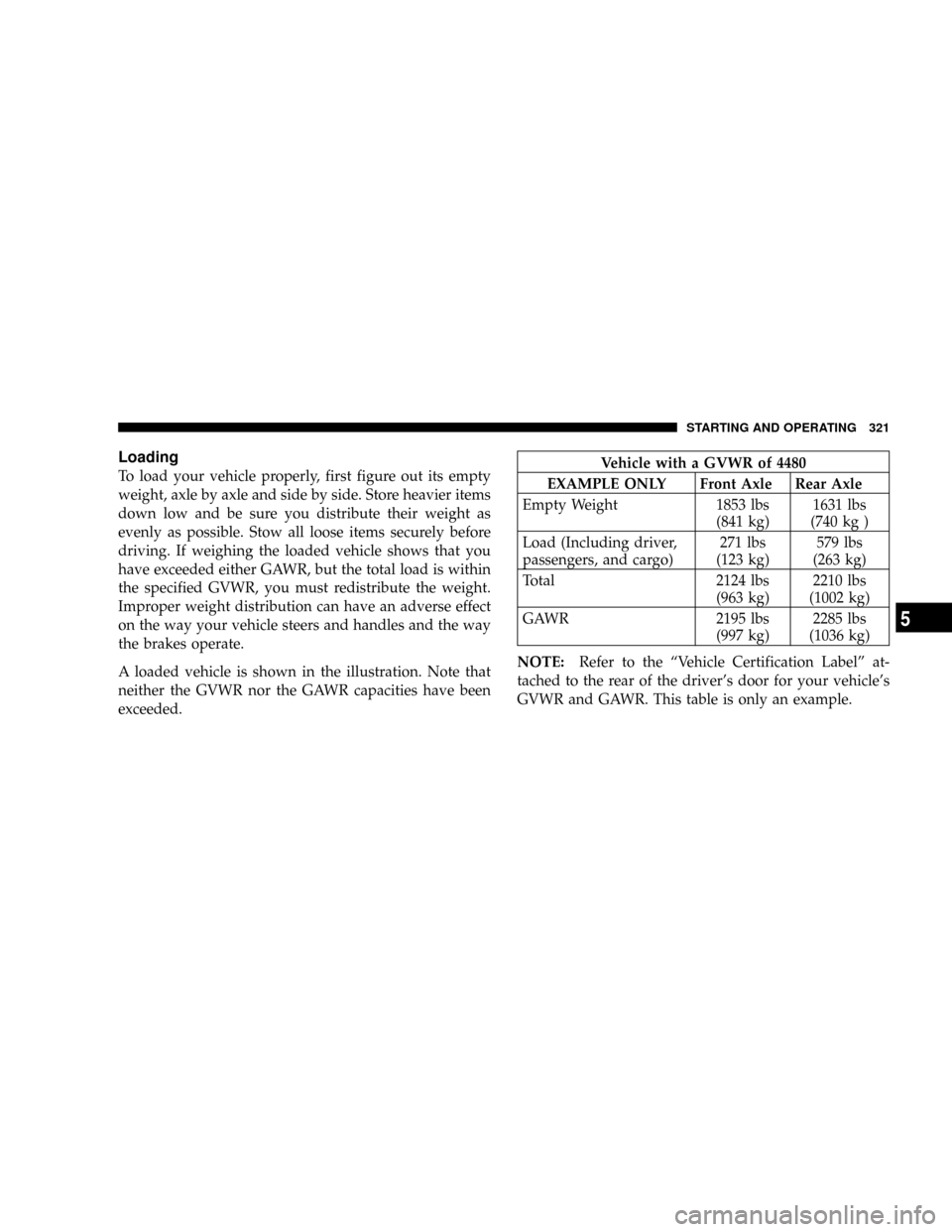
Loading
To load your vehicle properly, first figure out its empty
weight, axle by axle and side by side. Store heavier items
down low and be sure you distribute their weight as
evenly as possible. Stow all loose items securely before
driving. If weighing the loaded vehicle shows that you
have exceeded either GAWR, but the total load is within
the specified GVWR, you must redistribute the weight.
Improper weight distribution can have an adverse effect
on the way your vehicle steers and handles and the way
the brakes operate.
A loaded vehicle is shown in the illustration. Note that
neither the GVWR nor the GAWR capacities have been
exceeded.Vehicle with a GVWR of 4480
EXAMPLE ONLY Front Axle Rear Axle
Empty Weight 1853 lbs
(841 kg)1631 lbs
(740 kg )
Load (Including driver,
passengers, and cargo)271 lbs
(123 kg)579 lbs
(263 kg)
Total 2124 lbs
(963 kg)2210 lbs
(1002 kg)
GAWR 2195 lbs
(997 kg)2285 lbs
(1036 kg)
NOTE:Refer to the ªVehicle Certification Labelº at-
tached to the rear of the driver's door for your vehicle's
GVWR and GAWR. This table is only an example.
STARTING AND OPERATING 321
5
Page 328 of 454

WARNING!
Improper towing can lead to an injury accident.
Follow these guidelines to make your trailer towing
as safe as possible:
Make certain that the load is secured in the trailer
and that it will not shift during travel. When traile-
ring cargo that is not fully secured, dynamic load
shifts can occur that may be difficult for the driver to
control. You could lose control of your vehicle and
have an accident.
²When hauling cargo, or towing a trailer, do not
overload your vehicle or trailer. Overloading can cause
a loss of control, poor performance, or damage to
brakes, axle, engine, transaxle, steering, suspension,
chassis structure, or tires.
²Safety chains must always be used between your
vehicle and trailer. Always connect the chains to the
frame or hook retainers of the vehicle hitch. Cross the
chains under the trailer tongue and allow enough
slack for turning corners.
²Vehicles with trailers should not be parked on a grade.
When parking, apply the parking brake on the tow
vehicle. Put the tow vehicle automatic transaxle in P
for Park. Always, block or9chock9the trailer wheels.
²GCWR must not be exceeded.
²Total weight must be distributed between the tow
vehicle and the trailer such that the following four
ratings are not exceeded:
1. GVWR
2. GTW
3. GAWR
328 STARTING AND OPERATING