Page 350 of 454
CAUTION!
²If the vehicle being towed requires steering, the
ignition switch must be in the ON position, not in
the LOCK or ACC position.
²Do not attempt to tow this vehicle from the front
with sling type towing equipment. Damage to the
front fascia will result.
²Do not push or tow this vehicle with another
vehicle as damage to the bumper fascia and trans-
axle may result.
If you must use the accessories (wipers, defrosters, etc.)
while being towed, the key must be in the ON position,
not the ACC position. Make certain the transaxle remains
in NEUTRAL.
TOWING THIS VEHICLE BEHIND ANOTHER
VEHICLE WITH A TOW DOLLY
Rear towing is not recommendedwith the front wheels
on the ground, as transaxle damage can result. If rear
towing is the only alternative,a front end dolly must be
used.Proper towing equipment is necessary to prevent
damage to the vehicle.
350 WHAT TO DO IN EMERGENCIES
Page 372 of 454

apparent, and/or the system is not functioning as antici-
pated. Coordinate inspection efforts through a certified
DaimlerChrysler Dealership.
WARNING!
Fluid level should be checked on a level surface and
with the engine off to prevent injury from moving
parts and to insure accurate fluid level reading. Do
not overfill. Use only manufacturers recommended
power steering fluid.
If necessary, add fluid to restore to the proper indicated
level. With a clean cloth, wipe any spilled fluid from all
surfaces. Refer to ªFluids, Lubricants, and Genuine
Partsº in this section for the correct fluid type.
Front Suspension Ball Joints
There are two front suspension lower ball joints that are
permanently lubricated. Inspect these ball joints when
other maintenance is performed. A damaged seal and the
corresponding potentially damaged ball joint must be
replaced.
Steering Linkage
The tie rod end ball joints should be inspected for
external leakage and damage when other maintenance is
performed.
Body Lubrication
Locks and all body pivot points, including seat tracks,
door hinges, trunk hinges, and hood hinges, should be
lubricated periodically to assure quiet, easy operation
and to protect against rust and wear. Prior to the appli-
cation of any lubricant, the parts concerned should be
wiped clean to remove dust and grit; after lubricating
excess oil and grease should be removed. Particular
372 MAINTAINING YOUR VEHICLE
Page 373 of 454

attention should also be given to hood latching compo-
nents to insure proper function. When performing other
underhood services, the hood latch, release mechanism,
and safety catch should be cleaned and lubricated.
The external lock cylinders should be lubricated twice a
year, preferably in the fall and spring. Apply a small
amount of a high quality lubricant such as MopartLock
Cylinder Lubricant or equivalent directly into the lock
cylinder.
Windshield Wiper Blades
Clean the rubber edges of the wiper blades and the
windshield periodically with a sponge or soft cloth and a
mild non-abrasive cleaner or use the washer solvent. This
will remove accumulations of salt, waxes, or road film
and help reduce streaking and smearing.Operation of the wipers on dry glass for long periods
may cause deterioration of the wiper blades. Always use
washer fluid when using the wipers to remove salt or dirt
from a dry windshield.
Avoid using the wiper blades to remove frost or ice from
the windshield. Make sure that they are not frozen to the
glass before turning them on to avoid damaging the
blade.
Keep the blade rubber out of contact with petroleum
products such as engine oil, gasoline, etc.
NOTE:Always refer to the wiper blade packaging for
specific installation instructions. Many wiper blade re-
placements fit multiple vehicles.
MAINTAINING YOUR VEHICLE 373
7
Page 375 of 454
WARNING!
Exhaust gases can injure or kill. They contain carbon
monoxide (CO) which is colorless and odorless.
Breathing it can make you unconscious and can
eventually poison you. To avoid breathing CO, refer
to Exhaust Gas in the Safety Tips section of this
manual.
Cooling System
WARNING!
²When working near the radiator cooling fan, dis-
connect the fan motor lead or turn the ignition
switch to the LOCK position. The fan is tempera-
ture controlled and can start at any time the
ignition switch is in the ON position.
²You or others can be badly burned by hot coolant
or steam from your radiator. If you see or hear
steam coming from under the hood, don't open the
hood until the radiator has had time to cool. Never
try to open a cooling system pressure cap when the
radiator is hot.
MAINTAINING YOUR VEHICLE 375
7
Page 397 of 454
Cavity Cartridge
FuseMini
FuseDescription
15 40 Amp
GreenÐ Battery Feed Ð Ra-
diator Fan Relay
16 Ð 15 Amp
Lt. BlueIgnition Run/Acc Ð
Cigar Lighter
17 Ð 10 Amp
RedWireless Control
Module (WCM)/
Clock/Steering Con-
trol Module (SCM)
18 40 Amp
GreenÐ Battery Feed Ð Auto
Shutdown (ASD) Re-
lay
19 Ð 20 Amp
YellowPower Amp Feed 2 -
if equipped
20 Ð 15 Amp
Lt. BlueRadio
21 Ð 10 Amp
RedÐCavity Cartridge
FuseMini
FuseDescription
22 Ð 10 Amp
RedIgnition Run Ð Cli-
mate Controls/Hot
Cup Holder - if
equipped
23 Ð 15 Amp
Lt. BlueAuto Shutdown
(ASD) Relay Feed 3
24 Ð 25 Amp
ClearPower Top Module
25 Ð 10 Amp
RedIgnition Run Ð
Heated Mirrors - if
equipped
26 Ð 15 Amp
Lt. BlueAuto Shutdown
(ASD) Relay Feed 2
MAINTAINING YOUR VEHICLE 397
7
Page 398 of 454
Cavity Cartridge
FuseMini
FuseDescription
27 Ð 10 Amp
RedIgnition Run Ð Occu-
pant Classification
Module (OCM)/
Occupant Restraint
Controller (ORC)
28 Ð 10 Amp
RedIgnition Run Ð Occu-
pant Classification
Module (OCM)/
Occupant Restraint
Controller (ORC)
29 Ð Ð Hot Car (No Fuse Re-
quired)
30 Ð 20 Amp
YellowIgnition Run Ð
Heated Seats - if
equipped
31 Ð 10 Amp
RedÐCavity Cartridge
FuseMini
FuseDescription
32 30 Amp
PinkÐ Auto Shutdown
(ASD) Relay Feed 1
33 Ð 10 Amp
RedBattery Feed Ð
Switch Bank/
Diagnostic Link
Connector/
Powertrain Control
Module (PCM)
34 30 Amp
PinkÐ Battery Feed Ð Anti-
Lock Brakes (ABS)
Module - if
equipped/Electronic
Stability Program
(ESP) Module - if
equipped
398 MAINTAINING YOUR VEHICLE
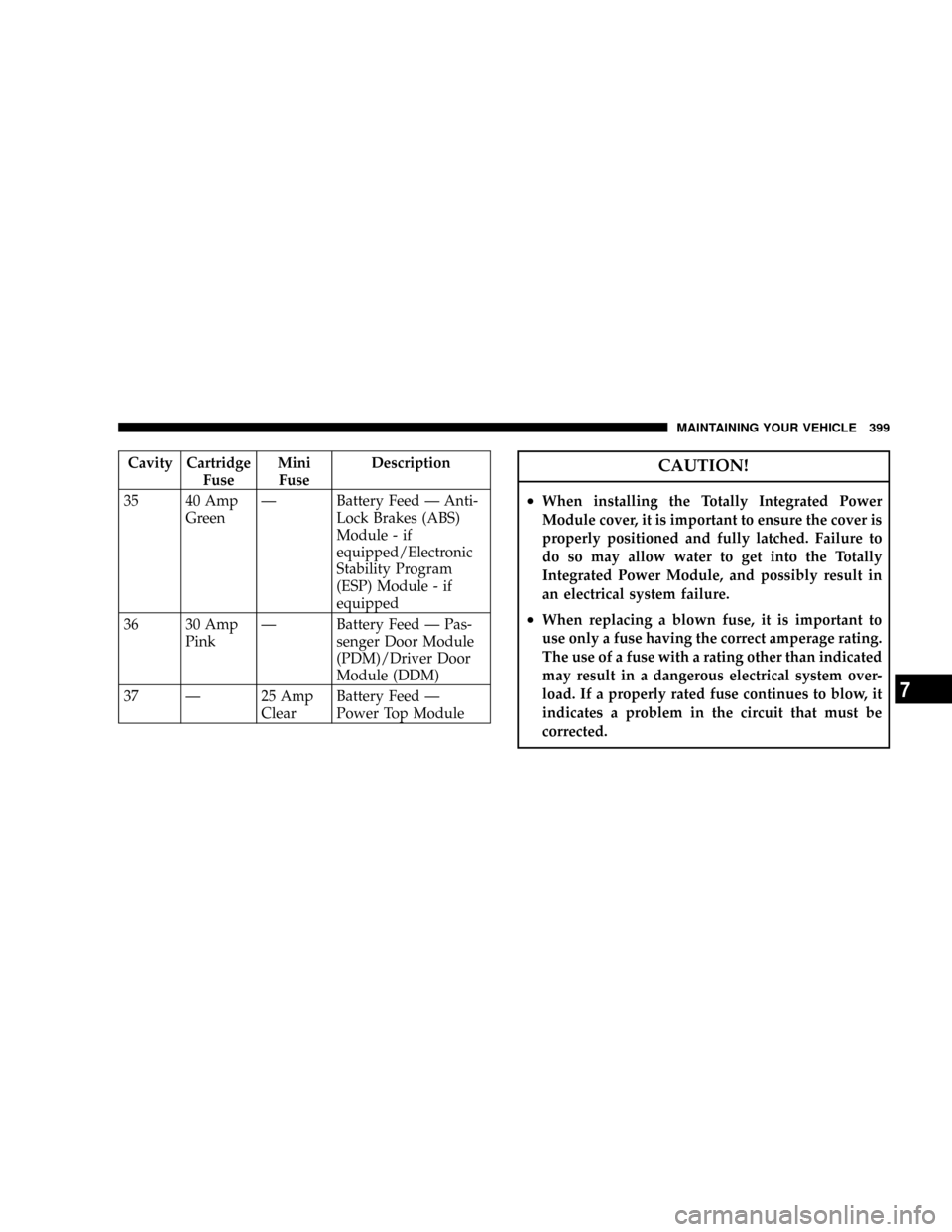
Page 399 of 454
Cavity Cartridge
FuseMini
FuseDescription
35 40 Amp
GreenÐ Battery Feed Ð Anti-
Lock Brakes (ABS)
Module - if
equipped/Electronic
Stability Program
(ESP) Module - if
equipped
36 30 Amp
PinkÐ Battery Feed Ð Pas-
senger Door Module
(PDM)/Driver Door
Module (DDM)
37 Ð 25 Amp
ClearBattery Feed Ð
Power Top ModuleCAUTION!
²When installing the Totally Integrated Power
Module cover, it is important to ensure the cover is
properly positioned and fully latched. Failure to
do so may allow water to get into the Totally
Integrated Power Module, and possibly result in
an electrical system failure.
²When replacing a blown fuse, it is important to
use only a fuse having the correct amperage rating.
The use of a fuse with a rating other than indicated
may result in a dangerous electrical system over-
load. If a properly rated fuse continues to blow, it
indicates a problem in the circuit that must be
corrected.
MAINTAINING YOUR VEHICLE 399
7
Page 401 of 454
BULB REPLACEMENT
Low Beam Headlight, High Beam Headlight
1. Open the hood.
NOTE:It may be necessary to remove the air cleaner
filter housing and position the totally integrated power
module aside prior to replacing the low beam headlight
on the driver's side of the vehicle.
2. Rotate the applicable bulb and connector assembly
1¤4
turn counterclockwise and remove the assembly from the
headlight housing.
3. Disconnect the bulb from the harness connector and
then connect the replacement bulb.
1 Ð High Beam Headlight
2 Ð Low Beam HeadlightMAINTAINING YOUR VEHICLE 4017