Page 73 of 457
also accommodate a flexible webbing-mounted LATCH-
compatible child seat by using the inboard lower anchors
of the two outboard seating positions. A rigid mount seat
can only be installed at this seating location by using the
vehicle's seat belt. Regardless of the specific type of lower
attachment, NEVER install LATCH-compatible child
seats such that two child seats share a common lower
anchorage. If you are installing LATCH-compatible child
restraints in adjacent rear seating positions, you can use
the LATCH anchors or the vehicle's seat belt for the
outboard position, but you must use the vehicle's seat
belt at the center position.
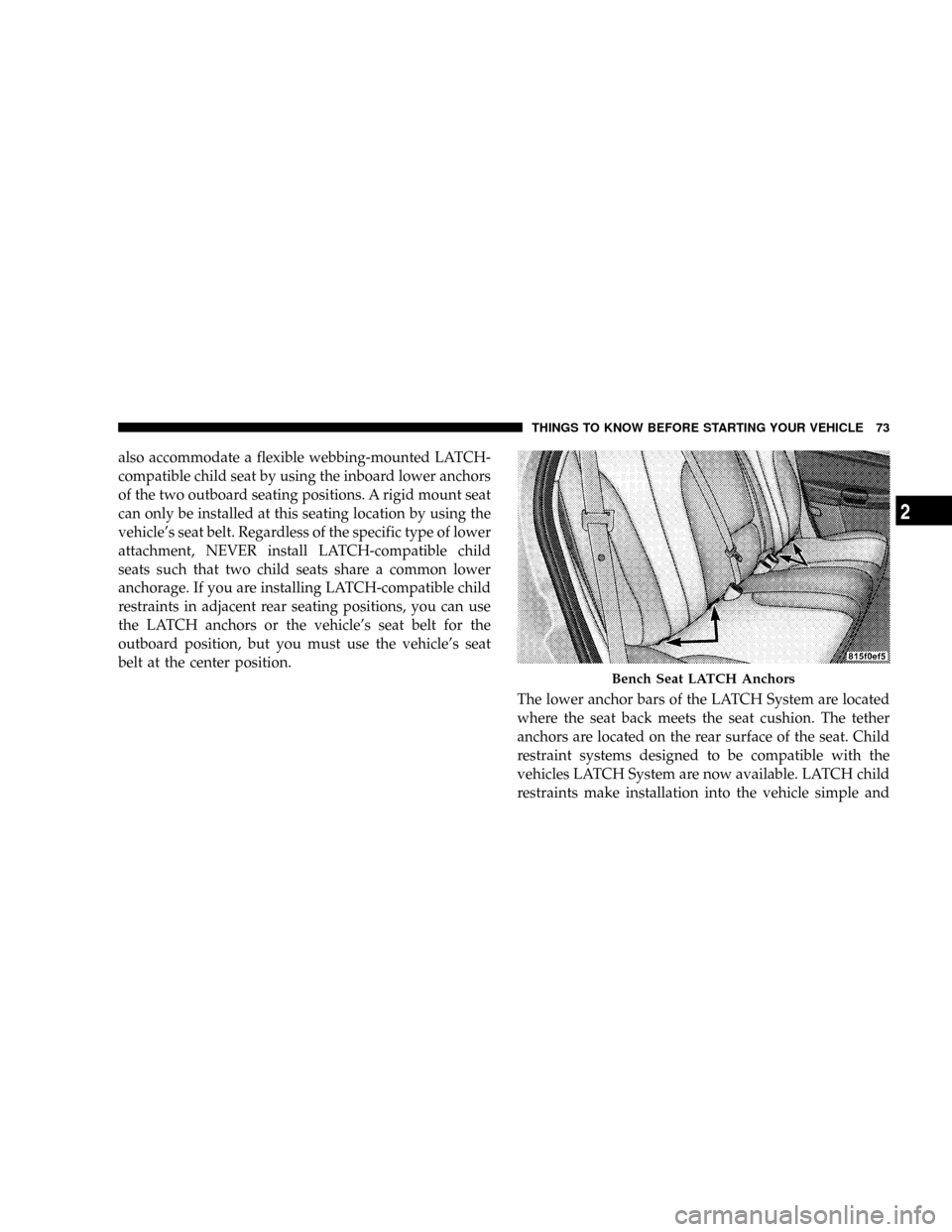
The lower anchor bars of the LATCH System are located
where the seat back meets the seat cushion. The tether
anchors are located on the rear surface of the seat. Child
restraint systems designed to be compatible with the
vehicles LATCH System are now available. LATCH child
restraints make installation into the vehicle simple and
Bench Seat LATCH Anchors
THINGS TO KNOW BEFORE STARTING YOUR VEHICLE 73
2
Page 74 of 457

convenient. When using the LATCH System, always
follow the child restraint manufacturer's installation in-
structions.
NOTE:If your child restraint seat is not LATCH com-
patible, install the restraint using the vehicle seat belts.
Tether Anchors
There are tether strap anchorages behind all second row
seating positions and for six passenger vehicles on the
driver's side third row seating position. The tether an-
chors are located in the rear surface of the seat. When
using the tether anchorages in the second row fold &
tumble seating positions and in the outboard second row
bench seating positions, ensure that the strap is routed
over the top of the seatback and under the head restraint
between the head restraint posts.When the tether anchorage is used in the center second
row bench seating position or on the third row seating
position, where equipped, the strap should be positioned
straight over the top of the seatback.
2ND ROW TETHER ANCHOR
74 THINGS TO KNOW BEFORE STARTING YOUR VEHICLE
Page 75 of 457
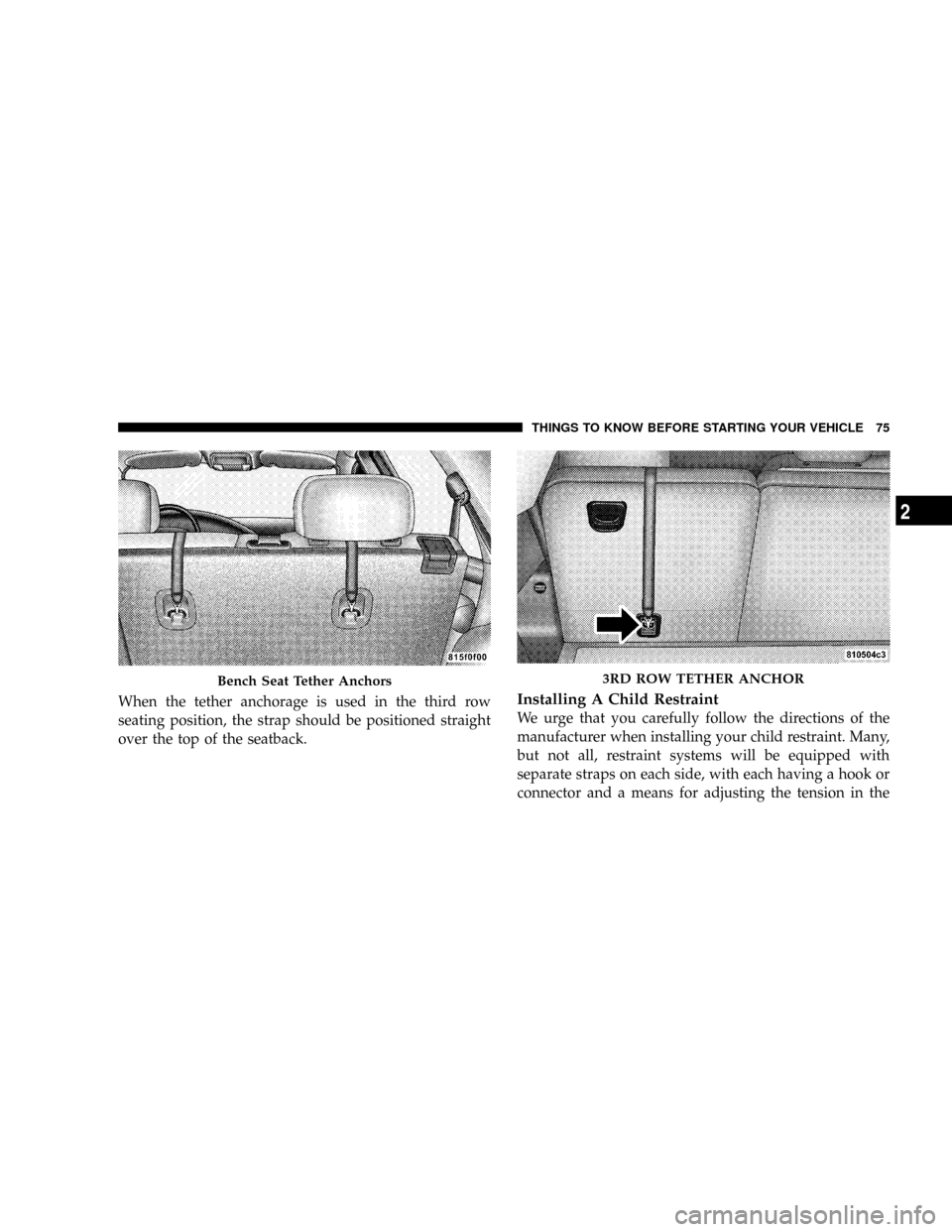
When the tether anchorage is used in the third row
seating position, the strap should be positioned straight
over the top of the seatback.Installing A Child Restraint
We urge that you carefully follow the directions of the
manufacturer when installing your child restraint. Many,
but not all, restraint systems will be equipped with
separate straps on each side, with each having a hook or
connector and a means for adjusting the tension in the
Bench Seat Tether Anchors3RD ROW TETHER ANCHOR
THINGS TO KNOW BEFORE STARTING YOUR VEHICLE 75
2
Page 76 of 457

strap. Forward-facing toddler restraints and some
rearward-facing infant restraints will also be equipped
with a tether strap, a hook and means for adjusting the
tension in the strap.
In general, you will first loosen the adjusters on the lower
straps and tether straps so that you can more easily attach
the hook or connector to the lower anchorages and tether
anchorages. Then tighten all three straps as you push the
child restraint rearward and downward into the seat.
Child restraint systems having attachments designed to
connect to the lower anchorages are now available. Child
restraints having tether straps and hooks for connection
to the seatback tether anchorage have been available for
some time. In fact, many child restraint manufacturer's
will provide add-on tether strap kits for some of their
older products.Because the lower anchorages are to be introduced to
passenger carrying vehicles over a period of years, child
restraint systems having attachments for those anchor-
ages will continue to have features for installation in
vehicles using the lap or lap/shoulder belt. They will also
have tether straps, and you are urged to take advantage
of all of the available attachments provided with your
child restraint in any vehicle.
NOTE:When using the LATCH attaching system to
install a child restraint, please ensure that all seat belts
not being used for occupant restraints are stowed and out
of reach of children. It is recommended that before
installing the child restraint, buckle the seat belt so the
seat belt is tucked behind the child restraint and out of
reach. If the buckled seat belt interferes with the child
restraint installation, instead of tucking the seat belt
behind the child restraint, route the seat belt through the
child restraint belt path and then buckle it. This should
stow the seat belt out of the reach of an inquisitive child.
76 THINGS TO KNOW BEFORE STARTING YOUR VEHICLE
Page 77 of 457
Remind all children in the vehicle that the seat belts are
not toys and should not be played with, and never leave
your child unattended in the vehicle.
Not all child restraint systems will be installed as we
have described here. Again, carefully follow the instruc-
tions that come with the child restraint system.
WARNING!
Improper installation of a child restraint to the
LATCH anchorages can lead to failure of an infant or
child restraint. The child could be badly injured or
killed. Follow the manufacturer's directions exactly
when installing an infant or child restraint.
Transporting Pets
Airbags deploying in the front seat could harm your pet.
An unrestrained pet could be thrown about and possibly
injured, or injure a passenger during panic braking or in
a collision.
Pets should be restrained in the rear seat in pet harnesses
or pet carriers that are secured by seat belts.
ENGINE BREAK-IN RECOMMENDATIONS
A long break-in period is not required for the engine in
your new vehicle.
Drive moderately during the first 300 miles (500 km).
After the initial 60 miles (100 km), speeds up to 50 or 55
mph (80 or 90 km/h) are desirable.
While cruising, brief full-throttle acceleration, within the
limits of local traffic laws, contributes to a good break-in.
Wide open throttle acceleration in low gear can be
detrimental and should be avoided.
THINGS TO KNOW BEFORE STARTING YOUR VEHICLE 77
2
Page 127 of 457
WARNING!
²Not all head restraints in this vehicle are the same.
Head restraints from one seating position should
not be removed and installed in any other seating
position. In a collision, serious injury or death may
result if the proper head restraint is not installed on
each seat.
²The cargo area in the rear of the vehicle should not
be used as a play area by children. They could be
seriously injured in a collision. Children should be
seated and using the proper restraint system.
²It is extremely dangerous to ride in a cargo area,
inside or outside of a vehicle. In a collision, people
riding in these areas are more likely to be seriously
injured or killed.
²Do not allow people to ride in any area of your
vehicle that is not equipped with seats and seat
belts.
²Be sure everyone in your vehicle is in a seat and
using a seat belt properly.
Load Floor Ð If Equipped
For additional cargo space, the second and third row
seatbacks may be folded forward and the load floor
extended to cover the center console.
To extend the load floor, follow these steps:
1. Move the second row seats to the full rear position.
2. Fold the second and third row seatbacks down.
UNDERSTANDING THE FEATURES OF YOUR VEHICLE 127
3
Page 171 of 457
WARNING!
²NEVERleave children alone in a vehicle. Occu-
pants, particularly unattended children, can be-
come entrapped by the power sunroof while oper-
ating the power sunroof switch. Such entrapment
may result in serious injury or death. Don't leave
the keys in the ignition. A child could operate
power windows, other controls, or move the ve-
hicle
²In an accident, there is a greater risk of being
thrown from a vehicle with an open sunroof. You
could also be seriously injured or killed. Always
fasten your seat belt properly and make sure all
passengers are properly secured too.
²Do not allow small children to operate the sunroof.
Never allow fingers or other body parts, or any
object to project through the sunroof opening.
Injury may result.
Wind Buffeting
Wind buffeting can be described as the perception of
pressure on the ears or a helicopter type sound in the
ears. Your vehicle may exhibit wind buffeting with the
windows down, or the sunroof (if equipped) in certain
open or partially open positions. This is a normal occur-
rence and can be minimized. If the buffeting occurs with
the rear windows open, open the front and rear windows
together to minimize the buffeting. If the buffeting occurs
with the sunroof open, adjust the sunroof opening to
minimize the buffeting or open any window.
Sunroof Comfort Position Ð If Equipped
If equipped, some model sunroofs will stop at a prede-
termined comfort position Ð not allowing the sunroof to
open to the full retracted glass position. The comfort
position stops the sunroof glass at approximately 3/4
open position. This will allow for minimal wind buffet-
ing.
UNDERSTANDING THE FEATURES OF YOUR VEHICLE 171
3
Page 177 of 457
4. Grasp the center portion of the cover flap. Pull it over
the cargo area.
5. Insert the pins on the ends of the cover flap into the
slots on the rear trim panel.
6. The liftgate may be opened or closed with the cargo
cover in place.
Cargo Tie-Down Hooks
The tie-downs located on cargo area floor and on the rear
trim panels should be used to safely secure loads when
vehicle is moving.
WARNING!
²Cargo tie-down hooks are not safe anchors for a
child seat tether strap. In a sudden stop or collision
a hook could pull loose and allow the child seat to
come loose. A child could be badly injured. Use
only the anchors provided for child seat tethers.
²The weight and position of cargo and passengers
can change the vehicle center of gravity and ve-
hicle handling. To avoid loss of control resulting
in personal injury, follow these guidelines for
loading your vehicle:
²Always place cargo evenly on the cargo floor. Put
heavier objects as low and as far forward as possible.
UNDERSTANDING THE FEATURES OF YOUR VEHICLE 177
3