Page 164 of 358

Residual Engine Heat Utilization (REST)
With the engine switched off, it is possible to
continue heating the interior for a short while.
Air volume is controlled automatically. Select a
temperature for each side of the passenger
compartment. Set the air distribution control switch to
the desired position.
To select, turn the key in the ignition switch to the ACC
or the OFF/LOCK position or remove. Press the recircu-
lation button. The indicator light in the button illumi-
nates. This function selection will not activate if the
battery charge level is insufficient.
To cancel, press the recirculation button. The indicator
light in the button goes out. The system will automati-
cally shut off if you turn the key in the ignition switch to
the ON/RUN position, after approximately 30 minutes,
or if the battery voltage drops.NOTE:This vehicle is equipped with an air conditioner
system that uses R-134a (HFC: hydrofluorocarbon) as a
refrigerant. Repairs should always be performed by a
qualified technician, and refrigerant should be collected
in a recovery system for recycling.
Dust Filter (If Equipped)
Nearly all dust particles and pollen are filtered out before
outside air enters the passenger compartment through
the air distribution system.
NOTE:Keep the air intake grille in front of windshield
free of snow and debris.
162 UNDERSTANDING YOUR INSTRUMENT PANEL
Page 165 of 358
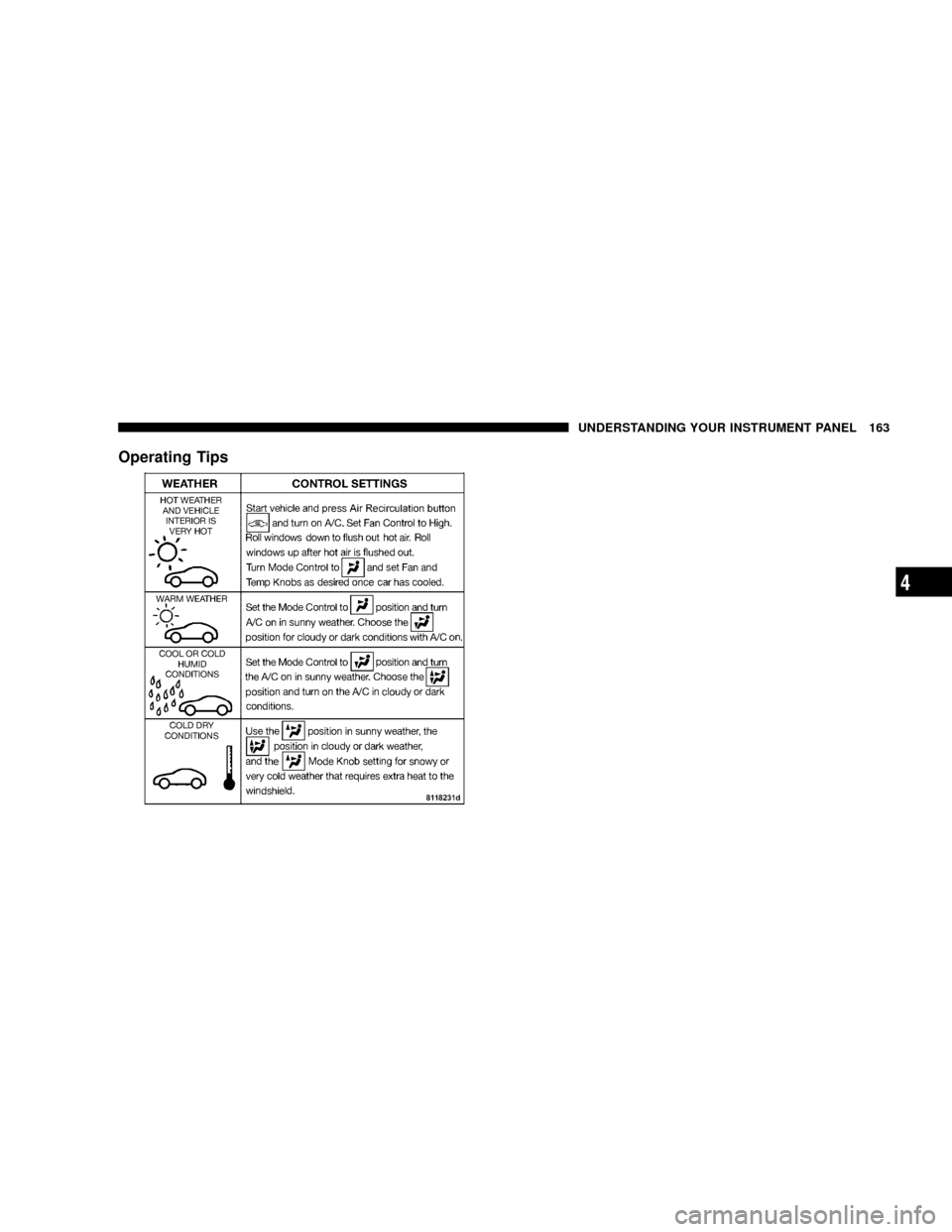
Operating Tips
UNDERSTANDING YOUR INSTRUMENT PANEL 163
4
Page 238 of 358

8. Unscrew the valve cap from the valve on the deflated
tire.
9. Screw the filler hose from the sealant bottle on the tire
valve.
10. Insert the power plug (4) into the power point on the
instrument panel.
11. Turn the ignition key to the ON/RUN position.
12. Press the switch on the air pump to 1. The air pump
should start to inflate the tire.
13. After five minutes, the tire should be inflated to at
least 26 psi (180 kPa) on the pressure gauge.
14. If the tire doesn't inflate to this level, press the air
pump switch to 0, disconnect the TIREFIT system from
the tire, and drive the vehicle back and forth approxi-
mately 30 feet (9 m) to distribute the sealant more evenly
within the tire.15. Attach the air pump hose directly to the tire, press the
switch to 1, and inflate the tire again.NOTE:If a tire
pressure of 26 psi (180 kPa) is not reached after five
minutes, the tire is too badly damaged. Do not attempt to
drive the vehicle further, and call for assistance.
16. If a tire pressure of 26 psi (180 kPa) is obtained, press
the air pump switch to 0, turn the ignition switch to the
OFF/LOCK position, and disconnect the TIREFIT sys-
tem.
17. Drive the vehicle for about 10 minutes to ensure
optimum distribution of the tire sealant within the tire.
18. Check the pressure in the tire. If the pressure is above
19 psi (130 kPa), inflate the tire to the pressure indicated
on the tire pressure label on the driver side latch pillar.
19. Have the tire inspected at the earliest opportunity at
an authorized dealer or tire service center.
236 WHAT TO DO IN EMERGENCIES
Page 267 of 358
You can check the oil level using the procedure described
in Checking Engine Oil Level in the Understanding Your
Instrument Panel section, or by checking the engine oil
dipstick.
The best time to check the engine oil level is about five
minutes after a fully warmed engine is shut off, or before
starting the engine after it has sat overnight.
Checking the oil while the vehicle is on level ground will
improve the accuracy of the oil level readings. Maintain
the oil level between the MIN and MAX markings on the
dipstick. Adding 1 qt (1 L) of oil when the reading is at
the MIN mark will result in a MAX reading on this
engine.
MAINTAINING YOUR VEHICLE 265
7
Page 268 of 358

Change Engine Oil
The oil change interval for yourvehicle is initially set at
7,000 mi (Canada: 11 000 km).
The Flexible Service System (FSS) in your vehicle evalu-
ates engine temperature, oil level, vehicle speed, engine
speed, distance driven, and the time elapsed since your
last service. It determines when your vehicle needs
maintenance service and alerts you in advance. The next
necessary service is indicated by the FSS in your instru-
ment cluster.
NOTE:Also see the FSS system details in the Under-
standing Your Instrument Panel section of this manual.
Very light duty driving cycles (most trips more than 10
mi [16 km]) at moderate speeds in moderate temperature
conditions) can extend the service interval beyond 7,000
mi (Canada: 11 000 km).IfANYof the following apply to your driving, the oil
change interval can be reduced significantly:
²Day and night temperatures are below 32ÉF (0ÉC)
²Stop-and-go driving
²Extensive engine idling
²Driving in dusty conditions
²Short trips of less than 10 mi (16 km)
²More than 50% of your driving is at sustained high
speeds during hot weather, above 90ÉF (32ÉC)
²Taxi, Police, or delivery service (commercial service)
Observe the oil change interval indicated by your FSS
system. This system will monitor the driving conditions
seen by your vehicle, and will recommend the best
interval for servicing your vehicle to maintain it in top
condition.
266 MAINTAINING YOUR VEHICLE
Page 296 of 358

CAUTION!
The use of vinyl, leather or plastic protectants may
cause excessive gloss and/or discoloration of interior
trim parts.
WARNING!
Do not use volatile solvents for cleaning purposes.
Many are potentially flammable, and if used in
closed areas they may cause respiratory harm.
Cleaning Headlights
Your vehicle has plastic headlights that are lighter and
less susceptible to stone breakage than glass headlights.
Plastic is not as scratch resistant as glass and therefore
different lens cleaning procedures must be followed.To minimize the possibility of scratching the lenses and
reducing light output, avoid wiping with a dry cloth. To
remove road dirt, wash with a mild soap solution fol-
lowed by rinsing.
Do not use abrasive cleaning components, solvents, steel
wool or other aggressive material to clean the lenses.
Glass Surfaces
All glass surfaces should be cleaned on a regular basis
with any commercial household-type glass cleaner.
Never use an abrasive-type cleaner. Use caution when
cleaning inside rear windows equipped with electric
defrosters. Do not use scrapers or other sharp instru-
ments which may scratch the elements.
Instrument Panel Cover
The instrument panel cover has a low glare surface which
minimizes reflections in the windshield. Do not use
294 MAINTAINING YOUR VEHICLE
Page 306 of 358
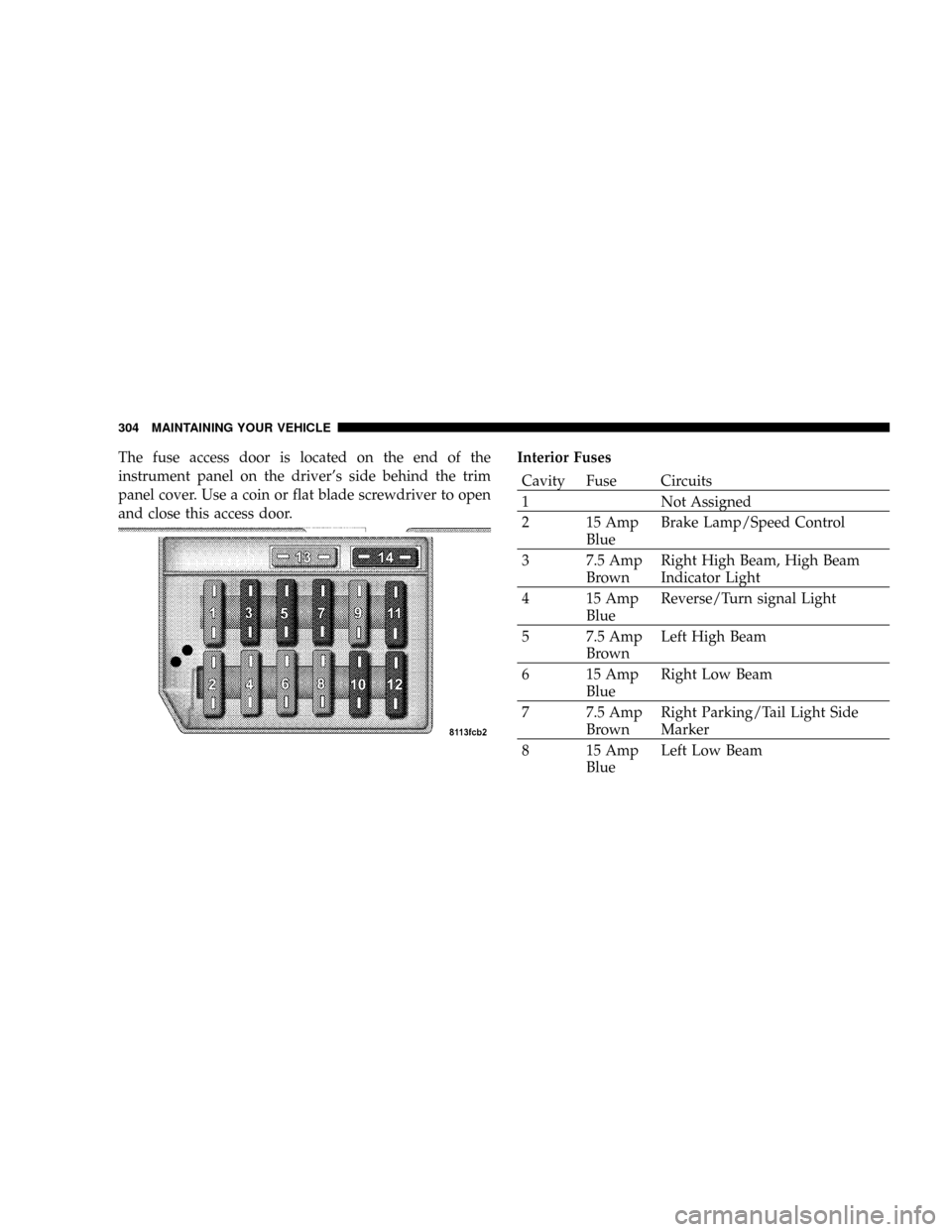
The fuse access door is located on the end of the
instrument panel on the driver's side behind the trim
panel cover. Use a coin or flat blade screwdriver to open
and close this access door.Interior Fuses
Cavity Fuse Circuits
1 Not Assigned
2 15 Amp
BlueBrake Lamp/Speed Control
3 7.5 Amp
BrownRight High Beam, High Beam
Indicator Light
4 15 Amp
BlueReverse/Turn signal Light
5 7.5 Amp
BrownLeft High Beam
6 15 Amp
BlueRight Low Beam
7 7.5 Amp
BrownRight Parking/Tail Light Side
Marker
8 15 Amp
BlueLeft Low Beam
304 MAINTAINING YOUR VEHICLE
Page 324 of 358

MAINTENANCE SCHEDULES
There are two maintenance schedules that show the
requiredservice for your vehicle.
Schedule ªAº typically rotates with Schedule ªB.º Follow
Schedule ªAº after the first service interval, Schedule ªBº
after the second service interval, and so on. In some cases
where the service interval has been extended due to very
light duty driving, a Schedule ªBº service may be indi-
cated following a previous Schedule ªBº service. There
are additional service tasks required under Schedule ªB.º
Your Flexible Service System (FSS) Ð see Understanding
Your Instrument Panel section Ð should give you an
exact indication of when your vehicle should be sched-
uled for service and which schedule to follow.
Additional Periodic Maintenanceitems should also be
performed beyond the items listed in the following charts
to assure the optimum performance of your vehicle.
SCOPE OF WORK FOR ªAº SCHEDULE
MAINTENANCE SERVICE
Oil Change
²Change oil and replace filter
Maintenance
²Lubricate hood hinges, latch, and secondary latch
²Reset FSS Display
Function Check
²Horn, hazard warning flashers, turn signals, and indi-
cator lamps
²Headlamps and exterior lighting
²Windshield wipers and washer system
Inspection
²Check front and rear brake pads for lining thickness
322 MAINTENANCE SCHEDULES
8
M
A
I
N
T
E
N
A
N
C
E
S
C
H
E
D
U
L
E
S