Page 237 of 358

WARNING!
Cuts or punctures larger than approximately 0.16 in. (4 mm),
tire damage caused by driving with extremely low tire
pressure or on a flat tire, or a damaged wheel can pose a
hazard while driving. TIREFIT should not be used in such
circumstances. Do not drive the vehicle under such circum-
stances. Contact your nearest authorized dealer for assis-
tance.
Take care not to allow the contents of TIREFIT to come in
contact with hair, eyes or clothing. TIREFIT is harmful if
inhaled, swallowed or absorbed through the skin: It causes
skin, eye and respiratory irritation. Any contact with eyes
or skin should be flushed immediately with plenty of
water. If clothing comes in contact with TIREFIT, change
clothing as soon as possible.
In case of allergic reaction or rash, consult a physician
immediately. Keep TIREFIT out of reach of children. If
swallowed, rinse mouth immediately with plenty of water
and drink plenty of water. Do not induce vomiting! Consult
a physician immediately.
Keep away from open flame or heat source.
Sealing tire with TIREFIT
1. Set the parking brake and turn on the hazard warning
flashers.
2. Move the transmission selector lever to the PARK
position (manual transmission to FIRST or REVERSE
gear) and turn off the engine.
3. Remove the TIREFIT kit and electric air pump from
the area below the cargo compartment carpet.
4. Open flap (2) on the electric air pump.
5. Pull the power plug (4) and air hose (5) along with the
pressure gauge out of the air pump housing.
6. Screw the air hose (5) onto the hose connection on the
TIREFIT sealant bottle (1).
7. Holding the sealant bottle by the top, insert it down-
wards into the recess (3) on the air pump.
WHAT TO DO IN EMERGENCIES 235
6
Page 240 of 358
Jacking the vehicle should only be necessary in the event
that a tire has been severely damaged, and must be
replaced. (See TIREFIT Tire Repair section for a descrip-
tion of cuts and punctures that may be repairable with
TIREFIT.)²Turn on the hazard warning flashers and park the
vehicle on a firm, level surface; avoid ice or slippery
areas.
²Firmly set the parking brake and shift the transmission
selector lever into PARK (manual transmission to
FIRST or REVERSE gear).
²Turn OFF the engine.
²Block the wheel diagonally
opposite the flat tire.
²Passengers must not remain in the vehicle when the
vehicle is jacked.
238 WHAT TO DO IN EMERGENCIES
Page 245 of 358
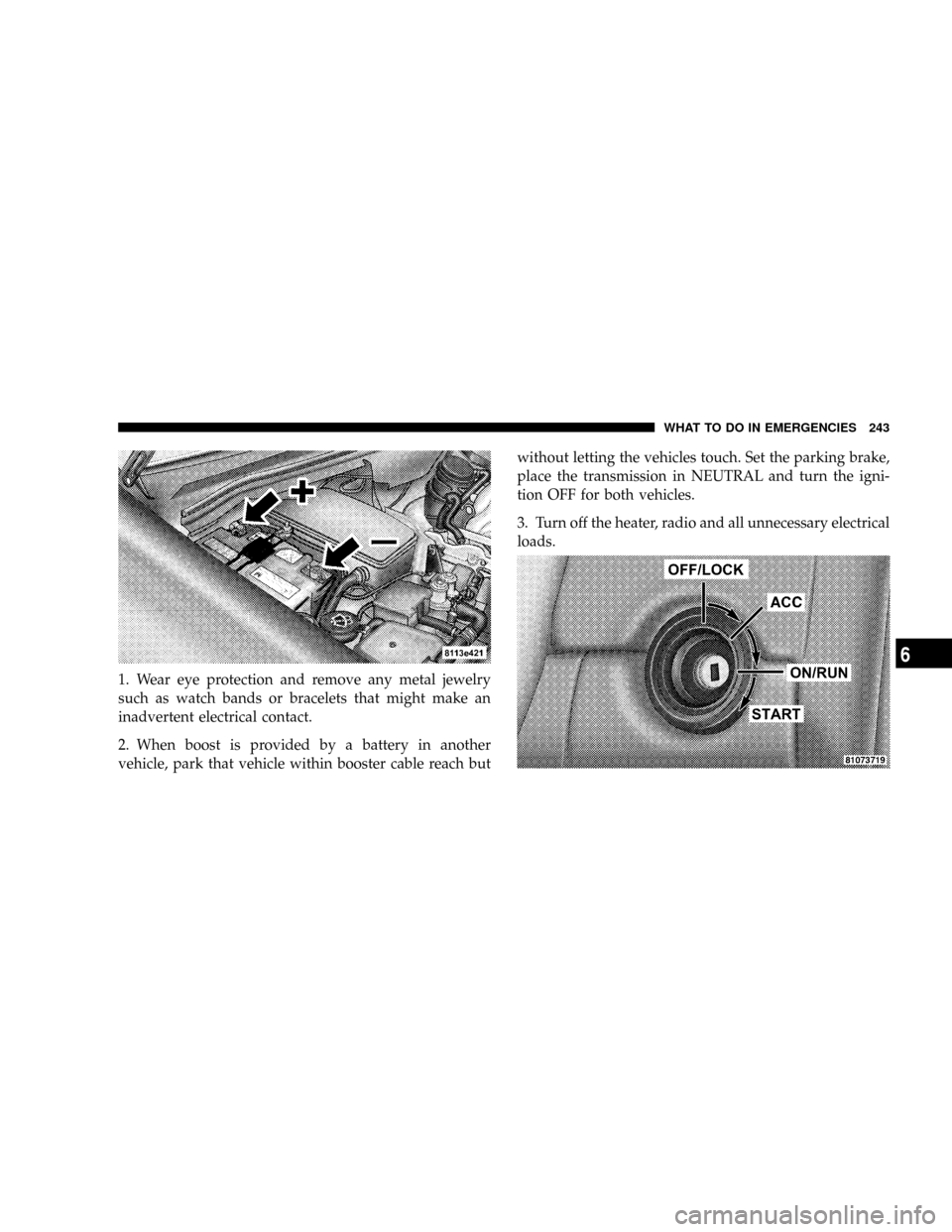
1. Wear eye protection and remove any metal jewelry
such as watch bands or bracelets that might make an
inadvertent electrical contact.
2. When boost is provided by a battery in another
vehicle, park that vehicle within booster cable reach butwithout letting the vehicles touch. Set the parking brake,
place the transmission in NEUTRAL and turn the igni-
tion OFF for both vehicles.
3. Turn off the heater, radio and all unnecessary electrical
loads.
WHAT TO DO IN EMERGENCIES 243
6
Page 248 of 358

CAUTION!
If the vehicle is towed with the front wheels raised, the
engine must be shut off (key in the ignition switch
turned to the OFF/LOCK or ACC positions). Other-
wise, the ESP will immediately be engaged and will
apply the rear wheel brakes. Switch OFF the tow-away
alarm as well as the automatic central locking system.
Towing restrictions for vehicles with automatic transmis-
sion: The vehicle may be towed with all wheels on the
ground and the transmission shift lever in the NEUTRAL
position for distances up to 30 mi (48 km) and at a speed
not to exceed 30 mph (48 km/h). The key must be turned
to the ON/RUN position in the ignition. To be certain to
avoid a possibility of damage to the transmission; how-
ever, we recommend the drive shaft be disconnected at
the rear axle drive flange for any towing beyond a short
tow to a nearby garage.Always comply with applicable state or local towing
ordinances.
CAUTION!
²Do not attempt to tow this vehicle from the front
with sling-type towing equipment. Damage to the
front fascia will result.
²Always use wheel lift equipment when towing
from the front. The only other approved method of
towing is with a flatbed truck.
²Do not tow the vehicle from the rear. Damage to
the rear sheet metal and fascia will occur.
²Do not push or tow this vehicle with another
vehicle as damage to the bumper fascia and trans-
mission may result.
246 WHAT TO DO IN EMERGENCIES
Page 260 of 358

NExhaust System......................279
NCooling System.......................280
NHoses And Vacuum/Vapor Harnesses.......284
NBrakes.............................285
NAutomatic Transmission................288
NManual Transmission..................289
NAppearance Care And Protection From
Corrosion...........................290
mConvertible Top Care....................295
NWashing............................296
NGeneral Cleaning.....................296
NWeather Strip Care....................297
mFuses...............................297NUnderhood Accessory Fuse Block Fuses.....297
NRelay Control Module Fuses.............302
NInterior Fuses........................303
mReplacement Bulbs......................305
NInterior Light Bulbs....................305
NExterior Light Bulbs...................305
mExterior Light Bulb Service................306
NHeadlights..........................306
NFront Turn Signal And Parking/Standing
Lights.............................307
NFront And Rear Sidemarker Lights.........307
NTail, Stop, Back Up And Turn Signal Lights . . . 308
NLicense Plate Light....................309
258 MAINTAINING YOUR VEHICLE
Page 287 of 358

Brakes
In order to assure brake system performance, all brake
system components should be inspected periodically.
Suggested service intervals can be found in the Mainte-
nance section.
WARNING!
Riding the brakes can lead to brake failure and
possibly an accident. Driving with your foot resting
or riding on the brake pedal can result in abnormally
high brake temperatures, excessive lining wear, and
possible brake damage. You wouldn't have your full
braking capacity in an emergency.
Brake and Power Steering System Hoses
When servicing the vehicle for scheduled maintenance,
inspect surface of hoses and nylon tubing for evidence of
heat and mechanical damage. Hard and brittle rubber,cracking, checking, tears, cuts, abrasions, and excessive
swelling suggest deterioration of the rubber. Particular
attention should be made to examining those hose sur-
faces nearest to high heat sources, such as the exhaust
manifold.
Inspect all hose clamps and couplings to make sure they
are secure and no leaks are present.
Ensure the nylon tubing in these areas has not melted or
collapsed.
NOTE:Often, fluids such as oil, power steering fluid,
and brake fluid are used during assembly plant opera-
tions to ease the assembly of hoses to couplings. There-
fore, oil wetness at the hose-coupling area is not neces-
sarily an indication of leakage. Actual dripping of hot
fluid when systems are under pressure (during vehicle
operation) should be noted before a hose is replaced
based on leakage.
MAINTAINING YOUR VEHICLE 285
7
Page 288 of 358
NOTE:Inspection of brake hoses should be done when-
ever the brake system is serviced and at every engine oil
change.
WARNING!
Worn brake hoses can burst and cause brake failure.
You could have an accident. If you see any signs of
cracking, scuffing, or worn spots, have the brake
hoses replaced immediately.
Brake Master Cylinder
The fluid level in the master cylinder should be checked
when performing under hood services, or immediately if
the brake system warning light is on.Be sure to clean the top of the master cylinder area before
removing the cap. If necessary, add fluid to bring the
fluid level up to the requirements described on the brake
fluid reservoir. Fluid level can be expected to fall as the
brake pads wear. Brake fluid level should be checked
when pads are replaced. However, low fluid level may be
caused by a leak and a checkup may be needed.
286 MAINTAINING YOUR VEHICLE
Page 289 of 358
Use brake fluid approved to MB 331.0, or a DOT 4 brake
fluid with: minimum dry boiling point (ERBP) 500ÉF,
minimum wet boiling point (WERBP) 356ÉF, maximum
viscosity 1500 mm
2/s, conforming to FMVSS 116 and
ISO 4925.
WARNING!
Use of a brake fluid that may have a lower initial
boiling point or unidentified as to specification, may
result in sudden brake failure during hard prolonged
braking. You could have an accident.
WARNING!
Use only brake fluid that has been in a tightly closed
container to avoid contamination from foreign mat-
ter. Use of contaminated fluid may result in reduced
brake performance or a sudden brake failure. You
could have an accident.
CAUTION!
Do not allow petroleum-based fluid to contaminate
the brake fluid as seal damage will result!
MAINTAINING YOUR VEHICLE 287
7