Page 197 of 358

When the ABS malfunction indicator light in the instru-
ment cluster comes on while the engine is running, it
indicates that the ABS has detected a malfunction and has
switched off. In this case, the brake system functions in
the usual manner, but without antilock assistance. With
the ABS malfunctioning, the BAS and ESP are also
switched off. Both malfunction indicator lights come on
with the engine running. If the charging voltage falls
below 10 volts, the malfunction indicator light comes on
and the ABS is switched off. When the voltage is above
this value again, the malfunction indicator light should
go out and the ABS is operational. If the malfunction
indicator light stays illuminated, have the system
checked at your authorized dealer as soon as possible.WARNING!
ABS cannot prevent the natural laws of physics from
acting on the vehicle, nor can it increase braking or
steering efficiency beyond that afforded by the con-
dition of the vehicle brakes and tires or the traction
afforded. The ABS cannot prevent accidents, includ-
ing those resulting from excessive speed in turns,
following another vehicle too closely, or hydroplan-
ing. Only a safe, attentive, and skillful driver can
prevent accidents. The capabilities of an ABS-
equipped vehicle must never be exploited in a reck-
less or dangerous manner which could jeopardize the
user's safety or the safety of others.
STARTING AND OPERATING 195
5
Page 250 of 358
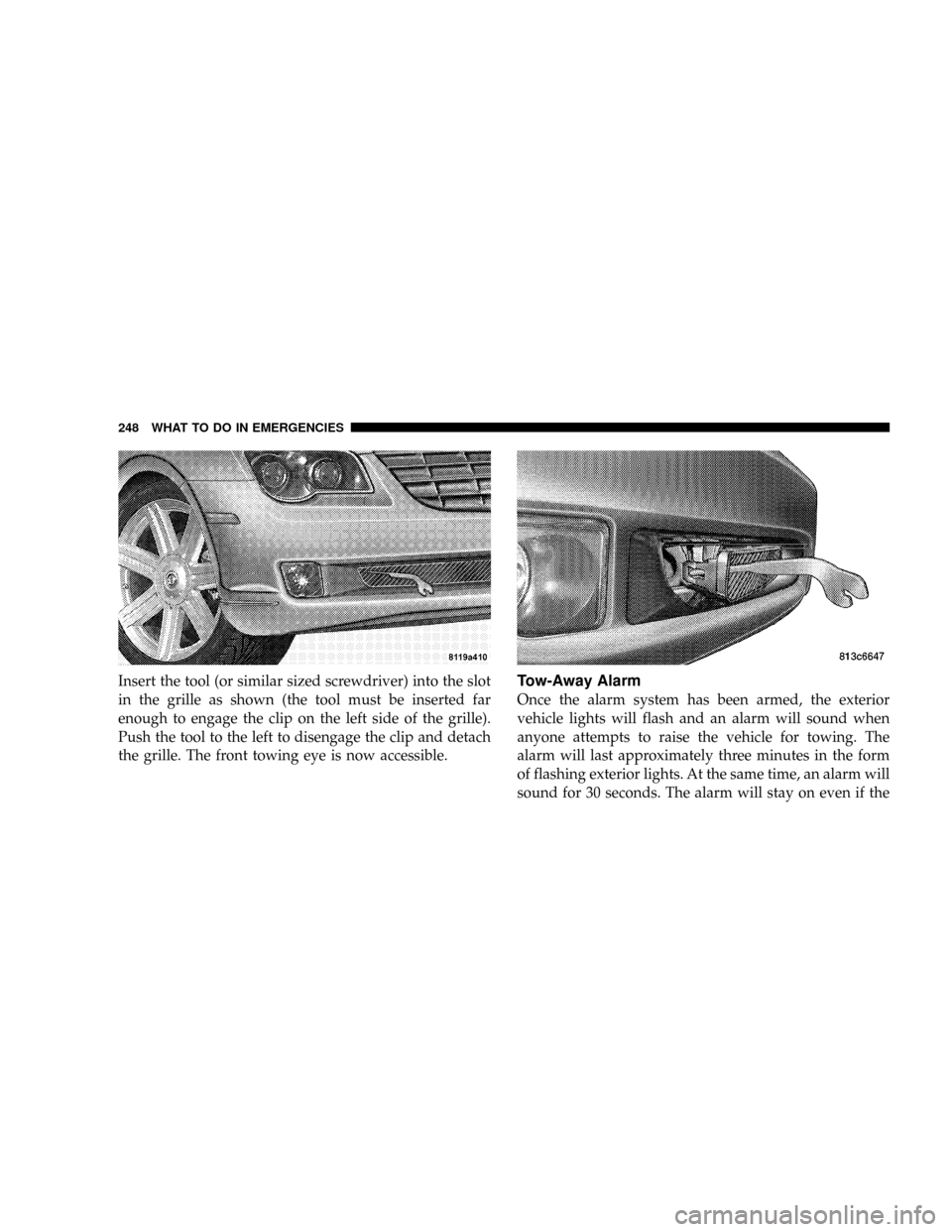
Insert the tool (or similar sized screwdriver) into the slot
in the grille as shown (the tool must be inserted far
enough to engage the clip on the left side of the grille).
Push the tool to the left to disengage the clip and detach
the grille. The front towing eye is now accessible.Tow-Away Alarm
Once the alarm system has been armed, the exterior
vehicle lights will flash and an alarm will sound when
anyone attempts to raise the vehicle for towing. The
alarm will last approximately three minutes in the form
of flashing exterior lights. At the same time, an alarm will
sound for 30 seconds. The alarm will stay on even if the
248 WHAT TO DO IN EMERGENCIES
Page 260 of 358

NExhaust System......................279
NCooling System.......................280
NHoses And Vacuum/Vapor Harnesses.......284
NBrakes.............................285
NAutomatic Transmission................288
NManual Transmission..................289
NAppearance Care And Protection From
Corrosion...........................290
mConvertible Top Care....................295
NWashing............................296
NGeneral Cleaning.....................296
NWeather Strip Care....................297
mFuses...............................297NUnderhood Accessory Fuse Block Fuses.....297
NRelay Control Module Fuses.............302
NInterior Fuses........................303
mReplacement Bulbs......................305
NInterior Light Bulbs....................305
NExterior Light Bulbs...................305
mExterior Light Bulb Service................306
NHeadlights..........................306
NFront Turn Signal And Parking/Standing
Lights.............................307
NFront And Rear Sidemarker Lights.........307
NTail, Stop, Back Up And Turn Signal Lights . . . 308
NLicense Plate Light....................309
258 MAINTAINING YOUR VEHICLE
Page 296 of 358

CAUTION!
The use of vinyl, leather or plastic protectants may
cause excessive gloss and/or discoloration of interior
trim parts.
WARNING!
Do not use volatile solvents for cleaning purposes.
Many are potentially flammable, and if used in
closed areas they may cause respiratory harm.
Cleaning Headlights
Your vehicle has plastic headlights that are lighter and
less susceptible to stone breakage than glass headlights.
Plastic is not as scratch resistant as glass and therefore
different lens cleaning procedures must be followed.To minimize the possibility of scratching the lenses and
reducing light output, avoid wiping with a dry cloth. To
remove road dirt, wash with a mild soap solution fol-
lowed by rinsing.
Do not use abrasive cleaning components, solvents, steel
wool or other aggressive material to clean the lenses.
Glass Surfaces
All glass surfaces should be cleaned on a regular basis
with any commercial household-type glass cleaner.
Never use an abrasive-type cleaner. Use caution when
cleaning inside rear windows equipped with electric
defrosters. Do not use scrapers or other sharp instru-
ments which may scratch the elements.
Instrument Panel Cover
The instrument panel cover has a low glare surface which
minimizes reflections in the windshield. Do not use
294 MAINTAINING YOUR VEHICLE
Page 307 of 358
Cavity Fuse Circuits
9 15 Amp
BlueFog Light
10 7.5 Amp
BrownLeft Parking/Tail Light Side
Marker
11 7.5 Amp
BrownLicense Plate/Instrument Cluster
Lighting/Symbol Lighting
12 Not Used - Spare Fuse
13 Not Used - Spare Fuse
14 Not Used - Spare Fuse
REPLACEMENT BULBS
Interior Light Bulbs
For lighted switches and interior lights, see your autho-
rized dealer for servicing requirements.
Exterior Light Bulbs
Bulb Bulb No.
Headlight - High and Low Beam......12V55W H7U
Front Turn Signal.......................Y21W
Front Parking/Standing Light.............. W5W
Front Side Marker Light.................. W5W
Rear Marker Light...................... W5W
Center High-Mounted Stop Light (CHMSL)..... LED
Front Fog Lights.....................HB455W
Rear Turn Signal Light...................Y21W
Rear Tail and Stop Light.................21/5W
Backup Light........................... 21W
License................................ 168
MAINTAINING YOUR VEHICLE 305
7
Page 308 of 358
EXTERIOR LIGHT BULB SERVICE
Headlights
WARNING!
Halogen lamps contain pressurized gas. A bulb can
explode if you:
²Touch or move it when hot
²Drop the bulb
²Scratch the bulb
Wear eye and hand protection.
NOTE:To prevent a possible electrical short circuit,
switch off light prior to replacing a bulb.
1. Push the tab down at the top end of the cover and
remove.2. Disconnect the electrical connector.
3. Release the spring clamps holding the bulb in place,
and pull out the bulb. Replace the bulb and reverse the
removal procedure exactly.
306 MAINTAINING YOUR VEHICLE
Page 309 of 358
CAUTION!
Do not touch the new bulb with your fingers. Oil
contamination will severely shorten bulb life. If the
bulb comes in contact with an oily surface, clean the
bulb with rubbing alcohol.
Front Turn Signal and Parking/Standing Lights
²
Twist the bulb socket counterclockwise and pull out.
Push the bulb into the socket, turn counterclockwise
and remove.
²Replace the bulb, push in and twist clockwise. Rein-
stall the socket, and turn clockwise.
Front and Rear Sidemarker Lights
1. Push the front sidemarker assembly in and slide it
forward. Push the rear sidemarker assembly in and slide
rearward. The assembly will release from the fascia.
2. Twist the bulb socket counterclockwise and pull out.
Push the bulb into the socket, turn counterclockwise and
remove.
3. Replace the light, push in and twist clockwise.
MAINTAINING YOUR VEHICLE 307
7
Page 310 of 358
4. Realign the two tabs and push the light in until it
engages into the lock.Tail, Stop, Back Up and Turn Signal Lights
1. Open the rear liftgate/decklid and remove the access
door in the trim panel.
2. Twist the bulb socket counterclockwise and pull out.
3. Replace the light and return to open socket, turn
clockwise until it stops.
4. Replace the access door in the trim panel.
308 MAINTAINING YOUR VEHICLE