2008 CHEVROLET UPLANDER ECU
[x] Cancel search: ECUPage 90 of 476

The passenger sensing system will turn off the right
front passenger’s frontal airbag and seat-mounted side
impact airbag (if equipped) under certain conditions.
The driver’s airbags are not part of the passenger
sensing system.
The passenger sensing system works with sensors that
are part of the right front passenger’s seat and safety
belt. The sensors are designed to detect the presence
of a properly-seated occupant and determine if the
right front passenger’s frontal airbag and seat-mounted
side impact airbag (if equipped) should be enabled
(may inate) or not.
Accident statistics show that children are safer if they
are restrained in the rear rather than the front seat.
We recommend that children be secured in a rear seat,
including: an infant or a child riding in a rear-facing
child restraint; a child riding in a forward-facing child
seat; an older child riding in a booster seat; and children,
who are large enough, using safety belts.
A label on your sun visor says, “Never put a rear-facing
child seat in the front.” This is because the risk to the
rear-facing child is so great, if the airbag deploys.
{CAUTION:
A child in a rear-facing child restraint can be
seriously injured or killed if the right front
passenger’s airbag inates. This is because
the back of the rear-facing child restraint
would be very close to the inating airbag.
Even though the passenger sensing system is
designed to turn off the right front passenger’s
frontal and seat-mounted side impact airbag
(if equipped) if the system detects a rear-facing
child restraint, no system is fail-safe, and
no one can guarantee that an airbag will not
deploy under some unusual circumstance,
even though it is turned off. We recommend
that rear-facing child restraints be secured in
a rear seat, even if the airbag(s) are off.
If you secure a forward-facing child restraint in
the right front seat, always move the front
passenger seat as far back as it will go. It is
better to secure the child restraint in a rear seat.
1-86
Page 91 of 476

If your vehicle does not have a rear seat that will
accommodate a rear-facing child restraint, we
recommend that rear-facing child restraints not be
transported in your vehicle, even if the airbag(s) are off.
The passenger sensing system is designed to turn
off the right front passenger’s frontal airbag and
seat-mounted side impact airbag (if equipped) if:
The right front passenger seat is unoccupied.
The system determines that an infant is present in
a rear-facing infant seat.
The system determines that a small child is present
in a child restraint.
The system determines that a small child is present
in a booster seat.
A right front passenger takes his/her weight off of
the seat for a period of time.
The right front passenger seat is occupied by a
smaller person, such as a child who has outgrown
child restraints.
Or, if there is a critical problem with the airbag
system or the passenger sensing system.
When the passenger sensing system has turned off the
right front passenger’s frontal airbag and seat-mounted
side impact airbag (if equipped), the off indicator will light
and stay lit to remind you that the airbag or airbags are
off. SeePassenger Airbag Status Indicator on page 3-38.If a child restraint has been installed and the on
indicator is lit, turn the vehicle off. Remove the child
restraint from the vehicle and reinstall the child restraint
following the child restraint manufacturer’s directions
and refer toSecuring a Child Restraint in the Right Front
Seat Position on page 1-64.
If, after reinstalling the child restraint and restarting
the vehicle, the on indicator is still lit, check to make
sure that the vehicle’s seatback is not pressing the child
restraint into the seat cushion. If this happens, slightly
recline the vehicle’s seatback and adjust the seat
cushion if possible. Also make sure the child restraint
is not trapped under the vehicle head restraint.
If this happens, adjust the head restraint. SeeHead
Restraints on page 1-6.
Remove any additional material from the seat such
as blankets, cushions, seat covers, seat heaters,
or seat massagers before reinstalling or securing the
child restraint.
If the on indicator is still lit, secure the child in the child
restraint in a rear seat position in the vehicle, and
check with your dealer/retailer. If no rear seat is
available, do not install a child restraint in this vehicle,
and check with your dealer/retailer.
1-87
Page 95 of 476

This could either prevent proper deployment of
the passenger airbag(s) or prevent the passenger
sensing system from properly turning off the
passenger airbag(s). SeePassenger Sensing
System on page 1-85.
If you have any questions about this, you should
contact Customer Assistance before you modify
your vehicle. The phone numbers and addresses
for Customer Assistance are in Step Two of
the Customer Satisfaction Procedure in this manual.
SeeCustomer Satisfaction Procedure on page 7-2.
Q:Because I have a disability, I have to get
my vehicle modied. How can I nd out whether
this will affect my airbag system?
A:If you have questions, call Customer Assistance.
The phone numbers and addresses for Customer
Assistance are in Step Two of the Customer
Satisfaction Procedure in this manual. See
Customer Satisfaction Procedure on page 7-2.
In addition, your dealer/retailer and the service manual
have information about the location of the airbag sensors,
sensing and diagnostic module and airbag wiring.
Restraint System Check
Checking the Restraint Systems
Now and then, make sure the safety belt reminder light
and all your belts, buckles, latch plates, retractors and
anchorages are working properly. If your vehicle has the
built-in child restraint, also periodically make sure the
harness straps, latch plates, buckle, clip, child head
restraint and anchorages are working properly.
Look for any other loose or damaged safety belt system
parts. If you see anything that might keep a safety belt
system from doing its job, have it repaired. Torn or frayed
safety belts may not protect you in a crash. They can rip
apart under impact forces. If a belt is torn or frayed, get a
new one right away. If your vehicle has the built-in child
restraint, torn or frayed harness straps can rip apart
under impact forces just like torn or frayed safety belts
can. They may not protect a child in a crash. If a harness
strap is torn or frayed, get a new harness right away.
Make sure the safety belt reminder light is working.
SeeSafety Belt Reminders on page 3-36for more
information.
Keep safety belts clean and dry. SeeCare of Safety
Belts and Built-in Child Restraint Harness on page 5-93
for more information.
1-91
Page 111 of 476
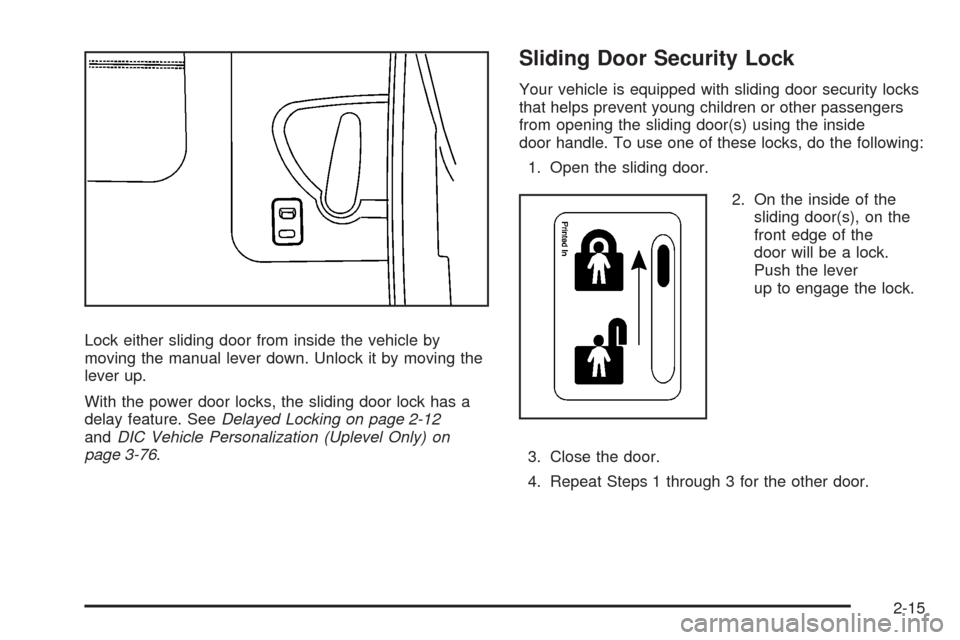
Lock either sliding door from inside the vehicle by
moving the manual lever down. Unlock it by moving the
lever up.
With the power door locks, the sliding door lock has a
delay feature. SeeDelayed Locking on page 2-12
andDIC Vehicle Personalization (Uplevel Only) on
page 3-76.
Sliding Door Security Lock
Your vehicle is equipped with sliding door security locks
that helps prevent young children or other passengers
from opening the sliding door(s) using the inside
door handle. To use one of these locks, do the following:
1. Open the sliding door.
2. On the inside of the
sliding door(s), on the
front edge of the
door will be a lock.
Push the lever
up to engage the lock.
3. Close the door.
4. Repeat Steps 1 through 3 for the other door.
2-15
Page 112 of 476
If your vehicle has power sliding door(s), you can
prevent power opening of the sliding door from the
passenger power sliding door (PSD) activation switch by
pressing the PSD second row passenger override
(deactivation) switch located on the overhead console.
SeePower Sliding Door (PSD) on page 2-16.
If you want to open the sliding door while the security
lock is on, unlock and open the door from the outside.
You should let adults and older children know how
the security lock works, and how to cancel the lock. If
you do not, adults or older children who ride in the rear
will not be able to open the sliding door from the
inside while the security lock feature is in use.
Canceling the Sliding Door
Security Lock
1. Unlock the sliding door and open the door from the
outside.
2. Push the security lock lever all the way down.
3. Close the door.
4. Repeat Steps 1 through 3 for the other door.
The sliding door lock will now work normally.
Power Sliding Door (PSD)
If your vehicle has this feature, you can open and close
the power sliding door(s) using the switches inside
your vehicle. You can also operate the sliding door(s)
with your remote keyless entry transmitter. SeeRemote
Keyless Entry (RKE) System on page 2-4.
{CAUTION:
Leaving your children or pets unattended in
your vehicle can be dangerous. They could
operate the power sliding door. A child or
others could be injured. Do not leave children
or pets unattended in your vehicle.
2-16
Page 118 of 476
If any of these conditions occur, the power sliding door
may need to be reset. If your vehicle has the dual
power sliding doors, both doors will have to be reset. To
reset a door, do the following:
1. Check to be sure the power sliding door is unlocked
and securely closed.
2. Turn the ignition to LOCK.
3. If the power sliding door overhead console switch is
in the override (deactivation) position, return to the
activation position.
4. Open the sliding door using the remote keyless
entry transmitter, overhead console switch,
or passenger switch. Allow the door to travel
fully open.
If the door does not travel to the fully open position,
press the overhead console switch to the override
(deactivation) position and slide the door fully open and
closed. Check for foreign objects in the tracks. Repeat
the procedure starting with Step 1. If the door resists
travel to the fully open position, see your dealer
for service.Liftgate
To unlock or lock the liftgate from the outside, use the
remote keyless entry transmitter. For more information,
seeRemote Keyless Entry (RKE) System Operation
on page 2-5.
You can also use the power door lock switch to lock
and unlock the liftgate.
Open the liftgate using the handle located above the
license plate. Once slightly opened, the liftgate will rise
by itself. Lamps in the rear of the vehicle will come
on, illuminating the rear cargo area.
Notice:If you open the liftgate without checking for
overhead obstructions such as a garage door,
you could damage the liftgate or the liftgate glass.
Always check to make sure the area above and
behind the liftgate is clear before opening it.
2-22
Page 122 of 476
Manual Rear Quarter Windows
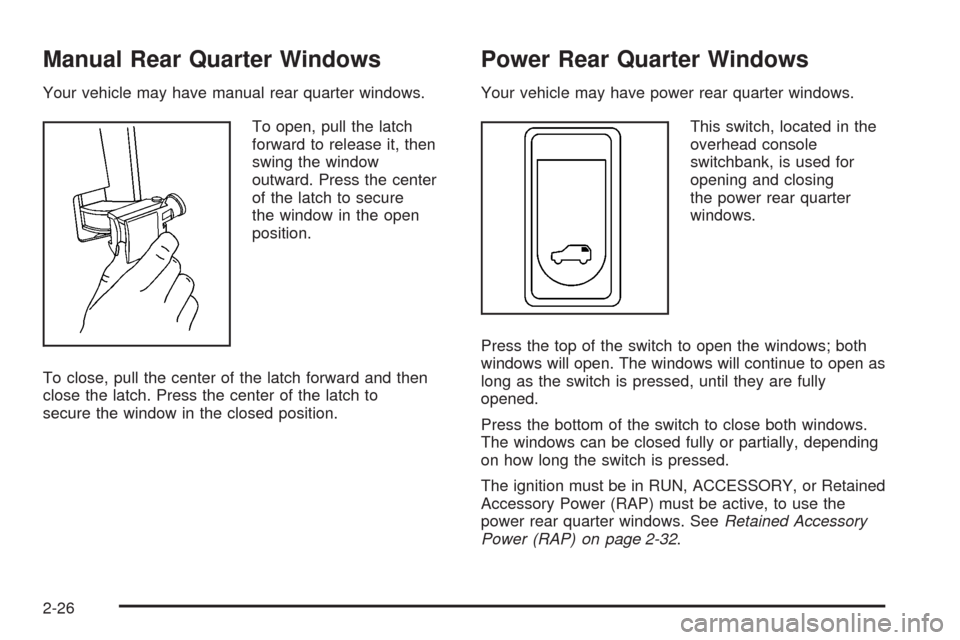
Your vehicle may have manual rear quarter windows.
To open, pull the latch
forward to release it, then
swing the window
outward. Press the center
of the latch to secure
the window in the open
position.
To close, pull the center of the latch forward and then
close the latch. Press the center of the latch to
secure the window in the closed position.
Power Rear Quarter Windows
Your vehicle may have power rear quarter windows.
This switch, located in the
overhead console
switchbank, is used for
opening and closing
the power rear quarter
windows.
Press the top of the switch to open the windows; both
windows will open. The windows will continue to open as
long as the switch is pressed, until they are fully
opened.
Press the bottom of the switch to close both windows.
The windows can be closed fully or partially, depending
on how long the switch is pressed.
The ignition must be in RUN, ACCESSORY, or Retained
Accessory Power (RAP) must be active, to use the
power rear quarter windows. SeeRetained Accessory
Power (RAP) on page 2-32.
2-26
Page 124 of 476
Arming with the Power Lock Switch
Your alarm system will arm when the key is removed
from the ignition and you use the driver’s power
door lock switch, with the driver’s door open or the
passenger’s door power door lock switch with the
passenger’s door open to lock the vehicle. If you would
like to turn on power door lock switch arming, see
DIC Vehicle Personalization (Uplevel Only) on
page 3-76.
When the security light ashes quickly the system is
arming. After all doors and the liftgate are closed
and locked, the security light will begin ashing at a
very slow rate to let you know the system is armed.
Arming with the Remote Keyless Entry
Transmitter
Your alarm system will arm if the key is not in the
ignition and you use your remote keyless entry
transmitter to lock the doors. The security light will ash
to let you know the system is arming. If you press
the transmitter’s lock button twice within ve seconds,
the horn will sound. After all doors and the liftgate
are closed and locked, the security light will begin
ashing at a very slow rate to let you know the system
is armed.
Arming with Your Key
Your alarm system will arm when you use your key to
lock the driver’s door. The security light will ash to
let you know the system is arming. After all doors and
the liftgate are closed and locked, the security light
will begin ashing at a very slow rate to let you know the
system is armed. If you would like your key not to
arm the system, seeDIC Vehicle Personalization
(Uplevel Only) on page 3-76.
Arming Conrmation
If remote unlock conrmation is on, the turn signal
lamps will ash briey to let you know when your alarm
system has disarmed. If you would not like the turn
signal lamps to ash, seeDIC Vehicle Personalization
(Uplevel Only) on page 3-76.
Disarming with the Remote Keyless
Entry Transmitter
Your alarm system will disarm when you use your
remote keyless entry transmitter to unlock the doors.
The security light will stop ashing to let you know the
system is no longer armed.
2-28