2008 CHEVROLET UPLANDER page 6
[x] Cancel search: page 6Page 32 of 476
How to Wear Safety Belts Properly
This section is only for people of adult size.
Be aware that there are special things to know about
safety belts and children. And there are different
rules for smaller children and babies. If a child will be
riding in your vehicle, seeOlder Children on page 1-42
orInfants and Young Children on page 1-46. Follow
those rules for everyone’s protection.
It is very important for all occupants to buckle up.
Statistics show that unbelted people are hurt more often
in crashes than those who are wearing safety belts.
Occupants who are not buckled up can be thrown out
of the vehicle in a crash. And they can strike others
in the vehicle who are wearing safety belts.
First, before you or your passenger(s) wear a safety
belt, there is important information you should know.
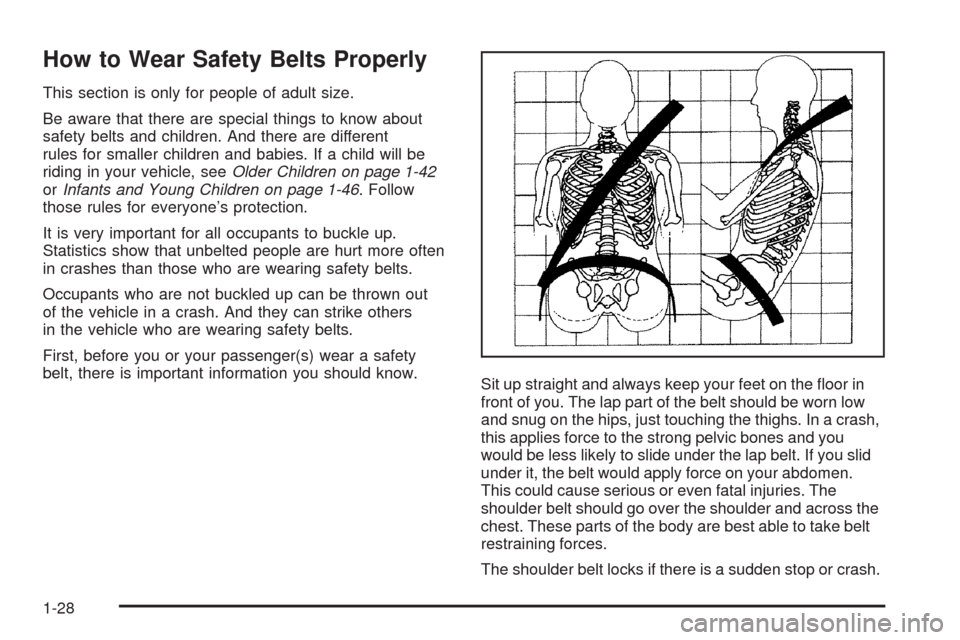
Sit up straight and always keep your feet on the oor in
front of you. The lap part of the belt should be worn low
and snug on the hips, just touching the thighs. In a crash,
this applies force to the strong pelvic bones and you
would be less likely to slide under the lap belt. If you slid
under it, the belt would apply force on your abdomen.
This could cause serious or even fatal injuries. The
shoulder belt should go over the shoulder and across the
chest. These parts of the body are best able to take belt
restraining forces.
The shoulder belt locks if there is a sudden stop or crash.
1-28
Page 40 of 476

Lap-Shoulder Belt
All seating positions in your vehicle have a
lap-shoulder belt.
Here is how to wear a lap-shoulder belt properly.
1. Adjust the seat, if the seat is adjustable, so you can
sit up straight. To see how, see “Seats” in the Index.
2. Pick up the latch plate and pull the belt across you.
Do not let it get twisted.
The lap-shoulder belt may lock if you pull the belt
across you very quickly. If this happens, let the belt
go back slightly to unlock it. Then pull the belt
across you more slowly.
If you ever pull the shoulder portion of a passenger
belt out all the way, you may engage the child
restraint locking feature. If this happens, just let the
belt go back all the way and start again.
Engaging the child restraint locking feature may
affect the passenger sensing system. See
Passenger Sensing System on page 1-85.3. Push the latch plate into the buckle until it clicks.
Pull up on the latch plate to make sure it is secure.
If the belt is not long enough, seeSafety Belt
Extender on page 1-42.
Make sure the release button on the buckle is
positioned so you would be able to unbuckle the
safety belt quickly if necessary.
4. If equipped with a shoulder belt height adjuster,
move it to the height that is right for you. Improper
shoulder belt height adjustment could reduce
the effectiveness of the safety belt in a crash.
See “Shoulder Belt Height Adjustment” later in
this section.
1-36
Page 42 of 476
Shoulder Belt Height Adjuster
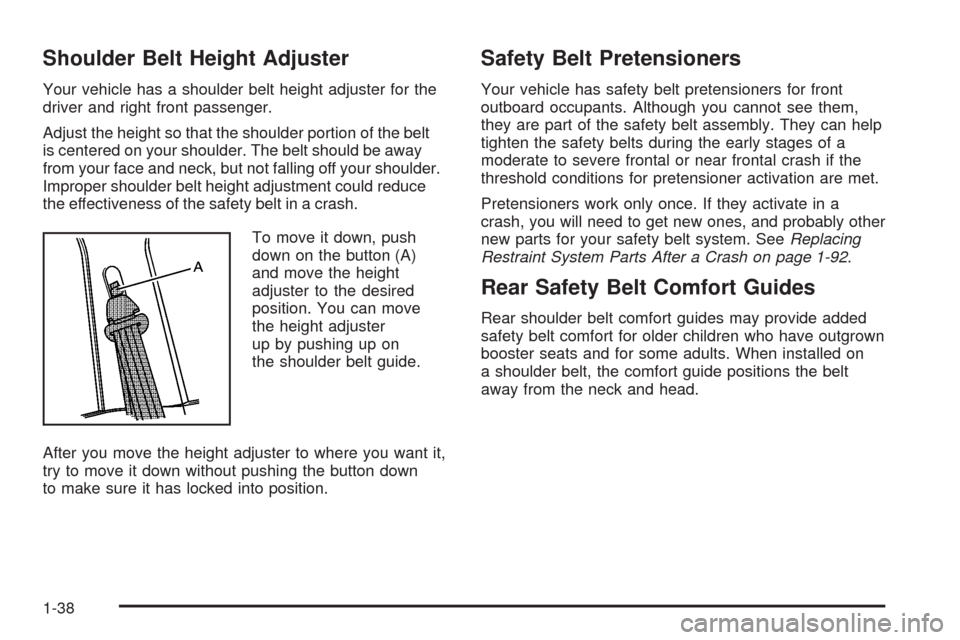
Your vehicle has a shoulder belt height adjuster for the
driver and right front passenger.
Adjust the height so that the shoulder portion of the belt
is centered on your shoulder. The belt should be away
from your face and neck, but not falling off your shoulder.
Improper shoulder belt height adjustment could reduce
the effectiveness of the safety belt in a crash.
To move it down, push
down on the button (A)
and move the height
adjuster to the desired
position. You can move
the height adjuster
up by pushing up on
the shoulder belt guide.
After you move the height adjuster to where you want it,
try to move it down without pushing the button down
to make sure it has locked into position.
Safety Belt Pretensioners
Your vehicle has safety belt pretensioners for front
outboard occupants. Although you cannot see them,
they are part of the safety belt assembly. They can help
tighten the safety belts during the early stages of a
moderate to severe frontal or near frontal crash if the
threshold conditions for pretensioner activation are met.
Pretensioners work only once. If they activate in a
crash, you will need to get new ones, and probably other
new parts for your safety belt system. SeeReplacing
Restraint System Parts After a Crash on page 1-92.
Rear Safety Belt Comfort Guides
Rear shoulder belt comfort guides may provide added
safety belt comfort for older children who have outgrown
booster seats and for some adults. When installed on
a shoulder belt, the comfort guide positions the belt
away from the neck and head.
1-38
Page 47 of 476
The manufacturer’s instructions that come with the
booster seat, state the weight and height limitations for
that booster. Use a booster seat with a lap-shoulder
belt until the child passes the below t test:
Sit all the way back on the seat. Do the knees bend
at the seat edge? If yes, continue. If no, return to
the booster seat.
Buckle the lap-shoulder belt. Does the shoulder belt
rest on the shoulder? If yes, continue. If no, try
using the rear safety belt comfort guide. See “Rear
Safety Belt Comfort Guides” underLap-Shoulder
Belt on page 1-36for more information. If the
shoulder belt still does not rest on the shoulder,
then return to the booster seat.
Does the lap belt t low and snug on the hips,
touching the thighs? If yes, continue. If no, return
to the booster seat.
Can proper safety belt t be maintained for the
length of the trip? If yes, continue. If no, return
to the booster seat.
Q:What is the proper way to wear safety belts?
A:An older child should wear a lap-shoulder belt and
get the additional restraint a shoulder belt can
provide. The shoulder belt should not cross the face
or neck. The lap belt should t snugly below the
hips, just touching the top of the thighs. This applies
belt force to the child’s pelvic bones in a crash.
It should never be worn over the abdomen, which
could cause severe or even fatal internal injuries
in a crash.
Also see “Rear Safety Belt Comfort Guides” under
Lap-Shoulder Belt on page 1-36.
According to accident statistics, children and infants
are safer when properly restrained in the rear seating
positions than in the front seating positions.
In a crash, children who are not buckled up can strike
other people who are buckled up, or can be thrown
out of the vehicle. Older children need to use safety
belts properly.
1-43
Page 55 of 476
To help reduce the chance of injury, the child restraint
must be secured in the vehicle. Child restraint systems
must be secured in vehicle seats by lap belts or the
lap belt portion of a lap-shoulder belt, or by the LATCH
system. SeeLower Anchors and Tethers for Children
(LATCH) on page 1-53for more information. A child
can be endangered in a crash if the child restraint is
not properly secured in the vehicle.
When securing an add-on child restraint, refer to the
instructions that come with the restraint which may be
on the restraint itself or in a booklet, or both, and to this
manual. The child restraint instructions are important,
so if they are not available, obtain a replacement
copy from the manufacturer.
Keep in mind that an unsecured child restraint can
move around in a collision or sudden stop and injure
people in the vehicle. Be sure to properly secure
any child restraint in your vehicle — even when no
child is in it.Securing the Child Within the
Child Restraint
{CAUTION:
A child can be seriously injured or killed
in a crash if the child is not properly secured
in the child restraint. Because there are
different systems, it is important to refer to
the instructions that come with the restraint.
Make sure the child is properly secured,
following the instructions that came with
that restraint.
1-51
Page 56 of 476
Where to Put the Restraint
Accident statistics show that children are safer if they
are restrained in the rear rather than the front seat.
We recommend that children and child restraints
be secured in a rear seat, including: an infant or a child
riding in a rear-facing child restraint; a child riding in
a forward-facing child seat; an older child riding in
a booster seat; and children, who are large enough,
using safety belts.
A label on your sun visor says, “Never put a rear-facing
child seat in the front.” This is because the risk to the
rear-facing child is so great, if the airbag deploys.{CAUTION:
A child in a rear-facing child restraint can be
seriously injured or killed if the right front
passenger’s airbag inates. This is because
the back of the rear-facing child restraint
would be very close to the inating airbag.
Even though the passenger sensing system is
designed to turn off the right front passenger’s
frontal airbag if the system detects a rear-facing
child restraint, no system is fail-safe, and
no one can guarantee that an airbag will not
deploy under some unusual circumstance,
even though it is turned off. We recommend
that rear-facing child restraints be secured in a
rear seat, even if the airbag is off.
If you secure a forward-facing child restraint in
the right front seat, always move the front
passenger seat as far back as it will go. It is
better to secure the child restraint in a rear seat.
SeePassenger Sensing System on page 1-85
for additional information.
1-52
Page 61 of 476
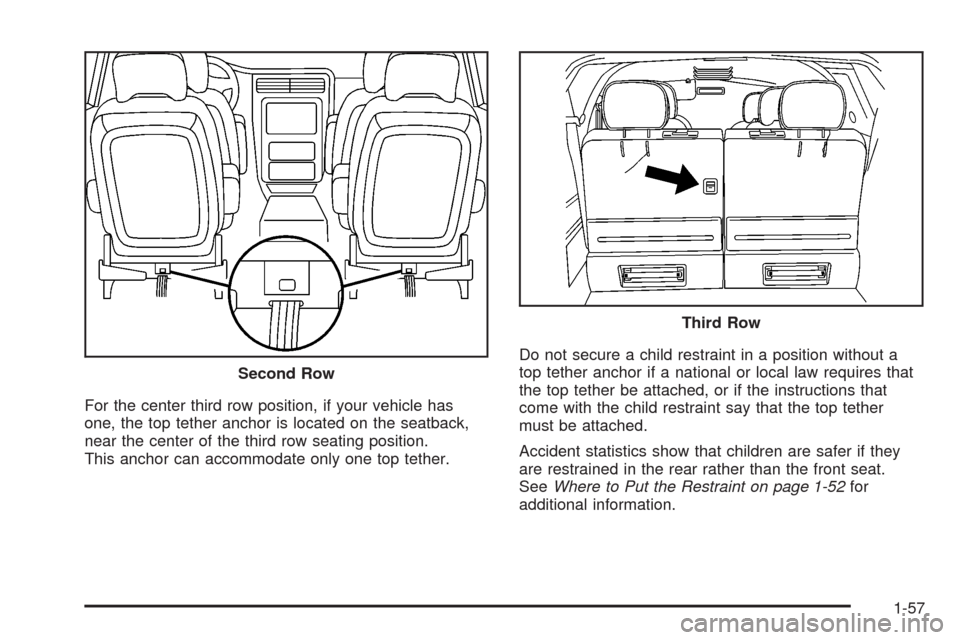
For the center third row position, if your vehicle has
one, the top tether anchor is located on the seatback,
near the center of the third row seating position.
This anchor can accommodate only one top tether.Do not secure a child restraint in a position without a
top tether anchor if a national or local law requires that
the top tether be attached, or if the instructions that
come with the child restraint say that the top tether
must be attached.
Accident statistics show that children are safer if they
are restrained in the rear rather than the front seat.
SeeWhere to Put the Restraint on page 1-52for
additional information. Second Row
Third Row
1-57
Page 65 of 476

If the position you are
using has an adjustable
headrest or head restraint
and you are using a
single tether, raise the
headrest or head restraint
and route the tether
under the headrest or
head restraint and
in between the headrest
or head restraint posts.
3. Push and pull the child restraint in different
directions to be sure it is secure.Securing a Child Restraint in a
Rear Seat Position
When securing a child restraint in a rear seating
position, study the instructions that came with your child
restraint to make sure it is compatible with this vehicle.
If your child restraint has the LATCH system, seeLower
Anchors and Tethers for Children (LATCH) on page 1-53
for how to install your child restraint using LATCH. If you
secure a child restraint using a safety belt and it uses a
top tether, seeLower Anchors and Tethers for Children
(LATCH) on page 1-53for top tether anchor locations.
Do not secure a child seat in a position without a top
tether anchor if a national or local law requires that
the top tether be anchored, or if the instructions
that come with the child restraint say that the top strap
must be anchored.
In Canada, the law requires that forward-facing child
restraints have a top tether, and that the tether be
attached.
If your child restraint does not have the LATCH system,
you will be using the safety belt to secure the child
restraint in this position. Be sure to follow the instructions
that came with the child restraint. Secure the child in
the child restraint when and as the instructions say.
1-61