2008 CHEVROLET UPLANDER coolant temperature
[x] Cancel search: coolant temperaturePage 344 of 476

Occasionally check the coolant level in the radiator.
For information on how to add coolant to the radiator,
seeCooling System on page 5-26.
Radiator Pressure Cap
Notice:The radiator cap on your vehicle is a
pressure-type cap and must be tightly installed to
prevent coolant loss and possible engine damage
from overheating. Be sure the cap is properly
closed.
SeeEngine Compartment Overview on page 5-12
for more information on location.
Engine Overheating
You will nd an engine coolant temperature gage on
your vehicle’s instrument panel. SeeEngine Coolant
Temperature Gage on page 3-43.
Your vehicle may also have an ENGINE COOLANT
HOT message displayed in the Driver Information
Center (DIC). SeeDIC Warnings and Messages on
page 3-58.
If Steam Is Coming From Your Engine
{CAUTION:
Steam from an overheated engine can burn
you badly, even if you just open the hood.
Stay away from the engine if you see or hear
steam coming from it. Turn it off and get
everyone away from the vehicle until it cools
down. Wait until there is no sign of steam or
coolant before you open the hood.
If you keep driving when the vehicles engine
is overheated, the liquids in it can catch re.
You or others could be badly burned. Stop
your engine if it overheats, and get out of the
vehicle until the engine is cool.
SeeOverheated Engine Protection Operating
Mode on page 5-25for information on driving
to a safe place in an emergency.
Notice:If your engine catches re because you keep
driving with no coolant, your vehicle can be badly
damaged. The costly repairs would not be covered by
your warranty. SeeOverheated Engine Protection
Operating Mode on page 5-25for information on
driving to a safe place in an emergency.
5-24
Page 345 of 476
If No Steam Is Coming From Your
Engine
If you get an engine overheat warning but see or hear
no steam, the problem may not be too serious.
Sometimes the engine can get a little too hot when you:
Climb a long hill on a hot day.
Stop after high-speed driving.
Idle for long periods in traffic.
Tow a trailer.
If you get the overheat warning with no sign of steam,
try this for a minute or so:
1. If your air conditioner is on, turn it off.
2. Turn on your heater to full hot at the highest fan
speed and open the windows as necessary.
3. If you are in a traffic jam, shift to NEUTRAL (N);
otherwise, shift to the highest gear while
driving — DRIVE (D) or THIRD (3).
If you no longer have the overheat warning, you can
drive. Just to be safe, drive slower for about 10 minutes.
If the warning does not come back on, you can drive
normally.
If the warning continues, pull over, stop, and park your
vehicle right away.If there is still no sign of steam, idle the engine for
three minutes while you are parked. If you still have the
warning, turn off the engine and get everyone out of
the vehicle until it cools down. Also, see “Overheated
Engine Protection Operating Mode” later in this section.
You may decide not to lift the hood but to get service
help right away.
Overheated Engine Protection
Operating Mode
This emergency operating mode lets your vehicle be
driven to a safe place in an emergency situation.
If an overheated engine condition exists, an overheat
protection mode which alternates ring groups of
cylinders helps prevent engine damage. In this mode,
there is a signicant loss in power and engine
performance. The temperature gage indicates an
overheat condition exists. Driving extended distances
and/or towing a trailer in the overheat protection
mode should be avoided.
Notice:After driving in the overheated engine
protection operating mode, to avoid engine damage,
allow the engine to cool before attempting any repair.
The engine oil will be severely degraded. Repair the
cause of coolant loss, change the oil and reset the
oil life system. SeeEngine Oil on page 5-13.
5-25
Page 352 of 476
Windshield Washer Fluid
What Washer Fluid to Use
When you need windshield washer uid, be sure to read
the manufacturer’s instructions before use. If you will
be operating your vehicle in an area where the
temperature may fall below freezing, use a uid that has
sufficient protection against freezing.
Adding Washer Fluid
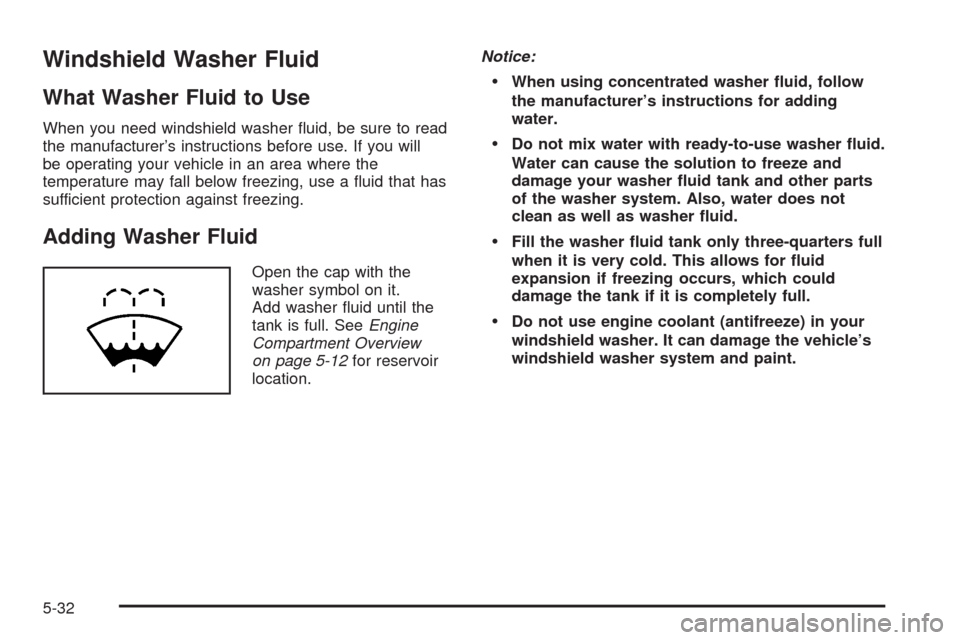
Open the cap with the
washer symbol on it.
Add washer uid until the
tank is full. SeeEngine
Compartment Overview
on page 5-12for reservoir
location.Notice:
When using concentrated washer uid, follow
the manufacturer’s instructions for adding
water.
Do not mix water with ready-to-use washer uid.
Water can cause the solution to freeze and
damage your washer uid tank and other parts
of the washer system. Also, water does not
clean as well as washer uid.
Fill the washer uid tank only three-quarters full
when it is very cold. This allows for uid
expansion if freezing occurs, which could
damage the tank if it is completely full.
Do not use engine coolant (antifreeze) in your
windshield washer. It can damage the vehicle’s
windshield washer system and paint.
5-32
Page 434 of 476

(h)Change automatic transmission fluid and filter if the
vehicle is mainly driven under one or more of these
conditions:
In heavy city traffic where the outside temperature
regularly reaches 90°F (32°C) or higher.
In hilly or mountainous terrain.
When doing frequent trailer towing.
Uses such as found in taxi, police, or delivery
service.
(i)Drain, flush, and refill cooling system. See Engine
Coolant on page 5-22 for what to use. Inspect hoses.
Clean radiator, condenser, pressure cap, and filler neck.
Pressure test the cooling system and pressure cap.
(j)Check system for interference or binding and
for damaged or missing parts. Replace parts as needed.
Replace any components that have high effort or
excessive wear. Do not lubricate accelerator or cruise
control cables.
(k)A fluid loss in any vehicle system could indicate a
problem. Have the system inspected and repaired
and the fluid level checked. Add fluid if needed.
(l)If you drive regularly under dusty conditions, the filter
may require replacement more often.
(m)Visually inspect belt for fraying, excessive cracks,
or obvious damage. Replace belt if necessary.Owner Checks and Services
These owner checks and services should be performed
at the intervals specied to help ensure the safety,
dependability, and emission control performance of your
vehicle. Your dealer/retailer can assist you with these
checks and services.
Be sure any necessary repairs are completed at once.
Whenever any uids or lubricants are added to your
vehicle, make sure they are the proper ones, as shown
inRecommended Fluids and Lubricants on page 6-11.
At Each Fuel Fill
It is important to perform these underhood checks at
each fuel fill.
Engine Oil Level Check
Notice:It is important to check the engine oil
regularly and keep it at the proper level. Failure to
keep the engine oil at the proper level can cause
damage to the engine not covered by your warranty.
Check the engine oil level and add the proper oil if
necessary. SeeEngine Oil on page 5-13.
6-8
Page 465 of 476

Check
Engine Light...............................................3-44
Checking Things Under the Hood......................5-10
Chemical Paint Spotting...................................5-96
Child Restraints
Built-In Child Restraint..................................1-68
Child Restraint Systems...............................1-49
Infants and Young Children...........................1-46
Lower Anchors and Tethers for Children..........1-53
Older Children.............................................1-42
Securing a Child Restraint in a Rear Seat
Position..................................................1-61
Securing a Child Restraint in the Right
Front Seat Position...................................1-64
Where to Put the Restraint...........................1-52
Chime Level Adjustment.................................3-121
Cigarette Lighter.............................................3-24
Cleaning
Aluminum Wheels........................................5-95
Child Restraint Pad......................................5-92
Exterior Lamps/Lenses.................................5-94
Fabric/Carpet..............................................5-91
Finish Care.................................................5-94
Instrument Panel, Vinyl, and Other Plastic
Surfaces.................................................5-92
Interior.......................................................5-90
Leather......................................................5-92
Tires..........................................................5-96
Underbody Maintenance...............................5-96
Washing Your Vehicle...................................5-93Cleaning (cont.)
Weatherstrips..............................................5-93
Windshield, Backglass, and Wiper Blades.......5-95
Climate Control System...................................3-24
Air Filter, Passenger Compartment.................3-32
Dual..........................................................3-27
Outlet Adjustment........................................3-30
Rear..........................................................3-30
Clock
............................................................3-85
Collision Damage Repair..................................7-11
Compact Spare Tire........................................5-89
Compass.......................................................3-56
Content Theft-Deterrent....................................2-27
Control of a Vehicle.......................................... 4-4
Convenience Center........................................2-62
Convenience Net............................................2-61
Coolant
Engine Temperature Gage............................3-43
Heater, Engine............................................2-34
Cooling System..............................................5-26
Cruise Control................................................3-10
Cruise Control Light........................................3-48
Cupholder(s)..................................................2-56
Customer Assistance Information
Courtesy Transportation.................................. 7-9
Customer Assistance for Text Telephone (TTY)
Users....................................................... 7-5
Customer Assistance Offices........................... 7-5
Customer Satisfaction Procedure..................... 7-2
GM Mobility Reimbursement Program............... 7-6
3
Page 467 of 476

Engine
Air Cleaner/Filter.........................................5-18
Check and Service Engine Soon Light............3-44
Coolant......................................................5-22
Coolant Heater............................................2-34
Coolant Temperature Gage...........................3-43
Drive Belt Routing.......................................6-14
Engine Compartment Overview......................5-12
Exhaust.....................................................2-41
Oil .............................................................5-13
Oil Life System...........................................5-16
Overheated Protection Operating Mode...........5-25
Overheating................................................5-24
Running While Parked..................................2-42
Starting......................................................2-32
Entry Lighting.................................................3-18
Event Data Recorders.....................................7-16
Exit Lighting...................................................3-19
Extender, Safety Belt.......................................1-42
Exterior Lamps...............................................3-14
F
Filter
Engine Air Cleaner......................................5-18
Finish Damage...............................................5-96
Fixed Mast Antenna.......................................3-121
Flashers, Hazard Warning.................................. 3-6Flash-to-Pass................................................... 3-8
Flat Tire........................................................5-72
Flat Tire, Changing.........................................5-73
Flat Tire, Storing.............................................5-86
Fluid.............................................................5-20
Power Steering...........................................5-31
Windshield Washer......................................5-32
Folding Tray...................................................2-59
Front Console Storage Area.............................2-59
Front Reading Lamps......................................3-19
Front Turn Signal, Parking and Daytime
Running Lamps...........................................5-44
Fuel............................................................... 5-5
Additives...................................................... 5-6
California Fuel.............................................. 5-5
E85 (85% Ethanol)........................................ 5-6
Filling a Portable Fuel Container....................5-10
Filling the Tank............................................. 5-8
Fuels in Foreign Countries.............................. 5-7
Gage.........................................................3-49
Gasoline Octane........................................... 5-5
Gasoline Specications.................................. 5-5
Low Warning Light.......................................3-49
Fuses
Fuses and Circuit Breakers.........................5-100
Instrument Panel Fuse Block.......................5-100
Underhood Fuse Block...............................5-102
Windshield Wiper.........................................5-99
5
Page 468 of 476

G
Gage
Engine Coolant Temperature.........................3-43
Fuel..........................................................3-49
Speedometer..............................................3-36
Tachometer.................................................3-36
Garage Door Opener.......................................2-51
Gasoline
Octane........................................................ 5-5
Specications............................................... 5-5
Glove Box.....................................................2-56
GM Mobility Reimbursement Program.................. 7-6
H
Hazard Warning Flashers................................... 3-6
Head Restraints............................................... 1-6
Headlamp
Aiming.......................................................5-41
Headlamp Wiring............................................5-99
Headlamps
Bulb Replacement.......................................5-42
Daytime Running Lamps/Automatic Headlamp
System...................................................3-16
Exterior Lamps............................................3-14
Flash-to-Pass............................................... 3-8
Halogen Bulbs............................................5-42
Headlamps and Sidemarker Lamps................5-42Headlamps (cont.)
High/Low Beam Changer................................ 3-8
On Reminder..............................................3-15
Wiper Activated...........................................3-15
Headlamps and Sidemarker Lamps...................5-42
Heated Seats................................................... 1-3
Heater...................................................3-24, 3-27
Highbeam On Light.........................................3-48
High-Speed Operation, Tires.............................5-56
Highway Hypnosis...........................................4-15
Hill and Mountain Roads..................................4-16
Hood
Checking Things Under................................5-10
Release.....................................................5-11
Horn............................................................... 3-6
How to Wear Safety Belts Properly...................1-28
I
Ignition Positions.............................................2-31
Infants and Young Children, Restraints...............1-46
Ination - Tire Pressure...................................5-54
Instrument Panel
Overview..................................................... 3-4
Instrument Panel (I/P)
Brightness..................................................3-17
Cluster.......................................................3-35
Interior Lamps
Control.......................................................3-17
6