2008 CHEVROLET SILVERADO length
[x] Cancel search: lengthPage 40 of 596
The manufacturer’s instructions that come with the
booster seat state the weight and height limitations for
that booster. Use a booster seat with a lap-shoulder belt
until the child passes the below t test:
Sit all the way back on the seat. Do the knees bend
at the seat edge? If yes, continue. If no, return to
the booster seat.
Buckle the lap-shoulder belt. Does the shoulder belt
rest on the shoulder? If yes, continue. If no, try
using the rear safety belt comfort guide. See “Rear
Safety Belt Comfort Guides” underLap-Shoulder
Belt on page 1-28for more information. If the
shoulder belt still does not rest on the shoulder,
then return to the booster seat.
Does the lap belt t low and snug on the hips,
touching the thighs? If yes, continue. If no, return
to the booster seat.
Can proper safety belt t be maintained for the
length of the trip? If yes, continue. If no, return
to the booster seat.
Q:What is the proper way to wear safety belts?
A:An older child should wear a lap-shoulder belt
and get the additional restraint a shoulder belt can
provide. The shoulder belt should not cross the face
or neck. The lap belt should t snugly below the hips,
just touching the top of the thighs. This applies belt
force to the child’s pelvic bones in a crash. It should
never be worn over the abdomen, which could cause
severe or even fatal internal injuries in a crash.
Also see “Rear Safety Belt Comfort Guides” under
Lap-Shoulder Belt on page 1-28.
According to accident statistics, children and infants
are safer when properly restrained in the rear seating
positions than in the front seating positions.
In a crash, children who are not buckled up can strike
other people who are buckled up, or can be thrown
out of the vehicle. Older children need to use safety
belts properly.
1-36
Page 117 of 596
B (ACC/ACCESSORY):This position lets things like
the radio and the windshield wipers operate while
the engine is off.
Lengthy operation of features such as the radio in the
ACC/ACCESSORY ignition position and the ON/RUN
position may drain the battery and prevent your vehicle
from starting. Do not operate your vehicle in the ACC/
ACCESSORY ignition position for a long period of time.
C (ON/RUN):This is the position for driving. It is the
position the ignition switch returns to after the engine
starts, and the key is released.
The battery could be drained if you leave the key in the
ACC/ACCESSORY or ON/RUN position with the engine
off. You may not be able to start your vehicle if the battery
is allowed to drain for an extended period of time.
D (START):This position starts the engine.Key In the Ignition
Never leave your vehicle with the keys inside, as it is an
easy target for joy riders or thieves. If you leave the key in
the ignition and park your vehicle, a chime will sound,
when you open the driver’s door. Always remember to
remove your key from the ignition and take it with you.
This will lock your ignition and transmission. Also, always
remember to lock the doors.
The battery could be drained if you leave the key in the
ignition while your vehicle is parked. You may not be
able to start your vehicle after it has been parked for an
extended period of time.
2-23
Page 209 of 596

2. Set the driver’s and passenger’s temperature.
To nd your comfort setting, start with a 74°F (23°C)
temperature setting and allow about 20 minutes
for the system to regulate. Use the driver’s or
passenger’s temperature buttons to adjust the
temperature setting as necessary. If you choose the
temperature setting of 60°F (15°C), the system
remains at the maximum cooling setting. If you
choose the temperature setting of 90°F (32°C),
the system remains at the maximum heat setting.
Choosing either maximum setting will not cause the
vehicle to heat or cool any faster.
Be careful not to cover the solar sensor located on
the top of the instrument panel near the windshield.
This sensor regulates air temperature based on
sun load. For more information on the solar sensor,
see “Sensors” later in this section.
To avoid blowing cold air in cold weather, the system
delays turning the fan on until warm air is available.
The length of delay depends on the engine coolant
temperature. Pressing the fan switch overrides this delay
and changes the fan to a selected speed.O(On/Off):Press this button to turn off the climate
control system. Outside air still enters the vehicle, and
is directed to the oor. This direction can be changed by
pressing the mode button. Recirculation can be
selected once you have selected vent or bi-level mode.
The temperature can also be adjusted using either
temperature button. If the air delivery mode or
temperature settings are adjusted with the system off,
the display illuminates briey to show the settings
and then returns to off. Press the on/off button or the up
down arrows on the fan switch, the defrost button,
AUTO button, or the air conditioning button to turn the
system on when it is off.
3-31
Page 287 of 596
MP3 Format
Burning an MP3 disc on a personal computer:
Make sure the MP3 les are recorded on a CD-R
or CD-RW disc.
Do not mix standard audio and MP3 les on
one disc.
Make sure the CD does not have more than a
maximum of 50 folders, 15 playlists, and 512 folders
and les to read and play.
Create a folder structure that makes it easy to nd
songs while driving. Organize songs by albums
using one folder for each album. Each folder
or album should contain 18 songs or less.
Avoid subfolders. The system can support up to
eight subfolders deep, however, keep the total
number of folders to a minimum in order to reduce
the complexity and confusion in trying to locate
a particular folder during playback.
Make sure playlists have a .mp3 or .wpl extension
(other le extensions might not work).
Minimize the length of the le, folder, or playlist
names. Long le, folder, or playlist names, or a
combination of a large number of les and folders,
or playlists could cause the player to be unable
to play up to the maximum number of les, folders,
playlists, or sessions. To play a large number of
les, folders, playlists or sessions, minimize
the length of the le, folder, or playlist name.
Long names also take up more space on the
display, potentially getting cut off.
Finalize the audio disc before burning it. Trying to
add music to an existing disc could cause the
disc not to function in the player.
Playlists can be changed by using the
Sc(previous)
and
cT(next) folder buttons, thefknob, or the
©SEEK¨arrows. MP3 CD-R or CD-RW that have
been recorded without using le folders can be played.
If a CD-R or CD-RW contains more than the maximum of
50 folders, 15 playlists, and 512 folders and les, the
player allows access and navigates up to the maximum,
but all items over the maximum are not accessible.
3-109
Page 292 of 596
Using an MP3 (Radio with CD
and DVD Player)
MP3/WMA CD-R or CD-RW Disc
Compressed Audio or Mixed Mode Discs
The radio also plays discs that contain both
uncompressed CD audio (.CDA les) and MP3/WMA
les depending on which slot the disc is loaded into.
By default the radio reads only the uncompressed audio
(.CDA) and ignores the MP3/WMA les on the DVD
deck. On the CD deck, press the CAT (category) button
to toggle between compressed and uncompressed
audio format, the default being the uncompressed
format (.CDA).
MP3/WMA Format
Burning an MP3/WMA disc on a personal computer:
Make sure the MP3/WMA les are recorded
on a CD-R or CD-RW disc.
Do not mix standard audio and MP3/WMA les on
one disc.
The CD player (lower slot) is able to read and play
a maximum combination of 512 les and folders.
The DVD player (upper slot) is able to read
255 folders, 15 playlists and 40 sessions.
Create a folder structure that makes it easy to nd
songs while driving. Organize songs by albums
using one folder for each album. Each folder
or album should contain 18 songs or less.
Avoid subfolders. The system can support up to
eight subfolders deep, however, keep the total
number of folders to a minimum in order to reduce
the complexity and confusion in trying to locate
a particular folder during playback.
Make sure playlists have a .m3u, .wpl or .pls
extension as other le extensions might not work.
Minimize the length of the le, folder, or playlist
names. Long le, folder, or playlist names, or a
combination of a large number of les and folders,
or playlists could cause the player to be unable
to play up to the maximum number of les, folders,
playlists, or sessions. To play a large number of
les, folders, playlists, or sessions, minimize
the length of the le, folder, or playlist name.
Long names also take up more space on the
display, potentially getting cut off.
Finalize the audio disc before burning it. Trying to
add music to an existing disc could cause the
disc not to function in the player.
3-114
Page 335 of 596
Driving Across an Incline
Sooner or later, an off-road trail will probably go across
the incline of a hill. If this happens, you have to
decide whether to try to drive across the incline. Here
are some things to consider:
{CAUTION:
Driving across an incline that is too steep will
make your vehicle roll over. You could be
seriously injured or killed. If you have any
doubt about the steepness of the incline, do
not drive across it. Find another route instead.
A hill that can be driven straight up or down may be
too steep to drive across. When you go straight up
or down a hill, the length of the wheel base — the
distance from the front wheels to the rear
wheels — reduces the likelihood the vehicle will
tumble end over end. But when you drive across an
incline, the much more narrow track width — the
distance between the left and right wheels — may
not prevent the vehicle from tilting and rolling over.
Also, driving across an incline puts more weight on
the downhill wheels. This could cause a downhill
slide or a rollover.
Surface conditions can be a problem when you drive
across a hill. Loose gravel, muddy spots, or even wet
grass can cause your tires to slip sideways, downhill.
If the vehicle slips sideways, it can hit something that
will trip it — a rock, a rut, etc. — and roll over.
Hidden obstacles can make the steepness of the
incline even worse. If you drive across a rock with the
uphill wheels, or if the downhill wheels drop into a rut
or depression, your vehicle can tilt even more.
For reasons like these, you need to decide carefully
whether to try to drive across an incline. Just because the
trail goes across the incline does not mean you have to
drive it. The last vehicle to try it might have rolled over.
When driving across an incline that is not too steep,
the vehicle can hit some loose gravel and start to slide
downhill. If you feel your vehicle starting to slide
sideways, turn downhill. This should help straighten out
the vehicle and prevent the side slipping. However,
a much better way to prevent this is to get out and
“walk the course” so you know what the surface is like
before you drive it.
4-23
Page 354 of 596
Two-Tiered Loading
Depending on the model of your pick-up, you can
create an upper load platform by positioning
two or four 2 inches (5 cm) by 6 inches (15 cm)
wooden planks across the width of the pickup box.
The planks must be inserted in the pickup box
depressions. The length of the planks must allow
for at least a 3/4 inch (2 cm) bearing surface
on each end of the plank.
When using this upper load platform, be sure the
load is securely tied down to prevent it from
shifting. The load’s center of gravity should be
positioned in a zone over the rear axle. The zone
is located in the area between the front of each
wheel well and the rear of each wheel well.
The center of gravity height must not extend above
the top of the pickup box areboard.
Any load that extends beyond the vehicle’s
taillamp area must be properly marked according
to local laws and regulations.
Remember not to exceed the Gross Axle Weight
Rating (GAWR) of the front or rear axle.Add-On Equipment
When you carry removable items, you may need
to put a limit on how many people you carry
inside your vehicle. Be sure to weigh your vehicle
before you buy and install the new equipment.
Notice:Overloading your vehicle may cause
damage. Repairs would not be covered by your
warranty. Do not overload your vehicle.
Remember not to exceed the Gross Axle Weight
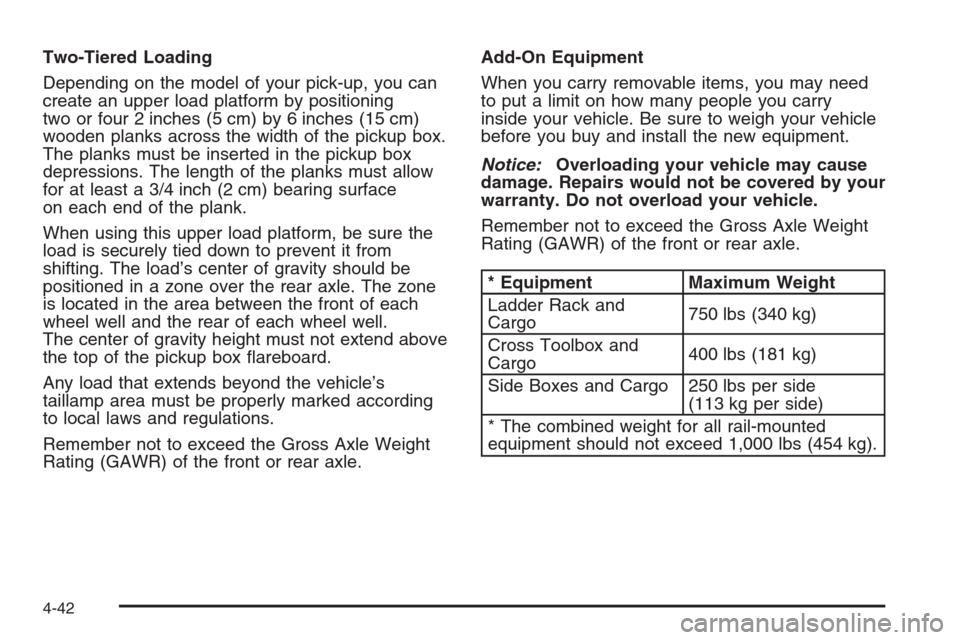
Rating (GAWR) of the front or rear axle.
* Equipment Maximum Weight
Ladder Rack and
Cargo750 lbs (340 kg)
Cross Toolbox and
Cargo400 lbs (181 kg)
Side Boxes and Cargo 250 lbs per side
(113 kg per side)
* The combined weight for all rail-mounted
equipment should not exceed 1,000 lbs (454 kg).
4-42