Page 90 of 596

Servicing Your Airbag-Equipped
Vehicle
Airbags affect how your vehicle should be serviced.
There are parts of the airbag system in several places
around your vehicle. Your dealer/retailer and the service
manual have information about servicing your vehicle
and the airbag system. To purchase a service manual,
seeService Publications Ordering Information on
page 7-15.
{CAUTION:
For up to 10 seconds after the ignition is
turned off and the battery is disconnected,
an airbag can still inate during improper
service. You can be injured if you are close
to an airbag when it inates. Avoid yellow
connectors. They are probably part of the
airbag system. Be sure to follow proper
service procedures, and make sure the person
performing work for you is qualied to do so.
Adding Equipment to Your
Airbag-Equipped Vehicle
Q:Is there anything I might add to or change
about the vehicle that could keep the airbags
from working properly?
A:Yes. If you add things that change your vehicle’s
frame, bumper system, height, front end or side
sheet metal, they may keep the airbag system from
working properly. Changing or moving any parts
of the front seats, safety belts, the airbag sensing
and diagnostic module, steering wheel, instrument
panel, roof-rail airbag modules, ceiling headliner
or pillar garnish trim, overhead console, front
sensors, rollover sensor module, or airbag wiring
can affect the operation of the airbag system.
1-86
Page 96 of 596
Outside Manual Mirrors..................................2-59
Outside Towing Mirrors..................................2-60
Outside Power Mirrors...................................2-61
Outside Power Foldaway Mirrors.....................2-62
Object Detection Systems...............................2-64
Ultrasonic Rear Parking Assist (URPA)............2-64
OnStar
®System.............................................2-67
Universal Home Remote System......................2-71
Universal Home Remote System Operation
(With Three Round LED)............................2-71Storage Areas................................................2-78
Glove Box...................................................2-78
Cupholders..................................................2-78
Instrument Panel Storage...............................2-78
Center Console Storage.................................2-79
Luggage Carrier...........................................2-79
Rear Seat Armrest........................................2-80
Cargo Management System...........................2-80
Sunroof.........................................................2-82
Section 2 Features and Controls
2-2
Page 114 of 596
PASS-Key®III+ Electronic
Immobilizer
The PASS-Key III+ system operates on a radio
frequency subject to Federal Communications
Commission (FCC) Rules and with Industry Canada.
This device complies with Part 15 of the FCC Rules.
Operation is subject to the following two conditions:
1. This device may not cause harmful interference.
2. This device must accept any interference received,
including interference that may cause undesired
operation.
This device complies with RSS-210 of Industry Canada.
Operation is subject to the following two conditions:
1. This device may not cause interference.
2. This device must accept any interference received,
including interference that may cause undesired
operation of the device.
Changes or modications to this system by other than
an authorized service facility could void authorization to
use this equipment.
PASS-Key III+ uses a radio frequency transponder in
the key that matches a decoder in the vehicle.
PASS-Key®III+ Electronic
Immobilizer Operation
Your vehicle has PASS-Key®III+ (Personalized
Automotive Security System) theft-deterrent system.
PASS-Key
®III+ is a passive theft-deterrent system.
The system is automatically armed when the key
is removed from the ignition.
The system is automatically disarmed when the key is
turned to ON/RUN, ACC/ACCESSORY or START
from the LOCK/OFF position.
You do not have to manually arm or disarm the system.
The security light will come on if there is a problem
with arming or disarming the theft-deterrent system.
When the PASS-Key
®III+ system senses that someone
is using the wrong key, it prevents the vehicle from
starting. Anyone using a trial-and-error method to start
the vehicle will be discouraged because of the high
number of electrical key codes.
If the engine does not start and the security light on
the instrument panel cluster comes on when trying to
start the vehicle, there may be a problem with your
theft-deterrent system. Turn the ignition off and try again.
2-20
Page 120 of 596
To control the fast idle:
To Enable the Fast idle, press and release the
Cruise Control On/Off button and ensure that
the LED is lit.
For the preset Fast Idle, press and release the
cruise set switch. This will set the preset fast
idle speed.
For the variable fast idle, press and hold the
accelerator at the desired RPM, then press
and release the cruise control cruise set switch
to set the desired idle speed.
When the fast idle is active the Driver Information
Center (DIC) will display “FAST IDLE ON”.
One of the following actions will turn off the fast idle:
Pressing the brake.
Selecting the Cancel button.
Releasing the Parking Brake.
The transmission shifter is moved out of PARK (P)
or NEUTRAL (N).
Selecting the cruise control on/off button when it
was previously on.
Adjustable Throttle and Brake Pedal
On vehicles with this feature, you can change the
position of the throttle and brake pedals.
This feature is designed for shorter drivers, since the
pedals cannot move farther away from the standard
position, but can move toward the driver for better
pedal reach.
No adjustment to the pedals can be made when the
vehicle is in REVERSE (R) or while using the cruise
control.
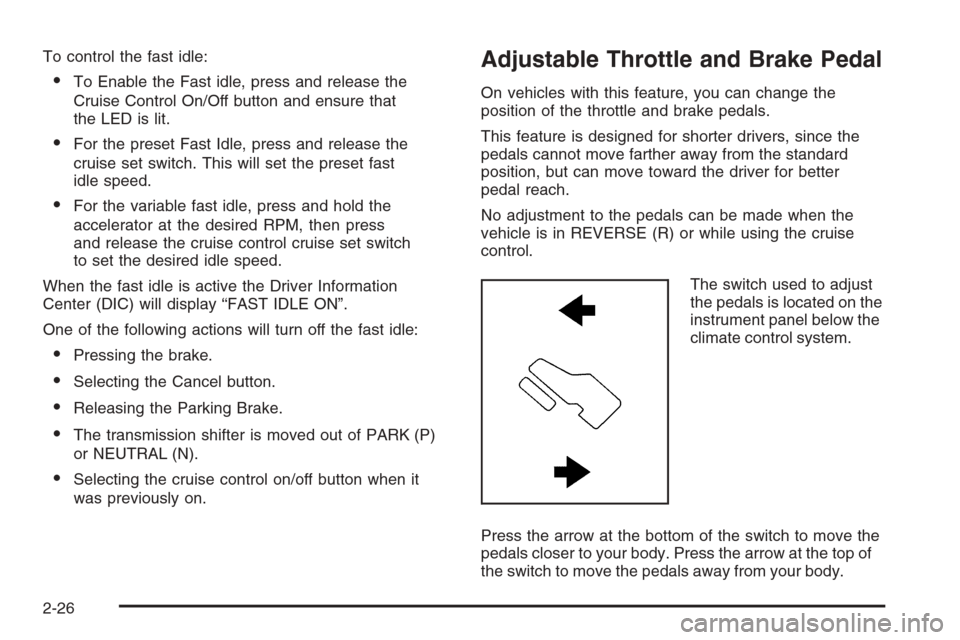
The switch used to adjust
the pedals is located on the
instrument panel below the
climate control system.
Press the arrow at the bottom of the switch to move the
pedals closer to your body. Press the arrow at the top of
the switch to move the pedals away from your body.
2-26
Page 122 of 596
How long should you keep the coolant heater plugged
in? The answer depends on the outside temperature, the
kind of oil you have, and some other things. Instead of
trying to list everything here, we ask that you contact your
dealer/retailer in the area where you will be parking your
vehicle. The dealer/retailer can give you the best advice
for that particular area.
Active Fuel Management™
Your vehicle’s V8 engine may have Active Fuel
Management™. This system allows the engine to
operate on either all or half of its cylinders, depending
on the driving conditions.
When less power is required, such as cruising at a
constant vehicle speed, the system will operate in the
half cylinder mode, allowing your vehicle to achieve
better fuel economy. When greater power demands are
required, such as accelerating from a stop, passing,
or merging onto a freeway, the system will maintain
full-cylinder operation.
If your vehicle has an Active Fuel Management™
indicator, seeDIC Operation and Displays (With DIC
Buttons) on page 3-57orDIC Operation and Displays
(Without DIC Buttons) on page 3-63for more information
on using this display.
Automatic Transmission Operation
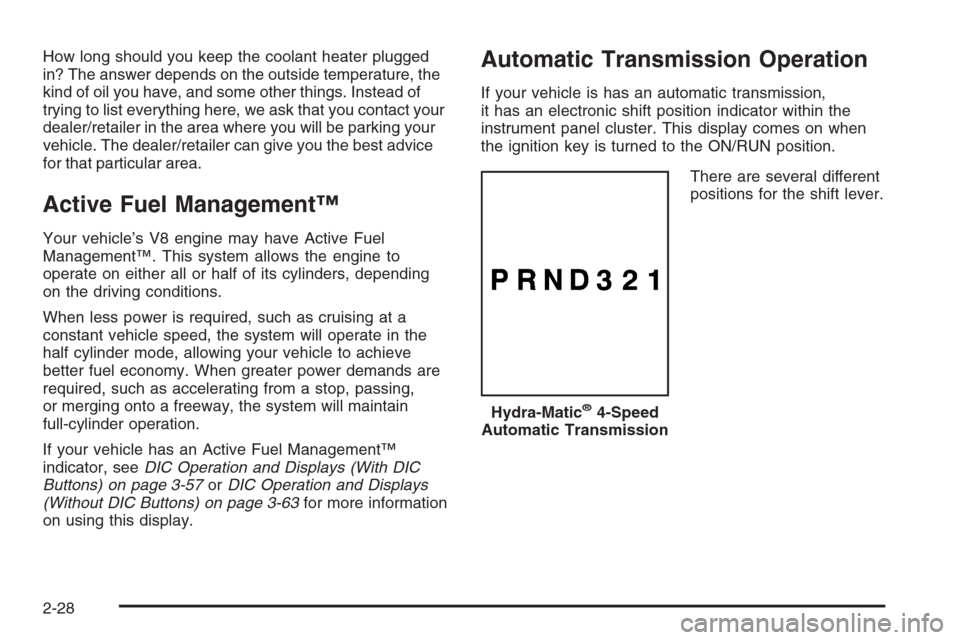
If your vehicle is has an automatic transmission,
it has an electronic shift position indicator within the
instrument panel cluster. This display comes on when
the ignition key is turned to the ON/RUN position.
There are several different
positions for the shift lever.
Hydra-Matic
®4-Speed
Automatic Transmission
2-28
Page 128 of 596
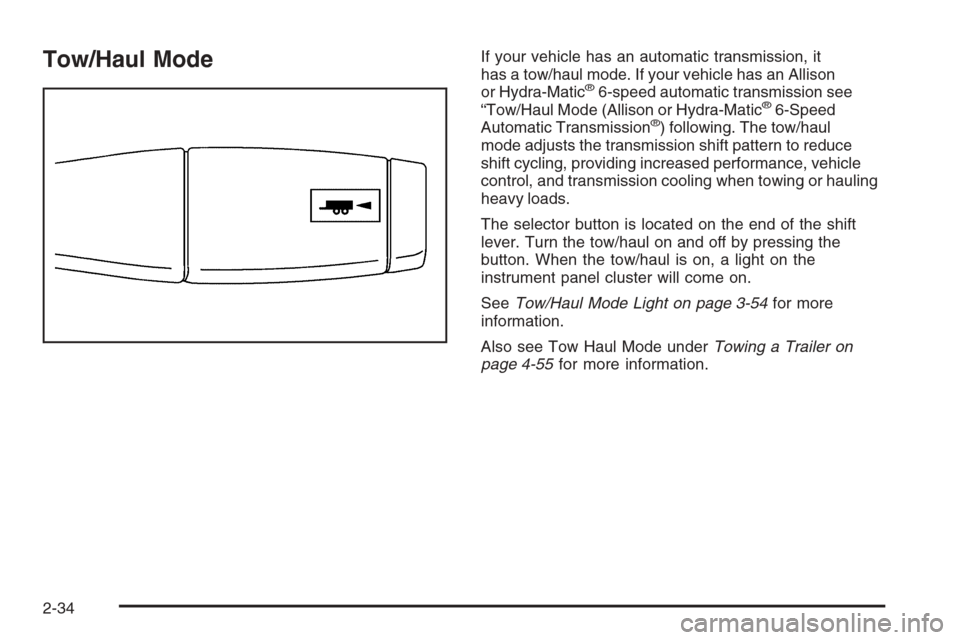
Tow/Haul ModeIf your vehicle has an automatic transmission, it
has a tow/haul mode. If your vehicle has an Allison
or Hydra-Matic
®6-speed automatic transmission see
“Tow/Haul Mode (Allison or Hydra-Matic®6-Speed
Automatic Transmission®) following. The tow/haul
mode adjusts the transmission shift pattern to reduce
shift cycling, providing increased performance, vehicle
control, and transmission cooling when towing or hauling
heavy loads.
The selector button is located on the end of the shift
lever. Turn the tow/haul on and off by pressing the
button. When the tow/haul is on, a light on the
instrument panel cluster will come on.
SeeTow/Haul Mode Light on page 3-54for more
information.
Also see Tow Haul Mode underTowing a Trailer on
page 4-55for more information.
2-34
Page 129 of 596
Tow/Haul Mode (Allison Transmission®
or Hydra-Matic®6-Speed Automatic
Transmission)
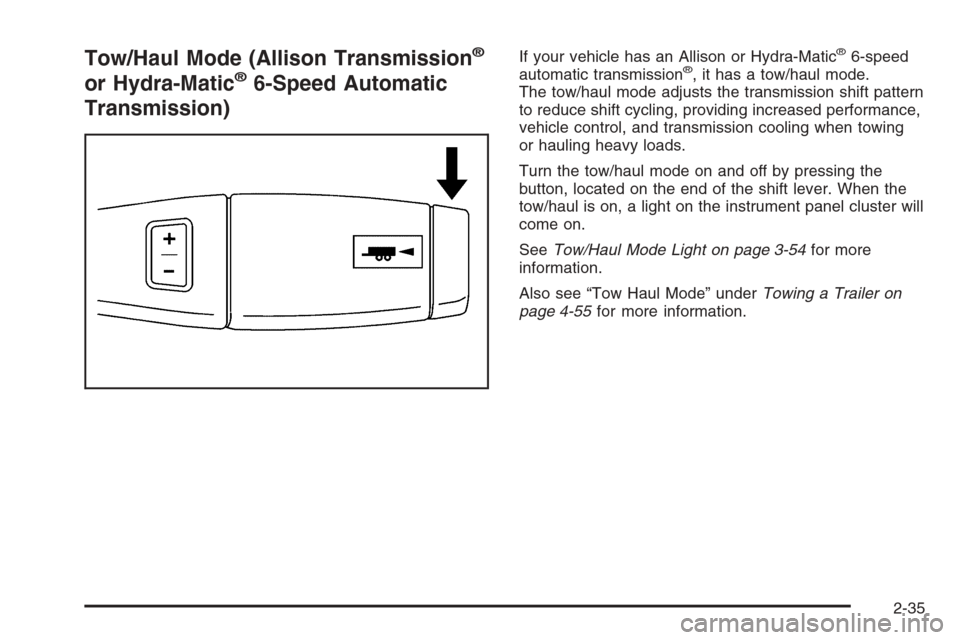
If your vehicle has an Allison or Hydra-Matic®6-speed
automatic transmission®, it has a tow/haul mode.
The tow/haul mode adjusts the transmission shift pattern
to reduce shift cycling, providing increased performance,
vehicle control, and transmission cooling when towing
or hauling heavy loads.
Turn the tow/haul mode on and off by pressing the
button, located on the end of the shift lever. When the
tow/haul is on, a light on the instrument panel cluster will
come on.
SeeTow/Haul Mode Light on page 3-54for more
information.
Also see “Tow Haul Mode” underTowing a Trailer on
page 4-55for more information.
2-35
Page 172 of 596
Storage Areas
Glove Box
To open the glove box, lift up on the lever.
Cupholders
Your vehicle may have cupholders located on and
behind the center console and in the rear seat armrest.
Pull the loop down on the rear seat armrest to access
the cupholders.
Pull downward on the lid to use the cupholders behind
the center console.
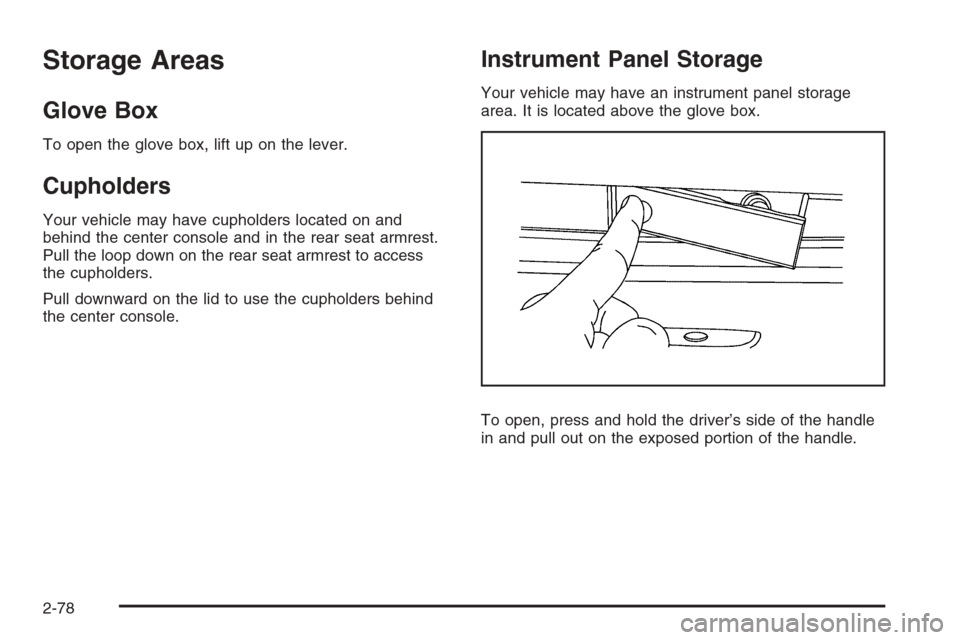
Instrument Panel Storage
Your vehicle may have an instrument panel storage
area. It is located above the glove box.
To open, press and hold the driver’s side of the handle
in and pull out on the exposed portion of the handle.
2-78