2008 CHEVROLET HHR ESP
[x] Cancel search: ESPPage 215 of 430
Police records show that almost 40 percent of all motor
vehicle-related deaths involve alcohol. In most cases,
these deaths are the result of someone who was
drinking and driving. In recent years, more than
17,000 annual motor vehicle-related deaths have been
associated with the use of alcohol, with about
250,000 people injured.
For persons under 21, it is against the law in every
U.S. state to drink alcohol. There are good medical,
psychological, and developmental reasons for
these laws.
The obvious way to eliminate the leading highway
safety problem is for people never to drink alcohol and
then drive.
Medical research shows that alcohol in a person’s
system can make crash injuries worse, especially
injuries to the brain, spinal cord, or heart. This means
that when anyone who has been drinking — driver
or passenger — is in a crash, that person’s chance of
being killed or permanently disabled is higher than if the
person had not been drinking.Control of a Vehicle
The following three systems help to control your vehicle
while driving — brakes, steering, and accelerator. At
times, as when driving on snow or ice, it is easy to ask
more of those control systems than the tires and
road can provide. Meaning, you can lose control of your
vehicle. SeeTraction Control System (TCS) on
page 4-6,Enhanced Traction System (ETS) on page 4-9,
andElectronic Stability Control (ESC) on page 4-10.
Adding non-dealer/non-retailer accessories can
affect your vehicle’s performance. SeeAccessories and
Modifications on page 5-3.
Braking
SeeBrake System Warning Light on page 3-35.
Braking action involves perception time and reaction
time. First, you have to decide to push on the brake
pedal. That is perception time. Then you have to bring
up your foot and do it. That is reaction time.
4-3
Page 218 of 430
Braking in Emergencies
At some time, nearly every driver gets into a situation
that requires hard braking.
If you have ABS, you can steer and brake at the same
time. However, if you do not have ABS, your rst
reaction — to hit the brake pedal hard and hold it
down — might be the wrong thing to do. Your wheels
can stop rolling. Once they do, the vehicle cannot
respond to your steering. Momentum will carry it in
whatever direction it was headed when the wheels
stopped rolling. That could be off the road, into the very
thing you were trying to avoid, or into traffic.
If you do not have ABS, use a “squeeze” braking
technique. This will give you maximum braking while
maintaining steering control. You can do this by pushing
on the brake pedal with steadily increasing pressure.
In an emergency, you will probably want to squeeze the
brakes hard without locking the wheels. If you hear or
feel the wheels sliding, ease off the brake pedal.
This will help you retain steering control. If you do have
ABS, it is different. SeeAntilock Brake System (ABS)
on page 4-5.
In many emergencies, steering can help you more than
even the very best braking.
Brake Assist
If your vehicle has ESC with ABS, it also has a brake
assist feature that responds to emergency braking
by generating additional pressure and engaging
the ABS. When this happens, the brake pedal will feel
easier to push. Just hold the brake pedal down
rmly and let the system work for you. You might feel
the brakes vibrate or notice some noise, but this is
normal. The brakes will return to normal operation after
the brake pedal is released.
Brake assist cannot compensate for unsafe driving
practices and braking effectiveness, itself, depends on
the condition of the road, tires, and brakes and
vehicle mass.
Traction Control System (TCS)
Your vehicle may have a Traction Control System (TCS)
that limits wheel spin. This is especially useful in
slippery road conditions. The system operates only if it
senses that the wheels are spinning too much or
are beginning to lose traction. When this happens, the
system works the front brakes and reduces engine
power by closing the throttle and managing engine spark
to limit wheel spin.
If your vehicle has TCS, there is a ESC/TCS button
located on the instrument panel.
4-6
Page 219 of 430
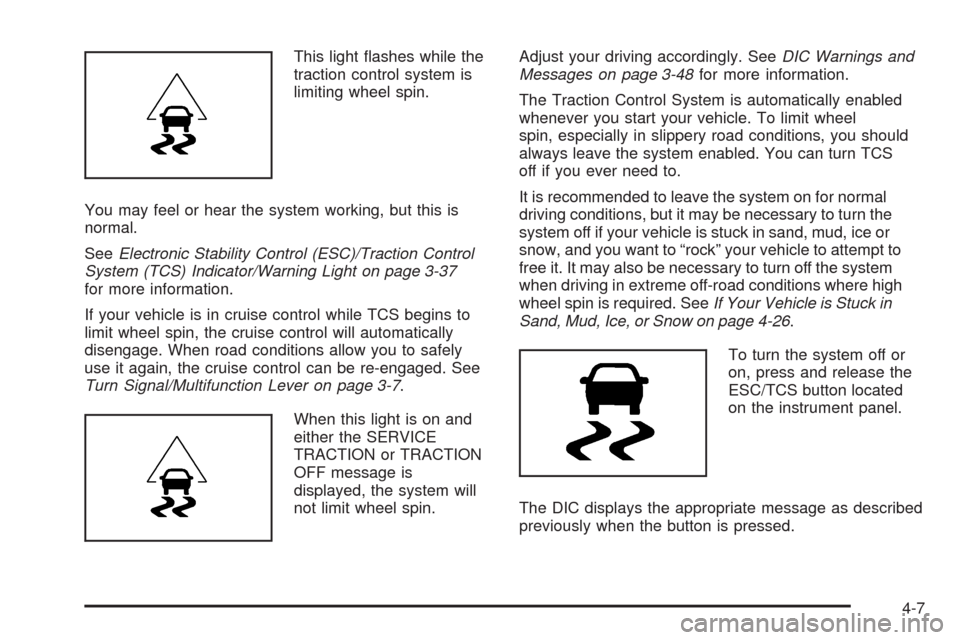
This light ashes while the
traction control system is
limiting wheel spin.
You may feel or hear the system working, but this is
normal.
SeeElectronic Stability Control (ESC)/Traction Control
System (TCS) Indicator/Warning Light on page 3-37
for more information.
If your vehicle is in cruise control while TCS begins to
limit wheel spin, the cruise control will automatically
disengage. When road conditions allow you to safely
use it again, the cruise control can be re-engaged. See
Turn Signal/Multifunction Lever on page 3-7.
When this light is on and
either the SERVICE
TRACTION or TRACTION
OFF message is
displayed, the system will
not limit wheel spin.Adjust your driving accordingly. SeeDIC Warnings and
Messages on page 3-48for more information.
The Traction Control System is automatically enabled
whenever you start your vehicle. To limit wheel
spin, especially in slippery road conditions, you should
always leave the system enabled. You can turn TCS
off if you ever need to.
It is recommended to leave the system on for normal
driving conditions, but it may be necessary to turn the
system off if your vehicle is stuck in sand, mud, ice or
snow, and you want to “rock” your vehicle to attempt to
free it. It may also be necessary to turn off the system
when driving in extreme off-road conditions where high
wheel spin is required. SeeIf Your Vehicle is Stuck in
Sand, Mud, Ice, or Snow on page 4-26.
To turn the system off or
on, press and release the
ESC/TCS button located
on the instrument panel.
The DIC displays the appropriate message as described
previously when the button is pressed.
4-7
Page 221 of 430
Enhanced Traction System (ETS)
Your vehicle may have an Enhanced Traction
System (ETS) that limits wheel spin. This is especially
useful in slippery road conditions. The system operates
only if it senses that one or both of the front wheels are
spinning or beginning to lose traction. When this
happens, the system reduces engine power and may also
upshift the transmission to limit wheel spin. You may feel
or hear the system working, but this is normal.
If your vehicle has ETS, there is not an ESC/TCS
button on the instrument panel. To turn the system
off, shift to LOW (L) or REVERSE (R). There is more
information about how to turn the system off later in
this section.
A LOW TRACTION message will appear on the Driver
Information Center (DIC) when the traction control
system is actively limiting wheel spin. Slippery road
conditions may exist if this message is displayed,
so adjust your driving accordingly.
If your vehicle is in cruise control when the ETS begins
to limit wheel spin, the cruise control will automatically
disengage. When road conditions allow you to safely
use it again, you may re-engage the cruise control. See
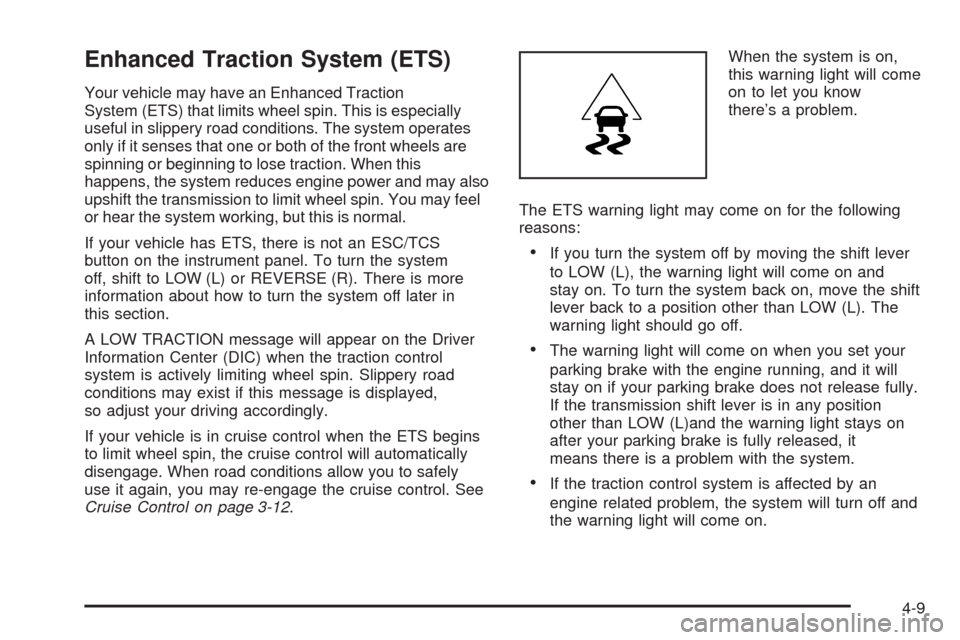
Cruise Control on page 3-12.When the system is on,
this warning light will come
on to let you know
there’s a problem.
The ETS warning light may come on for the following
reasons:
If you turn the system off by moving the shift lever
to LOW (L), the warning light will come on and
stay on. To turn the system back on, move the shift
lever back to a position other than LOW (L). The
warning light should go off.
The warning light will come on when you set your
parking brake with the engine running, and it will
stay on if your parking brake does not release fully.
If the transmission shift lever is in any position
other than LOW (L)and the warning light stays on
after your parking brake is fully released, it
means there is a problem with the system.
If the traction control system is affected by an
engine related problem, the system will turn off and
the warning light will come on.
4-9
Page 222 of 430
If the warning light stays on, or comes on when you’re
driving, there may be a problem with your ETS and
your vehicle may need service. When this warning light
is on, the system will not limit wheel spin. Adjust
your driving accordingly.
If the ETS warning light comes on and stays on for an
extended period of time when the transmission shift
lever is in any position other than LOW (L), your vehicle
needs service.
To limit wheel spin, especially in slippery road
conditions, you should always leave the ETS on. But
you can turn the system off if you prefer.
To turn the system off, shift to LOW (L) or REVERSE (R).
When you turn the system off, the ETS warning light will
come on and stay on when the gear shift is in LOW (L).
The warning light will not come on when the gear shift is
in REVERSE (R). If the ETS is limiting wheel spin when
you shift to LOW (L) or REVERSE (R) to turn the system
off, the warning light will come on in LOW (L). But the
system won’t turn off right away. It will wait until there’s no
longer a current need to limit wheel spin.
You can turn the system back on at any time by shifting to
AUTOMATIC OVERDRIVE (D) or INTERMEDIATE (I).
The ETS warning light should go off.
Adding non-dealer/non-retailer accessories can affect
your vehicle’s performance. SeeAccessories and
Modifications on page 5-3for more information.Limited-Slip Differential
Your vehicle may have this feature. A limited-slip
transmission can give you additional traction on snow,
mud, ice, sand or gravel. It works like a standard
transmission most of the time, but when one of the front
wheels loses traction, this feature will allow the wheel
with traction to move the vehicle. The limited slip design
has minimal impact to the steering feel, but boosts
the traction performance under all conditions.
Electronic Stability Control (ESC)
Your vehicle may have an Electronic Stability
Control (ESC) system which combines antilock brake,
and traction and stability control systems that help
the driver maintain directional control of the vehicle in
most driving conditions.
When the vehicle is started and begins to move, the
system performs several diagnostic checks to ensure
there are no problems. You may hear or feel the system
working. This is normal and does not mean there is a
problem with your vehicle. The system should initialize
before the vehicle reaches 20 mph (32 km/h).
If the system fails to turn on or activate, the ESC/TCS
light comes on, and the ESC OFF and/or SERVICE ESC
message displays.
4-10
Page 223 of 430
For more information, seeDriver Information
Center (DIC) on page 3-46andElectronic Stability
Control (ESC)/Traction Control System (TCS)
Indicator/Warning Light on page 3-37.
This light ashes on the
instrument panel cluster
when the ESC system
is on and activated.
ESC activates when the computer senses a discrepancy
between your intended path and the direction the vehicle
is actually travelling. ESC selectively applies braking
pressure at any one of the vehicle’s brakes to help steer
the vehicle in the direction which you are steering.
When the system activates, an ESC ACTIVE message
displays on the Driver Information Center. SeeDIC
Warnings and Messages on page 3-48. This light also
ashes on the instrument panel cluster when the
ESC system is on and activated. You may also hear a
noise or feel vibration in the brake pedal. This is
normal. Continue to steer the vehicle in the direction
you want it to go.When the light is on solid and the message(s),
SERVICE ESC, ESC OFF, or both display, the system
will not assist the driver in maintaining directional
control of the vehicle. Adjust your driving accordingly.
SeeDIC Warnings and Messages on page 3-48.
The Electronic Stability Control (ESC) system is
automatically enabled whenever you start your vehicle.
To assist the driver with vehicle directional control,
especially in slippery road conditions, you should always
leave the system on. But, you can turn ESC off if you
ever need to.
If the vehicle is in cruise control when the system
begins to assist the driver maintain directional control of
the vehicle, the ESC/TCS light will ash and the
cruise control will automatically disengage. When road
conditions allow you to use cruise again, you may
re-engage the cruise control. SeeCruise Control on
page 3-12.
The ESC/TCS button
is located on the
instrument panel.
4-11
Page 228 of 430
Passing
Passing another vehicle on a two-lane road can be
dangerous. To reduce the risk of danger while passing,
we suggest the following tips:
Look down the road, to the sides, and to crossroads
for situations that might affect a successful pass. If
in doubt, wait.
Watch for traffic signs, pavement markings, and
lines that could indicate a turn or an intersection.
Never cross a solid or double-solid line on your side
of the lane.
Do not get too close to the vehicle you want to
pass. Doing so can reduce your visibility.
Wait your turn to pass a slow vehicle.
When you are being passed, ease to the right.
Loss of Control
Let us review what driving experts say about what
happens when the three control systems — brakes,
steering, and acceleration — do not have enough friction
where the tires meet the road to do what the driver has
asked.
In any emergency, do not give up. Keep trying to steer
and constantly seek an escape route or area of less
danger.
Skidding
In a skid, a driver can lose control of the vehicle.
Defensive drivers avoid most skids by taking reasonable
care suited to existing conditions, and by not overdriving
those conditions. But skids are always possible.
The three types of skids correspond to your vehicle’s
three control systems. In the braking skid, the wheels are
not rolling. In the steering or cornering skid, too much
speed or steering in a curve causes tires to slip and lose
cornering force. And in the acceleration skid, too much
throttle causes the driving wheels to spin.
4-16
Page 230 of 430
Driving at Night
Night driving is more dangerous than day driving because
some drivers are likely to be impaired — by alcohol or
drugs, with night vision problems, or by fatigue.
Night driving tips include:
Drive defensively.
Do not drink and drive.
Reduce headlamp glare by adjusting the inside
rearview mirror.
Slow down and keep more space between you and
other vehicles because your headlamps can only
light up so much road ahead.
Watch for animals.
When tired, pull off the road.
Do not wear sunglasses.
Avoid staring directly into approaching headlamps.
Keep the windshield and all glass on your vehicle
clean — inside and out.
Keep your eyes moving, especially during turns or
curves.
No one can see as well at night as in the daytime.
But, as we get older, these differences increase.
A 50-year-old driver might need at least twice as much
light to see the same thing at night as a 20-year-old.
Driving in Rain and on Wet Roads
Rain and wet roads can reduce vehicle traction
and affect your ability to stop and accelerate. Always
drive slower in these types of driving conditions
and avoid driving through large puddles and
deep-standing or owing water.
4-18