Page 344 of 436
The TPMS sensor matching process is outlined below:
1. Set the parking brake.
2. Turn the ignition switch to ON/RUN with the
engine off.
3. Press the Remote Keyless Entry (RKE) transmitter’s
LOCK and UNLOCK buttons at the same time for
approximately ve seconds. The horn sounds twice
to signal the receiver is in relearn mode and TIRE
LEARNING ACTIVE message displays on the DIC
screen.
4. Start with the driver side front tire.
5. Remove the valve cap from the valve cap stem.
Activate the TPMS sensor by increasing or
decreasing the tire’s air pressure for ve seconds,
or until a horn chirp sounds. The horn chirp, which
may take up to 30 seconds to sound, conrms that
the sensor identication code has been matched to
this tire and wheel position.6. Proceed to the passenger side front tire, and repeat
the procedure in Step 5.
7. Proceed to the passenger side rear tire, and repeat
the procedure in Step 5.
8. Proceed to the driver side rear tire, and repeat the
procedure in Step 5. The horn sounds two times to
indicate the sensor identication code has been
matched to the driver side rear tire, and the TPMS
sensor matching process is no longer active.
The TIRE LEARNING ACTIVE message on the DIC
display screen goes off.
9. Turn the ignition switch to LOCK/OFF.
10. Set all four tires to the recommended air pressure
level as indicated on the Tire and Loading
Information label.
11. Put the valve caps back on the valve stems.
5-66
Page 393 of 436
Maintenance Footnotes
(a)Visually inspect brake lines and hoses for proper
hook-up, binding, leaks, cracks, chafing, etc. Inspect
disc brake pads for wear and rotors for surface
condition. Inspect other brake parts, including calipers,
parking brake, etc. Check parking brake adjustment.
(b)Visually inspect front and rear suspension and
steering system for damaged, loose, or missing parts or
signs of wear. Visually check constant velocity joints,
rubber boots, and axle seals for leaks. With 3.4L
V6 engine: Inspect electric power steering cables for
proper hook-up, binding, cracks, chafing, etc. With 3.6L
V6 engine: Inspect hydraulic power steering lines and
hoses for proper hook-up, binding, leaks, cracks,
chafing, etc.
(c)Visually inspect hoses and have them replaced if
they are cracked, swollen, or deteriorated. Inspect
all pipes, fittings and clamps; replace with genuine parts
as needed. To help ensure proper operation, a pressure
test of the cooling system and pressure cap and cleaning
the outside of the radiator and air conditioning condenser
is recommended at least once a year.(d)Inspect wiper blades for wear, cracking, or
contamination. Clean the windshield and wiper blades, if
contaminated. Replace wiper blades that are worn or
damaged. See Windshield Wiper Blade Replacement on
page 5-50andWindshield and Wiper Blades on
page 5-95for more information.
(e)Make sure the safety belt reminder light and safety
belt assemblies are working properly. Look for any
other loose or damaged safety belt system parts. If you
see anything that might keep a safety belt system
from doing its job, have it repaired. Have any torn or
frayed safety belts replaced. Also see Checking the
Restraint Systems on page 1-72.
(f)Lubricate all key lock cylinders, hood latch
assemblies, secondary latches, pivots, spring anchor
and release pawl, hood and door hinges, rear folding
seats, and liftgate hinges. More frequent lubrication may
be required when exposed to a corrosive environment.
Applying silicone grease on weatherstrips with a clean
cloth will make them last longer, seal better, and not stick
or squeak.
(g)If you drive regularly under dusty conditions, the
filter may require replacement more often.
6-7
Page 397 of 436
Ignition Transmission Lock Check
While parked, and with the parking brake set, try to turn
the ignition to LOCK/OFF in each shift lever position.
The ignition should turn to LOCK/OFF only
when the shift lever is in PARK (P).
The ignition key should come out only in
LOCK/OFF.
Contact your dealer/retailer if service is required.
Parking Brake and Automatic
Transmission Park (P) Mechanism Check
{CAUTION:
When you are doing this check, your vehicle
could begin to move. You or others could be
injured and property could be damaged. Make
sure there is room in front of your vehicle in
case it begins to roll. Be ready to apply the
regular brake at once should the vehicle begin
to move.Park on a fairly steep hill, with the vehicle facing
downhill. Keeping your foot on the regular brake, set the
parking brake.
To check the parking brake’s holding ability:
With the engine running and the transmission
in NEUTRAL (N), slowly remove foot pressure from
the regular brake pedal. Do this until the vehicle
is held by the parking brake only.
To check the PARK (P) mechanism’s holding ability:
With the engine running, shift to PARK (P). Then
release the parking brake followed by the
regular brake.
Contact your dealer/retailer if service is required.
Underbody Flushing Service
At least every spring, use plain water to ush any
corrosive materials from the underbody. Take care to
clean thoroughly any areas where mud and other debris
can collect.
6-11
Page 399 of 436
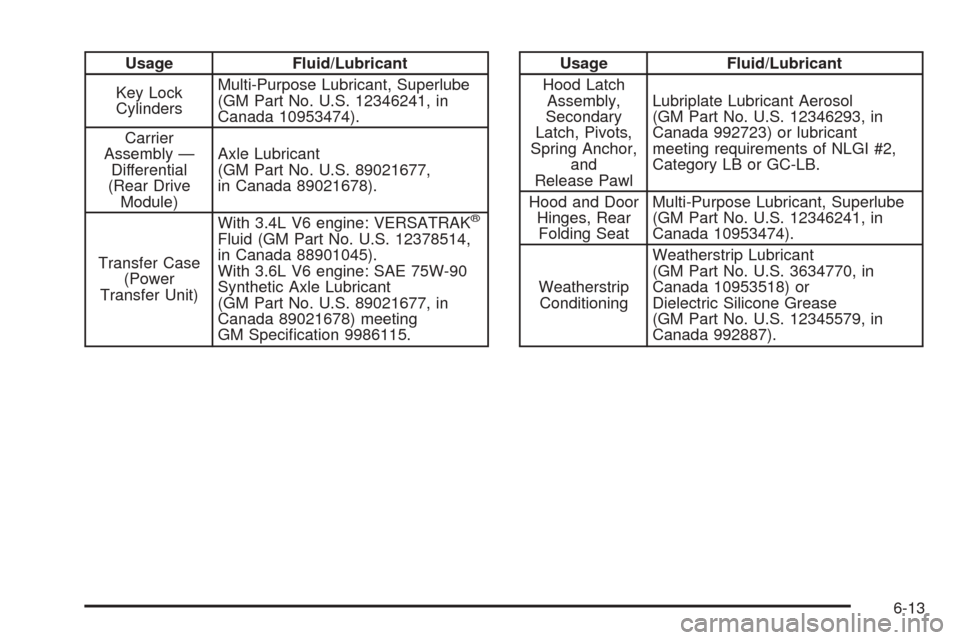
Usage Fluid/Lubricant
Key Lock
CylindersMulti-Purpose Lubricant, Superlube
(GM Part No. U.S. 12346241, in
Canada 10953474).
Carrier
Assembly —
Differential
(Rear Drive
Module)Axle Lubricant
(GM Part No. U.S. 89021677,
in Canada 89021678).
Transfer Case
(Power
Transfer Unit)With 3.4L V6 engine: VERSATRAK
®
Fluid (GM Part No. U.S. 12378514,
in Canada 88901045).
With 3.6L V6 engine: SAE 75W-90
Synthetic Axle Lubricant
(GM Part No. U.S. 89021677, in
Canada 89021678) meeting
GM Specication 9986115.
Usage Fluid/Lubricant
Hood Latch
Assembly,
Secondary
Latch, Pivots,
Spring Anchor,
and
Release PawlLubriplate Lubricant Aerosol
(GM Part No. U.S. 12346293, in
Canada 992723) or lubricant
meeting requirements of NLGI #2,
Category LB or GC-LB.
Hood and Door
Hinges, Rear
Folding SeatMulti-Purpose Lubricant, Superlube
(GM Part No. U.S. 12346241, in
Canada 10953474).
Weatherstrip
ConditioningWeatherstrip Lubricant
(GM Part No. U.S. 3634770, in
Canada 10953518) or
Dielectric Silicone Grease
(GM Part No. U.S. 12345579, in
Canada 992887).
6-13
Page 428 of 436
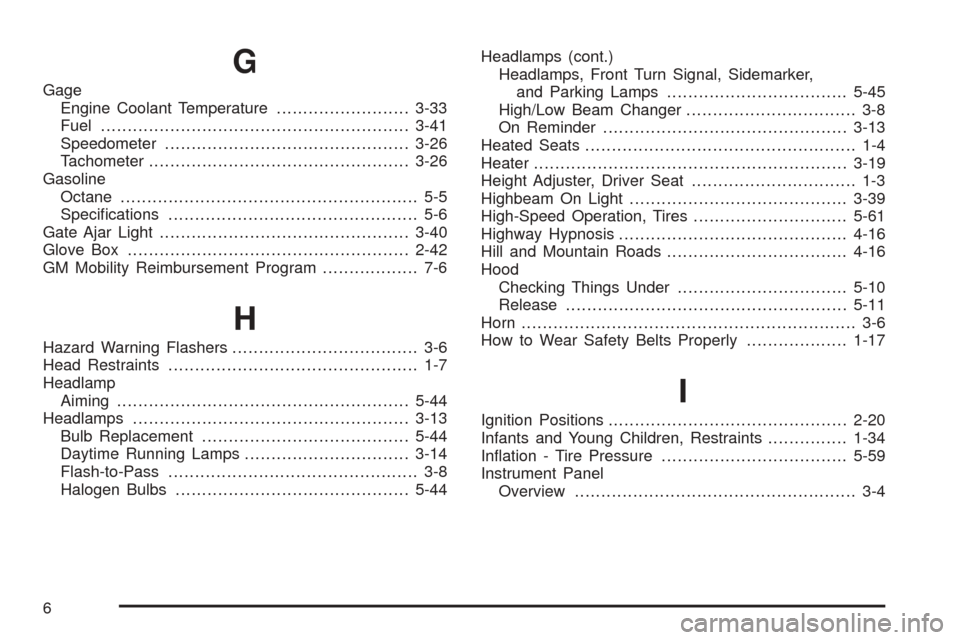
G
Gage
Engine Coolant Temperature.........................3-33
Fuel..........................................................3-41
Speedometer..............................................3-26
Tachometer.................................................3-26
Gasoline
Octane........................................................ 5-5
Specications............................................... 5-6
Gate Ajar Light...............................................3-40
Glove Box.....................................................2-42
GM Mobility Reimbursement Program.................. 7-6
H
Hazard Warning Flashers................................... 3-6
Head Restraints............................................... 1-7
Headlamp
Aiming.......................................................5-44
Headlamps....................................................3-13
Bulb Replacement.......................................5-44
Daytime Running Lamps...............................3-14
Flash-to-Pass............................................... 3-8
Halogen Bulbs............................................5-44Headlamps (cont.)
Headlamps, Front Turn Signal, Sidemarker,
and Parking Lamps..................................5-45
High/Low Beam Changer................................ 3-8
On Reminder..............................................3-13
Heated Seats................................................... 1-4
Heater...........................................................3-19
Height Adjuster, Driver Seat............................... 1-3
Highbeam On Light.........................................3-39
High-Speed Operation, Tires.............................5-61
Highway Hypnosis...........................................4-16
Hill and Mountain Roads..................................4-16
Hood
Checking Things Under................................5-10
Release.....................................................5-11
Horn............................................................... 3-6
How to Wear Safety Belts Properly...................1-17
I
Ignition Positions.............................................2-20
Infants and Young Children, Restraints...............1-34
Ination - Tire Pressure...................................5-59
Instrument Panel
Overview..................................................... 3-4
6