2008 CHEVROLET EQUINOX mirror
[x] Cancel search: mirrorPage 251 of 436
Loss of Control
Let us review what driving experts say about what
happens when the three control systems — brakes,
steering, and acceleration — do not have enough friction
where the tires meet the road to do what the driver
has asked.
In any emergency, do not give up. Keep trying to steer
and constantly seek an escape route or area of less
danger.
Skidding
In a skid, a driver can lose control of the vehicle.
Defensive drivers avoid most skids by taking reasonable
care suited to existing conditions, and by not overdriving
those conditions. But skids are always possible.
The three types of skids correspond to your vehicle’s
three control systems. In the braking skid, the wheels
are not rolling. In the steering or cornering skid, too
much speed or steering in a curve causes tires to slip
and lose cornering force. And in the acceleration skid,
too much throttle causes the driving wheels to spin.
A cornering skid is best handled by easing your foot off
the accelerator pedal.
Remember: Any traction control system helps avoid only
the acceleration skid. If your traction system is off, then
an acceleration skid is also best handled by easing yourfoot off the accelerator pedal. SeeTraction Control
System (TCS) on page 4-6andStabiliTrak
®System
on page 4-7.
If your vehicle starts to slide, ease your foot off the
accelerator pedal and quickly steer the way you want
the vehicle to go. If you start steering quickly enough,
your vehicle may straighten out. Always be ready
for a second skid if it occurs.
Of course, traction is reduced when water, snow, ice,
gravel, or other material is on the road. For safety, you
will want to slow down and adjust your driving to these
conditions. It is important to slow down on slippery
surfaces because stopping distance will be longer and
vehicle control more limited.
While driving on a surface with reduced traction, try
your best to avoid sudden steering, acceleration,
or braking, including reducing vehicle speed by shifting
to a lower gear. Any sudden changes could cause
the tires to slide. You may not realize the surface is
slippery until your vehicle is skidding. Learn to recognize
warning clues — such as enough water, ice, or packed
snow on the road to make a mirrored surface — and
slow down when you have any doubt.
Remember: Any Antilock Brake System (ABS) helps
avoid only the braking skid.
4-13
Page 252 of 436
Driving at Night
Night driving is more dangerous than day driving
because some drivers are likely to be impaired — by
alcohol or drugs, with night vision problems, or by
fatigue.
Night driving tips include:
Drive defensively.
Do not drink and drive.
Reduce headlamp glare by adjusting the inside
rearview mirror.
Slow down and keep more space between you and
other vehicles because your headlamps can only
light up so much road ahead.
Watch for animals.
When tired, pull off the road.
Do not wear sunglasses.
Avoid staring directly into approaching headlamps.
Keep the windshield and all glass on your vehicle
clean — inside and out.
Keep your eyes moving, especially during turns or
curves.
No one can see as well at night as in the daytime. But,
as we get older, these differences increase. A
50-year-old driver might need at least twice as much
light to see the same thing at night as a 20-year-old.
Driving in Rain and on Wet Roads
Rain and wet roads can reduce vehicle traction and
affect your ability to stop and accelerate. Always drive
slower in these types of driving conditions and avoid
driving through large puddles and deep-standing or
owing water.
4-14
Page 254 of 436
Before Leaving on a Long Trip
To prepare your vehicle for a long trip, consider having it
serviced by your dealer/retailer before departing.
Things to check on your own include:
Windshield Washer Fluid:Reservoir full? Windows
clean — inside and outside?
Wiper Blades:In good shape?
Fuel, Engine Oil, Other Fluids:All levels checked?
Lamps:Do they all work and are lenses clean?
Tires:Are treads good? Are tires inated to
recommended pressure?
Weather and Maps:Safe to travel? Have
up-to-date maps?
Highway Hypnosis
Always be alert and pay attention to your surroundings
while driving. If you become tired or sleepy, nd a safe
place to park your vehicle and rest.
Other driving tips include:
Keep the vehicle well ventilated.
Keep interior temperature cool.
Keep your eyes moving — scan the road ahead
and to the sides.
Check the rearview mirror and vehicle instruments
often.
Hill and Mountain Roads
Driving on steep hills or through mountains is different
than driving on at or rolling terrain. Tips for driving
in these conditions include:
Keep your vehicle serviced and in good shape.
Check all uid levels and brakes, tires, cooling
system, and transmission.
Going down steep or long hills, shift to a
lower gear.
{CAUTION:
If you do not shift down, the brakes could get
so hot that they would not work well. You
would then have poor braking or even none
going down a hill. You could crash. Shift down
to let the engine assist the brakes on a steep
downhill slope.
4-16
Page 275 of 436
Driving with a Trailer
{CAUTION:
If you have the liftgate open and you pull a
trailer with your vehicle, carbon monoxide (CO)
could come into your vehicle. You cannot see
or smell CO. It can cause unconsciousness or
death. SeeEngine Exhaust on page 2-35.To
maximize your safety when towing a trailer:
Have your exhaust system inspected for
leaks, and make necessary repairs before
starting on your trip.
Keep the liftgate closed.
If exhaust does come into your vehicle
through a window in the rear or another
opening, drive with your front, main
heating or cooling system on and with the
fan on any speed. This will bring fresh,
outside air into your vehicle. Do not use
the climate control setting for maximum air
because it only recirculates the air inside
your vehicle. SeeClimate Control System
on page 3-19.Towing a trailer requires a certain amount of experience.
Before setting out for the open road, you will want to
get to know your rig. Acquaint yourself with the feel of
handling and braking with the added weight of the trailer.
And always keep in mind that the vehicle you are
driving is now a good deal longer and not nearly as
responsive as your vehicle is by itself.
Before you start, check all trailer hitch parts and
attachments, safety chains, electrical connector, lamps,
tires and mirror adjustment. If the trailer has electric
brakes, start your vehicle and trailer moving and then
apply the trailer brake controller by hand to be sure the
brakes are working. This lets you check your electrical
connection at the same time.
During your trip, check occasionally to be sure that the
load is secure, and that the lamps and any trailer brakes
are still working.
4-37
Page 380 of 436
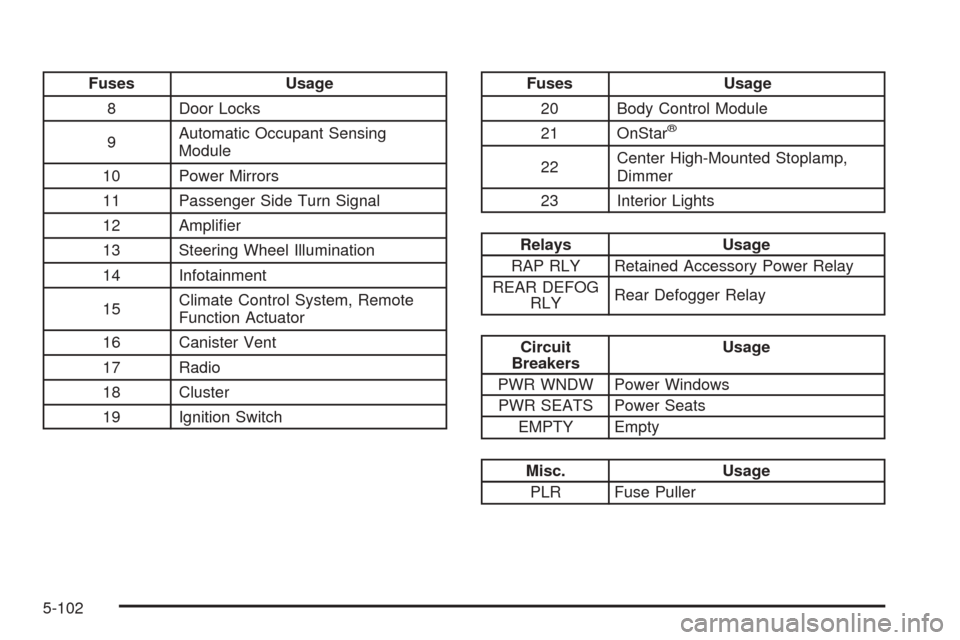
Fuses Usage
8 Door Locks
9Automatic Occupant Sensing
Module
10 Power Mirrors
11 Passenger Side Turn Signal
12 Amplier
13 Steering Wheel Illumination
14 Infotainment
15Climate Control System, Remote
Function Actuator
16 Canister Vent
17 Radio
18 Cluster
19 Ignition SwitchFuses Usage
20 Body Control Module
21 OnStar
®
22Center High-Mounted Stoplamp,
Dimmer
23 Interior Lights
Relays Usage
RAP RLY Retained Accessory Power Relay
REAR DEFOG
RLYRear Defogger Relay
Circuit
BreakersUsage
PWR WNDW Power Windows
PWR SEATS Power Seats
EMPTY Empty
Misc. Usage
PLR Fuse Puller
5-102
Page 430 of 436
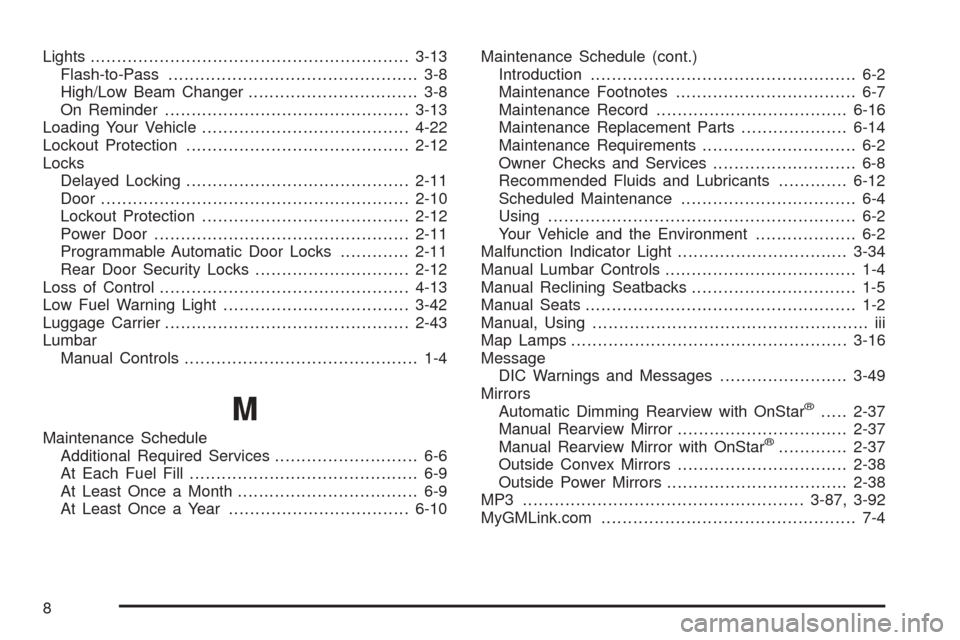
Lights............................................................3-13
Flash-to-Pass............................................... 3-8
High/Low Beam Changer................................ 3-8
On Reminder..............................................3-13
Loading Your Vehicle.......................................4-22
Lockout Protection..........................................2-12
Locks
Delayed Locking..........................................2-11
Door..........................................................2-10
Lockout Protection.......................................2-12
Power Door................................................2-11
Programmable Automatic Door Locks.............2-11
Rear Door Security Locks.............................2-12
Loss of Control...............................................4-13
Low Fuel Warning Light...................................3-42
Luggage Carrier..............................................2-43
Lumbar
Manual Controls............................................ 1-4
M
Maintenance Schedule
Additional Required Services........................... 6-6
At Each Fuel Fill........................................... 6-9
At Least Once a Month.................................. 6-9
At Least Once a Year..................................6-10Maintenance Schedule (cont.)
Introduction.................................................. 6-2
Maintenance Footnotes.................................. 6-7
Maintenance Record....................................6-16
Maintenance Replacement Parts....................6-14
Maintenance Requirements............................. 6-2
Owner Checks and Services........................... 6-8
Recommended Fluids and Lubricants.............6-12
Scheduled Maintenance................................. 6-4
Using.......................................................... 6-2
Your Vehicle and the Environment................... 6-2
Malfunction Indicator Light................................3-34
Manual Lumbar Controls.................................... 1-4
Manual Reclining Seatbacks............................... 1-5
Manual Seats................................................... 1-2
Manual, Using.................................................... iii
Map Lamps....................................................3-16
Message
DIC Warnings and Messages........................3-49
Mirrors
Automatic Dimming Rearview with OnStar
®.....2-37
Manual Rearview Mirror................................2-37
Manual Rearview Mirror with OnStar
®.............2-37
Outside Convex Mirrors................................2-38
Outside Power Mirrors..................................2-38
MP3 .....................................................3-87, 3-92
MyGMLink.com................................................ 7-4
8
Page 431 of 436
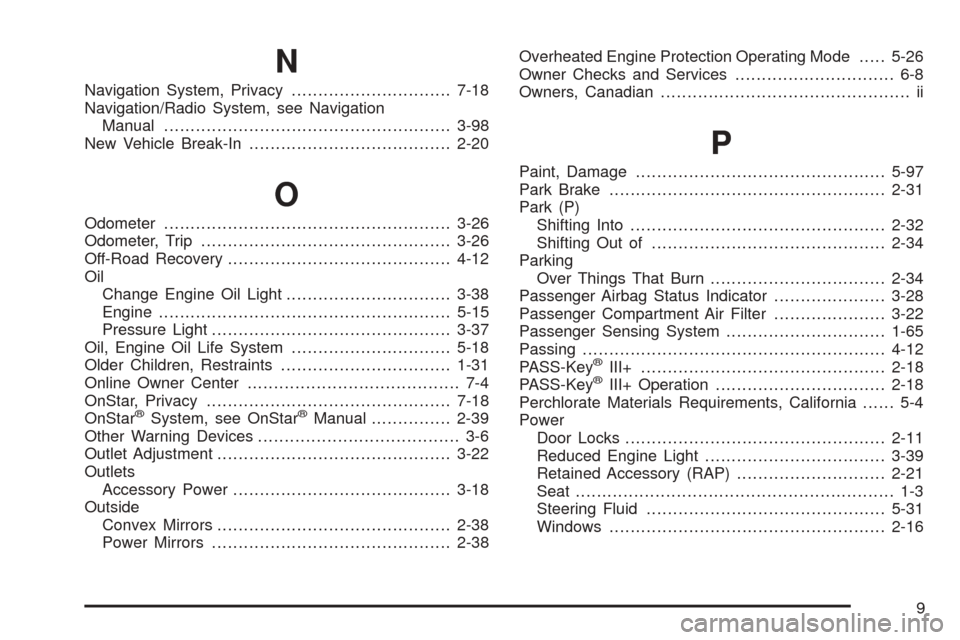
N
Navigation System, Privacy..............................7-18
Navigation/Radio System, see Navigation
Manual......................................................3-98
New Vehicle Break-In......................................2-20
O
Odometer......................................................3-26
Odometer, Trip...............................................3-26
Off-Road Recovery..........................................4-12
Oil
Change Engine Oil Light...............................3-38
Engine.......................................................5-15
Pressure Light.............................................3-37
Oil, Engine Oil Life System..............................5-18
Older Children, Restraints................................1-31
Online Owner Center........................................ 7-4
OnStar, Privacy..............................................7-18
OnStar
®System, see OnStar®Manual...............2-39
Other Warning Devices...................................... 3-6
Outlet Adjustment............................................3-22
Outlets
Accessory Power.........................................3-18
Outside
Convex Mirrors............................................2-38
Power Mirrors.............................................2-38Overheated Engine Protection Operating Mode.....5-26
Owner Checks and Services.............................. 6-8
Owners, Canadian............................................... ii
P
Paint, Damage...............................................5-97
Park Brake....................................................2-31
Park (P)
Shifting Into................................................2-32
Shifting Out of............................................2-34
Parking
Over Things That Burn.................................2-34
Passenger Airbag Status Indicator.....................3-28
Passenger Compartment Air Filter.....................3-22
Passenger Sensing System..............................1-65
Passing.........................................................4-12
PASS-Key
®III+..............................................2-18
PASS-Key®III+ Operation................................2-18
Perchlorate Materials Requirements, California...... 5-4
Power
Door Locks.................................................2-11
Reduced Engine Light..................................3-39
Retained Accessory (RAP)............................2-21
Seat............................................................ 1-3
Steering Fluid.............................................5-31
Windows....................................................2-16
9
Page 432 of 436
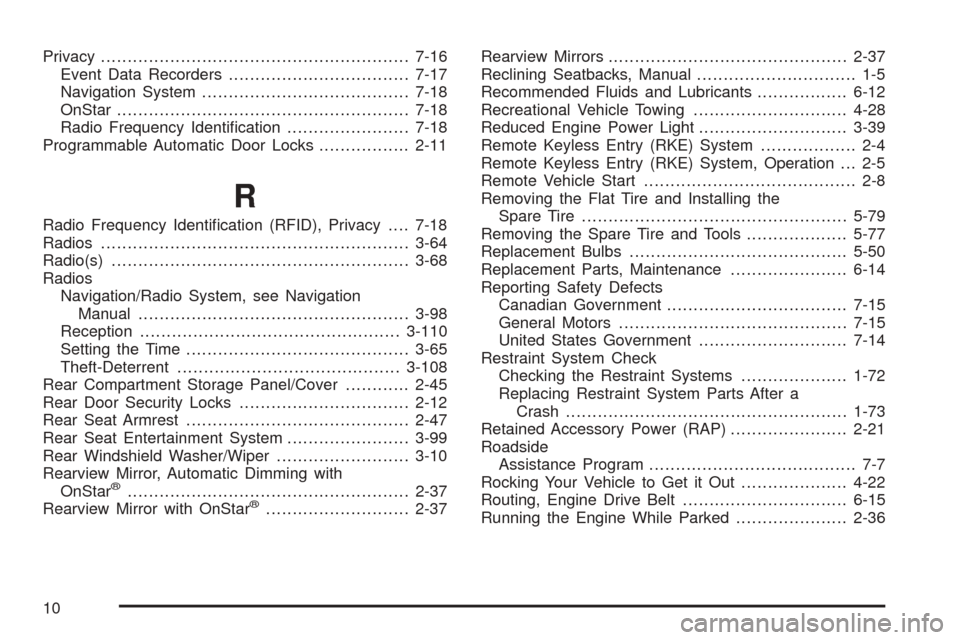
Privacy..........................................................7-16
Event Data Recorders..................................7-17
Navigation System.......................................7-18
OnStar.......................................................7-18
Radio Frequency Identication.......................7-18
Programmable Automatic Door Locks.................2-11
R
Radio Frequency Identication (RFID), Privacy....7-18
Radios..........................................................3-64
Radio(s)........................................................3-68
Radios
Navigation/Radio System, see Navigation
Manual...................................................3-98
Reception.................................................3-110
Setting the Time..........................................3-65
Theft-Deterrent..........................................3-108
Rear Compartment Storage Panel/Cover............2-45
Rear Door Security Locks................................2-12
Rear Seat Armrest..........................................2-47
Rear Seat Entertainment System.......................3-99
Rear Windshield Washer/Wiper.........................3-10
Rearview Mirror, Automatic Dimming with
OnStar
®.....................................................2-37
Rearview Mirror with OnStar®...........................2-37Rearview Mirrors.............................................2-37
Reclining Seatbacks, Manual.............................. 1-5
Recommended Fluids and Lubricants.................6-12
Recreational Vehicle Towing.............................4-28
Reduced Engine Power Light............................3-39
Remote Keyless Entry (RKE) System.................. 2-4
Remote Keyless Entry (RKE) System, Operation . . . 2-5
Remote Vehicle Start........................................ 2-8
Removing the Flat Tire and Installing the
Spare Tire..................................................5-79
Removing the Spare Tire and Tools...................5-77
Replacement Bulbs.........................................5-50
Replacement Parts, Maintenance......................6-14
Reporting Safety Defects
Canadian Government..................................7-15
General Motors...........................................7-15
United States Government............................7-14
Restraint System Check
Checking the Restraint Systems....................1-72
Replacing Restraint System Parts After a
Crash.....................................................1-73
Retained Accessory Power (RAP)......................2-21
Roadside
Assistance Program....................................... 7-7
Rocking Your Vehicle to Get it Out....................4-22
Routing, Engine Drive Belt...............................6-15
Running the Engine While Parked.....................2-36
10