2008 CHEVROLET CORVETTE wheel
[x] Cancel search: wheelPage 256 of 432
Skidding
In a skid, a driver can lose control of the vehicle.
Defensive drivers avoid most skids by taking reasonable
care suited to existing conditions, and by not overdriving
those conditions. But skids are always possible.
The three types of skids correspond to your vehicle’s
three control systems. In the braking skid, the wheels are
not rolling. In the steering or cornering skid, too much
speed or steering in a curve causes tires to slip and lose
cornering force. And in the acceleration skid, too much
throttle causes the driving wheels to spin.
A cornering skid is best handled by easing your foot off
the accelerator pedal.
Remember: Any traction control system helps avoid only
the acceleration skid. If your traction control system is
off, then an acceleration skid is also best handled
by easing your foot off the accelerator pedal.
If your vehicle starts to slide, ease your foot off the
accelerator pedal and quickly steer the way you want
the vehicle to go. If you start steering quickly enough,
your vehicle may straighten out. Always be ready
for a second skid if it occurs.Of course, traction is reduced when water, snow, ice,
gravel, or other material is on the road. For safety,
you will want to slow down and adjust your driving to
these conditions. It is important to slow down on slippery
surfaces because stopping distance will be longer and
vehicle control more limited.
While driving on a surface with reduced traction, try
your best to avoid sudden steering, acceleration, or
braking, including reducing vehicle speed by shifting to a
lower gear. Any sudden changes could cause the tires to
slide. You may not realize the surface is slippery until
your vehicle is skidding. Learn to recognize warning
clues — such as enough water, ice, or packed snow on
the road to make a mirrored surface — and slow down
when you have any doubt.
Remember: Any Antilock Brake System (ABS) helps
avoid only the braking skid.
4-14
Page 265 of 432
Then, shut the engine off and close the window almost
all the way to preserve the heat. Start the engine again
and repeat this only when you feel really uncomfortable
from the cold. But do it as little as possible. Preserve the
fuel as long as you can. To help keep warm, you can get
out of the vehicle and do some fairly vigorous exercises
every half hour or so until help comes.
If Your Vehicle is Stuck in Sand,
Mud, Ice, or Snow
Slowly and cautiously spin the wheels to free the
vehicle when stuck in sand, mud, ice, or snow. See
Rocking Your Vehicle to Get It Out on page 4-24.
If the vehicle has a traction system, it can often help to
free a stuck vehicle. Refer to the vehicle’s traction
system in the Index. If stuck too severely for the traction
system to free the vehicle, turn the traction system off
and use the rocking method.
{CAUTION:
If you let your vehicle’s tires spin at high
speed, they can explode, and you or others
could be injured. The vehicle can overheat,
causing an engine compartment re or other
damage. Spin the wheels as little as possible
and avoid going above 35 mph (55 km/h) as
shown on the speedometer.
For information about using tire chains on the vehicle,
seeTire Chains on page 5-81.
4-23
Page 266 of 432
Rocking Your Vehicle to Get It Out
First, turn the steering wheel left and right to clear
the area around the front wheels. Turn the traction
control system off. SeeTraction Control System (TCS)
on page 4-6. Then shift back and forth between
REVERSE (R) and a forward gear, spinning the wheels
as little as possible. For a manual transmission, shift
slowly between either FIRST (1) or SECOND (2)
and REVERSE (R), allowing the wheels to stop before
shifting into gear. To prevent transmission wear,
wait until the wheels stop spinning before shifting gears.
Release the accelerator pedal while you shift, and
press lightly on the accelerator pedal when the
transmission is in gear. By slowly spinning the wheels in
the forward and reverse directions, you will cause a
rocking motion that could free your vehicle. If that does
not get your vehicle out after a few tries, it might
need to be towed out. If your vehicle does need to be
towed out, seeTowing Your Vehicle on page 4-29.
Loading the Vehicle
It is very important to know how much weight your
vehicle can carry. This weight is called the vehicle
capacity weight and includes the weight of all
occupants, cargo and all nonfactory-installed
options. Two labels on your vehicle show how much
weight it may properly carry, the Tire and Loading
Information label and the Certication label.
{CAUTION:
Do not load the vehicle any heavier than
the Gross Vehicle Weight Rating (GVWR),
or either the maximum front or rear Gross
Axle Weight Rating (GAWR). If you do,
parts on the vehicle can break, and it can
change the way your vehicle handles.
These could cause you to lose control
and crash. Also, overloading can shorten
the life of the vehicle.
4-24
Page 271 of 432
If you put things inside your vehicle — like
suitcases, tools, packages or anything else — they
will go as fast as the vehicle goes. If you have to
stop or turn quickly, or if there is a crash, they will
keep going.
{CAUTION:
Things you put inside your vehicle can
strike and injure people in a sudden stop
or turn, or in a crash.
Put things in the rear area of your
vehicle. Try to spread the weight
evenly.
Never stack heavier things, like
suitcases, inside the vehicle so that
some of them are above the tops of
the seats.
Do not leave an unsecured child
restraint in your vehicle.
When you carry something inside the
vehicle, secure it whenever you can.
Towing
Towing Your Vehicle
The vehicle was neither designed nor intended to be
towed with any of its wheels on the ground.
Consult your dealer/retailer or a professional towing
service if the disabled vehicle needs to be towed.
SeeRoadside Assistance Program on page 7-8.
Notice:Dolly towing or dinghy towing your vehicle
may cause damage because of reduced ground
clearance. Always put your vehicle on a atbed truck.
Recreational Vehicle Towing
Notice:Dolly towing or dinghy towing your vehicle
may cause damage because of reduced ground
clearance. Always put your vehicle on a atbed truck.
The vehicle was neither designed nor intended to be
towed with any of its wheels on the ground. If the vehicle
must be towed, see “Towing Your Vehicle” earlier in this
section.
Towing a Trailer
Your vehicle is neither designed nor intended to tow
a trailer.
4-29
Page 274 of 432
Ination - Tire Pressure.................................5-66
High-Speed Operation...................................5-68
Tire Pressure Monitor System.........................5-68
Tire Pressure Monitor Operation.....................5-70
Tire Inspection and Rotation...........................5-72
When It Is Time for New Tires.......................5-73
Buying New Tires.........................................5-74
Different Size Tires and Wheels......................5-75
Uniform Tire Quality Grading..........................5-76
Wheel Alignment and Tire Balance..................5-78
Wheel Replacement......................................5-78
Tire Chains..................................................5-81
Lifting the Vehicle.........................................5-81
If a Tire Goes Flat........................................5-86
Appearance Care............................................5-87
Interior Cleaning...........................................5-87
Fabric/Carpet...............................................5-88
Coated Moldings...........................................5-89
Leather.......................................................5-89
Instrument Panel, Vinyl, and Other Plastic
Surfaces..................................................5-90
Cargo Cover and Convenience Net.................5-90
Care of Safety Belts......................................5-90
Weatherstrips...............................................5-91
Washing Your Vehicle...................................5-91
Cleaning Exterior Lamps/Lenses.....................5-91Finish Care..................................................5-92
Windshield and Wiper Blades.........................5-93
Removable Roof Panel..................................5-93
Convertible Top............................................5-94
Aluminum or Chrome-Plated Wheels
and Trim..................................................5-94
Tires...........................................................5-95
Finish Damage.............................................5-95
Underbody Maintenance................................5-96
Fiberglass Springs (Composite Springs)...........5-96
Chemical Paint Spotting.................................5-96
Vehicle Care/Appearance Materials..................5-97
Vehicle Identication......................................5-98
Vehicle Identication Number (VIN).................5-98
Service Parts Identication Label.....................5-98
Electrical System............................................5-99
Add-On Electrical Equipment..........................5-99
Headlamp Wiring..........................................5-99
Windshield Wiper Fuses................................5-99
Power Windows and Other Power Options.......5-99
Fuses and Circuit Breakers..........................5-100
Instrument Panel Fuse Block........................5-100
Engine Compartment Fuse Block...................5-104
Capacities and Specications........................5-107
Section 5 Service and Appearance Care
5-2
Page 281 of 432
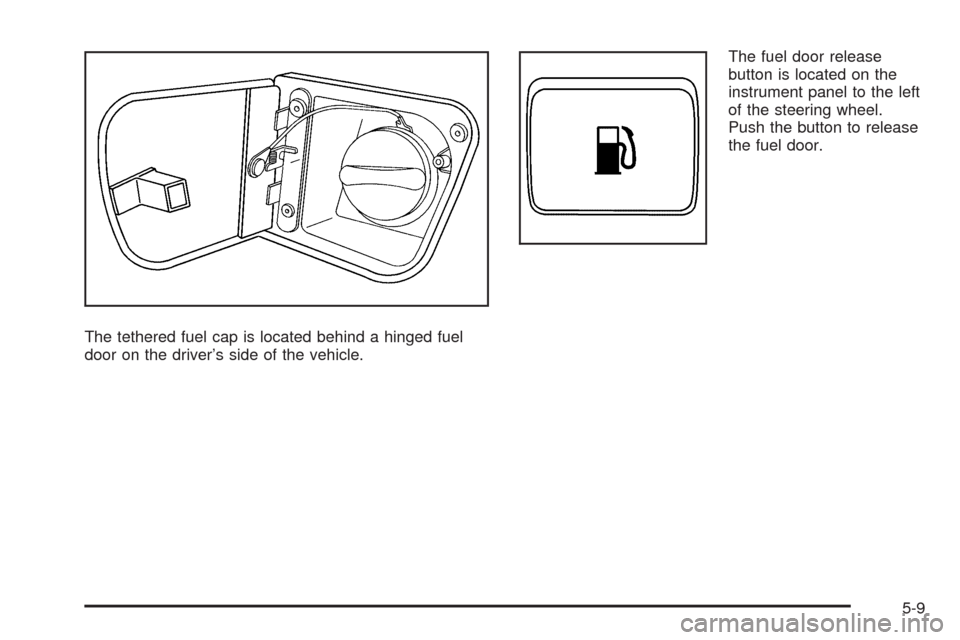
The tethered fuel cap is located behind a hinged fuel
door on the driver’s side of the vehicle.The fuel door release
button is located on the
instrument panel to the left
of the steering wheel.
Push the button to release
the fuel door.
5-9
Page 325 of 432
Headlamps, Front Turn Signal, and
Parking Lamps
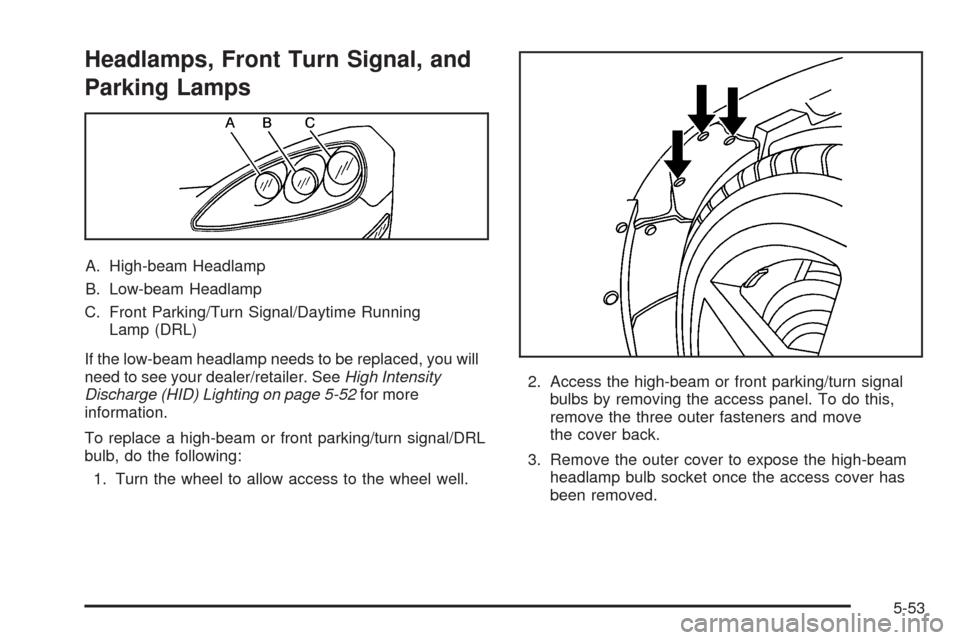
A. High-beam Headlamp
B. Low-beam Headlamp
C. Front Parking/Turn Signal/Daytime Running
Lamp (DRL)
If the low-beam headlamp needs to be replaced, you will
need to see your dealer/retailer. SeeHigh Intensity
Discharge (HID) Lighting on page 5-52for more
information.
To replace a high-beam or front parking/turn signal/DRL
bulb, do the following:
1. Turn the wheel to allow access to the wheel well.2. Access the high-beam or front parking/turn signal
bulbs by removing the access panel. To do this,
remove the three outer fasteners and move
the cover back.
3. Remove the outer cover to expose the high-beam
headlamp bulb socket once the access cover has
been removed.
5-53
Page 331 of 432
Low-Prole Performance Tire
The original equipment tires on your vehicle are
classied as low-prole performance tires.
These tires are designed for very responsive
driving on wet or dry pavement. You may
also notice more road noise with low-prole tires
and that they tend to wear faster.
Notice:If the vehicle has low-prole tires,
they are more susceptible to damage from road
hazards or curb impact than standard prole
tires. Tire and/or wheel assembly damage
can occur when coming into contact with road
hazards like, potholes, or sharp edged
objects, or when sliding into a curb. The
vehicle warranty does not cover this type of
damage. Keep tires set to the correct ination
pressure and, when possible avoid contact
with curbs, potholes, and other road hazards.
Winter Tires
If you expect to drive on snow or ice covered roads
often, you may want to get winter tires for your vehicle.
All season tires provide good overall performance on
most surfaces but they may not offer the traction
you would like or the same level of performance as
winter tires on snow or ice covered roads.
Winter tires, in general, are designed for increased
traction on snow and ice covered roads. With winter
tires, there may be decreased dry road traction,
increased road noise, and shorter tread life. After
switching to winter tires, be alert for changes in vehicle
handling and braking.
See your dealer/retailer for details regarding winter tire
availability and proper tire selection. Also, seeBuying
New Tires on page 5-74.
If you choose to use winter tires:
Use tires of the same brand and tread type on all
four wheel positions.
Use only radial ply tires of the same size, load range,
and speed rating as the original equipment tires.
Winter tires with the same speed rating as your original
equipment tires may not be available for H, V, W, Y,
and ZR speed rated tires. If you choose winter tires with
a lower speed rating, never exceed the tire’s maximum
speed capability.
5-59