Page 281 of 432
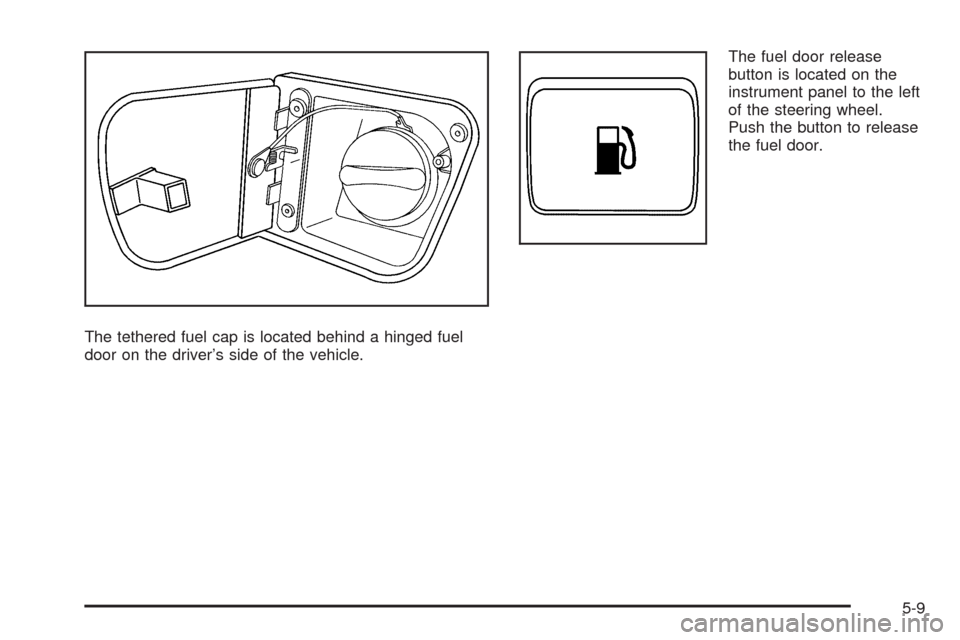
The tethered fuel cap is located behind a hinged fuel
door on the driver’s side of the vehicle.The fuel door release
button is located on the
instrument panel to the left
of the steering wheel.
Push the button to release
the fuel door.
5-9
Page 287 of 432
A. Clutch Master Cylinder Reservoir (If Equipped).
SeeHydraulic Clutch on page 5-27.
B. Windshield Washer Fluid Reservoir. See “Adding
Washer Fluid” underWindshield Washer Fluid
on page 5-41.
C. Brake Fluid Reservoir. See “Brake Fluid” under
Brakes on page 5-42.
D. Coolant Surge Tank and Pressure Cap. SeeEngine
Coolant on page 5-28.
E. Engine Air Cleaner/Filters. SeeEngine Air
Cleaner/Filter on page 5-25.F. Power Steering Fluid Reservoir. SeePower Steering
Fluid on page 5-39.
G. Engine Oil Fill Cap. See “When to Add Engine Oil”
underEngine Oil on page 5-17.
H. Engine Oil Dipstick. See “Checking Engine Oil”
underEngine Oil on page 5-17.
I. Engine Compartment Fuse Block. SeeEngine
Compartment Fuse Block on page 5-104.
J. Passenger Compartment Air Filter (Out of View).
SeePassenger Compartment Air Filter on page 3-32.
K. Battery. SeeBattery on page 5-45.
5-15
Page 289 of 432
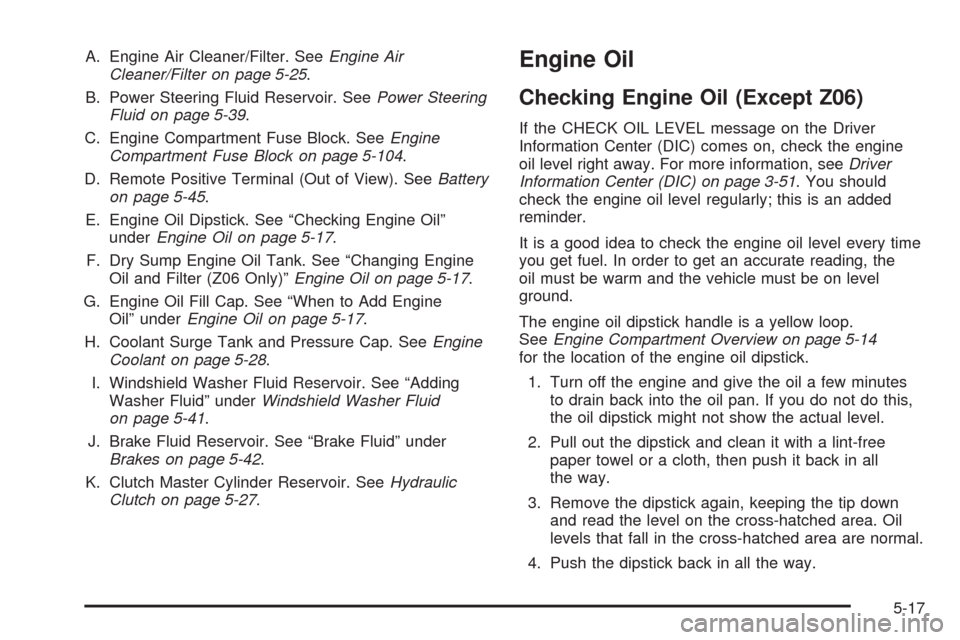
A. Engine Air Cleaner/Filter. SeeEngine Air
Cleaner/Filter on page 5-25.
B. Power Steering Fluid Reservoir. SeePower Steering
Fluid on page 5-39.
C. Engine Compartment Fuse Block. SeeEngine
Compartment Fuse Block on page 5-104.
D. Remote Positive Terminal (Out of View). SeeBattery
on page 5-45.
E. Engine Oil Dipstick. See “Checking Engine Oil”
underEngine Oil on page 5-17.
F. Dry Sump Engine Oil Tank. See “Changing Engine
Oil and Filter (Z06 Only)”Engine Oil on page 5-17.
G. Engine Oil Fill Cap. See “When to Add Engine
Oil” underEngine Oil on page 5-17.
H. Coolant Surge Tank and Pressure Cap. SeeEngine
Coolant on page 5-28.
I. Windshield Washer Fluid Reservoir. See “Adding
Washer Fluid” underWindshield Washer Fluid
on page 5-41.
J. Brake Fluid Reservoir. See “Brake Fluid” under
Brakes on page 5-42.
K. Clutch Master Cylinder Reservoir. SeeHydraulic
Clutch on page 5-27.Engine Oil
Checking Engine Oil (Except Z06)
If the CHECK OIL LEVEL message on the Driver
Information Center (DIC) comes on, check the engine
oil level right away. For more information, seeDriver
Information Center (DIC) on page 3-51. You should
check the engine oil level regularly; this is an added
reminder.
It is a good idea to check the engine oil level every time
you get fuel. In order to get an accurate reading, the
oil must be warm and the vehicle must be on level
ground.
The engine oil dipstick handle is a yellow loop.
SeeEngine Compartment Overview on page 5-14
for the location of the engine oil dipstick.
1. Turn off the engine and give the oil a few minutes
to drain back into the oil pan. If you do not do this,
the oil dipstick might not show the actual level.
2. Pull out the dipstick and clean it with a lint-free
paper towel or a cloth, then push it back in all
the way.
3. Remove the dipstick again, keeping the tip down
and read the level on the cross-hatched area. Oil
levels that fall in the cross-hatched area are normal.
4. Push the dipstick back in all the way.
5-17
Page 311 of 432
5. Then replace the pressure cap. Be sure the
pressure cap is hand-tight and fully seated.
Check the level in the surge tank when the system
has cooled down. If the coolant is not at the proper
level, repeat Steps 1 through 4, then reinstall the
pressure cap. If the coolant is not at the proper level
when the system cools down again, see your
dealer/retailer.Power Steering Fluid
SeeEngine Compartment
Overview on page 5-14for
reservoir location.
When to Check Power Steering Fluid
It is not necessary to regularly check power steering uid
unless you suspect there is a leak in the system or
you hear an unusual noise. A uid loss in this system
could indicate a problem. Have the system inspected
and repaired.
5-39
Page 312 of 432
How to Check Power Steering Fluid
To check the power steering uid, do the following:
1. Turn the ignition off and let the engine compartment
cool down.
2. Wipe the cap and the top of the reservoir clean.
3. Unscrew the cap and wipe the dipstick with a
clean rag.
4. Replace the cap and completely tighten it.
5. Remove the cap again and look at the uid level on
the dipstick. There are markings on both sides of
the dipstick.
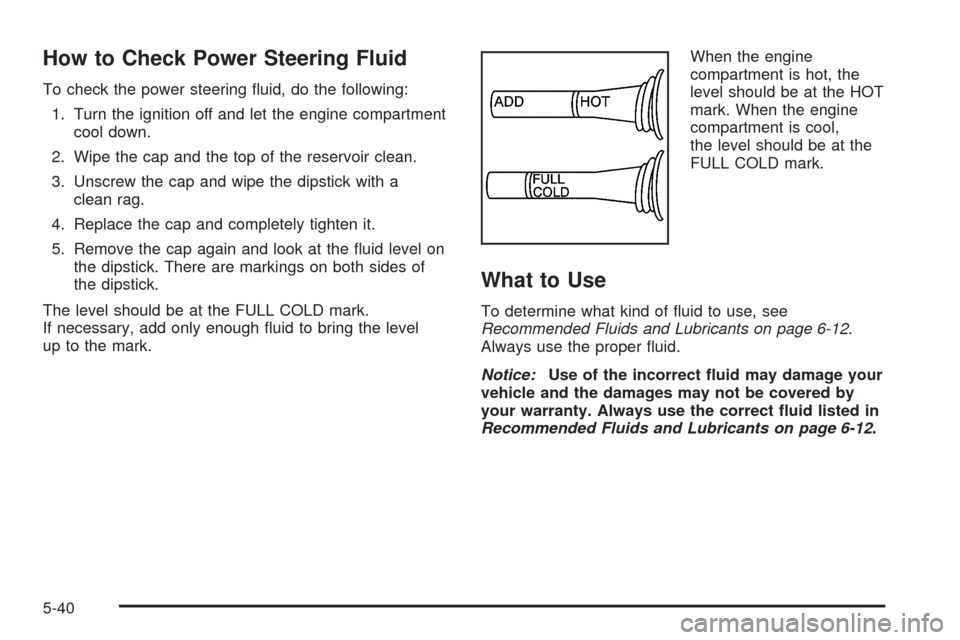
The level should be at the FULL COLD mark.
If necessary, add only enough uid to bring the level
up to the mark.When the engine
compartment is hot, the
level should be at the HOT
mark. When the engine
compartment is cool,
the level should be at the
FULL COLD mark.
What to Use
To determine what kind of uid to use, see
Recommended Fluids and Lubricants on page 6-12.
Always use the proper uid.
Notice:Use of the incorrect uid may damage your
vehicle and the damages may not be covered by
your warranty. Always use the correct uid listed in
Recommended Fluids and Lubricants on page 6-12.
5-40
Page 334 of 432
Tire Terminology and Denitions
Air Pressure:The amount of air inside the
tire pressing outward on each square inch of the
tire. Air pressure is expressed in pounds per
square inch (psi) or kilopascal (kPa).
Accessory Weight
:This means the combined
weight of optional accessories. Some examples of
optional accessories are, automatic transmission,
power steering, power brakes, power windows,
power seats, and air conditioning.
Aspect Ratio
:The relationship of a tire’s height
to its width.
Belt
:A rubber coated layer of cords that is located
between the plies and the tread. Cords may be
made from steel or other reinforcing materials.
Bead
:The tire bead contains steel wires wrapped
by steel cords that hold the tire onto the rim.
Bias Ply Tire
:A pneumatic tire in which the plies
are laid at alternate angles less than 90 degrees
to the centerline of the tread.
Cold Tire Pressure
:The amount of air pressure
in a tire, measured in pounds per square inch
(psi) or kilopascals (kPa) before a tire has built up
heat from driving. SeeInflation - Tire Pressure
on page 5-66.Curb Weight
:The weight of a motor vehicle with
standard and optional equipment including the
maximum capacity of fuel, oil, and coolant,
but without passengers and cargo.
DOT Markings
:A code molded into the sidewall
of a tire signifying that the tire is in compliance
with the U.S. Department of Transportation (DOT)
motor vehicle safety standards. The DOT code
includes the Tire Identication Number (TIN),
an alphanumeric designator which can also identify
the tire manufacturer, production plant, brand,
and date of production.
GVWR
:Gross Vehicle Weight Rating. See
Loading the Vehicle on page 4-24.
GAWR FRT
:Gross Axle Weight Rating for the
front axle. SeeLoading the Vehicle on page 4-24.
GAWR RR
:Gross Axle Weight Rating for the
rear axle. SeeLoading the Vehicle on page 4-24.
Intended Outboard Sidewall
:The side of an
asymmetrical tire, that must always face outward
when mounted on a vehicle.
Kilopascal (kPa)
:The metric unit for air pressure.
Light Truck (LT-Metric) Tire
:A tire used on
light duty trucks and some multipurpose passenger
vehicles.
5-62
Page 373 of 432
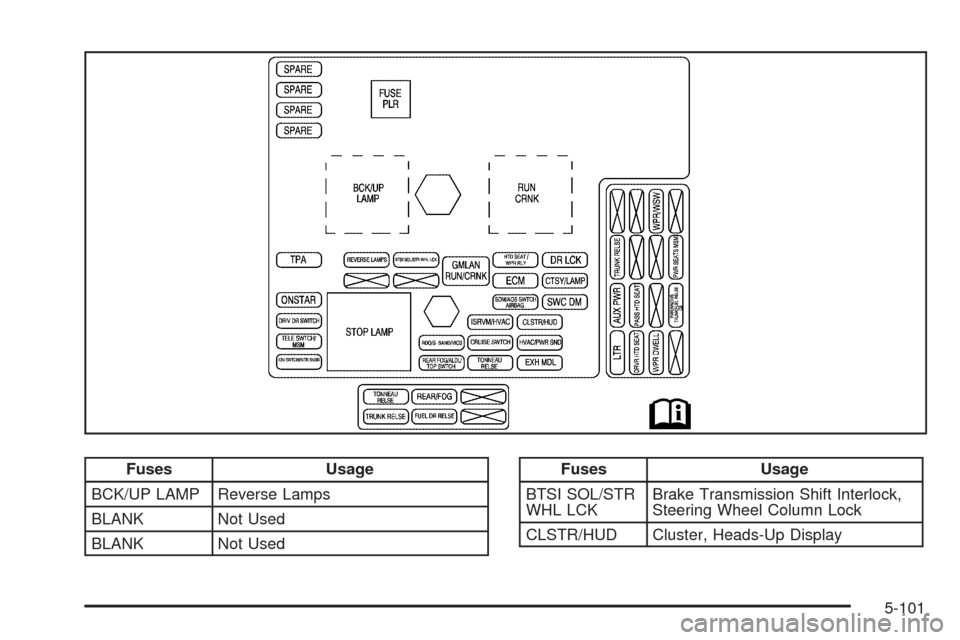
Fuses Usage
BCK/UP LAMP Reverse Lamps
BLANK Not Used
BLANK Not UsedFuses Usage
BTSI SOL/STR
WHL LCKBrake Transmission Shift Interlock,
Steering Wheel Column Lock
CLSTR/HUD Cluster, Heads-Up Display
5-101
Page 374 of 432

Fuses Usage
CRUISE
SWITCHCruise Control Switch
CTSY/LAMP Courtesy Lamp
DR LCK Door Locks
DRIV DR
SWITCHDriver Door Switch
ECM Engine Control Module (ECM)
EXH MDLExhaust Module (Z06), Spare
(Coupe and Convertible)
GM LAN
RUN/CRNKGM LAN Devices
HTD SEAT/
WPR RLYHeated Seat, Wiper Relays
HVAC/
PWR SNDHeating. Ventilation/Air Conditioning,
Power Sounder
IGN
SWTCH/INTR
SNSRIgnition Switch, Intrusion Sensor
ISRVM/HVACElectric Inside Rearview Mirror,
Heating, Ventilation, Air Conditioning
ONSTAR OnStar
®
Fuses Usage
RDO/S-BAND/
VICSRadio, S-Band, VICS
REAR FOG/
ALDL/TOP
SWTCHRear Fog Lamp, Assembly Line
Diagnostic Link Connector,
Convertible Top Switch
REVERSE
LAMPSReverse Lamps
RUN CRNK Run/Crank Relay
SDM/AOS
SWTCH
AIRBAGSensing and Diagnostic Module,
Automatic Occupant Sensing
Module, Airbag
SPARE Spare
SPARE Spare
SPARE Spare
SPARE Spare
STOP LAMP Stop Lamp
SWC DM Steering Wheel Dimming
TELE
SWTCH/MSMTelescope Switch, Memory Seat
Module
TONNEAU
RELSETonneau Release
TPA Tonneau Pulldown Actuator
5-102