2008 CHEVROLET AVEO spare tire
[x] Cancel search: spare tirePage 297 of 384
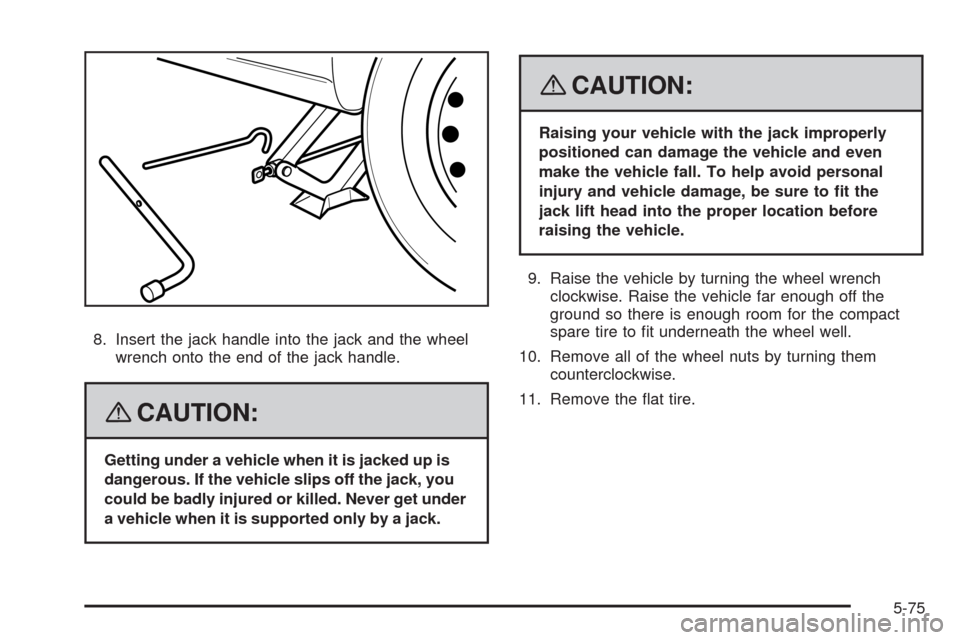
8. Insert the jack handle into the jack and the wheel
wrench onto the end of the jack handle.
{CAUTION:
Getting under a vehicle when it is jacked up is
dangerous. If the vehicle slips off the jack, you
could be badly injured or killed. Never get under
a vehicle when it is supported only by a jack.
{CAUTION:
Raising your vehicle with the jack improperly
positioned can damage the vehicle and even
make the vehicle fall. To help avoid personal
injury and vehicle damage, be sure to t the
jack lift head into the proper location before
raising the vehicle.
9. Raise the vehicle by turning the wheel wrench
clockwise. Raise the vehicle far enough off the
ground so there is enough room for the compact
spare tire to fit underneath the wheel well.
10. Remove all of the wheel nuts by turning them
counterclockwise.
11. Remove the flat tire.
5-75
Page 298 of 384
{CAUTION:
Rust or dirt on a wheel, or on the parts to
which it is fastened, can make wheel nuts
become loose after time. The wheel could
come off and cause an accident. When you
change a wheel, remove any rust or dirt from
places where the wheel attaches to the vehicle.
In an emergency, you can use a cloth or a
paper towel to do this; but be sure to use a
scraper or wire brush later, if needed, to get
all the rust or dirt off. SeeChanging a Flat Tire
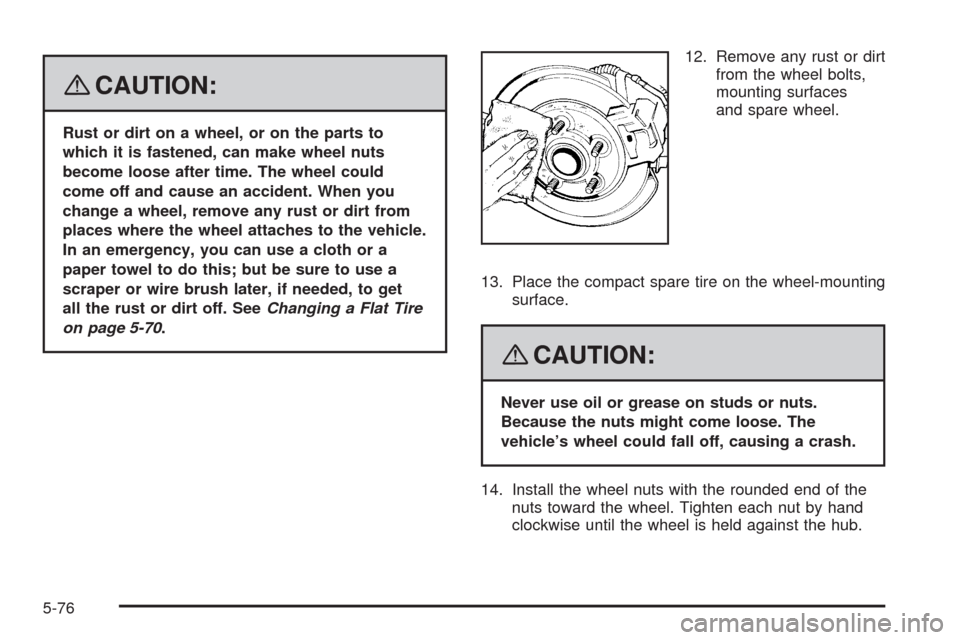
on page 5-70.12. Remove any rust or dirt
from the wheel bolts,
mounting surfaces
and spare wheel.
13. Place the compact spare tire on the wheel-mounting
surface.
{CAUTION:
Never use oil or grease on studs or nuts.
Because the nuts might come loose. The
vehicle’s wheel could fall off, causing a crash.
14. Install the wheel nuts with the rounded end of the
nuts toward the wheel. Tighten each nut by hand
clockwise until the wheel is held against the hub.
5-76
Page 300 of 384
Storing a Flat or Spare Tire
and Tools
{CAUTION:
Storing a jack, a tire, or other equipment in the
passenger compartment of the vehicle could
cause injury. In a sudden stop or collision,
loose equipment could strike someone. Store
all these in the proper place.
To store a flat or compact spare tire and tools:
1. Store the flat tire or the compact spare in the
compact spare tire compartment.
2. Secure the retainer.
3. Store the tools securely in the foam tray and
place the tray back in the cargo area.
4. Replace the trim cover.
The compact spare tire is for temporary use only.
Replace the compact spare tire with a full-size tire
as soon as you can. SeeCompact Spare Tire
on page 5-78.
Compact Spare Tire
Although the compact spare tire was fully inflated when
your vehicle was new, it can lose air after a time.
Check the inflation pressure regularly. It should be
60 psi (420 kPa).
After installing the compact spare on your vehicle,
you should stop as soon as possible and make sure
your spare tire is correctly inflated. The compact spare
is made to perform well at speeds up to 50 mph
(80 km/h), so you can finish your trip and have your
full-size tire repaired or replaced where you want.
Of course, it is best to replace your spare with a full-size
tire as soon as you can. Your spare will last longer
and be in good shape in case you need it again.
Notice:When the compact spare is installed,
do not take your vehicle through an automatic car
wash with guide rails. The compact spare can
get caught on the rails. That can damage the tire
and wheel, and maybe other parts of your vehicle.
5-78
Page 301 of 384
Do not use your compact spare on other vehicles.
And do not mix your compact spare tire or wheel with
other wheels or tires. They will not fit. Keep your
spare tire and its wheel together.
Notice:Tire chains will not t your compact spare.
Using them can damage your vehicle and can
damage the chains too. Do not use tire chains on
your compact spare.
Appearance Care
Interior Cleaning
Your vehicle’s interior will continue to look its best if it is
cleaned often. Although not always visible, dust and
dirt can accumulate on your upholstery. Dirt can damage
carpet, fabric, leather, and plastic surfaces. Regular
vacuuming is recommended to remove particles
from your upholstery. It is important to keep your
upholstery from becoming and remaining heavily soiled.
Soils should be removed as quickly as possible. Your
vehicle’s interior may experience extremes of heat
that could cause stains to set rapidly.Lighter colored interiors may require more frequent
cleaning. Use care because newspapers and garments
that transfer color to your home furnishings may also
transfer color to your vehicle’s interior.
When cleaning your vehicle’s interior, only use cleaners
specifically designed for the surfaces being cleaned.
Permanent damage may result from using cleaners on
surfaces for which they were not intended. Use glass
cleaner only on glass. Remove any accidental over-spray
from other surfaces immediately. To prevent over-spray,
apply cleaner directly to the cleaning cloth.
Notice:If you use abrasive cleaners when cleaning
glass surfaces on your vehicle, you could scratch
the glass and/or cause damage to the rear window
defogger. When cleaning the glass on your
vehicle, use only a soft cloth and glass cleaner.
Many cleaners contain solvents that may become
concentrated in your vehicle’s breathing space.
Before using cleaners, read and adhere to all safety
instructions on the label. While cleaning your vehicle’s
interior, maintain adequate ventilation by opening
your vehicle’s doors and windows.
Dust may be removed from small buttons and knobs
using a small brush with soft bristles.
5-79
Page 342 of 384
Part B: Owner Checks and Services
Listed in this part are owner checks and services
which should be performed at the intervals specified
to help ensure the safety, dependability and emission
control performance of your vehicle.
Be sure any necessary repairs are completed at once.
Whenever any fluids or lubricants are added to your
vehicle, make sure they are the proper ones, as
shown in Part D.
At Each Fuel Fill
It is important to perform these underhood checks
at each fuel fill.
Engine Oil Level Check
Notice:It is important to check the engine oil
regularly and keep it at the proper level. Failure to
keep the engine oil at the proper level can cause
damage to the engine not covered by your warranty.
Check the engine oil level and add the proper oil if
necessary. SeeEngine Oil on page 5-13.
Engine Coolant Level Check
Check the engine coolant level and add DEX-COOL®
coolant mixture if necessary. SeeEngine Coolant
on page 5-22.
Windshield Washer Fluid Level Check
Check the windshield washer fluid level in the windshield
washer fluid reservoir and add the proper fluid if
necessary.
At Least Once a Month
Tire Ination Check
Inspect the tires and make sure the tires are inflated to
the correct pressures. Do not forget to check the spare
tire. SeeInflation - Tire Pressure on page 5-57.
At Least Twice a Year
Restraint System Check
Make sure the safety belt reminder light and safety belt
assemblies are working properly. Look for any other
loose or damaged safety belt system parts. If you see
anything that might keep a safety belt system from
doing its job, have it repaired. Have any torn or frayed
safety belts replaced. Also seeChecking the Restraint
Systems on page 1-72.
6-18
Page 359 of 384
•Flat Tire Change:Installation of a spare tire in good
condition, when equipped and properly inflated, is
covered at no charge. The customer is responsible
for the repair or replacement of the tire if not covered
by a warrantable failure.
•Jump Start:A battery jump start is covered at no
charge if the vehicle does not start.
•Trip Routing Service (Canada only):Upon
request, Roadside Assistance will send you detailed,
computer personalized maps, highlighting your
choice of either the most direct route or the most
scenic route to your destination, anywhere in
North America, along with helpful travel information
pertaining to your trip.
Please allow three weeks before your planned
departure date. Trip routing requests will be limited
to six per calendar year.
•Trip Interruption Benets and Assistance
(Canada only):In the event of a warranty
related vehicle disablement, while en route and
over 250 kilometres from the original point of
departure, you may qualify for trip interruption
expense assistance. This assistance covers
reasonable reimbursement of up to a maximum
of $500 (Canadian) for (A) meals (maximumof $50/day), (B) lodging (maximum of $100/night)
and (C) alternate ground transportation (maximum of
$40/day). This benefit is to assist you with some of
the unplanned expense you may incur while waiting
for your vehicle to be repaired.
Pre-authorization, original detailed receipts and a
copy of the repair order are required.
Once authorization has been given, your advisor will
help you make any necessary arrangements and
explain how to claim for trip interruption expense
assistance.
•Alternative Service (Canada only):There may be
times, when Roadside Assistance cannot provide
timely assistance. Your advisor may authorize you to
secure local emergency road service, and you will be
reimbursed up to $100 upon submission of the
original receipt to Roadside Assistance.
In many instances, mechanical failures may be covered.
However, any cost for parts and labor for non-warranty
repairs are the responsibility of the driver.
Chevrolet and General Motors of Canada Limited reserve
the right to limit services or reimbursement to an owner or
driver when, in their sole discretion, the claims become
excessive in frequency or type of occurrence.
7-9
Page 373 of 384
Check
Engine Light.......................................3-36, 3-49
Checking Things Under the Hood......................5-10
Chemical Paint Spotting...................................5-86
Child Restraints
Child Restraint Systems...............................1-38
Infants and Young Children...........................1-34
Lower Anchors and Tethers for Children..........1-42
Older Children.............................................1-32
Securing a Child Restraint in a
Rear Seat Position...................................1-49
Securing a Child Restraint in the
Right Front Seat Position..........................1-52
Where to Put the Restraint...........................1-40
Cigarette Lighter.............................................3-19
Cleaning
Aluminum Wheels........................................5-85
Exterior Lamps/Lenses.................................5-83
Fabric/Carpet..............................................5-80
Finish Care.................................................5-83
Instrument Panel, Vinyl, and Other
Plastic Surfaces.......................................5-82
Interior.......................................................5-79
Leather......................................................5-81
Tires..........................................................5-85
Underbody Maintenance...............................5-86Cleaning (cont.)
Washing Your Vehicle...................................5-83
Weatherstrips..............................................5-82
Windshield and Wiper Blades........................5-84
Climate Control System...................................3-20
Air Filter, Passenger Compartment.................3-24
Outlet Adjustment........................................3-24
Clock....................................................3-20, 3-44
Clutch, Hydraulic.............................................5-21
Collision Damage Repair..................................7-13
Compact Spare Tire........................................5-78
Control of a Vehicle.......................................... 4-3
Coolant
Engine Temperature Gage
............................3-35
Heater, Engine............................................2-20
Surge Tank Pressure Cap.............................5-25
Cooling System..............................................5-26
Cruise Control................................................3-13
Cruise Control Light................................3-40, 3-53
Cupholder(s)..................................................2-35
Customer Assistance Information
Courtesy Transportation................................7-11
Customer Assistance for Text
Telephone (TTY) Users............................... 7-6
Customer Assistance Offices........................... 7-6
Customer Satisfaction Procedure..................... 7-2
3
Page 381 of 384
Removing the Flat Tire and Installing the
Spare Tire..................................................5-73
Removing the Spare Tire and Tools...................5-71
Replacement Bulbs.........................................5-48
Reporting Safety Defects
Canadian Government..................................7-17
General Motors...........................................7-17
United States Government............................7-16
Restraint System Check
Checking the Restraint Systems....................1-72
Replacing Restraint System Parts
After a Crash..........................................1-73
Roadside
Assistance Program....................................... 7-8
Rocking Your Vehicle to Get it Out....................4-17
Routing, Engine Drive Belt..............................5-101
Running the Engine While Parked.....................2-31
S
Safety Belt
Reminder Light...................................3-30, 3-44
Safety Belts
Care of......................................................5-82
How to Wear Safety Belts Properly................1-19
Lap-Shoulder Belt........................................1-27Safety Belts (cont.)
Safety Belt Extender....................................1-31
Safety Belt Use During Pregnancy.................1-30
Safety Belts Are for Everyone.......................1-14
Safety Warnings and Symbols.............................. iii
Seats
Driver Seat Height Adjuster............................. 1-3
Head Restraints............................................ 1-6
Manual Lumbar............................................. 1-3
Rear Seat Operation..............................1-7, 1-10
Reclining Seatbacks...................................... 1-4
Secondary Information Center (SIC)...................3-43
Securing a Child Restraint
Rear Seat Position......................................1-49
Right Front Seat Position..............................1-52
Selecting the Right Schedule, Maintenance.......... 6-5
Service........................................................... 5-3
Accessories and Modifications......................... 5-3
Adding Equipment to the Outside of
Your Vehicle.............................................. 5-5
California Pershlorate Materials
Requirements............................................ 5-4
California Proposition 65 Warning.................... 5-4
Doing Your Own Work................................... 5-4
Engine Soon Light...............................3-36, 3-49
Publications Ordering Information...................7-17
11