2008 CADILLAC STS traction control
[x] Cancel search: traction controlPage 249 of 500

STABILITY SYS (System) OFF
This message displays any time StabiliTrak®or
Enhanced StabiliTrak®is turned off using the TC
(traction control) on/off button. SeeTraction Control
System (TCS) on page 4-6and “Enhanced StabiliTrak
®
and Traction Control Mode Selection” underEnhanced
StabiliTrak®on page 4-9for more information. When
this message has been displayed, StabiliTrak®or
Enhanced StabiliTrak®is no longer available to assist
with directional control of the vehicle. Adjust your driving
accordingly. SeeStabiliTrak
®System on page 4-8or
Enhanced StabiliTrak®on page 4-9for more information.
STABILITY SYS (System) READY
This message displays any time StabiliTrak®is turned
back on using the TC (traction control) on/off button.
SeeTraction Control System (TCS) on page 4-6
for more information. When this message has been
displayed, StabiliTrak
®is ready to assist with directional
control of the vehicle, if needed. SeeStabiliTrak®
System on page 4-8for more information.
STABILITY TOURING MODE
If your All-Wheel Drive (AWD) vehicle has the
Active Steering with Enhanced StabiliTrak®option,
this message displays when the Stability Touring
Mode is re-activated by using the traction control
button after:
Driving in the Stability Competitive Mode.
The stability control system is turned off
by the driver.
This message may also display after exiting
STABILITY SECURE MODE when certain system
faults or vehicle conditions have been cleared.
SeeEnhanced StabiliTrak
®on page 4-9.
STARTING DISABLED THEFT
PROBLEM
This message displays when incorrect conditions
exist within the theft-deterrent system. See your
dealer/retailer for service.
3-95
Page 250 of 500

STARTING DISABLED THROTTLE
PROBLEM
This message displays when your vehicle’s throttle
system is not functioning properly. Have your vehicle
serviced by your dealer/retailer.
THEFT ATTEMPTED
This symbol appears
with this message.
This message displays if the theft-deterrent system
has detected a break-in attempt while you were away
from your vehicle.
TRACTION ACTIVE
This message displays when the Traction Control
System (TCS) is actively limiting wheel spin. Slippery
road conditions may exist if this message is displayed,
so adjust your driving accordingly. The message
stays on for a few seconds after the TCS stops limiting
wheel spin. SeeTraction Control System (TCS)
on page 4-6for more information.
TRANS (Transmission) HOT IDLE
ENGINE
Notice:If you drive your vehicle while the
transmission uid is overheating and the
transmission temperature warning is displayed
on the instrument panel cluster and/or DIC, you
can damage the transmission. This could lead
to costly repairs that would not be covered by
your warranty. Do not drive your vehicle with
overheated transmission uid or while the
transmission temperature warning is displayed.
This message displays when the transmission uid
in your vehicle is too hot. Stop the vehicle and allow
it to idle until the transmission cools down or until
this message is removed.
3-96
Page 252 of 500

Audio System(s)
Determine which radio your vehicle has and then
read the pages following to familiarize yourself with
its features.
{CAUTION:
This system provides you with far greater
access to audio stations and song listings.
Giving extended attention to entertainment
tasks while driving can cause a crash and you
or others can be injured or killed. Always keep
your eyes on the road and your mind on the
drive — avoid engaging in extended searching
while driving.
Keeping your mind on the drive is important for
safe driving. SeeDefensive Driving on page 4-2.
Here are some ways in which you can help avoid
distraction while driving.While your vehicle is parked:
Familiarize yourself with all of its controls.
Familiarize yourself with its operation.
Set up your audio system by presetting your
favorite radio stations, setting the tone, and
adjusting the speakers. Then, when driving
conditions permit, you can tune to your favorite
radio stations using the presets and steering
wheel controls if the vehicle has them.
Notice:Before adding any sound equipment to
your vehicle, such as an audio system, CD player,
CB radio, mobile telephone, or two-way radio, make
sure that it can be added by checking with your
dealer/retailer. Also, check federal rules covering
mobile radio and telephone units. If sound equipment
can be added, it is very important to do it properly.
Added sound equipment may interfere with the
operation of your vehicle’s engine, radio, or other
systems, and even damage them. Your vehicle’s
systems may interfere with the operation of sound
equipment that has been added.
Your vehicle has a feature called Retained Accessory
Power (RAP). With RAP, the audio system can be
played even after the ignition is turned off. SeeRetained
Accessory Power (RAP) on page 2-29for more
information.
3-98
Page 279 of 500

Your Driving, the Road, and Your Vehicle..........4-2
Defensive Driving...........................................4-2
Drunk Driving.................................................4-2
Control of a Vehicle........................................4-3
Braking.........................................................4-4
Antilock Brake System (ABS)...........................4-5
Braking in Emergencies...................................4-6
Traction Control System (TCS).........................4-6
Competitive Driving Mode (STS-V)....................4-7
Magnetic Ride Control.....................................4-8
Limited-Slip Rear Axle.....................................4-8
StabiliTrak
®System........................................4-8
Enhanced StabiliTrak®.....................................4-9
Panic Brake Assist........................................4-12
All-Wheel Drive (AWD) System.......................4-13
Steering......................................................4-13
Off-Road Recovery.......................................4-16
Passing.......................................................4-16
Loss of Control.............................................4-16Competitive Driving.......................................4-18
Driving at Night............................................4-18
Driving in Rain and on Wet Roads..................4-19
Before Leaving on a Long Trip.......................4-20
Highway Hypnosis........................................4-20
Hill and Mountain Roads................................4-21
Winter Driving..............................................4-22
If Your Vehicle is Stuck in Sand, Mud,
Ice, or Snow.............................................4-25
Rocking Your Vehicle to Get It Out.................4-26
Loading Your Vehicle....................................4-26
Towing..........................................................4-31
Towing Your Vehicle.....................................4-31
Recreational Vehicle Towing...........................4-31
Towing a Trailer (Vehicles With
Heavy Duty Cooling)..................................4-34
Towing a Trailer (Vehicles Without
Heavy Duty Cooling)..................................4-40
Section 4 Driving Your Vehicle
4-1
Page 281 of 500

Death and injury associated with drinking and driving is a
global tragedy.
Alcohol affects four things that anyone needs to drive a
vehicle: judgment, muscular coordination, vision, and
attentiveness.
Police records show that almost 40 percent of all motor
vehicle-related deaths involve alcohol. In most cases,
these deaths are the result of someone who was drinking
and driving. In recent years, more than 17,000 annual
motor vehicle-related deaths have been associated with
the use of alcohol, with about 250,000 people injured.
For persons under 21, it is against the law in every U.S.
state to drink alcohol. There are good medical,
psychological, and developmental reasons for
these laws.
The obvious way to eliminate the leading highway
safety problem is for people never to drink alcohol and
then drive.Medical research shows that alcohol in a person’s
system can make crash injuries worse, especially
injuries to the brain, spinal cord, or heart. This means
that when anyone who has been drinking — driver
or passenger — is in a crash, that person’s chance of
being killed or permanently disabled is higher than if the
person had not been drinking.
Control of a Vehicle
The following three systems help to control your vehicle
while driving — brakes, steering, and accelerator. At
times, as when driving on snow or ice, it is easy to ask
more of those control systems than the tires and
road can provide. Meaning, you can lose control of your
vehicle. SeeTraction Control System (TCS) on
page 4-6andStabiliTrak
®System on page 4-8or
Enhanced StabiliTrak®on page 4-9.
Adding non-dealer/non-retailer accessories can affect
your vehicle’s performance. SeeAccessories and
Modifications on page 5-3.
4-3
Page 284 of 500
Braking in Emergencies
With ABS, you can steer and brake at the same time. In
many emergencies, steering can help you more than
even the very best braking.
Traction Control System (TCS)
Your vehicle has a traction control system that limits
wheel spin. This is especially useful in slippery
road conditions. On a rear-wheel-drive vehicle, the
system operates if it senses that one or both of the rear
wheels are spinning or beginning to lose traction. On
an All-Wheel-Drive (AWD) vehicle, the system will
operate if it senses that any of the wheels are spinning
or beginning to lose traction. When this happens,
the system brakes the spinning wheel(s) and/or reduces
engine power to limit wheel spin.
You may feel or hear the system working, but this is
normal.
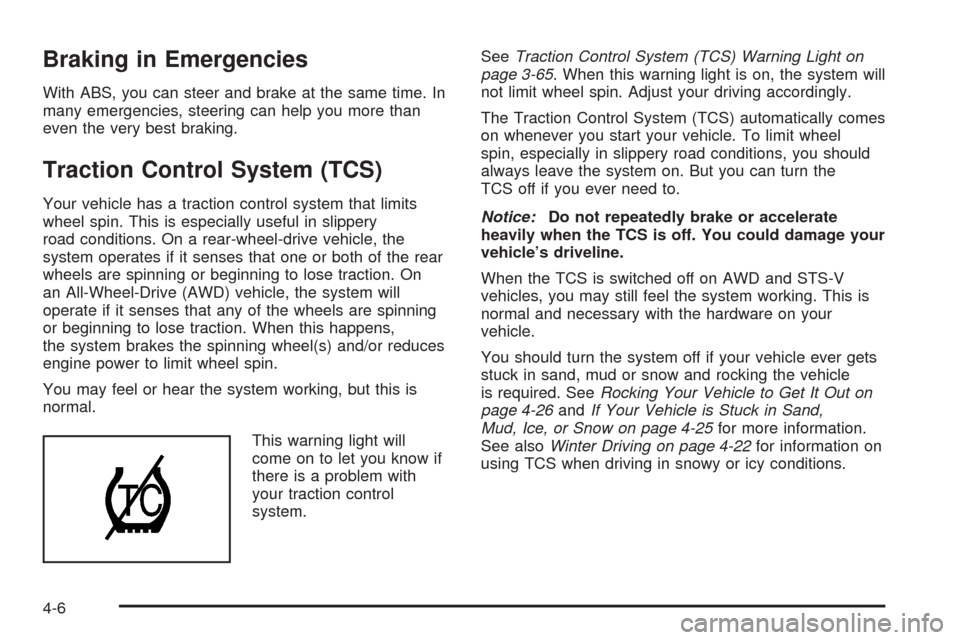
This warning light will
come on to let you know if
there is a problem with
your traction control
system.SeeTraction Control System (TCS) Warning Light on
page 3-65. When this warning light is on, the system will
not limit wheel spin. Adjust your driving accordingly.
The Traction Control System (TCS) automatically comes
on whenever you start your vehicle. To limit wheel
spin, especially in slippery road conditions, you should
always leave the system on. But you can turn the
TCS off if you ever need to.
Notice:Do not repeatedly brake or accelerate
heavily when the TCS is off. You could damage your
vehicle’s driveline.
When the TCS is switched off on AWD and STS-V
vehicles, you may still feel the system working. This is
normal and necessary with the hardware on your
vehicle.
You should turn the system off if your vehicle ever gets
stuck in sand, mud or snow and rocking the vehicle
is required. SeeRocking Your Vehicle to Get It Out on
page 4-26andIf Your Vehicle is Stuck in Sand,
Mud, Ice, or Snow on page 4-25for more information.
See alsoWinter Driving on page 4-22for information on
using TCS when driving in snowy or icy conditions.
4-6
Page 285 of 500

To turn the system off,
press the TC (traction
control) button located
near the shift lever.
If your All Wheel Drive vehicle has the optional
enhanced vehicle stability control system called Active
Steering with Enhanced StabiliTrak
®, the Traction
Control button is used to turn traction control on and off
and to select between three stability control modes:
Touring, Competitive and Off. SeeEnhanced
StabiliTrak
®on page 4-9for Traction Control button
operating instructions.
If you press the TC button once, the Traction Control
System will turn off and the Traction Control System
Warning Light will come on. Press the TC button again
to turn the system back on. If you press and hold
the TC button for ve seconds, the StabiliTrak
®system
and the Traction Control System will turn off. Press
the TC button again to turn StabiliTrak
®back on. For
more information, seeStabiliTrak®System on page 4-8.
Adding non-GM accessories can affect your vehicle’s
performance. SeeAccessories and Modifications
on page 5-3for more information.
Competitive Driving Mode (STS-V)
The driver can select this optional handling mode
by pressing the Traction Control button, located near
the shift lever, twice within ve seconds. Competitive
driving mode allows the driver to have control of
the power applied to the rear wheels, while the
StabiliTrak
®system helps steer the vehicle by selective
brake application. In competitive mode, the levels at
which StabiliTrak
®is engaged have been modied
to better suit a performance driving environment. When
the traction control warning light is on, the Traction
Control System will not be operating. Adjust your driving
accordingly.
When you press the Traction Control button again, the
Traction Control System will be on. The traction
engaged symbol will be displayed temporarily in the DIC
and a chime will be heard. SeeDIC Warnings and
Messages on page 3-80for more information.
4-7
Page 286 of 500

Magnetic Ride Control
Your vehicle may have Magnetic Ride Control that
automatically adjusts the ride of your vehicle. Automatic
ride control is achieved through a computer used to
control and monitor the suspension system. The
controller receives input from various sensors to
determine the proper system response. If the controller
detects a problem within the system, the DIC will
display a SERVICE SUSPENSION SYS message. See
DIC Warnings and Messages on page 3-80for more
information. See your dealer for service.
Limited-Slip Rear Axle
Your limited-slip rear axle can give you additional
traction on snow, mud, ice, sand or gravel. It works like
a standard axle most of the time, but when one of
the rear wheels has no traction and the other does, this
feature will allow the wheel with traction to move the
vehicle.
StabiliTrak®System
Your vehicle has a vehicle stability enhancement
system called StabiliTrak®. It is an advanced computer
controlled system that assists with directional control
of the vehicle in difficult driving conditions.
If your all-wheel-drive vehicle has the optional enhanced
vehicle stability control system called Active Steering
with Enhanced StabiliTrak
®, seeEnhanced StabiliTrak®
on page 4-9.
StabiliTrak
®activates when the computer senses a
discrepancy between the intended path and the direction
the vehicle is actually traveling. StabiliTrak
®selectively
applies braking pressure at any one of the vehicle’s
brakes to help steer the vehicle in the direction which
you are steering.
When the system activates, a STABILITY SYS ACTIVE
message will be displayed on the Driver Information
Center (DIC). SeeDIC Warnings and Messages
on page 3-80. You may also hear a noise or feel
vibration in the brake pedal. This is normal. Continue to
steer the vehicle in the direction you want it to go.
4-8