Page 404 of 490
2. Open the hoist shaft access cover (C) on the
bumper to access the spare tire lock (K).
3. To remove the spare tire lock insert the ignition key,
turn it clockwise and then pull it.4. Assemble the two jack handle extensions (D) and
wheel wrench (E) as shown.
5-80
Page 432 of 490
Fuses Usage
21 Power Door Lock 1 (Lock Feature)
22 Driver Information Center (DIC)
23 Rear Wiper
24 Not Used
25Driver Seat Module, Remote
Keyless Entry System
26 Not Used
Harness
ConnectorUsage
LT DR Driver Door Harness Connection
BODY Harness Connector
BODY Harness Connector
Center Instrument Panel Fuse Block
The center instrument panel fuse block is located
underneath the instrument panel, to the left of the
steering column.
Top View
Harness
ConnectorUsage
BODY 2 Body Harness Connector 2
BODY 1 Body Harness Connector 1
5-108
Page 435 of 490

Fuses Usage
24Fuel Injectors, Ignition Coils
(Left Side)
25 Trailer Park Lamps
26 Driver Side Park Lamps
27 Passenger Side Park Lamps
28 Fog Lamps
29 Horn
30Passenger Side High-Beam
Headlamp
31 Daytime Running Lamps
32 Driver Side High-Beam Headlamp
33 Daytime Running Lights 2
34 Sunroof
35Key Ignition System, Theft Deterrent
System
36 Windshield Wiper
37 SEO B2 Uptter Usage (Battery)
38 Electric Adjustable Pedals
39 Climate Controls (Battery)
40 Airbag System (Ignition)
41 AmplierFuses Usage
42 Audio System
43Miscellaneous (Ignition),
Cruise Control
44 Liftgate Release
45 Airbag System (Battery)
46 Instrument Panel Cluster
47 Power Take-Off
48Auxiliary Climate Control (Ignition),
Compass-Temperature Mirror
49Center High-Mounted Stoplamp
(CHMSL)
50 Rear Defogger
51 Heated Mirror
52 SEO B1 Uptter Usage (Battery)
53Cigarette Lighter, Auxiliary Power
Outlet
54Automatic Level Control Compressor
Relay, SEO Uptter Usage
55 Climate Controls (Ignition)
56Engine Control Module, Secondary
Fuel Pump (Ignition)
5-111
Page 447 of 490

(f)Lubricate all key lock cylinders, hood latch assembly,
secondary latch, pivots, spring anchor, release pawl,
rear compartment hinges, outer tailgate handle
pivot points, latch bolt, fuel door hinge, and folding seat
hardware. More frequent lubrication may be required
when exposed to a corrosive environment. Applying
silicone grease on weatherstrips with a clean cloth will
make them last longer, seal better, and not stick or
squeak.
(g)Inspect system. Check all fuel and vapor lines and
hoses for proper hook-up, routing, and condition.
Check that the purge valve works properly, if equipped.
Replace as needed.
(h)Change automatic transmission fluid and filter if the
vehicle is mainly driven under one or more of these
conditions:
In heavy city traffic where the outside temperature
regularly reaches 90°F (32°C) or higher.
In hilly or mountainous terrain.
When doing frequent trailer towing.
Uses such as found in taxi, police, or delivery
service.(i)Drain, flush, and refill cooling system. This service
can be complex; you should have your dealer/retailer
perform this service. See Engine Coolant on page 5-23
for what to use. Inspect hoses. Clean radiator,
condenser, pressure cap, and filler neck. Pressure test
the cooling system and pressure cap.
(j)A fluid loss in any vehicle system could indicate a
problem. Have the system inspected and repaired and
the fluid level checked. Add fluid if needed.
(k)If you drive regularly under dusty conditions, inspect
the filter at each engine oil change.
(l)Visually inspect belt for fraying, excessive cracks, or
obvious damage. Replace belt if necessary.
(m)Check vent hose at transfer case for kinks and
proper installation.
6-9
Page 450 of 490

Ignition Transmission Lock Check
While parked, and with the parking brake set, try to turn
the ignition to LOCK/OFF in each shift lever position.
The ignition should turn to LOCK/OFF only
when the shift lever is in PARK (P).
The ignition key should come out only in LOCK/OFF.
Contact your dealer/retailer if service is required.
Parking Brake and Automatic
Transmission Park (P) Mechanism
Check
{CAUTION:
When you are doing this check, your vehicle
could begin to move. You or others could be
injured and property could be damaged.
Make sure there is room in front of your vehicle
in case it begins to roll. Be ready to apply the
regular brake at once should the vehicle begin
to move.Park on a fairly steep hill, with the vehicle facing
downhill. Keeping your foot on the regular brake,
set the parking brake.
To check the parking brake’s holding ability:
With the engine running and transmission in
NEUTRAL (N), slowly remove foot pressure from
the regular brake pedal. Do this until the vehicle is
held by the parking brake only.
To check the PARK (P) mechanism’s holding
ability: With the engine running, shift to PARK (P).
Then release the parking brake followed by the
regular brake.
Contact your dealer/retailer if service is required.
Hood and Liftgate Support Gas Strut
Service
Visually inspect gas strut for signs of wear, corrosion,
cracks, loss of lubricant, or other damage. Check
the hold open ability of gas strut. If necessary, replace
with genuine parts from your dealer/retailer.
Underbody Flushing Service
At least every spring, use plain water to ush any
corrosive materials from the underbody. Take care to
clean thoroughly any areas where mud and other debris
can collect.
6-12
Page 451 of 490

Recommended Fluids and
Lubricants
Fluids and lubricants identied below by name, part
number, or specication can be obtained from your
dealer/retailer.
Usage Fluid/Lubricant
Engine OilThe engine requires a special
engine oil meeting GM Standard
GM4718M. Oils meeting this
standard can be identied as
synthetic, and should also be
identied with the American
Petroleum Institute (API) Certied
for Gasoline Engines starburst
symbol. However, not all synthetic
API oils with the starburst symbol
will meet this GM standard.
Look for and use only oil that
meets GM Standard GM4718M.
For the proper viscosity, seeEngine
Oil on page 5-14.
Usage Fluid/Lubricant
Engine Coolant50/50 mixture of clean, drinkable
water and use only DEX-COOL
®
Coolant. SeeEngine Coolant on
page 5-23.
Hydraulic Brake
SystemDelco
®Supreme 11 Brake Fluid or
equivalent DOT-3 brake uid.
Windshield
WasherOptikleen
®Washer Solvent.
Power Steering
SystemGM Power Steering Fluid
(GM Part No. U.S. 89021184,
in Canada 89021186).
Automatic
TransmissionDEXRON
®-VI Automatic
Transmission Fluid.
Key Lock
CylindersMulti-Purpose Lubricant, Superlube
(GM Part No. U.S. 12346241,
in Canada 10953474).
Chassis
LubricationChassis Lubricant
(GM Part No. U.S. 12377985,
in Canada 88901242) or lubricant
meeting requirements of NLGI #2,
Category LB or GC-LB.
6-13
Page 476 of 490

OnStar®
If your vehicle has OnStar and you subscribe to the
OnStar services, please refer to the OnStar Terms and
Conditions for information on data collection and
use. See alsoOnStar
®System on page 2-51in this
manual for more information.
Navigation System
If your vehicle has a navigation system, use of the
system may result in the storage of destinations,
addresses, telephone numbers, and other trip
information. Refer to the navigation system operating
manual for information on stored data and for deletion
instructions.
Radio Frequency Identication
(RFID)
RFID technology is used in some vehicles for functions
such as tire pressure monitoring and ignition system
security, as well as in connection with conveniences
such as key fobs for remote door locking/unlocking and
starting, and in-vehicle transmitters for garage door
openers. RFID technology in GM vehicles does not use
or record personal information or link with any other
GM system containing personal information.
7-18
Page 481 of 490
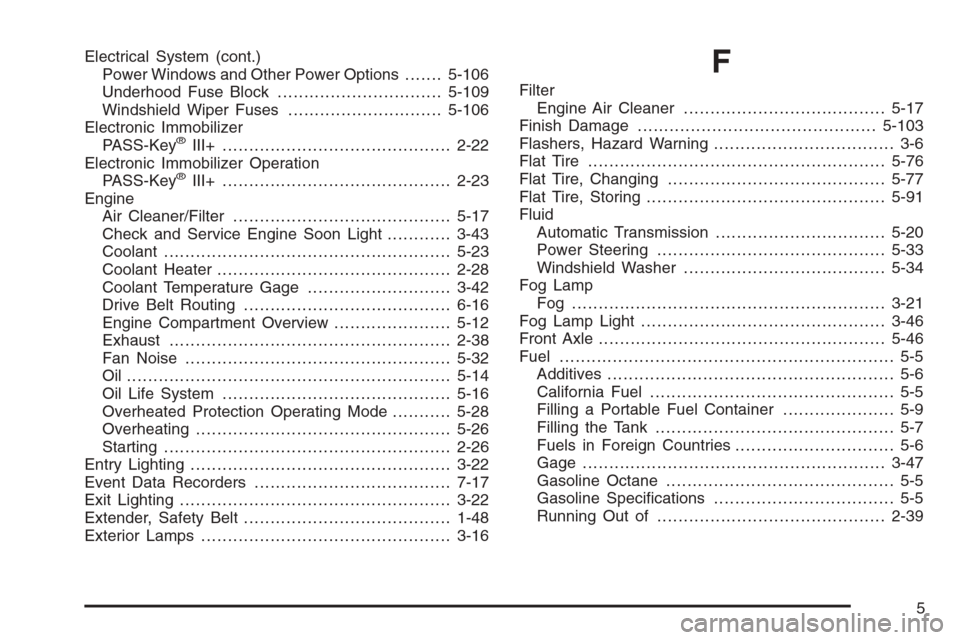
Electrical System (cont.)
Power Windows and Other Power Options.......5-106
Underhood Fuse Block...............................5-109
Windshield Wiper Fuses.............................5-106
Electronic Immobilizer
PASS-Key
®III+...........................................2-22
Electronic Immobilizer Operation
PASS-Key
®III+...........................................2-23
Engine
Air Cleaner/Filter.........................................5-17
Check and Service Engine Soon Light............3-43
Coolant......................................................5-23
Coolant Heater............................................2-28
Coolant Temperature Gage...........................3-42
Drive Belt Routing.......................................6-16
Engine Compartment Overview......................5-12
Exhaust.....................................................2-38
Fan Noise..................................................5-32
Oil .............................................................5-14
Oil Life System...........................................5-16
Overheated Protection Operating Mode...........5-28
Overheating................................................5-26
Starting......................................................2-26
Entry Lighting.................................................3-22
Event Data Recorders.....................................7-17
Exit Lighting...................................................3-22
Extender, Safety Belt.......................................1-48
Exterior Lamps...............................................3-16
F
Filter
Engine Air Cleaner......................................5-17
Finish Damage.............................................5-103
Flashers, Hazard Warning.................................. 3-6
Flat Tire........................................................5-76
Flat Tire, Changing.........................................5-77
Flat Tire, Storing.............................................5-91
Fluid
Automatic Transmission................................5-20
Power Steering...........................................5-33
Windshield Washer......................................5-34
Fog Lamp
Fog ...........................................................3-21
Fog Lamp Light..............................................3-46
Front Axle......................................................5-46
Fuel............................................................... 5-5
Additives...................................................... 5-6
California Fuel.............................................. 5-5
Filling a Portable Fuel Container..................... 5-9
Filling the Tank............................................. 5-7
Fuels in Foreign Countries.............................. 5-6
Gage .........................................................3-47
Gasoline Octane........................................... 5-5
Gasoline Specications.................................. 5-5
Running Out of...........................................2-39
5

