Page 324 of 440

6. Connect the red positive (+) cable to the positive (+)
terminal location on the vehicle with the dead
battery. Use a remote positive (+) terminal if the
vehicle has one.
7. Do not let the other end touch metal. Connect it to
the positive (+) terminal location on the vehicle with
the good battery. Use a remote positive (+)
terminal if the vehicle has one.8. Now connect the black negative (−) cable to the
negative (−) terminal location on the vehicle with
the good battery. Use a remote negative (−) terminal
if the vehicle has one.
Do not let the other end touch anything until the
next step. The other end of the negative (−) cable
does not go to the dead battery. It goes to a
heavy, unpainted metal engine part or to a remote
negative (–) terminal on the vehicle with the
dead battery.
9. Connect the other end of the negative (−) cable at
least 18 inches (45 cm) away from the dead battery,
but not near engine parts that move. The electrical
connection is just as good there, and the chance
of sparks getting back to the battery is much less.
10. Now start the vehicle with the good battery and run
the engine for a while.
11. Try to start the vehicle that had the dead battery. If
it will not start after a few tries, it probably needs
service.
Notice:If the jumper cables are connected or
removed in the wrong order, electrical shorting may
occur and damage the vehicle. The repairs would
not be covered by your warranty. Always connect
and remove the jumper cables in the correct
order, making sure that the cables do not touch
each other or other metal. 5.3L Engine
5-54
Page 325 of 440
A. Heavy, Unpainted Metal Engine Part or Remote
Negative (−) Terminal
B. Good Battery or Remote Positive (+) and Remote
Negative (−) Terminals
C. Dead Battery or Remote Positive (+) TerminalTo disconnect the jumper cables from both vehicles, do
the following:
1. Disconnect the black negative (−) cable from the
vehicle that had the dead battery.
2. Disconnect the black negative (−) cable from the
vehicle with the good battery.
3. Disconnect the red positive (+) cable from the
vehicle with the good battery.
4. Disconnect the red positive (+) cable from the other
vehicle.
5. Return the fuse block cover to its original position.
Jumper Cable Removal
5-55
Page 326 of 440

Headlamp Aiming
The vehicle has a visual optical headlamp aiming
system. The aim has been preset at the factory and
should need no further adjustment
However, if the vehicle is damaged in a crash, the
headlamp aim may be affected and adjustment may be
necessary.
If oncoming vehicles ash their high beams at you, this
may also mean the vertical aim needs to be adjusted.
It is recommended that the vehicle is taken to your
dealer/retailer for service if the headlamps need to be
re-aimed. It is possible however, to re-aim the
headlamps as described.
The vehicle should:
Be placed so the headlamps are 25 ft. (7.6 m) from
a light colored wall.
Have all four tires on a perfectly level surface which
is level all the way to the wall.
Be placed so it is perpendicular to the wall.
Not have any snow, ice or mud on it.
Be fully assembled and all other work stopped while
headlamp aiming is being done.
Be normally loaded with a full tank of fuel and one
person or 160 lbs (75 kg) on the driver seat.
Have all tires properly inated.Headlamp aiming is done with the vehicle’s low-beam
headlamps. The high-beam headlamps will be correctly
aimed if the low-beam headlamps are aimed properly.
Locate the vertical headlamp aiming screws under
the hood near the headlamps.
The adjustment screw can be turned with a 6 mm
male hex.
5-56
Page 327 of 440
To adjust the vertical aim on the headlamps:
1. Open the hood. SeeHood Release on page 5-11
for more information.
2. Locate the aim dot on the lens of the low-beam
headlamp.
3. Measure the distance from the ground to the aim
dot on the low-beam headlamp. Record the
distance.4. At the wall measure from the ground upward (A) to
the recorded distance from Step 3 and mark it.
Notice:Do not cover a headlamp to improve beam
cut-off when aiming. Covering a headlamp may
cause excessive heat build-up which may cause
damage to the headlamp.
5. Draw or tape a horizontal line (B) on the wall the
width of the vehicle at the height of the mark
in Step 4.
6. Turn on the low-beam headlamps and place a
piece of cardboard or equivalent in front of the
headlamp not being adjusted. Do not place directly
on the headlamp. This allows only the beam of light
from the headlamp being adjusted to be seen on the
at surface.
5-57
Page 328 of 440

7. Locate the vertical headlamp aiming screws, which
are under the hood near each headlamp assembly.
The adjustment screw can be turned with a 6 mm
male hex.
8. Turn the vertical aiming screw until the headlamp
beam is aimed to the horizontal tape line. Turn it
clockwise or counterclockwise to raise or lower the
angle of the beam.
9. Make sure that the light from the headlamp is
positioned at the bottom edge of the horizontal tape
line. The lamp on the left (A) shows the correct
headlamp aim. The lamp on the right (B) shows the
incorrect headlamp aim.
10. Repeat Steps 7 through 9 for the opposite
headlamp.Bulb Replacement
For the proper type of replacement bulbs, see
Replacement Bulbs on page 5-61.
For any bulb changing procedure not listed in this
section, contact your dealer/retailer.
Halogen Bulbs
{CAUTION:
Halogen bulbs have pressurized gas inside
and can burst if you drop or scratch the bulb.
You or others could be injured. Be sure to read
and follow the instructions on the bulb
package.
5-58
Page 329 of 440
Taillamps, Turn Signal, Sidemarker,
Stoplamps and Back-up Lamps
To replace a taillamp, turn signal, sidemarker, stoplamp
or back-up lamp bulb:
1. Open the trunk. SeeTrunk on page 2-14for more
information.
2. Remove the convenience net if the vehicle has one.
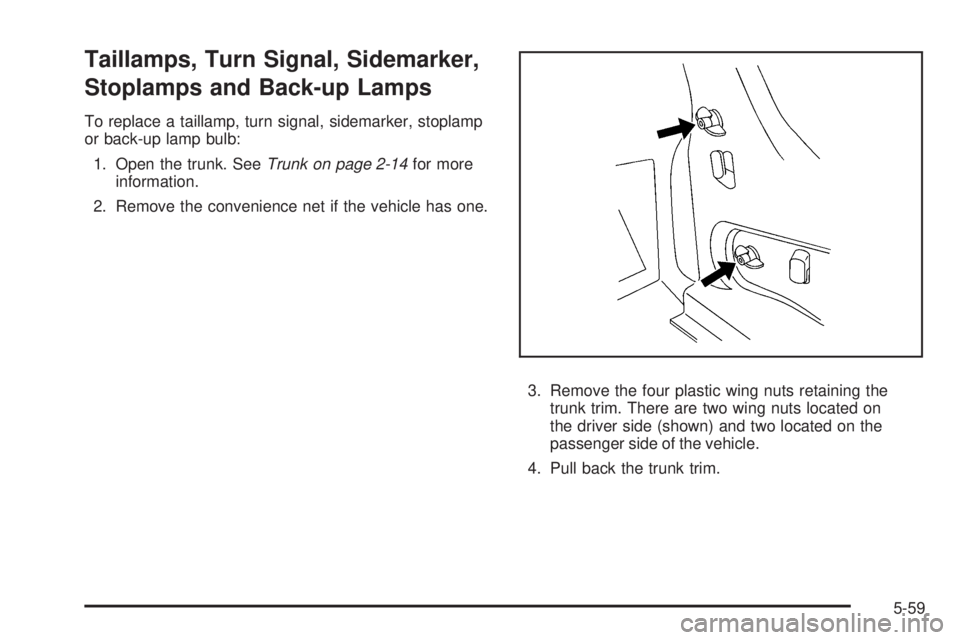
3. Remove the four plastic wing nuts retaining the
trunk trim. There are two wing nuts located on
the driver side (shown) and two located on the
passenger side of the vehicle.
4. Pull back the trunk trim.
5-59
Page 391 of 440

This schedule is for vehicles that:
carry passengers and cargo within recommended
limits. You will nd these limits on the Tire and
Loading Information label. SeeLoading Your
Vehicle on page 4-21.
are driven on reasonable road surfaces within legal
driving limits.
use the recommended fuel. SeeGasoline Octane
on page 5-5.
The services inScheduled Maintenance on page 6-4
should be performed when indicated. SeeAdditional
Required Services on page 6-6andMaintenance
Footnotes on page 6-7for further information.
{CAUTION:
Performing maintenance work on a vehicle can
be dangerous. In trying to do some jobs, you
can be seriously injured. Do your own
maintenance work only if you have the
required know-how and the proper tools and
equipment for the job.
CAUTION: (Continued)
CAUTION: (Continued)
If you have any doubt, see your dealer/retailer
to have a qualied technician do the work. See
Doing Your Own Service Work on page 5-4.
Some maintenance services can be complex. So,
unless you are technically qualied and have the
necessary equipment, you should have your
dealer/retailer do these jobs.
When you go to your dealer/retailer for your service
needs, you will know that trained and supported service
technicians will perform the work using genuine parts.
If you want to purchase service information, seeService
Publications Ordering Information on page 7-16.
Owner Checks and Services on page 6-8tells you what
should be checked, when to check it, and what you can
easily do to help keep your vehicle in good condition.
The proper replacement parts, uids, and lubricants to
use are listed inRecommended Fluids and Lubricants
on page 6-12andMaintenance Replacement Parts
on page 6-13. When your vehicle is serviced, make sure
these are used. All parts should be replaced and all
necessary repairs done before you or anyone else
drives the vehicle. We recommend the use of genuine
parts from your dealer/retailer.
6-3
Page 409 of 440

STEP THREE — U.S. Owners:Both General Motors
and your dealer are committed to making sure you
are completely satised with your new vehicle. However,
in the United States, if you continue to remain
unsatised after following the procedure outlined in
Steps One and Two, you should le with the BBB Auto
Line Program to enforce your rights.
The BBB Auto Line Program is an out of court program
administered by the Council of Better Business
Bureaus to settle automotive disputes regarding vehicle
repairs or the interpretation of the New Vehicle
Limited Warranty. Although you may be required to
resort to this informal dispute resolution program prior to
ling a court action, use of the program is free of
charge and your case will generally be heard within
40 days. If you do not agree with the decision given in
your case, you may reject it and proceed with any other
venue for relief available to you.You may contact the BBB Auto Line Program using the
toll-free telephone number or write them at the
following address:
BBB Auto Line Program
Council of Better Business Bureaus, Inc.
4200 Wilson Boulevard
Suite 800
Arlington, VA 22203-1838
Telephone: 1-800-955-5100
This program is available in all 50 states and the District
of Columbia. Eligibility is limited by vehicle age,
mileage and other factors. General Motors reserves the
right to change eligibility limitations and/or discontinue
its participation in this program.
7-3